
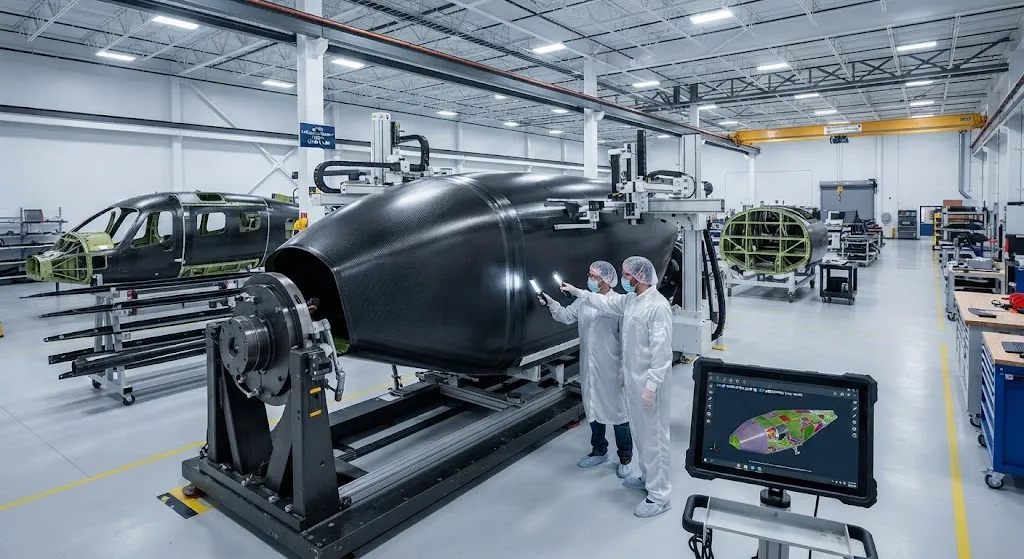
Electric vertical takeoff and landing (eVTOL) aircraft carry an unusually high share of carbon fiber in their airframes. Analysts estimate that composite materials account for 60-70 percent of the structural mass of typical four-to-seven-passenger designs, a density of carbon fiber usag
Introduction
Electric vertical takeoff and landing (eVTOL) aircraft carry an unusually high share of carbon fiber in their airframes. Analysts estimate that composite materials account for 60-70 percent of the structural mass of typical four-to-seven-passenger designs, a density of carbon fiber usage matched only by the most advanced military aircraft. The reason is straightforward: a battery-powered air taxi must carry its energy storage as dead weight, so every kilogram saved in the airframe translates directly into payload or range. This article maps the airframe architectures of the three most closely watched programs - Joby Aviation's S4, Archer Aviation's Midnight and Lilium's seven-seat jet - and explains how certification strategy drives their material choices.
For composite material suppliers and manufacturing partners, the eVTOL sector matters because these programs are being certified under newly created regulatory frameworks in both the United States and Europe. That regulatory novelty forces design teams to select mature, well-characterized carbon fiber systems with extensive allowables data, which in turn shapes the entire material map of the aircraft.
Why Certification Drives Material Selection
The type certification of an eVTOL aircraft does not follow the conventional fixed-wing or rotorcraft rules. In the United States, the FAA treats eVTOL aircraft as a special class under Title 14 Code of Federal Regulations Part 21.17(b), which means the applicant must show compliance with selected airworthiness criteria from Part 23 (small airplanes) and Part 27 (normal category rotorcraft), modified by program-specific special conditions. In Europe, EASA applies its dedicated Special Condition for VTOL aircraft (SC-VTOL), which defines crashworthiness, battery and structural requirements before any applicant can be type-certified.
The practical consequence for composite design is conservative material selection:
- Proven fiber systems: High-strength intermediate-modulus fibers such as T700-class and T800-class carbon are preferred over ultra-high-modulus grades because their statistical allowables are published across multiple prepreg suppliers and test campaigns.
- Established prepreg matrices: Toughened epoxy prepreg systems with decades of aerospace service history provide the block-level design values that certification engineers accept without extensive new test programs.
- Environmentally controlled processing: Autoclave and out-of-autoclave prepreg curing produce the low porosity levels, typically below one percent, required to demonstrate B-basis allowables to the certifying authority.
This conservatism means that eVTOL airframes are being built with materials that were qualified for helicopters and business jets a generation ago, rather than with the newest experimental fiber grades.
Joby S4: Monolithic Carbon Structure at High Rate
Joby Aviation's S4 is a five-seat design (one pilot, four passengers) with six tilting rotors and a cruise speed of about 322 kilometers per hour. The airframe is an all-composite monocoque in which the fuselage skins carry the primary bending and torsion loads, with internal frames and spars adding local stiffness. Joby has described the structure as relying on large, continuous carbon fiber skins that minimize part count and bonded joint lines.
The material map for the S4 centers on toughened epoxy prepreg with intermediate-modulus carbon fiber, cured in autoclaves during the current production-representative phase. Joby's manufacturing system emphasizes automation - automated fiber placement for the skins and automated cutting and kitting for the prepreg - because the production target of one aircraft per day requires cycle times that manual hand layup cannot sustain. The fuselage is designed so that major structural elements are co-cured or secondarily bonded, reducing fastener count and final assembly labor.
Archer Midnight: Cost-Focused Carbon Airframe
Archer Aviation's Midnight carries one pilot and four passengers with twelve electric motors - six dedicated to vertical lift and six tilting motors for forward flight. The airframe follows a similar conceptual path to the S4: a carbon fiber monocoque with integrated floor structure, pressure-tested cabin skins and bonded subassemblies. Archer has emphasized manufacturability and cost from the outset, aiming for a cost-per-seat-mile that competes with ground taxi service.
Midnight uses aerospace-grade carbon fiber epoxy prepreg systems, with design allowables generated specifically for the program and submitted to the FAA as part of the special class certification. Where the S4 leans on autoclave processing, Archer has pursued out-of-autoclave and oven-cure-capable material forms where allowables permit, reducing energy cost per part. The company's manufacturing facility in Covington, Georgia is designed around production-representative assembly lines with automated drilling, fastening and inspection stations supporting the bonded airframe.
Lilium Jet: Ducted Fans and the EASA Path
The Lilium Jet differs structurally from the other two programs. It is a seven-passenger design with 36 ducted electric fans integrated into the wing and foreplane, and its airframe is built almost entirely from carbon fiber composites. Because the aircraft operates in the fixed-wing cruise regime for most of its flight, the wing structure must carry high flight loads while also housing the distributed electric propulsion system, giving the airframe a distinct architecture centered on a torque-box wing and a lightweight fuselage barrel.
Lilium is certifying under EASA's SC-VTOL framework, which differs materially from the FAA special class path. SC-VTOL requires compliance with enhanced crashworthiness, rotor containment and battery installation requirements, and it places its own demands on structural design data. The material selection for the Lilium Jet therefore reflects European supplier qualification and the need for extensive environmental and fatigue test campaigns that EASA expects to see for bonded primary structures.
Airframe Architecture Comparison
The table below compares the three flagship architectures across the parameters that matter most to composite suppliers:
| Parameter | Joby S4 | Archer Midnight | Lilium Jet |
|---|---|---|---|
| Seat capacity | 4 passengers + pilot | 4 passengers + pilot | 6 passengers + pilot |
| Propulsion layout | 6 tilting rotors | 12 motors (6 lift, 6 tilt) | 36 ducted fans |
| Cruise speed | ~322 km/h | ~240 km/h | ~280 km/h |
| Primary structure | Monolithic monocoque | Monocoque, bonded subassemblies | Torque-box wing + fuselage barrel |
| Dominant material | Toughened epoxy prepreg, IM carbon | Epoxy prepreg, OOA where allowed | Toughened epoxy prepreg, IM carbon |
| Cure method | Autoclave (production phase) | Autoclave and OOA | Autoclave |
| Certification basis | FAA special class, 14 CFR 21.17(b) | FAA special class, 14 CFR 21.17(b) | EASA SC-VTOL |
Manufacturing Implications for the Supply Chain
All three programs converge on the same supply-chain consequence: they need qualified, traceable carbon fiber prepreg in volumes that exceed what prototype programs consumed. A single production-representative eVTOL airframe uses roughly 150-300 kilograms of carbon fiber prepreg, and at production rates of one to two aircraft per day, a single OEM consumes several tonnes of prepreg per month.
That demand profile has four implications for composite material buyers:
- Supplier qualification: Certification requires every fiber batch to be traceable from precursor through prepreg, with documented statistical process control.
- Allowables ownership: OEMs must generate and maintain their own material allowables databases, not merely inherit published supplier data.
- Process capability: Porosity control, ply tolerance and bonding quality must hold within tighter bands than in legacy aerospace programs because certification data is program-specific.
- Second-source strategy: Regulators increasingly expect demonstrated dual sourcing for fiber and prepreg, pushing OEMs to qualify equivalent material systems with multiple suppliers.
Frequently Asked Questions
Why do eVTOL aircraft use so much carbon fiber compared with conventional aircraft?
Battery-powered aircraft must carry their energy storage as mass, unlike fuel-burning aircraft where fuel is consumed in flight. Every kilogram saved in the eVTOL airframe directly increases payload, range or endurance, so designers push structural mass fractions as low as possible. Carbon fiber composites provide the highest stiffness-to-weight and strength-to-weight ratios of any production aerospace material, which is why 60-70 percent of the structural mass of typical eVTOL designs is composite material.
What is the difference between FAA special class certification and EASA SC-VTOL?
In the United States, eVTOL aircraft are certified as a special class under 14 CFR Part 21.17(b), with the applicant showing compliance against selected Part 23 and Part 27 criteria modified by special conditions. In Europe, EASA has written a dedicated Special Condition for VTOL, which sets its own crashworthiness, battery and structural requirements. Both paths demand demonstration-level structural test data, but the specific compliance criteria differ, which is why OEMs typically select materials with broad test coverage acceptable to their chosen certifying authority.
Which carbon fiber grades dominate eVTOL airframe design?
Most production-representative eVTOL airframes rely on high-strength intermediate-modulus fibers in the T700 and T800 strength classes, combined with toughened epoxy prepreg matrices. These systems are preferred because their statistical allowables are widely published and test-verified across suppliers, which shortens the qualification effort required for type certification. Ultra-high-modulus grades appear mainly in localized stiffness-critical parts rather than in the primary structure.
Conclusion
The airframe architectures of the Joby S4, the Archer Midnight and the Lilium Jet all converge on a composite-intensive structural design, but each program shapes its material map around its certification basis. The FAA special class route and the EASA SC-VTOL framework both reward conservative, well-characterized material systems, which is why T700- and T800-class fiber with toughened epoxy prepreg dominates production-representative eVTOL design. For material suppliers, the practical consequence is a demand for qualification support, allowables data and traceable volume supply rather than for experimental fiber grades.
YongXian supplies carbon fiber tows, fabrics and prepreg-compatible reinforcement materials for aerospace programs including eVTOL development. Explore our carbon fiber product range or contact our engineering team to discuss material systems for your eVTOL airframe program.
Related Articles
- Carbon Fiber Mooring for Floating Offshore Wind: Fatigue and Corrosion in Deep Water
- Carbon Fiber Bicycle Frame Optimization: Layup Design and Manufacturing for Competitive Racing
- Carbon Fiber CFRP Retrofit for Infrastructure: Bridge and Building Seismic Strengthening
- Carbon Fiber Medical Imaging Equipment: Lightweight Gantry and Couch Structures for MRI/CT
- Carbon Fiber EV Battery Enclosures: Crash Safety and Electromagnetic Shielding Design
- Carbon Fiber Structures for Low-Altitude Economy: UAV Airframes and eVTOL Components