EU Green Deal and Carbon Fiber: How Sustainability Regulations Are Reshaping Material Choice
July 12, 2026
The European Green Deal — the EU's comprehensive roadmap to climate neutrality by 2050 — is fundamentally reshaping industrial material selection across all sectors including aerospace, automotive, wind energy, and construction. For carbon fiber composites, the implications are profound: new regulations on carbon footprint accounting, end-of-life recycling mandates, chemical substance restrictions (REACH), and the Carbon Border Adjustment Mechanism (CBAM) are changing how B2B buyers evaluate carbon fiber suppliers and specify composite materials. This article examines the regulatory landscape and its impact on carbon fiber procurement decisions.
# EU Green Deal and Carbon Fiber: How Sustainability Regulations Are Reshaping Material Choice
## Summary
The European Green Deal — the EU's comprehensive roadmap to climate neutrality by 2050 — is fundamentally reshaping industrial material selection across all sectors including aerospace, automotive, wind energy, and construction. For carbon fiber composites, the implications are profound: new regulations on carbon footprint accounting, end-of-life recycling mandates, chemical substance restrictions (REACH), and the Carbon Border Adjustment Mechanism (CBAM) are changing how B2B buyers evaluate carbon fiber suppliers and specify composite materials. This article examines the regulatory landscape and its impact on carbon fiber procurement decisions.
---
## The Regulatory Framework: What B2B Buyers Need to Know
The European Green Deal encompasses multiple regulatory instruments that affect carbon fiber production, use, and disposal. The most impactful for the composites industry are:
### 1. Carbon Border Adjustment Mechanism (CBAM)
Effective October 2023 (transition phase), with full implementation starting January 2027, CBAM imposes a carbon price on imported goods equivalent to the EU Emissions Trading System (ETS) carbon price. For carbon fiber — classified under CN codes 6815 (carbon fibers and articles thereof) — importers must purchase CBAM certificates covering embedded emissions. The 2026 ETS carbon price is approximately €75-85 per tonne of CO₂, projected to reach €100-130 by 2030.
**Impact**: A tonne of virgin carbon fiber (produced from virgin PAN precursor, natural gas-fired carbonization) has an estimated carbon footprint of 22.5-35.0 kg CO₂e/kg (C-free, Cefic data). At €85/tonne CO₂, CBAM adds €1.91-2.98 per kg of imported carbon fiber — equivalent to 8-15% of the current market price for standard modulus fiber ($22-28/kg). For a B2B buyer importing 100 tonnes annually, this represents €191,000-298,000 in additional compliance costs from 2027.
### 2. Ecodesign for Sustainable Products Regulation (ESPR)
The ESPR, adopted in 2024, establishes mandatory requirements for product durability, repairability, recyclability, and recycled content across regulated product groups. The European Commission has indicated that composite materials — including carbon fiber reinforced polymers — will be prioritized in the 2026-2027 work plan. ESPR will require:
- Digital Product Passports (DPP) containing material composition, carbon footprint, and recyclability data
- Minimum recycled carbon fiber (rCF) content requirements for certain product categories
- Design for disassembly and recyclability criteria for multi-material composite parts
### 3. Waste Framework Directive Amendments (2024/884)
The amended Waste Framework Directive specifically targets fiber-reinforced composites. Key provisions:
- **Landfill ban**: Composite waste containing >2% carbon fiber by weight will be banned from EU landfills by 2028 (provisional target)
- **Extended Producer Responsibility (EPR)**: Carbon fiber producers and importers must finance end-of-life collection and recycling infrastructure — estimated cost: €0.50-1.20 per kg of product placed on the EU market
- **Recycling targets**: Minimum 50% of carbon fiber composite waste must be recycled (not downcycled) by 2030
---
## Carbon Footprint of Carbon Fiber: Current State
Understanding the carbon footprint of carbon fiber production is essential for B2B buyers navigating Green Deal compliance.
### Table 1: Carbon Footprint of Carbon Fiber by Production Route
| Production Route | Carbon Footprint (kg CO₂e/kg CF) | Energy Source | PAN Precursor | Maturity | Cost ($/kg) |
|---|---|---|---|---|---|
| Virgin — standard (gas-fired) | 22.5-35.0 | Natural gas | Virgin PAN from acrylonitrile (propylene-based) | Commercial | 16-28 |
| Virgin — renewable energy | 12.0-18.5 | Hydro/wind/solar | Virgin PAN (conventional) | Commercial | 17-30 |
| Virgin — bio-based PAN | 9.5-14.0 | Natural gas or renewable | Bio-AN from glycerol or isobutanol | Pilot/demo | 22-40 |
| Virgin — lignin-based precursor | 8.0-12.0 | Natural gas or renewable | Lignin (from paper pulping) | Pilot | 18-35 |
| Recycled — pyrolysis (rCF) | 3.5-6.0 | Natural gas or renewable | End-of-life CF waste | Commercial (low scale) | 10-18 |
| Recycled — fluidized bed | 3.0-5.5 | Electricity | End-of-life CF waste | Demo | 12-20 |
| Recycled — microwave pyrolysis | 2.5-4.5 | Renewable electricity | End-of-life CF waste | Pilot | 14-22 |
### EU ETS Carbon Price Projections
- 2026: €75-85/tonne CO₂
- 2027: €85-100/tonne CO₂
- 2028: €90-115/tonne CO₂
- 2030: €100-130/tonne CO₂
- 2035: €120-160/tonne CO₂
---
## REACH Compliance and Chemical Restrictions
REACH (Registration, Evaluation, Authorization and Restriction of Chemicals, Regulation EC 1907/2006) affects carbon fiber composite production through restrictions on resin feedstocks and processing chemicals.
### Chemicals Under Scrutiny for the Composites Industry
- **Bisphenol A (BPA)**: Used in epoxy resin production. ECHA proposed stricter SVHC (Substance of Very High Concern) classification in 2025, with potential authorization requirement by 2028. B2B impact: epoxy resin prices projected to rise 12-18% by 2028 if alternatives (bisphenol F, bisphenol S) require requalification.
- **Methylenediphenyl diisocyanate (MDI)**: Used in polyurethane resins and adhesives. REACH authorization sunset date: August 2027. Polyurethane-based prepregs and adhesives must transition to MDI-free alternatives or secure authorization.
- **Styrene**: Used in unsaturated polyester and vinyl ester resins. ECHA is evaluating a potential restriction on styrene content >1% in composite workpieces due to worker exposure limits. Impact: polyester/vinyl ester composites may require emission capture systems or alternative resin systems for EU production.
- **Acrylonitrile (AN)**: PAN precursor monomer. ECHA is assessing AN under the authorization process (2026-2028). Impact on carbon fiber supply: potential upstream cost increase for PAN precursor producers.
---
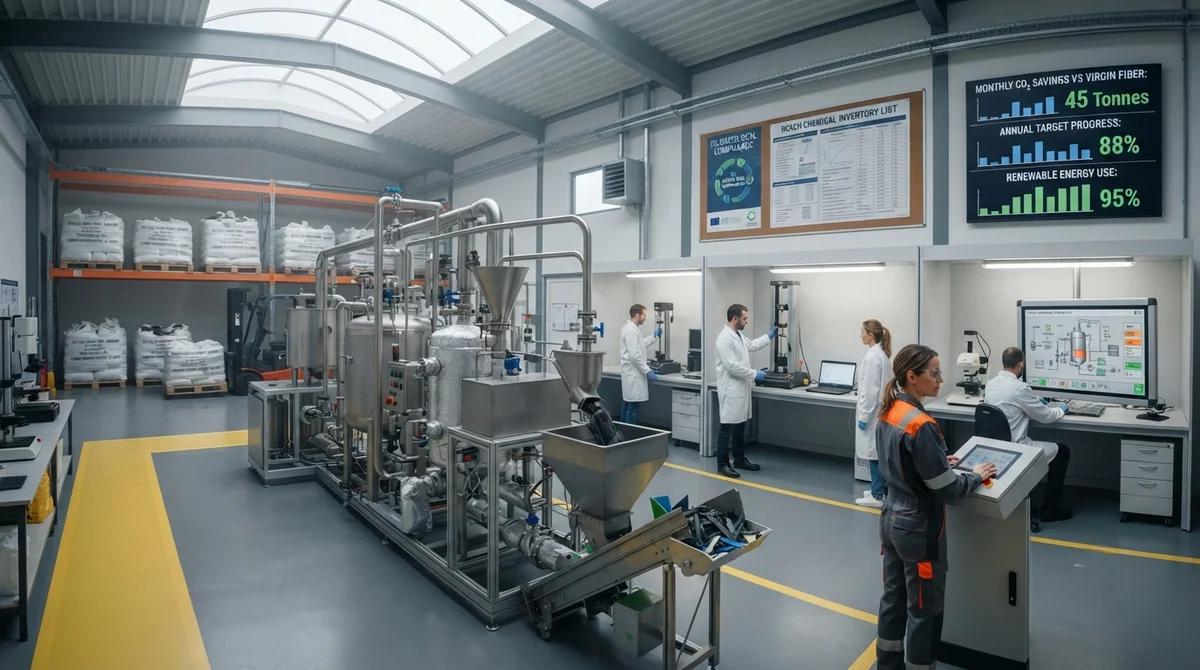
## The Case for Recycled Carbon Fiber (rCF)
Regulatory pressures are driving rapid growth in the recycled carbon fiber industry. By 2027, rCF is expected to account for 12-18% of total carbon fiber consumed in the EU, up from approximately 4-5% in 2025.
### Table 2: rCF vs. Virgin CF — Key Parameters for B2B Procurement
| Parameter | Virgin CF (Standard Modulus) | rCF (Pyrolysis — HT Process) | rCF (Pyrolysis — LT Process) |
|---|---|---|---|
| Tensile strength retention vs virgin | 100% (4,900 MPa) | 85-98% | 65-85% |
| Tensile modulus retention vs virgin | 100% (230 GPa) | 95-100% | 90-100% |
| Fiber length distribution | Continuous | 3-30 mm (chopped/milled) | 3-30 mm |
| Form factor | Tow, fabric, prepreg | Chopped, milled, nonwoven mat | Chopped, milled |
| Carbon footprint (kg CO₂e/kg) | 22.5-35.0 | 3.5-6.0 | 3.0-5.0 |
| Price ($/kg) | 16-28 | 10-18 | 8-14 |
| Availability | High (global) | Limited (EU only, 6,000-8,000 t/yr capacity 2026) | Emerging |
| Best use cases | Primary structure, high loaded | Non-structural, semi-structural (SMC/BMC, injection molding) | Filler, thermal/acoustic insulation |
---
## Strategic Recommendations for B2B Carbon Fiber Buyers
### 1. Conduct a Carbon Footprint Audit Now
Starting in 2027, imported carbon fiber will incur CBAM costs. Buyers should request Environmental Product Declarations (EPDs) from all suppliers — ideally ISO 14067 or EN 15804 certified. Include a 3-5 year projection of CBAM costs in your total cost of ownership (TCO) model. A virgin CF buyer paying $25/kg today should model an effective cost of $27-29/kg by 2028 (including CBAM + EPR).
### 2. Qualify rCF for Semi-Structural Applications
Identify applications where rCF can replace virgin CF without requalification of the entire assembly — non-structural brackets, covers, interior panels, sound barriers, thermal shields. The typical qualification cost for rCF in a semi-structural application is $50,000-200,000 (testing, validation, customer approval). Payback is achieved within 1-3 years through material cost savings ($6-18/kg differential vs virgin CF) and regulatory compliance.
### 3. Engage with EU-Based Recyclers
The EU's End-of-Life Vehicles (ELV) Directive and the emerging Waste Framework Directive amendments will create a significant domestic rCF supply. Current EU recycling capacity (2026): approximately 8,000 tonnes/year (CFK Valley Recycling, Gen 2 Carbon, ELG Carbon Fibre, ThermoHaar). Projected capacity by 2030: 25,000-35,000 tonnes/year. B2B buyers should establish offtake agreements with recyclers to secure rCF supply before demand outstrips capacity — expected market inflection point: 2027-2028.
### 4. Redesign for Disassembly and Recycling
ESPR requirements for design for disassembly and recyclability will affect new product developments from 2027. Key design changes:
- Avoid co-cured metal inserts (prevents fiber/metal separation in recycling)
- Use thermoplastic matrices (PA6, PA12, PEEK) where possible — easier to recycle than thermosets
- Standardize fiber/resin combinations to simplify waste sorting (reduce from 50+ prepreg types to 5-10 standardized systems)
- Mark all composite parts with material identification per ISO 10466 or equivalent
---
## FAQ
Q: Does CBAM apply to carbon fiber imported into the EU from China, Japan, or the United States?
A: Yes — CBAM applies to all imported carbon fiber (CN code 6815) regardless of origin. During the transition phase (Oct 2023-Dec 2026), importers must report embedded emissions without financial payment. From January 2027, CBAM certificates must be purchased at the EU ETS auction price for the reporting period. The embedded emissions calculation requires data from carbonization furnace energy consumption, PAN precursor production, electricity mix of the producing country, and transportation. Non-EU producers may deduct any carbon price already paid in the country of origin (e.g., China's national ETS, currently €7-10/tonne CO₂, or Japan's carbon tax at €3-5/tonne). For Chinese-produced carbon fiber using coal-fired electricity (~750 g CO₂e/kWh), the total carbon footprint is typically 30-35 kg CO₂e/kg CF, resulting in CBAM cost of €2.55-2.98/kg. For Japanese-produced CF using grid electricity (~430 g CO₂e/kWh) and gas-fired carbonization, the footprint ranges 22-28 kg CO₂e/kg, yielding CBAM cost of €1.87-2.38/kg.
Q: How can B2B buyers verify the carbon footprint data provided by carbon fiber suppliers?
A: Three verification methods exist. (1) Require ISO 14067 Type III Environmental Product Declarations (EPDs) from suppliers — these are third-party verified, cover cradle-to-gate emissions, and include the 70 mandatory parameters under EN 15804+A2. (2) Request the underlying Life Cycle Assessment (LCA) report to verify allocation methods — critical for bio-based precursors where biogenic carbon accounting (temporary storage vs. zero-rating) significantly affects the declared footprint. (3) Conduct an independent audit using one of the emerging industry-specific LCA tools — the European Composites Industry Association (EuCIA) Eco-Compass tool or the Institut Bauen und Umwelt (IBU) data platform. Be aware of greenwashing risks: some suppliers declare "carbon-neutral CF" through purchased offsets rather than actual emission reductions. For EU ETS and CBAM compliance, only actual scope 1, 2, and 3 emissions (minus offsets) are relevant.
Q: What is the timeline for the proposed landfill ban on carbon fiber composite waste in the EU?
A: The current provisional timeline under the amended Waste Framework Directive: (1) 2026: Member states must establish separate collection systems for end-of-life composite waste from industrial sources (>1,000 kg/year per generator). (2) 2027: Mandatory reporting of composite waste quantities and disposal routes by all waste generators and handlers. (3) 2028: Landfill ban for composite waste containing >2% carbon fiber by weight (provisional — final threshold may be 1%). (4) 2029: Landfill ban extended to all composite waste regardless of carbon fiber content. (5) 2030: Minimum 50% recycling rate target for carbon fiber composites. B2B buyers should factor these deadlines into supplier qualification — suppliers without demonstrated waste management and recycling pathways may face regulatory risk from 2027 onwards. Germany, France, and the Netherlands are already enforcing landfill restrictions on CF waste through national regulations ahead of the EU-wide ban.
Q: Are thermoplastic carbon fiber composites favored under the Green Deal regulations?
A: Yes — thermoplastic composites (CF/PA6, CF/PA12, CF/PEEK, CF/PEKK) are significantly advantaged under the Green Deal framework for three reasons. First, thermoplastic matrices enable mechanical recycling (remelting and re-molding), which is more energy-efficient than the pyrolysis or solvolysis required for thermoset CFRP recycling. Second, thermoplastic parts can be joined by welding (ultrasonic, induction, resistance) rather than adhesives — simplifying disassembly at end of life. Third, the carbon footprint of thermoplastic composites in the use phase can be lower due to shorter processing cycles (minutes vs hours in autoclave). However, the carbon footprint of the polymer itself is typically higher than thermoset epoxies: CF/PA6: 5.5-8.0 kg CO₂e/kg prepreg vs CF/epoxy: 4.0-6.5 kg CO₂e/kg prepreg. The breakeven comes at end-of-life: recycled CF/PA6 retains 85-95% of virgin tensile properties after one remelting cycle, whereas recycled carbon fiber from pyrolyzed epoxy retains 65-98% but requires a complete remanufacturing process. B2B buyers designing new platforms for the EU market should consider thermoplastic matrices as a strategic choice for Green Deal compliance from 2028 onward.
EU Green Deal carbon fiberCBAM carbon fibercarbon fiber recyclingrCF recycled carbon fibersustainable composites