
European hydrogen truck and bus fleets are entering their scale-up phase. Industry analysts tracking heavy-duty hydrogen programs across the European Union expect more than 50,000 fuel-cell trucks and hydrogen buses to be in operation by 2027, up from a few thousand in 2025. The growth
Introduction
European hydrogen truck and bus fleets are entering their scale-up phase. Industry analysts tracking heavy-duty hydrogen programs across the European Union expect more than 50,000 fuel-cell trucks and hydrogen buses to be in operation by 2027, up from a few thousand in 2025. The growth is driven by three converging forces: the EU Alternative Fuels Infrastructure Regulation (AFIR) requires hydrogen refueling stations in all major urban nodes and along the core TEN-T network, national purchase programs in Germany, France and the Netherlands are subsidizing fleet orders, and heavy-duty vehicle CO2 standards are pushing manufacturers toward zero-emission powertrains with the range and refueling speed that hydrogen offers over battery-electric for long-haul and continuous-duty operations.
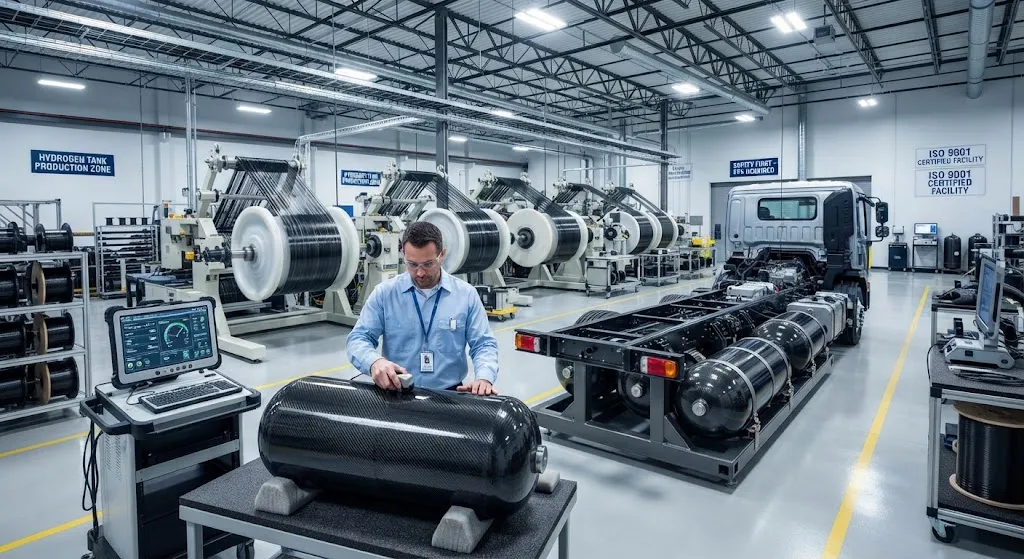
For composite material suppliers, the fleet ramp-up matters because nearly every hydrogen truck and bus stores its fuel in carbon fiber overwrapped pressure vessels. Hydrogen storage is the single largest composite application per vehicle, and the transition from pilot fleets to tens of thousands of vehicles converts a specialty market into a volume manufacturing chain.
The 2027 Fleet Projection
The 50,000-vehicle projection combines multiple sub-segments with different growth trajectories. Heavy-duty fuel-cell trucks are the largest contributor because long-haul routes of 500-800 kilometers per day favor hydrogen's energy density per kilogram over battery weight. Hydrogen buses, especially in urban and regional operation, represent the most mature segment with the longest operating history. The table below summarizes the expected fleet structure:
| Segment | 2025 baseline | 2027 projection | Main growth driver |
|---|---|---|---|
| Fuel-cell heavy-duty trucks | ~1,500-2,000 | ~25,000-30,000 | AFIR station coverage, truck CO2 rules |
| Hydrogen city buses | ~2,500-3,000 | ~15,000-18,000 | Urban clean-air zones, purchase programs |
| Refuse, coach and other HDV | ~200-300 | ~3,000-5,000 | Municipal green fleets |
| Total | ~4,500-5,500 | ~50,000+ | Regulation plus subsidy alignment |
The exact number depends on station availability, but the direction is consistent across forecasts: commercial vehicle hydrogen demand in Europe is expected to grow from roughly 30,000 tonnes per year in 2025 to 200,000-300,000 tonnes by 2027 as these fleets enter service.
The 700-bar Storage System
Heavy-duty hydrogen vehicles predominantly use 700-bar compressed storage in Type IV pressure vessels, which combine a polymer liner wound with carbon fiber composite. The 700-bar pressure level delivers roughly twice the volumetric energy density of 350-bar storage, which matters for trucks where chassis space is tight and payload limits are strict.
A typical fuel-cell truck carries five to eight Type IV tanks totaling 40-80 kilograms of hydrogen. Each such tank uses 20-40 kilograms of carbon fiber, meaning a single truck contains roughly 150-300 kilograms of carbon fiber in its storage system alone. Key system parameters include:
- Operating pressure: 700 bar nominal with a service life defined by pressure cycling between 20-100 percent of nominal.
- Cycle life: Type IV tanks in fleet service are designed for 11,000-15,000 refueling cycles, corresponding to 8-12 years of daily use.
- Refueling rate: Heavy-duty dispensers target 5-10 kilograms per minute to complete a fill in under 15 minutes, matching diesel refueling expectations.
- Composite mass: Carbon fiber accounts for 55-70 percent of the tank's empty weight, making precursor supply a critical cost driver.
Refueling Network Build-Out
Fleet-scale operation depends on station density. AFIR sets binding obligations: hydrogen refueling stations must be available by 2030 in every urban node and every 200 kilometers along the core TEN-T network, with capacities of at least one tonne per day. Member-state rollout plans translate this into roughly 700-1,000 heavy-duty-capable stations operational or under construction across Europe by 2027.
Each heavy-duty station typically installs 1-4 tonnes of buffer storage, often at 500-900 bar, serving 50-150 vehicles per day. The buffer storage itself is a growing consumer of Type IV vessels, adding a stationary segment on top of the vehicle-side demand. This combination of vehicle tanks and station buffers creates a matched demand picture where the two sides of the hydrogen storage market grow together.
Composite Supply Chain Implications
The fleet ramp converts hydrogen storage from a niche to a volume chain with clear consequences for composite buyers:
- Fiber demand concentration: Ten thousand trucks and fifteen thousand buses in operation by 2027, with replacement tanks every 8-12 years, represent annual carbon fiber consumption of 10,000-20,000 tonnes for EU vehicle storage alone, before station buffers are counted.
- Qualification requirements: Tanks must comply with UN ECE R134 regulation, requiring documented material qualification, traceable fiber batches and statistical process control comparable to aerospace standards.
- Cost pressure: Tank manufacturers are pursuing higher-yield tow counts and automated winding to cut fiber cost per kilogram of stored hydrogen, favoring suppliers that can deliver qualified large-tow carbon fiber at scale.
- Second-source expectations: Fleet operators and regulators increasingly expect tank makers to qualify multiple fiber sources, reducing single-supplier risk in a fast-growing demand environment.
These pressures mirror the dynamics seen in other volume composite markets: the winners will be suppliers that combine qualification data with manufacturing scale.
Regional Deployment Patterns
Deployment is not uniform across Europe. Germany leads with the largest truck order book, anchored by the national Klima- und Transformationsfonds purchase program, while the Netherlands concentrates on heavy-duty applications around Rotterdam and the port logistics corridor. France is scaling both buses and trucks through city-level clean-air mandates in Paris, Lyon and Marseille. Northern Italy and Spain are building hydrogen corridors along the Mediterranean TEN-T routes, and the Scandinavian countries pair heavy-duty hydrogen with domestic green hydrogen production from hydro and wind electricity. For tank producers, this geography matters because regional station rollout speed determines where fleet orders convert to production commitments first.
Frequently Asked Questions
Why do European hydrogen trucks use 700-bar storage instead of 350-bar?
Operating pressure determines how much hydrogen fits in a given tank volume. At 700 bar, a Type IV vessel stores roughly twice the mass of hydrogen per unit volume as at 350 bar. For heavy-duty trucks, where the chassis has limited space for tank packaging and payload regulations limit total vehicle mass, the higher pressure reduces the number of tanks needed and the space they occupy. This is why nearly all fuel-cell truck and long-range bus programs in Europe specify 700-bar systems despite the higher cost of the stronger composite overwrap.
How much carbon fiber goes into a single hydrogen truck?
A typical fuel-cell truck carries five to eight Type IV tanks holding 40-80 kilograms of hydrogen, and each tank contains roughly 20-40 kilograms of carbon fiber. The storage system alone therefore uses about 150-300 kilograms of carbon fiber per truck, which is comparable to the composite content of a light aircraft airframe. This makes hydrogen storage the single largest composite application on the vehicle and a major demand driver for the carbon fiber industry as fleets scale.
What is the difference between vehicle tank demand and station buffer demand?
Vehicle tanks are Type IV pressure vessels installed on the truck or bus themselves, cycled every time the vehicle refuels. Station buffers are large stationary Type IV vessels at the refueling station, typically storing 1-4 tonnes of hydrogen at 500-900 bar, from which vehicle fills are dispensed. Both use carbon fiber overwrapped vessels, so the two segments add to the same composite demand base: the vehicle fleet drives recurring tank replacement every 8-12 years, while station build-out creates one-time but large buffer installations at each new site.
Conclusion
European hydrogen truck and bus fleets are on a clear path toward 50,000+ vehicles in operation by 2027, and every one of them stores hydrogen in carbon fiber Type IV pressure vessels at 700 bar. The EU regulatory framework, national purchase programs and heavy-duty CO2 standards are aligning to make this the fastest-growing single application for carbon fiber in Europe, with annual fiber consumption in the tens of thousands of tonnes once station buffers are included. For composite buyers, the implications are straightforward: qualified large-tow fiber supply, documented ECE R134 qualification data, and second-source readiness will separate the suppliers that capture this volume from those that watch it pass by.
YongXian supplies carbon fiber tows and reinforcement materials for Type IV hydrogen storage vessel production. Explore our carbon fiber product range or contact our engineering team to discuss material qualification for your hydrogen storage program.
Part of topic
Related Articles
- Carbon Fiber Mooring for Floating Offshore Wind: Fatigue and Corrosion in Deep Water
- Carbon Fiber Bicycle Frame Optimization: Layup Design and Manufacturing for Competitive Racing
- Carbon Fiber CFRP Retrofit for Infrastructure: Bridge and Building Seismic Strengthening
- Carbon Fiber Medical Imaging Equipment: Lightweight Gantry and Couch Structures for MRI/CT
- Carbon Fiber EV Battery Enclosures: Crash Safety and Electromagnetic Shielding Design
- Carbon Fiber Structures for Low-Altitude Economy: UAV Airframes and eVTOL Components