
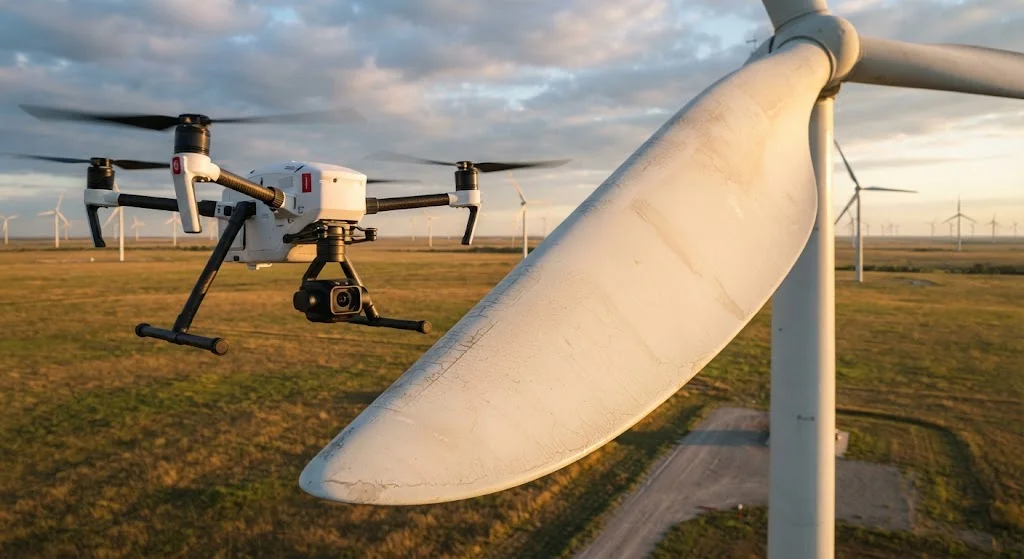
Wind turbine inspection has historically relied on rope-access technicians or cranes to visually examine blades, towers, and nacelles — a process that is slow, expensive, and limited by weather conditions. A single onshore turbine inspection typically requires 6-12 hours of technician t
Introduction
Wind turbine inspection has historically relied on rope-access technicians or cranes to visually examine blades, towers, and nacelles — a process that is slow, expensive, and limited by weather conditions. A single onshore turbine inspection typically requires 6-12 hours of technician time and may cost $3,000-8,000 depending on turbine height and access complexity. Offshore inspections are significantly more expensive, often requiring specialized vessel mobilization and favorable weather windows.
Drone-based inspection automation addresses these constraints by deploying autonomous or semi-autonomous unmanned aerial vehicles (UAVs) equipped with high-resolution cameras, thermal sensors, and LiDAR to capture detailed condition data from turbine components. When combined with AI-powered defect detection algorithms, these systems can identify leading-edge erosion, surface cracks, lightning damage, and adhesive joint degradation with accuracy matching or exceeding human inspectors — while reducing inspection time to 30-90 minutes per turbine. This article examines the sensor technologies, AI classification approaches, and operational integration strategies that are making drone inspection the standard for modern wind farm maintenance.
Drone Platform Selection and Sensor Payloads
Wind turbine inspection drones fall into three operational categories, each optimized for different inspection scenarios:
- Visual inspection drones: Multirotor platforms carrying 20-60 megapixel cameras for blade surface documentation. Standard configurations include DJI Matrice 300 RTK with Zenmuse P1 camera, offering 45-minute flight times and 10mm/pixel resolution at 30-meter standoff distance. These platforms capture high-resolution imagery of blade surfaces, tower welds, and nacelle external components.
- Thermal inspection drones: Same platforms equipped with radiometric thermal cameras (640x512 resolution, NETD <50 mK) for detecting subsurface defects, water ingress in blades, and electrical anomalies in nacelle components. Thermal inspection identifies defects invisible to visual inspection — delamination boundaries, moisture accumulation, and bolt loosening indicated by temperature gradients.
- LiDAR-equipped drones: Platforms carrying terrestrial-grade LiDAR scanners for measuring blade deflection, tower lean, and foundation settlement. Point cloud data enables quantitative structural analysis beyond surface condition assessment, supporting structural health monitoring programs.
Most inspection operations use a combination of visual and thermal sensors on a single platform, capturing both datasets in a single flight to minimize turbine downtime. Multi-sensor fusion — overlaying thermal anomalies on high-resolution visual imagery — improves defect localization accuracy by 25-35% compared to single-sensor inspection.
AI Defect Detection Algorithms
The volume of data captured during drone inspection (500-2,000 images per turbine blade) makes manual review time-consuming and subjective. Deep learning defect detection systems address this by automatically identifying, classifying, and grading defects from inspection imagery:
| Defect Type | AI Detection Accuracy | Human Inspector Accuracy | False Positive Rate |
|---|---|---|---|
| Leading-edge erosion | 94-97% | 82-88% | 3-5% |
| Surface cracks (visual) | 91-95% | 85-90% | 4-7% |
| Lightning strike damage | 96-99% | 88-93% | 2-4% |
| Adhesive joint defects | 88-92% | 75-82% | 5-8% |
| Subsurface delamination (thermal) | 85-90% | 65-75% | 6-10% |
| Bolt loosening indicators | 89-93% | 78-85% | 4-6% |
Convolutional neural networks (CNNs) trained on labeled defect datasets achieve these accuracy levels through transfer learning from pre-trained image recognition models. The training process requires 5,000-15,000 labeled images per defect type, with data augmentation (rotation, scaling, brightness adjustment) to improve generalization across different turbine models and lighting conditions. The most effective architectures use feature pyramid networks (FPN) or U-Net variants for pixel-level defect segmentation, combined with object detection heads (YOLOv5/v8 or Faster R-CNN) for defect localization and classification.
Flight Path Planning and Autonomous Navigation
Autonomous drone inspection requires precise flight path planning to ensure consistent coverage while maintaining safe standoff distances from rotating blades and turbine structures. Key technical considerations include:
- Blade-relative positioning: GPS alone provides insufficient accuracy for blade inspection; RTK-GPS combined with visual SLAM (Simultaneous Localization and Mapping) enables centimeter-level positioning relative to the blade surface, maintaining 8-15 meter standoff distance throughout the inspection.
- Blade state awareness: Inspection during turbine operation (rotor spinning) provides better blade surface coverage but requires real-time blade tracking and dynamic path adjustment. Blade state estimation algorithms predict blade position using LiDAR or radar sensing, adjusting drone trajectory to avoid moving blades while maintaining optimal imaging geometry.
- Wind turbulence management: Turbine wake turbulence affects drone stability within 50-100 meters downstream of operating turbines. Flight path planning must account for wake zones, scheduling inspection of downwind turbine rows during low-wind periods or inspecting with the turbine parked.
- Battery and flight time optimization: Multirotor inspection drones typically achieve 30-45 minutes of flight time, sufficient for inspecting 2-4 turbines per battery depending on inspection detail level. Landing zone planning, battery swap logistics, and multi-drone coordination maximize daily inspection throughput.
Integration with Wind Farm Management Systems
Drone inspection generates the most value when integrated into broader wind farm management and maintenance planning systems. The data pipeline from drone capture to maintenance action involves:
- Automated report generation: AI-processed inspection data generates standardized condition reports with defect severity grading (typically IEC 61400-based scales), photographic evidence, and recommended maintenance actions. Report generation time drops from 2-3 days (manual review) to 2-4 hours (AI-assisted).
- Predictive maintenance integration: Inspection data feeds into turbine health monitoring systems, enabling degradation trend analysis. Leading-edge erosion rates, crack propagation tracking, and adhesive joint condition monitoring inform predictive maintenance scheduling, replacing calendar-based or reactive maintenance strategies.
- Fleet-level analytics: Aggregated inspection data across multiple turbines identifies fleet-wide patterns — specific blade models with higher erosion rates, manufacturing batch defects, or site-specific environmental factors affecting component life. These insights drive procurement decisions, warranty claims, and design feedback to turbine manufacturers.
- Digital twin synchronization: Inspection imagery and defect maps can be registered to turbine digital twins, updating structural models with real-world condition data and improving simulation accuracy for remaining useful life predictions.
Regulatory and Operational Considerations
Wind turbine drone inspection operates within aviation regulatory frameworks that vary by jurisdiction. Most countries require Visual Line of Sight (VLOS) operations for commercial drone flights, limiting inspection range to 300-500 meters from the pilot. Beyond Visual Line of Sight (BVLOS) operations — necessary for efficient inspection of large wind farms — require specific approvals, drone-to-drone detect-and-avoid systems, or ground-based surveillance radar. Several countries have established streamlined BVLOS approval pathways for wind farm inspection, recognizing the operational safety benefits of drone-based condition monitoring versus traditional rope-access methods. Insurance requirements, pilot certification standards, and data security protocols for inspection imagery are additional considerations for wind farm operators planning drone inspection programs.
Frequently Asked Questions
How much does drone inspection cost compared to traditional rope-access methods?
Drone inspection typically costs 40-60% less than rope-access inspection when considering total operational costs. Onshore turbine inspection by rope access costs $3,000-8,000 per turbine (technician labor, safety equipment, crane hire for nacelle access). Drone inspection costs $1,500-4,000 per turbine for equivalent or superior data quality. The savings compound for offshore wind farms, where vessel mobilization costs ($50,000-150,000/day) make rope-access inspection prohibitively expensive, while drone inspection from crew transfer vessels or jack-up barges dramatically reduces vessel time requirements.
What happens when defects are detected — how quickly must repairs be made?
Defect severity determines repair urgency. Minor leading-edge erosion (surface roughness changes without material loss) typically allows scheduled repair during the next planned maintenance window, often 6-18 months. Moderate defects (cracks <50mm, localized delamination <200mm diameter) require repair within 3-12 months depending on growth rate monitoring. Severe defects (large delamination, structural cracks, significant material loss) may require immediate turbine shutdown and emergency repair. AI defect classification systems assign severity grades based on defect dimensions, location, and type, automatically triggering appropriate maintenance workflows.
Can drones inspect turbines while they are operating?
Yes, modern autonomous inspection drones can inspect operating turbines using blade-tracking algorithms and real-time path adjustment. However, operational inspection has limitations: turbine must operate at reduced power (typically 60-80% rated capacity) to reduce blade tip speeds, wind conditions must be below 8-10 m/s for drone stability, and blade pitch must be controlled to present optimal inspection angles. Many wind farm operators prefer "parked" inspection (turbine stopped) for detailed blade inspection, accepting the 4-8 hours of downtime per turbine versus the 30-90 minutes of drone flight time, to ensure consistent imaging quality and avoid weather-related data capture variability.
Conclusion
Drone inspection automation with AI defect detection is establishing itself as the standard for wind turbine condition assessment, delivering faster, more accurate, and more cost-effective inspection than traditional rope-access methods. The combination of high-resolution multi-sensor payloads, deep learning defect classification, and autonomous flight path planning enables comprehensive blade, tower, and nacelle inspection with 40-60% cost reduction. As BVLOS regulations mature and AI detection algorithms improve, drone inspection will become increasingly integrated with predictive maintenance systems, enabling wind farm operators to optimize maintenance scheduling and maximize turbine availability.
For wind farm operators evaluating drone inspection programs, the practical considerations are sensor payload selection, AI detection system validation, and regulatory compliance for BVLOS operations. Explore our carbon fiber drone structural components, including lightweight frames and sensor mounting systems designed for inspection UAVs, or contact our engineering team to discuss drone component requirements for your wind farm inspection program.
Part of topic
Related Articles
- Carbon Fiber Mooring for Floating Offshore Wind: Fatigue and Corrosion in Deep Water
- Carbon Fiber Bicycle Frame Optimization: Layup Design and Manufacturing for Competitive Racing
- Carbon Fiber CFRP Retrofit for Infrastructure: Bridge and Building Seismic Strengthening
- Carbon Fiber Medical Imaging Equipment: Lightweight Gantry and Couch Structures for MRI/CT
- Carbon Fiber EV Battery Enclosures: Crash Safety and Electromagnetic Shielding Design
- Carbon Fiber Structures for Low-Altitude Economy: UAV Airframes and eVTOL Components