
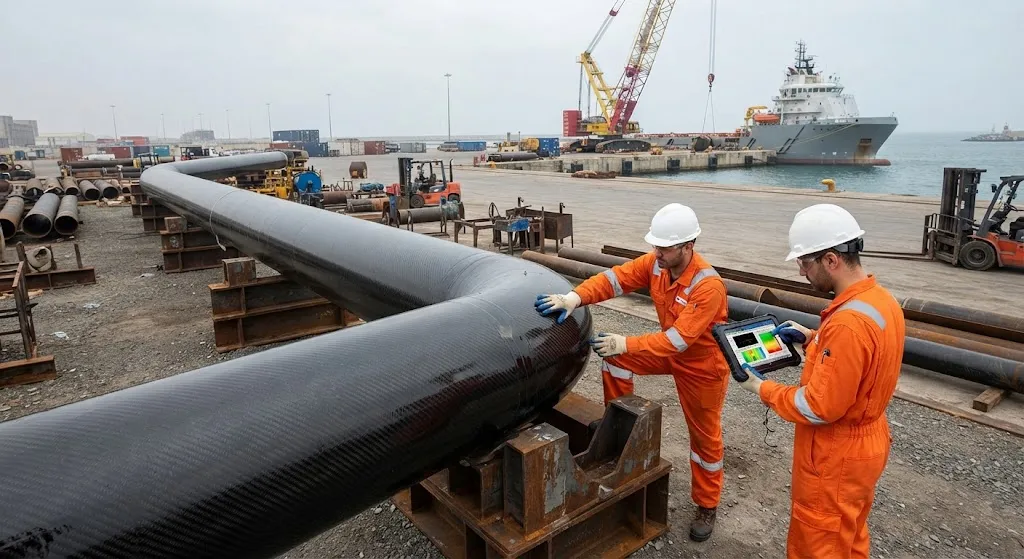
Deepwater risers are the arteries of offshore production — vertical pipes that carry hydrocarbons from the seabed to a floating platform. As operators push into water depths beyond 2,000 meters, risers face a brutal combination of hydrostatic pressure, internal well pressure, corrosive
Introduction
Deepwater risers are the arteries of offshore production — vertical pipes that carry hydrocarbons from the seabed to a floating platform. As operators push into water depths beyond 2,000 meters, risers face a brutal combination of hydrostatic pressure, internal well pressure, corrosive produced fluids, and continuous wave-driven fatigue loading. Steel risers have served the industry for decades, but their weight and corrosion behavior create real penalties in deep water.
Carbon fiber reinforced polymer (CFRP) risers promise to change that calculus. Composite risers weigh a fraction of steel in water, resist seawater and sour-service corrosion, and exhibit fatigue behavior that can outlast steel in many loading regimes. The technology has moved from JIP studies in the 1990s to field-qualified systems, and a growing number of operators now evaluate CFRP risers as a serious alternative. This article compares the two systems on the dimensions that decide project economics — fatigue life, corrosion resistance, suspended weight, and lifecycle cost — and lays out what buyers should verify before specifying composite risers.
Why Deepwater Punishes Steel Risers
The loads on a deepwater riser are unrelenting. Each wave cycle flexes the riser at its touchdown zone and at the platform connection, generating stress ranges that accumulate into fatigue damage. In sour fields, hydrogen sulfide attacks steel welds and can cause sulfide stress cracking. Seawater accelerates corrosion at the splash zone and in the annulus between riser and outer casing, where inspection is difficult. The result is a maintenance burden: steel risers require scheduled inspection, corrosion monitoring, and periodic repair campaigns that interrupt production.
| Riser Type | Load-Bearing Material | Typical Application | Key Weakness |
|---|---|---|---|
| Drilling riser | Steel (high-strength) | Well construction, BOP connection | Heavy, fatigue-limited in deep water |
| Steel catenary riser | Steel pipe | Production and export, tiebacks | Corrosion fatigue at touchdown zone |
| Top-tensioned riser | Steel pipe | Dry-tree platforms | Weight drives platform buoyancy needs |
| Composite riser | CFRP overwrap or full composite | Production, high-pressure service | Qualification cost, connector interface |
The industry's response to these problems has historically been metallurgy: higher-strength steel, corrosion-resistant alloys, and fatigue-mitigation devices. But there is a limit to how far steel can go. In very deep water, the riser's own weight becomes a dominant design constraint, forcing larger and more expensive floaters to carry the payload. Composite risers attack this problem at its root by fundamentally reducing the weight of the pipe itself.
Weight Savings: The Physics of Composite Risers
The most immediate advantage of CFRP risers is weight. Carbon fiber composites have a density of roughly 1.6 g/cm³ against 7.8 g/cm³ for steel, and their specific strength is several times higher. Translating those properties into a riser joint, a composite riser typically weighs 50-60 percent less than the equivalent steel joint in air, and the advantage grows in water because of buoyancy. Lighter risers reduce the load on the floater, which can mean a smaller hull, smaller tensioners, and lower mooring requirements — savings that amplify across the whole field architecture.
| Property | Steel Riser | CFRP Riser | Impact on System |
|---|---|---|---|
| Density | 7.8 g/cm³ | 1.6 g/cm³ | Weight-driven hull and tensioner design |
| Weight in water vs steel | Baseline | ~60% lower | Smaller floater, lower capex |
| Corrosion fatigue | Susceptible, crack growth in seawater | No corrosion fatigue | Longer inspection intervals |
| Fatigue resistance | Fracture-mechanics limited | High cycle capacity when well designed | Extended service life |
| Sour service | Requires alloy or inhibitor | Eligible with qualified liner | Simpler material barrier strategy |
Field experience supports the weight argument. The first composite production risers installed in the North Sea carried full working pressure in the 1990s, and subsequent qualification programs have demonstrated that designed CFRP riser joints can match the burst and fatigue margins of steel over a defined service life. The economics tilt further in shallow-to-moderate tensioned riser systems, where every kilogram of suspended weight translates directly into floater payload.
Fatigue Life and Corrosion Resistance in Service
Fatigue is where composite risers separate most decisively from steel. Steel fatigue in corrosive deepwater service follows fracture mechanics: a crack initiates at a weld or a corrosion pit, then grows under each load cycle until failure. The mitigation is inspection — finding cracks before they reach critical size. Composite risers, by contrast, do not corrode, and their fatigue behavior is dominated by the matrix and fiber-matrix interface rather than crack growth in a metallic structure. A CFRP riser with a chemically resistant liner and barrier can therefore run for decades without the corrosion-fatigue crack growth that would drive a steel riser to inspection or replacement.
- Corrosion eliminated: No galvanic or crevice corrosion in the composite structure itself; seawater exposure is managed via the outer barrier and connector design.
- Fatigue predictable: S-N behavior characterized at the laminate level, with damage accumulating as distributed microcracking rather than a single critical crack.
- Inspection intervals extended: ROV-based visual inspection and periodic pressure tests replace frequent ultrasonic and magnetic-particle campaigns on steel.
- Sour service handled by liner: A qualified polymer liner or thin metallic barrier shields the overwrap from produced fluids, avoiding sulfide stress cracking concerns.
None of this is automatic — it depends on design. The composite riser's fatigue life is set by the laminate architecture, the winding or layup angles, the resin toughness, and the quality of the connector-to-pipe interface. Buyers should treat fatigue performance as a design deliverable backed by test data, not a material property that comes free with carbon fiber.
Qualification and Cost: The Real Decision Factors
The obstacles to composite risers are not technical feasibility but qualification cost and first-article economics. A composite riser qualification program covers material allowables, joint fatigue testing, burst and collapse testing, connector performance, and long-term aging in representative fluids and temperatures. That effort is expensive and time-consuming, and it is only justified when the system-level savings — floater size, inspection burden, service life — exceed the premium over steel.
| Cost Factor | Steel | CFRP |
|---|---|---|
| Fabrication cost per joint | Lower (mature supply chain) | Higher (specialized winding) |
| Qualification program | Established, well-understood | Case-by-case, expensive |
| Platform and floater cost | Higher (heavier payload) | Lower (lighter payload) |
| Inspection over life | Frequent, intrusive | Extended intervals |
| Lifecycle cost | Higher in deep water | Competitive in deep water |
The crossover point depends on water depth, field life, and riser count. In shallow water with short field life, steel remains the obvious choice — qualification cost has no time to pay back. In deepwater fields with 20-plus-year production lives and dozens of risers, the weight, fatigue, and inspection advantages of composite systems can dominate the lifecycle picture. Standards and guidance from industry bodies (notably DNV's offshore composite standards) provide the framework for qualification, and operators with composite experience are increasingly willing to specify them on new projects.
Frequently Asked Questions
Why are composite risers not used everywhere despite their advantages?
The barrier is qualification cost and industry conservatism, not physics. Every riser application requires a case-specific qualification program covering fatigue, burst, collapse, connector performance, and long-term aging — an expensive and time-consuming process. Additionally, the oil and gas supply chain is built around steel: fabrication yards, connectors, codes, and inspection services are mature for steel pipe and thin for composites. As more operators accumulate field experience and industry standards mature, each new project becomes easier to justify. In very deep water, where steel risers impose a heavy floater penalty, the economics already favor composites.
How long do composite risers last compared with steel risers?
Design life of 20-30 years is typical for both, but the failure modes and maintenance burdens differ. A steel riser's life is limited by corrosion fatigue — crack initiation and growth under cyclic loading in seawater — which demands periodic inspection and sometimes repair. A well-designed composite riser with a qualified liner and connector does not suffer corrosion fatigue, so its life is governed by laminate fatigue, aging of the matrix, and liner integrity, addressed through design and qualification rather than frequent intervention. The practical benefit is not always a longer designed life but a longer period between intrusive inspections, which reduces downtime and inspection cost.
What is the weight saving of a composite riser in deep water?
A composite riser joint typically weighs 50-60 percent less than an equivalent steel joint in air, and even more effectively than steel in water once buoyancy is counted. For a deepwater field with a large riser payload, this translates into concrete system savings: a smaller floater hull, smaller tensioners, reduced mooring loads, and lower installation costs. The exact saving depends on the riser's dimensions, working pressure, and the liner system, which is why operators size the floater only after a system-level weight audit rather than a per-joint comparison.
Do composite risers need a liner for produced fluids?
Yes in most hydrocarbon service. The carbon fiber overwrap provides structural strength but must be protected from produced fluids and gases — sour constituents such as hydrogen sulfide, water, aromatics, and high temperatures can degrade the epoxy matrix over time. A qualified polymer liner or a thin metallic barrier inside the composite pipe shields the overwrap, much as in composite flowlines and subsea piping. Liner selection, including resistance to permeation and rapid gas decompression, is one of the central items in a composite riser qualification program and should be treated seriously when specifying the system.
Conclusion
Composite deepwater risers are no longer an experiment. The weight, fatigue, and corrosion advantages over steel are well-documented, and the economics favor them wherever deep water, long field life, and large riser counts make floater payload and inspection burden decisive. What separates successful programs from failures is discipline: qualification based on representative fatigue and aging tests, a qualified liner matched to the produced fluids, and a connector interface engineered for the actual loading.
For operators and engineering contractors evaluating riser systems, composite materials deserve a place on the alternatives list from day one of concept selection. Explore our carbon fiber products for oil and gas applications, or contact our engineering team to discuss material qualification, laminate design, and supply support for deepwater composite riser programs.
Part of topic
Related Articles
- Carbon Fiber Mooring for Floating Offshore Wind: Fatigue and Corrosion in Deep Water
- Carbon Fiber Bicycle Frame Optimization: Layup Design and Manufacturing for Competitive Racing
- Carbon Fiber CFRP Retrofit for Infrastructure: Bridge and Building Seismic Strengthening
- Carbon Fiber Medical Imaging Equipment: Lightweight Gantry and Couch Structures for MRI/CT
- Carbon Fiber EV Battery Enclosures: Crash Safety and Electromagnetic Shielding Design
- Carbon Fiber Structures for Low-Altitude Economy: UAV Airframes and eVTOL Components