
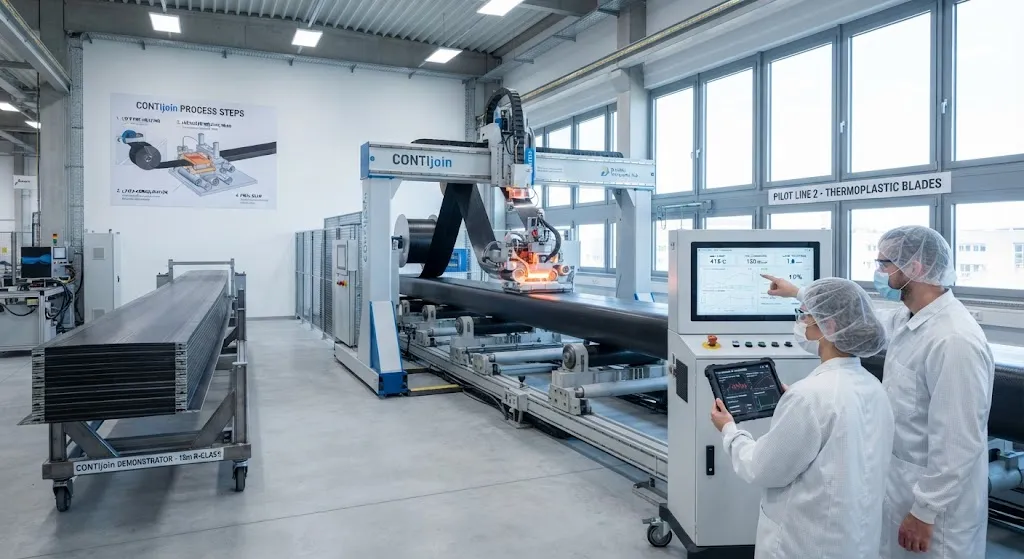
Spar cap production remains one of the most labor-intensive operations in blade manufacturing. A 100-meter-class spar cap can require hundreds of hours of hand layup: manual placement of pultruded carbon plates or prepreg stacks into a multi-meter mold, followed by vacuum bagging, infus
Introduction
Spar cap production remains one of the most labor-intensive operations in blade manufacturing. A 100-meter-class spar cap can require hundreds of hours of hand layup: manual placement of pultruded carbon plates or prepreg stacks into a multi-meter mold, followed by vacuum bagging, infusion and a full curing cycle. The labor content drives cost, and the manual process limits throughput — two pressures that blade factories in high-wage countries feel directly as they compete with lower-cost regions.
Fraunhofer's CONTIjoin process, developed by the Institute for Manufacturing Technology and Advanced Materials (IWS), attacks both constraints with a fundamentally different approach. Instead of laminating and curing a thermoset spar cap in one shot, CONTIjoin builds the main belt continuously from thermoplastic UD tape semi-finished products, welding layer after layer in an automated in-line process. Joined by IMWS, which develops tapes up to ten times wider than standard, and IWES, which validates the process on an 18-meter shell demonstrator, the technology is the clearest evidence yet that high-wage countries can automate their way back into economically competitive blade production — while making the blade recyclable at the end of its life.
How CONTIjoin Builds a Spar Cap
The process inverts the classic blade manufacturing sequence. In a thermoset blade, the spar cap is an infused part inside a vacuum bag: the material is placed, resin is injected, and the whole assembly cures over hours in a heated mold. CONTIjoin instead treats the spar cap as a welding job. Pre-consolidated thermoplastic UD tapes, each a semi-finished product with fiber already embedded in a thermoplastic matrix such as PA6 or PPS, are fed through a welding head that heats, presses and consolidates them onto the growing laminate, layer by layer, in a single continuous pass.
This in-line build-up has three structural consequences:
- No curing cycle: the thermoplastic matrix is consolidated by heat and pressure on the line itself, cutting the cycle from hours to the time needed to traverse the tape.
- Continuous process: tapes are welded in an endless sequence, so the spar cap is built without seams between panels, improving load path continuity along the blade length.
- Automated quality: each weld seam is created under the same controlled temperature, pressure and speed, replacing operator-dependent layup with machine-repeatable consolidation.
The economics follow from automation: one continuous welding line replaces a queue of manual layup stations, and the labor shifts from skilled laminators to operators who supervise a machine running at constant speed.
The Ten-Times-Wider Tape from IMWS
The productivity ceiling of any welding-based process is the tape width: a narrow tape must traverse the cap many times to cover its width, and each pass repeats the handling cycle. Fraunhofer IMWS has attacked exactly this parameter. By developing thermoplastic UD tapes up to ten times wider than the standard 25-50 mm strips used in AFP and tape welding, IMWS reduces the number of passes needed to cover a spar cap width by roughly an order of magnitude.
Wide tape changes more than speed. A wider consolidated layer means fewer weld seams per laminate volume, which reduces the seam density that can act as a seed for voids or delamination in fatigue loading. The table below compares the tape formats used in different automated build-up routes:
| Parameter | Standard AFP Tape | Conventional Welding Tape | IMWS Wide Tape (CONTIjoin) |
|---|---|---|---|
| Typical width | 6.35-12.7 mm | 25-50 mm | Up to 10x standard width |
| Passes to cover 1 m cap width | 100-160 | 20-40 | 2-5 |
| Throughput driver | Placement rate | Weld speed x passes | Weld speed x width |
| Seam density in laminate | Highest | Medium | Lowest |
| Typical matrix | PA6, PPS, PEKK | PA6, PA12 | PA6, PPS (blade-grade) |
Wide-tape welding also demands more from the heating system, because a wider nip must reach consolidation temperature uniformly across the full width. The IWS welding head is designed for this larger footprint, with distributed heating that maintains a consistent weld temperature profile and controlled pressure across the tape edge-to-edge.
The 18-Meter Demonstrator at IWES
Process economics only matter if the result flies in an actual blade. Fraunhofer IWES, the institute that tests full structural components for wind energy, has taken the CONTIjoin route out of the laboratory and validated it on an 18-meter shell demonstrator. The demonstrator is not a coupon test: it is a blade-scale shell segment built with the automated in-line process, then subjected to structural testing that checks the spar cap bond, the shell integration and the fatigue behavior of the welded laminate.
The 18-meter scale is deliberately meaningful. It matches the inboard section of a multi-megawatt blade where the spar cap carries the highest loads, so the tests exercise the exact operating regime the process must survive. The validation chain covers:
- Structural adhesion: the welded spar cap-to-shell bond, evaluated under static and cyclic loading to confirm the weld line, not the adhesive, remains the design-limiting feature.
- Fatigue performance: coupon and sub-component fatigue data from the welded laminate, checking the seam density against the S-N scatter that thermoset blades display.
- Recyclability validation: end-of-life recovery routes for the thermoplastic blade, where the matrix can be remelted and the fiber reclaimed instead of being landfilled or downcycled as thermoset scrap.
The central claim of the demonstrator is economic, not just technical: with an automated line running at constant speed and no curing step, the cost per spar cap in a high-wage factory can approach or beat manual infusion-based production in lower-cost regions — the argument that makes automation the strategic answer for European blade plants.
Why Thermoplastic Replaces the Infusion Logic
Thermoset blades infuse the entire spar cap in one operation, which is efficient at building a monolithic part but slow at the margins: the infusion, cure and inspection steps all scale with part size. Thermoplastic build-up breaks that logic by making the laminate incrementally, with consolidation happening at the point of welding rather than in a global cure. Two practical advantages follow:
First, capital efficiency. A thermoplastic line processes one continuous strip at a time, so the same line builds a 40-meter spar cap with the same footprint it needs for an 8-meter section; the tool is sized to the weld head and the feed system, not to the full blade. Second, repair economics. A damaged thermoplastic laminate can be locally reheated and reconsolidated — or a damaged section can be cut out and rewelded in place — which is far cheaper than the scarf-patch and re-cure repairs typical of thermoset blades.
The recyclability argument closes the loop. With the EU's sustainability pressure on blade waste rising, a spar cap whose PA6 or PPS matrix can be remelted and whose fiber can be reclaimed makes the end-of-life case as strong as the manufacturing case. CONTIjoin therefore answers two questions at once: how to automate blade production in high-wage countries, and how to make the blade circular at retirement.
Frequently Asked Questions
What makes CONTIjoin different from automated fiber placement in thermoset blades?
AFP places dry fiber or prepreg on a tool and still relies on infusion or an oven cure for consolidation, so the curing step remains part of the process. CONTIjoin welds pre-consolidated thermoplastic UD tapes directly into the laminate: heat and pressure at the weld head consolidate each layer in place, eliminating the separate cure. The practical difference is throughput — no hours-long cure window, and a continuous line instead of a placement head feeding an oven — and recyclability, since a thermoplastic matrix can be remelted at end of life while a cured thermoset cannot.
Why are wider thermoplastic tapes important for spar cap economics?
Because the number of welding passes scales with tape width. A standard 25-50 mm tape needs 20-40 passes to cover a meter of spar cap width, each pass repeating the feed and weld handling; the IMWS wide tape, up to ten times wider, reduces that to 2-5 passes. Fewer passes mean higher line throughput, and less seam density in the laminate improves the fatigue case by removing potential void and delamination seeds. The heating system must keep the wider weld nip uniform, which is why the wide-tape work pairs with the distributed-heating welding head.
Does the 18-meter demonstrator prove the process works at commercial scale?
It proves the process on the most loaded inboard section of a multi-megawatt blade: structural adhesion of the welded spar cap-to-shell bond, fatigue behavior of the welded laminate, and recyclability are all validated at 18-meter scale. Full commercial scale means extending the same line logic to full-length spar caps and integrating it into a serial blade factory, which is a plant-engineering step rather than a process-risk step. The demonstrator is deliberately focused on eliminating the technical uncertainties — weld quality, seam density, bond integrity — that would block that factory investment.
How does CONTIjoin manufacturing affect blade repair and end-of-life recycling?
Thermoplastic matrices change both. Locally, a damaged area can be reheated and reconsolidated, or cut out and replaced by a welded patch, avoiding the scarf-joint and full re-cure used for thermoset repair. At retirement, the PA6 or PPS matrix can be remelted and the carbon fiber reclaimed as recycled fiber, whereas a cured thermoset blade is typically downcycled or landfilled. For OEMs and operators, this converts the blade from single-use infrastructure into a recoverable asset and directly addresses tightening EU waste regulation.
Conclusion
CONTIjoin reorganizes spar cap manufacturing around a continuous, automated welding line instead of manual layup and global cure. The three Fraunhofer institutes close the loop between them: IWS builds the in-line welding process, IMWS supplies tapes up to ten times wider to remove the throughput ceiling, and IWES validates the result on an 18-meter shell demonstrator that exercises the most loaded section of a real blade. The sum is the strongest current argument that high-wage countries can automate their way to competitive blade economics — and that the same thermoplastic material choice makes the blade recyclable when its 25-year service ends.
For blade manufacturers and suppliers evaluating thermoplastic spar cap technology, the question is no longer whether the process works, but how fast the wide-tape line can be industrialized into serial production. Explore our carbon fiber profiles and structural tape products suited to thermoplastic spar cap applications, or contact our engineering team to discuss material support for automated blade manufacturing programs.
Part of topic
Related Articles
- Bio-Based Carbon Fiber Precursors: Lignin and Polyethylene for Low-Cost Production
- Large-Tow Carbon Fiber Cost Analysis: 48K vs 60K Price-Performance Comparison
- Carbon Fiber-Resin Interface Bonding: Surface Treatment and Coupling Agent Optimization
- Digital Twin for Carbon Fiber Manufacturing: Real-Time Process Monitoring and Defect Prevention
- Thermoplastic Carbon Fiber Welding for Automotive: Ultrasonic and Induction Welding Process Windows
- Large-Tow Carbon Fiber Wet Spinning: Process Optimization for 48K/60K Production Efficiency
Interested in Our Products?
Contact our team for competitive pricing and technical specifications.
Get a QuoteRelated Products
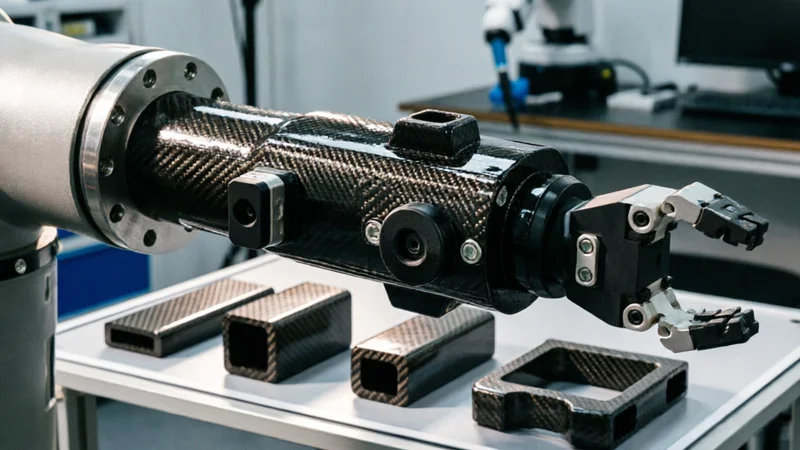
Carbon Fiber Robot End Effector Link — Custom Shape & Sensor Integration
Custom-shaped carbon fiber end effector links for robotic arms. Designed for automation integrators and research labs requiring lightweight, rigid connections between the robot wrist and gripper/tool. Can incorporate sensor mounting bosses, cable routing channels, and quick-change interfaces.
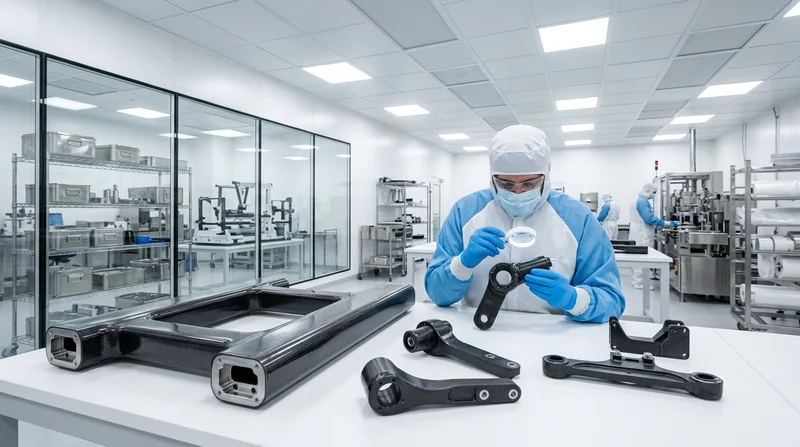
Custom Carbon Fiber Medical Device Components
Medical-grade carbon fiber components manufactured for imaging equipment, surgical instruments, and patient support systems. Carbon fiber's radiolucency (X-ray transparency) and high strength-to-weight ratio make it ideal for CT scanner beds, wheelchair frames, surgical robot arms, and MRI-compatible accessories. Biocompatible resin systems available.
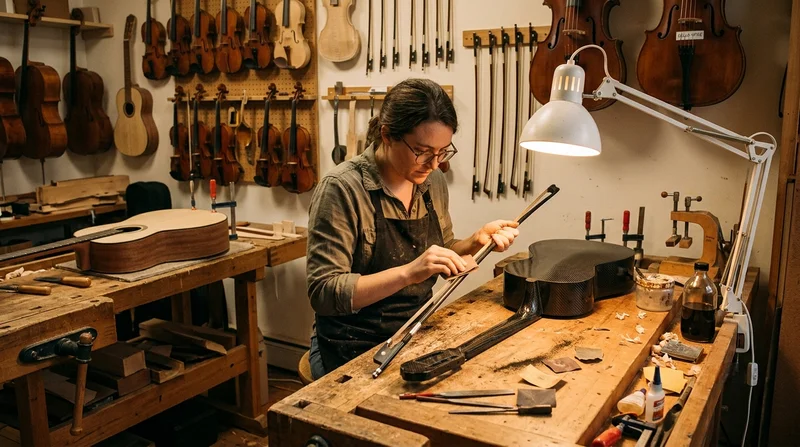
Custom Carbon Fiber Musical Instrument Parts
Carbon fiber components for musical instrument manufacturing offering superior dimensional stability, low weight, and consistent acoustic properties. We produce carbon fiber bows, guitar necks, violin chin rests, drum shells, and wind instrument bodies. Carbon fiber instruments are immune to humidity changes and temperature fluctuations that affect wooden instruments.
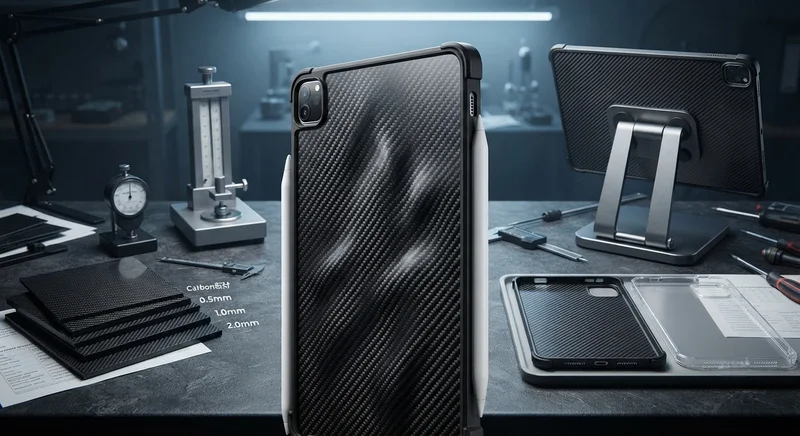
Carbon Fiber Tablet Case — Ultra-Light Protective Shell
Lightweight carbon fiber protective case for tablets and iPads. Molded from T700 3K prepreg with reinforced corner protection. Adds minimal weight while providing superior rigidity and drop protection compared to polycarbonate or silicone cases. Ideal for field workers, enterprise deployments, and professionals requiring durable tablet protection.
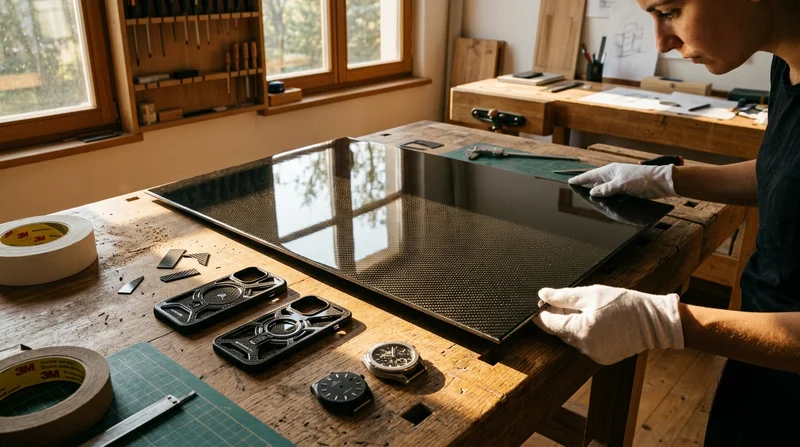
Carbon Fiber Plate — High-Gloss Decorative
High-gloss decorative carbon fiber plate with a mirror-like surface finish. The glossy coating enhances the visible 3K twill weave, creating a premium aesthetic for consumer-facing applications. Lightweight yet stiff, available in thin gauges for easy cutting and forming.