
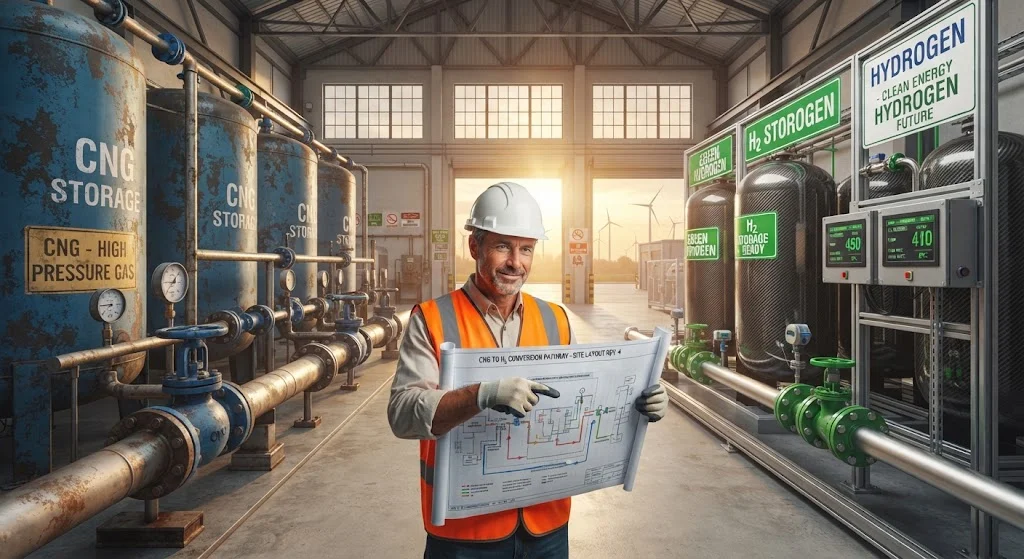
The global gas distribution industry faces a pivotal strategic question: how to navigate the transition from fossil natural gas to hydrogen while maintaining service reliability and managing infrastructure investment risk. Compressed natural gas (CNG) infrastructure — comprising high-pr
Introduction
The global gas distribution industry faces a pivotal strategic question: how to navigate the transition from fossil natural gas to hydrogen while maintaining service reliability and managing infrastructure investment risk. Compressed natural gas (CNG) infrastructure — comprising high-pressure storage vessels, compression systems, distribution pipelines, and vehicle fueling stations — represents a $340 billion installed asset base that cannot be economically replaced overnight. The emerging consensus among gas utilities and energy policymakers is that CNG infrastructure can serve as a practical bridge technology toward hydrogen distribution, provided that key components are adapted to handle hydrogen's unique material compatibility challenges.
This bridge strategy is particularly relevant for carbon fiber composite components, where the material's hydrogen permeation characteristics and high-pressure performance make it both a candidate for hydrogen service and a focus area for conversion engineering. This article examines the technical pathways for CNG-to-hydrogen conversion, analyzes the carbon fiber components most suitable for adaptation, and provides guidance for gas utilities planning their hydrogen transition strategy.
CNG Infrastructure as Hydrogen Bridge
The strategic value of CNG infrastructure as a hydrogen bridge derives from several structural advantages that reduce the capital intensity of the energy transition:
- Pressure regime compatibility: CNG systems typically operate at 200-250 bar (3,000-3,600 psi), which overlaps significantly with hydrogen distribution pressures of 30-80 bar for pipeline injection and 350-700 bar for vehicle fueling. This pressure compatibility means that many CNG components can be rated for hydrogen service with relatively modest engineering modifications.
- Existing customer connections: Gas utilities have established meter connections, service lines, and billing relationships with millions of commercial and residential customers. Converting these connections to hydrogen-blended gas requires minimal customer-side modification while enabling progressive decarbonization.
- Regulatory framework: Most gas distribution safety regulations were developed for natural gas but include provisions for gas quality specifications that can accommodate hydrogen blending up to 10-20% by volume without requiring wholesale regulatory revision.
- Workforce expertise: Gas utility technicians trained in high-pressure gas handling, leak detection, and pipeline maintenance possess transferable skills for hydrogen operations, reducing the workforce transition cost compared to building hydrogen expertise from scratch.
Carbon Fiber Components for Hydrogen Adaptation
Carbon fiber composite components play specific roles in CNG systems that make them particularly relevant to hydrogen conversion. The material's high strength-to-weight ratio, corrosion resistance, and fatigue performance are valuable in both CNG and hydrogen applications, but hydrogen introduces specific material compatibility considerations:
| Component | CNG Application | Hydrogen Adaptation Requirements | Carbon Fiber Considerations |
|---|---|---|---|
| Type IV storage vessels | 200-250 bar CNG storage | 350-700 bar H2 fueling; permeation barriers | Enhanced liner permeation testing; revised winding patterns |
| Composite pipeline sections | Medium-pressure distribution | Hydrogen embrittlement assessment; permeation monitoring | FRP pipeline qualification per ASME B31.12 |
| Pressure regulator housings | Pressure reduction stations | Hydrogen-compatible seals; leak detection integration | Housing redesign for H2 sensor mounting |
| Vehicle fueling nozzles | CNG dispensing | 350/700 bar dual-pressure; H2 leak prevention | Carbon fiber reinforced nozzle bodies |
| Compressor rod components | CNG compression | H2-compatible lubrication; seal material change | Carbon fiber piston rods for H2 compressors |
| Emergency shut-off valve actuators | Safety systems | Hydrogen-safe electrical classification | Carbon fiber actuator housings for weight reduction |
Type IV Storage Vessel Conversion
Type IV composite storage vessels — featuring carbon fiber reinforced polymer (CFRP) overwrap on polymer liners — are the highest-value CNG components with hydrogen conversion potential. These vessels, which typically store CNG at 200-250 bar for vehicle fueling stations and peak-shaving applications, can be adapted for hydrogen service at 350-700 bar with specific engineering modifications:
- Liner permeation management: Hydrogen molecules are 2.8 times smaller than methane molecules, creating higher permeation rates through polymer liners. HDPE and nylon liners used in CNG vessels may require permeation testing at hydrogen pressures, with some applications necessitating liner material upgrades to high-density polyethylene (HDPE) with enhanced barrier properties or thermoplastic polyamide liners.
- Winding pattern optimization: Hydrogen storage at 700 bar requires higher hoop stress capacity than CNG at 250 bar. Carbon fiber winding patterns must be reoptimized to handle the increased internal pressure, typically requiring 15-25% additional fiber volume fraction or modified winding angles.
- Cyclic fatigue assessment: Hydrogen fueling involves more frequent pressure cycles than CNG filling (daily vehicle fueling vs. weekly station replenishment). The carbon fiber overwrap must be qualified for the increased cycle count, which may require additional fatigue testing per ISO 19881 or SAE J2579 standards.
- Safety factor revision: Hydrogen's wider flammability range and lower ignition energy require revised safety factors for storage vessels. The typical CNG safety factor of 2.25 may need to increase to 2.5-3.0 for hydrogen service, affecting vessel weight and cost calculations.
Pipeline Conversion Strategy
Carbon fiber reinforced polymer (CFRP) pipelines used in CNG distribution present a distinct conversion pathway compared to steel pipelines, with both advantages and limitations for hydrogen service:
- Hydrogen embrittlement immunity: Unlike steel pipelines, CFRP pipelines do not suffer from hydrogen embrittlement, making them inherently compatible with hydrogen service without the monitoring and inspection requirements that steel pipelines require.
- Permeation monitoring: CFRP pipelines require hydrogen permeation monitoring systems that are not necessary for natural gas service. Fiber optic sensing cables embedded during pipeline manufacture can provide real-time permeation data, but this capability must be specified during original pipeline construction or added through retrofit.
- Joint compatibility: Mechanical joints and couplings used in CNG CFRP pipelines must be validated for hydrogen service, as hydrogen can permeate through elastomeric seals more readily than methane. Joint redesign may be required for long-term hydrogen operation.
- Pressure rating adjustment: Some CNG CFRP pipelines operate at pressures below hydrogen distribution requirements. Pressure re-rating requires engineering analysis of the existing pipeline's fiber architecture and may necessitate section replacement for pressure-critical applications.
Economic Considerations
The economics of CNG-to-hydrogen conversion favor carbon fiber components in specific applications where the material's performance advantages justify conversion engineering costs:
- Vehicle fueling stations: Converting existing CNG vehicle fueling stations to hydrogen service typically costs $2-4 million per station, compared to $8-12 million for greenfield hydrogen stations. The 50-65% cost reduction makes conversion the preferred pathway for most station operators.
- Peak-shaving storage: CNG peak-shaving storage facilities can be converted to hydrogen storage for grid balancing applications, with conversion costs of $150-250 per kilowatt-hour of storage capacity versus $400-600 for new hydrogen storage systems.
- Distribution pipeline sections: Converting existing CFRP pipeline sections to hydrogen service costs $800-1,200 per meter, compared to $2,000-3,500 per meter for new hydrogen-rated pipelines. The cost advantage is most significant for short pipeline sections connecting production facilities to storage or dispensing points.
Frequently Asked Questions
What is the maximum hydrogen blending ratio permitted in existing CNG pipelines?
Most gas distribution regulations permit hydrogen blending up to 5-10% by volume in existing natural gas pipelines without requiring system modifications. Some jurisdictions have approved blending ratios up to 20% for specific applications, particularly in industrial zones with dedicated pipeline networks. The limiting factors are typically gas quality specifications for end-use equipment (boilers, furnaces, turbines) rather than pipeline material compatibility. Carbon fiber composite pipelines generally have no intrinsic limitation on hydrogen blending ratios, as the material does not suffer from hydrogen embrittlement. The primary consideration is ensuring that downstream equipment can operate safely with the blended gas composition.
How do CNG Type IV vessels perform in hydrogen service compared to purpose-built hydrogen tanks?
CNG Type IV vessels adapted for hydrogen service typically achieve 85-90% of the performance characteristics of purpose-built hydrogen tanks, with the primary differences being slightly higher permeation rates (0.5-1.0% per day versus 0.1-0.3% for dedicated hydrogen vessels) and marginally reduced cycle life (5,000-8,000 cycles versus 10,000-15,000 cycles). For vehicle fueling station applications where daily fill cycles are lower than mobile hydrogen applications, these performance differences are acceptable. The cost advantage of conversion — typically 40-50% less than new hydrogen vessels — makes converted CNG vessels economically attractive for station operators transitioning to hydrogen fueling.
What safety certifications are required for CNG components converted to hydrogen service?
Converted CNG components must be re-certified under hydrogen-specific standards, typically ISO 19881 for composite pressure vessels, SAE J2601 for hydrogen fueling protocols, and local jurisdiction-specific gas safety regulations. The certification process includes hydrogen permeation testing, cyclic pressure testing at hydrogen pressures, material compatibility validation, and safety factor verification. For carbon fiber composite components, the certification process typically requires 3-6 months and costs $50,000-150,000 per vessel type, depending on the testing scope and jurisdiction requirements. Some gas utilities are establishing shared certification programs to distribute these costs across multiple conversion projects.
Conclusion
CNG infrastructure represents a practical and economically viable bridge technology for gas distribution networks transitioning to hydrogen service. Carbon fiber composite components — particularly Type IV storage vessels, pipeline sections, and fueling equipment — are well-suited for hydrogen adaptation due to the material's inherent hydrogen compatibility and high-pressure performance. The conversion pathway offers 40-65% cost savings compared to greenfield hydrogen infrastructure, making it the preferred strategy for most gas utilities managing the energy transition. Success in this bridge strategy requires systematic assessment of existing CNG assets, engineering modification of carbon fiber components for hydrogen service, and navigation of hydrogen-specific safety certification requirements. As hydrogen blending ratios increase and pure hydrogen distribution expands, the CNG-to-hydrogen conversion pathway will play an increasingly important role in achieving decarbonization targets while maintaining gas service reliability.
For gas utilities and energy infrastructure developers planning hydrogen transition strategies, understanding the CNG conversion pathway is essential for capital planning and timeline management. Explore our carbon fiber products for hydrogen storage and distribution applications, including Type IV vessel overwrap materials and pipeline composite solutions, or contact our engineering team to discuss hydrogen conversion requirements for specific CNG infrastructure assets.
Part of topic
Related Articles
- Carbon Fiber Mooring for Floating Offshore Wind: Fatigue and Corrosion in Deep Water
- Carbon Fiber Bicycle Frame Optimization: Layup Design and Manufacturing for Competitive Racing
- Carbon Fiber CFRP Retrofit for Infrastructure: Bridge and Building Seismic Strengthening
- Carbon Fiber Medical Imaging Equipment: Lightweight Gantry and Couch Structures for MRI/CT
- Carbon Fiber EV Battery Enclosures: Crash Safety and Electromagnetic Shielding Design
- Carbon Fiber Structures for Low-Altitude Economy: UAV Airframes and eVTOL Components