
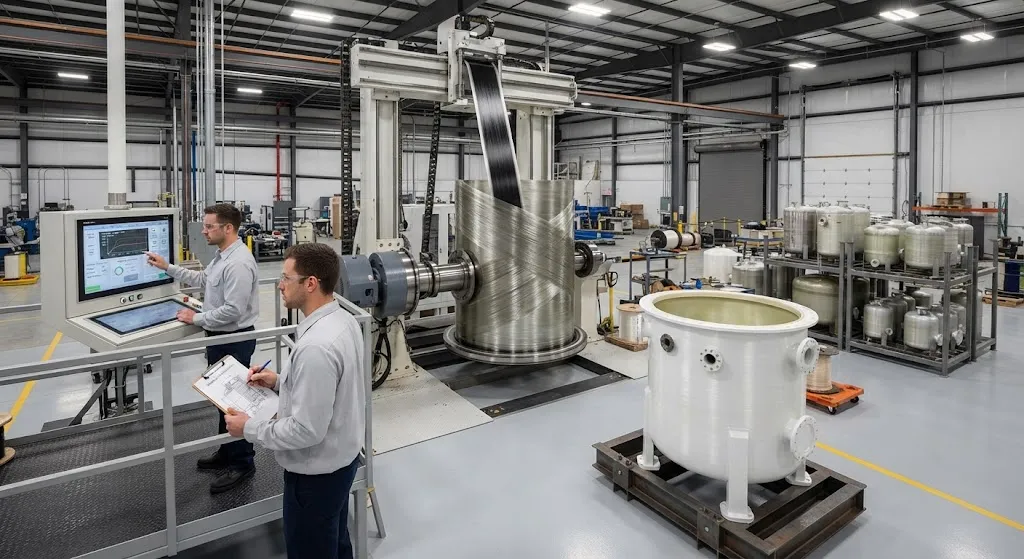
Filament-wound composite chemical tanks are the standard answer to a corrosive problem that steel never fully solves. From hydrochloric acid storage for metal finishing lines to caustic soda tanks in water treatment plants, process industries store aggressive chemicals in vessels that m
Introduction
Filament-wound composite chemical tanks are the standard answer to a corrosive problem that steel never fully solves. From hydrochloric acid storage for metal finishing lines to caustic soda tanks in water treatment plants, process industries store aggressive chemicals in vessels that must resist chemical attack, hold pressure or vacuum, and survive for decades. Carbon steel corrodes in these services; lined steel adds cost and inspection burden; and high-alloy metals such as stainless steel or Hastelloy become prohibitively expensive as tank size grows.
Composite tanks built by filament winding solve the problem from both ends: a resin-rich corrosion barrier defeats the chemical attack, while continuous fiber reinforcement in the wall carries the structural load. Adding carbon fiber further increases stiffness and reduces weight, which matters for large tanks, seismic designs, and double-wall containment. This article explains how these tanks are built, how the corrosion barrier is engineered, and how buyers should specify and inspect them.
How Filament Winding Builds a Chemical Tank
Filament winding is a process in which continuous fiber tows are drawn through a resin bath, then wound onto a rotating mandrel in a programmed pattern. For chemical tanks, the typical sequence builds the wall in three functional zones. First, the corrosion barrier is applied onto the mandrel — a resin-rich layer with a surfacing veil that contains no structural fiber and is formulated for high chemical resistance. Second, the structural layers are wound: glass fiber tows at controlled helical angles provide hoop and axial strength, and the winding angle program is adjusted along the tank body to match the pressure loading at each location. Third, the tank is cured, the mandrel is removed (for a removable mandrel such as a collapsible steel tool or a soluble core), and nozzles and fittings are laminated or bonded into place.
Two winding patterns dominate. Helical winding covers the whole tank with fibers at angles between roughly 20 and 90 degrees to the axis, distributing load between hoop and axial directions. Hoop-only winding places fibers near 90 degrees and is used for the cylindrical sections where internal pressure creates the largest circumferential stress. Most tanks combine both: helical layers for axial strength and buckling resistance at the ends, and additional hoop layers in the barrel where pressure stresses are highest.
Engineering the Corrosion Barrier
The corrosion barrier is the tank's first line of defense and the layer that determines service life against chemical attack. It is engineered to prevent the three failure mechanisms that destroy unprotected composites: chemical degradation of the resin, osmotic blistering, and wicking of corrosive liquid along fiber surfaces. The barrier therefore contains no structural fibers — no wicking paths — and is built from a resin selected for the specific chemical service, often a Novolac epoxy or a premium vinyl ester formulated for high-temperature concentrated acids and alkalis.
Barrier thickness is specified by the corrosion rating of the resin. Under the widely used corrosion guides published by resin suppliers, chemicals are grouped into service classes, and each class maps to a required barrier thickness — commonly 2.5 millimeters for moderate service and 5 millimeters for severe service with hot, concentrated media. A surfacing veil of C-glass or organic mat reinforces the resin-rich layer against thermal cycling and mechanical damage while maintaining the resin barrier. The same logic extends to the resin-rich interior surface of fittings and nozzles, where flow erosion and local turbulence attack the material.
Weight Savings and the Role of Carbon Fiber
Composite chemical tanks already weigh a fraction of their steel equivalents because glass fiber composites have roughly one quarter of the density of carbon steel. A vertical storage tank that needs 30 to 40 millimeters of steel wall for pressure and corrosion allowance can use 10 to 15 millimeters of glass composite in the structural wall, cutting vessel weight by 60 to 75 percent. The table below compares the material characteristics relevant to chemical tank design:
| Property | Carbon Steel | Glass Fiber Composite | Carbon Fiber Composite |
|---|---|---|---|
| Density | 7.85 g/cm³ | 1.8-2.0 g/cm³ | 1.5-1.6 g/cm³ |
| Tensile modulus | 200 GPa | 35-45 GPa | 120-230 GPa |
| Corrosion resistance | Poor without lining | Excellent with barrier | Excellent with barrier |
| Typical wall thickness | 30-40 mm (corrosion + pressure) | 10-15 mm structural wall | 6-12 mm structural wall |
| Relative weight | Baseline | 25-40% of steel | 20-35% of steel |
Carbon fiber earns its place in specific situations rather than as a blanket replacement for glass. Where a tank must resist wind and seismic loading on a tall slender geometry, carbon hoop layers add stiffness with less thickness. Where vacuum service imposes buckling constraints, higher-modulus fiber raises the buckling margin per millimeter of wall. And where double-wall tanks must minimize the annulus gap between containment and primary vessels, a stiff carbon-reinforced inner wall holds its shape under pressure without excessive wall build-up. These cases justify the higher fiber cost because they reduce total system weight, installation cost, and foundation size.
Specification, Inspection, and Service Life
Buyers specify chemical tanks against recognized standards, most prominently the ASME RTP-1 standard for reinforced thermoset plastic corrosion-resistant equipment and the pressure vessel codes where they apply. A sound specification addresses four elements:
- Chemical service definition: the media, concentration, and operating temperature that set the resin grade and barrier class.
- Barrier specification: the required corrosion barrier thickness and the resin corrosion rating for the service.
- Laminate schedule: winding angles, layer counts, and structural wall thickness for each tank zone.
- Acceptance testing: documented process parameters and barrier integrity checks before shipment.
Field inspection then focuses on what can be verified. Visual and tap testing of the interior surface finds blistering and delamination; ultrasonic thickness measurement checks wall build; and careful handling rules protect the barrier during transport and installation. Tanks in severe service are typically surveyed on an interval, and the corrosion barrier is repaired in place rather than replaced — a maintenance advantage unique to composites, since a damaged steel lining often means a new vessel.
Frequently Asked Questions
Why are filament-wound composite tanks preferred over steel for aggressive chemicals?
Steel corrodes when exposed to hydrochloric acid, concentrated caustics, and other aggressive media, so it needs expensive linings and still requires wall thickness to carry pressure plus a corrosion allowance that can be consumed over time. Filament-wound composite tanks resist the chemical with a resin-rich corrosion barrier designed for the specific service, carry the load with continuous fiber layers, and weigh 60 to 75 percent less than equivalent steel vessels. Barrier damage can also be repaired in place, whereas a failed steel lining usually means a new tank.
How thick should the corrosion barrier be for a chemical storage tank?
Barrier thickness follows the corrosion rating of the resin system. Under the common corrosion guides from resin suppliers, moderate chemical service maps to a barrier of about 2.5 millimeters, while severe service with hot, concentrated media requires about 5 millimeters. The barrier is resin-rich with no structural fiber, reinforced by a surfacing veil, and is separate from the structural fiber layers that carry pressure and load. Exact values depend on the chemical, concentration, temperature, and the resin manufacturer's rating data.
When does it make sense to use carbon fiber in a filament-wound chemical tank?
Carbon fiber is justified where stiffness or weight dominates the design. Tall, slender tanks that must resist wind and seismic loading use carbon hoop layers to add stiffness with less wall thickness. Vacuum service uses higher-modulus fiber to raise the buckling margin. Double-wall containment tanks use stiff carbon-reinforced inner walls to hold shape under pressure while keeping the annular gap small. In ordinary pressure service where glass fiber provides adequate stiffness, carbon fiber adds cost without proportional benefit.
Conclusion
Filament-wound composite chemical tanks combine a corrosion barrier that resists the chemical, continuous fiber layers that carry the structural load, and a laminate density that cuts vessel weight by 60 to 75 percent versus steel. Carbon fiber extends the design envelope where stiffness and weight dominate — seismic and wind-loaded tall tanks, vacuum service, and double-wall containment. For buyers, the practical discipline is specification: choose the resin and barrier thickness for the actual chemical service, define the winding schedule, and verify barrier integrity and laminate quality before the tank leaves the factory.
YongXian supplies carbon fiber and glass fiber fabrics, rovings, and reinforcement materials for filament-wound vessels and corrosion-resistant equipment. Explore our carbon fiber product range or contact our engineering team to discuss reinforcement systems for your tank program.
Part of topic
Related Articles
- Carbon Fiber Mooring for Floating Offshore Wind: Fatigue and Corrosion in Deep Water
- Carbon Fiber Bicycle Frame Optimization: Layup Design and Manufacturing for Competitive Racing
- Carbon Fiber CFRP Retrofit for Infrastructure: Bridge and Building Seismic Strengthening
- Carbon Fiber Medical Imaging Equipment: Lightweight Gantry and Couch Structures for MRI/CT
- Carbon Fiber EV Battery Enclosures: Crash Safety and Electromagnetic Shielding Design
- Carbon Fiber Structures for Low-Altitude Economy: UAV Airframes and eVTOL Components