
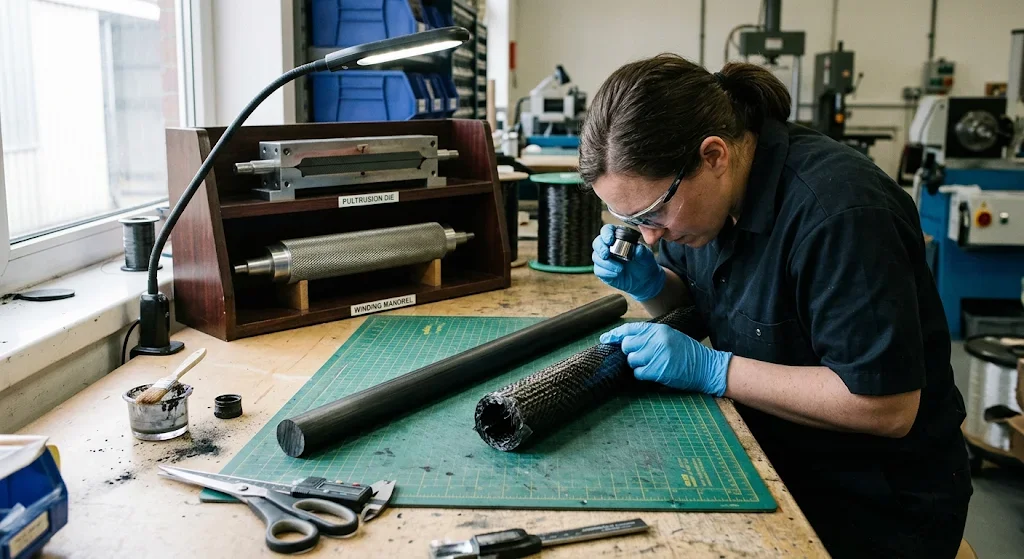
Every builder who orders a carbon fiber rod eventually faces the same fork in the road: pultruded or roll-wrapped. The two processes look similar in a catalog listing, but they differ in fibre orientation, bending behaviour, surface finish, and how the rod behaves under crash or impact loads. Choosi
Introduction
Every builder who orders a carbon fiber rod eventually faces the same fork in the road: pultruded or roll-wrapped. The two processes look similar in a catalog listing, but they differ in fibre orientation, bending behaviour, surface finish, and how the rod behaves under crash or impact loads. Choosing the wrong process for the job is one of the most common reasons a carbon fiber rod underperforms its datasheet.
This guide explains what each process actually does to the fibre, how that changes the rod in service, and how to decide which carbon fiber rod fits a given load case. Whether you are sourcing small carbon fiber rods for a drone spar or specifying the best carbon fiber rod for a robotic arm, the decision starts with orientation, not diameter.
Pultruded Carbon Fiber Rod: Process and Properties
Pultrusion pulls continuous fibre rovings through a resin bath and then through a heated forming die, so the fibres run almost entirely along the rod axis. The result is a rod with very high longitudinal tensile strength and modulus, typically in the range of 1,600-2,200 MPa tensile and 120-150 GPa modulus for standard-modulus tow. Because the fibre fraction is high, often 60-70 percent by volume, the specific stiffness of a pultruded carbon fiber rod is hard to beat on a per-gram basis.
The trade-off is transverse weakness. With almost no circumferential or helical fibre, a pultruded rod resists axial pull well but dents, splits, or crushes more easily under point loads or side impact. Surface finish is usually smooth but may show a faint die line, and roundness depends on die quality rather than hand layup skill.
| Property | Pultruded rod | Roll-wrapped rod | Fiberglass rod |
|---|---|---|---|
| Primary fibre direction | Axial (0°) | Axial plus helical layers | Mixed |
| Tensile strength (typical) | 1,600-2,200 MPa | 1,200-1,800 MPa | 400-800 MPa |
| Flexural modulus | 120-150 GPa | 90-130 GPa | 25-45 GPa |
| Impact tolerance | Moderate | High | High |
| Typical use | Spar, antenna, shaft | Robot arm, roll bar, handle | Low-load brace |
The table shows why a pultruded carbon fiber rod wins on pure stiffness per gram, while a roll-wrapped rod wins when the part must survive side loads or repeated flexing. Small carbon fiber rods for model aircraft spars are usually pultruded, because the load is dominated by bending along the axis. The best carbon fiber rod for a landing skid or a protective hoop, by contrast, is almost always roll-wrapped, because the helical plies stop a crack from running the length of the rod.
- Pultruded: choose for axial stiffness, straightness, and consistent diameter at low cost.
- Roll-wrapped: choose for impact, side load, and fatigue resistance.
- Hybrid layups: some rods combine a pultruded core with roll-wrapped outer plies for both stiffness and toughness.
- Gel-coat finish: adds UV protection and a cleaner surface for exposed parts.
Roll-Wrapped Carbon Fiber Rod: How Layup Changes Performance
Roll-wrapping winds prepreg or wet-wound fibre onto a mandrel at defined angles, then cures the assembly under heat and pressure. The angle stack is the design lever: 0° plies carry axial load, while ±45° and 90° plies resist torsion, crushing, and split propagation. A roll-wrapped carbon fiber rod can therefore be tuned for a specific failure mode, which is why high-end robotic arms and drone protective structures favour the process.
The mandrel also sets dimensional accuracy. Metal mandrels hold tolerance well but must be stripped after cure; water-soluble mandrels avoid stripping but can leave a slightly rougher bore. Wall thickness, fibre volume, and cure cycle all show up in the final rod stiffness, so a supplier that publishes the layup schedule is more trustworthy than one that only publishes a diameter and a colour.
Choosing the Best Carbon Fiber Rod for Your Build
Start with the load case, then pick the process, then pick the diameter. For a pure bending member such as a wing spar or a pushrod, a pultruded carbon fiber rod gives the highest stiffness for the least mass. For a part that will see impact, torsion, or cyclic side loading, a roll-wrapped rod buys toughness at the cost of some axial modulus. For small carbon fiber rods under 4 mm diameter, the difference between the two processes narrows because the fibre volume is limited by geometry, so straightness and roundness often matter more than the layup label.
Verify the supplier by asking three questions: what is the fibre volume fraction, what is the layup schedule, and what is the tolerance on diameter and straightness. A credible answer usually includes a number in each case. If the answers are vague, treat the rod as an ungraded commodity and design with a larger safety margin.
Frequently Asked Questions
What is the difference between a pultruded and a roll-wrapped carbon fiber rod?
Pultrusion runs fibres almost entirely along the rod axis, giving maximum longitudinal stiffness. Roll-wrapping adds helical and circumferential plies, which improve impact and torsion resistance at the cost of some axial modulus.
Which carbon fiber rod is better for a drone spar?
For a pure spar, a pultruded rod is usually the best carbon fiber rod because the load is dominated by axial bending. If the spar also acts as a landing skid or must survive crashes, consider a roll-wrapped or hybrid layup instead.
How do I choose small carbon fiber rods for a model build?
Match diameter to the bending moment, then confirm straightness and roundness on the datasheet. For diameters under 4 mm, dimensional consistency often matters more than the process label, so request a sample before a bulk order.
Conclusion
A carbon fiber rod is not a single product; it is a family of parts defined by fibre orientation as much as by diameter. Pultruded rods win on stiffness per gram, roll-wrapped rods win on toughness, and the best carbon fiber rod for your build is the one whose layup matches the load case. YongXian supplies both pultruded and roll-wrapped carbon fiber rods with published layup data, so send your drawing and load requirements before ordering. browse carbon fiber rods or request a custom rod quote.
Part of topic
Related Articles
- Prusament PETG Carbon Fiber: Print Settings and Mechanical Behavior
- Small Carbon Fiber Rods: Diameters, Stock Lengths, and Uses
- How to Create Carbon Fiber Parts: Tooling Choices Compared
- A sheet of carbon fiber: Anatomy of Cloth, Resin, and Cure
- Full Carbon Fiber Plates: 100% Laminate vs Hybrid Layups
- How to Make Carbon Fiber Parts: Wet Layup to Autoclave
Interested in Our Products?
Contact our team for competitive pricing and technical specifications.
Get a QuoteRelated Products

Round Carbon Fiber Tube — 3K Plain Weave T700
Standard round carbon fiber tube manufactured from Toray T700 grade fiber with 3K plain weave. Offers balanced strength and stiffness for general industrial applications including robotics, automation, sports equipment, and aerospace structures.
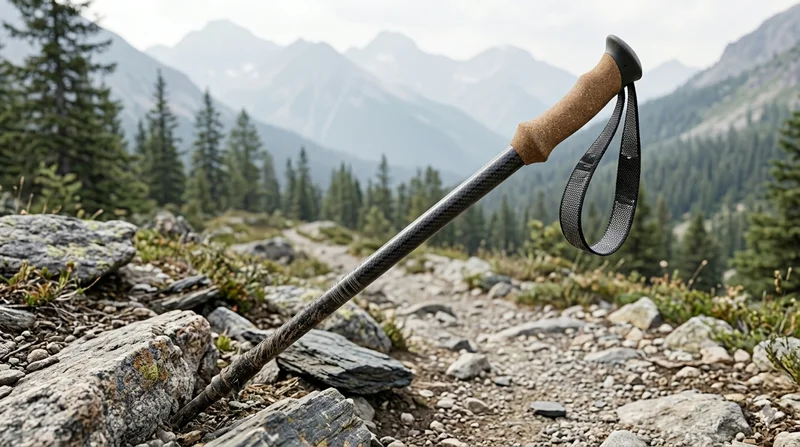
Carbon Fiber Trekking Pole
Lightweight carbon fiber trekking pole manufactured from high-grade carbon fiber tube. Weighs only 160g per pole while providing superior shock absorption and durability for hiking, trail running, and backpacking.

Carbon Fiber Pickleball Paddle
High-performance pickleball paddle with Toray T700 carbon fiber face and polypropylene honeycomb core. Delivers excellent power-to-weight ratio, spin generation, and vibration dampening for competitive play.

Square Carbon Fiber Tube — 3K Twill T700
Square cross-section carbon fiber tube manufactured with 3K twill weave for torsional strength. Preferred for structural frames, trusses, and support columns where rectangular geometry offers design flexibility.

Carbon Fiber Plate — 3K Twill T700 3.0mm
Medium-thickness 3.0mm carbon fiber plate offering significantly higher load capacity while maintaining attractive 3K twill finish. Suitable for structural brackets, reinforcement plates, and load-bearing panels.