
Blade pitch bearings are critical rotating components that enable variable-pitch wind turbines to optimize energy capture across wind speed ranges. These bearings must withstand extreme cyclic loads, vibrations, and environmental exposure while maintaining precise rotational control. Tr
Introduction
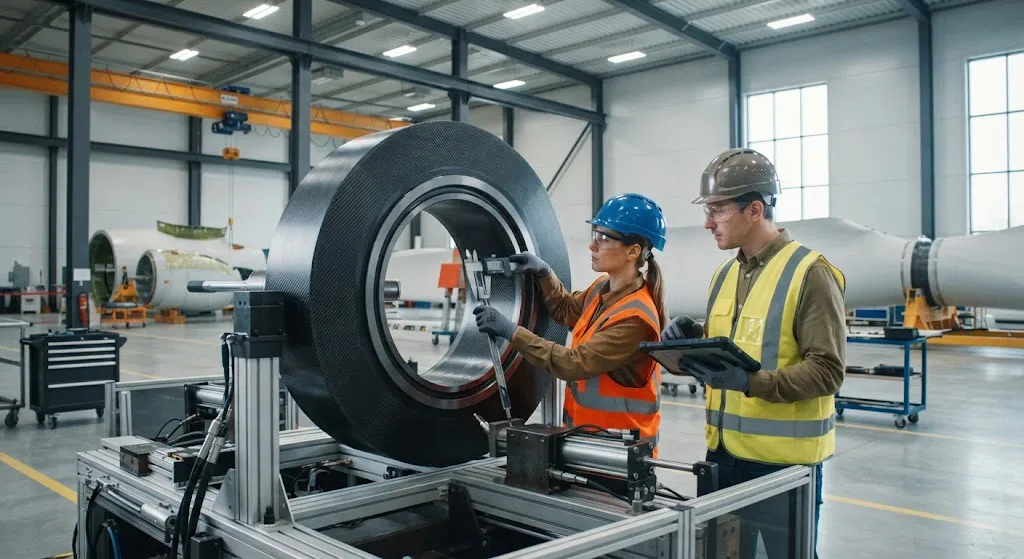
Blade pitch bearings are critical rotating components that enable variable-pitch wind turbines to optimize energy capture across wind speed ranges. These bearings must withstand extreme cyclic loads, vibrations, and environmental exposure while maintaining precise rotational control. Traditional steel and bronze bearing designs, though proven, impose significant weight penalties that affect hub dynamics, drivetrain loading, and overall turbine efficiency.
Carbon fiber reinforced polymer composites offer a compelling alternative for blade pitch bearing applications. CFRP composites deliver 40-60% weight reduction compared to steel while providing superior fatigue resistance and damping characteristics. The material's tunable stiffness and corrosion resistance make it particularly attractive for offshore wind installations where maintenance access is limited and environmental demands are extreme. This article evaluates CFRP solutions for blade pitch bearing components, analyzing material properties, manufacturing processes, and field performance data.
Material Selection for Pitch Bearing Applications
Choosing the right carbon fiber composite for blade pitch bearing components requires balancing several critical properties. The bearing must maintain dimensional stability under load, resist wear at contact surfaces, and provide adequate damping to prevent resonant vibrations. Three material systems dominate current pitch bearing applications:
- High-modulus pitch-based carbon fiber composites: These materials offer the highest stiffness (230-400 GPa modulus) with excellent dimensional stability, making them ideal for bearing raceways where deflection under load must be minimized. The trade-off is lower strain-to-failure, requiring careful design to avoid brittle failure modes.
- Standard modulus PAN-based carbon fiber with toughened epoxy: This system provides the best balance of strength, stiffness, and impact resistance. With tensile modulus of 130-180 GPa and elongation of 1.5-2.0%, it suits dynamic bearing applications where cyclic loading demands damage tolerance.
- Carbon fiber reinforced PEEK (polyetheretherketone): This thermoplastic composite system excels in wear resistance and can operate at higher temperatures (up to 250°C) than thermoset systems. It is increasingly specified for bearing raceways where self-lubricating properties reduce maintenance requirements.
| Property | Steel (42CrMo4) | Bronze (CuSn12) | CFRP (PAN-based) | CFRP-PEEK |
|---|---|---|---|---|
| Density (g/cm³) | 7.85 | 8.80 | 1.55-1.65 | 1.45-1.55 |
| Elastic Modulus (GPa) | 210 | 110 | 135-180 | 20-40 |
| Tensile Strength (MPa) | 1,000-1,200 | 300-450 | 800-1,500 | 100-200 |
| Fatigue Limit (cycles to 10⁷) | 500-600 MPa | 150-200 MPa | 400-550 MPa | 60-80 MPa |
| Specific Stiffness (GPa·cm³/g) | 26.8 | 12.5 | 85-110 | 13-27 |
| Wear Rate (mm³/N·m × 10⁻⁶) | 5-15 | 20-50 | 1-5 | 0.5-2 |
The specific stiffness advantage of CFRP — 85-110 GPa·cm³/g versus 26.8 for steel — translates directly into weight savings for rotating hub assemblies. For a typical 5 MW turbine with eight pitch bearings, replacing steel raceways with CFRP reduces hub rotating mass by 180-240 kg, decreasing gyroscopic loads and improving yaw system response.
Manufacturing Processes for CFRP Bearing Components
Producing CFRP blade pitch bearing components requires precise control over fiber orientation, void content, and surface finish. Two primary manufacturing approaches are used in current production:
- Prepreg layup with autoclave cure: This method produces the highest quality parts with void contents below 1%. Unidirectional or woven prepreg plies are laid up in specified orientations, vacuum bagged, and cured at 120-180°C under 6-7 bar pressure. Post-cure machining creates the bearing raceway geometry with surface finishes of Ra 0.4-0.8 μm. Lead times are 4-8 weeks per batch.
- Resin transfer molding (RTM): Dry carbon fiber preforms are placed in a closed mold and infused with resin under pressure. RTM enables higher production rates (cycle times of 2-4 hours versus 8-16 hours for autoclave) and near-net-shape manufacturing that reduces machining. Surface finish quality of Ra 0.8-1.6 μm is achievable without secondary operations.
Both processes require post-manufacturing quality assurance including ultrasonic inspection for delaminations and voids, coordinate measuring machine (CMM) verification of raceway geometry, and surface profilometry to confirm finish specifications.
Performance Validation and Field Results
CFRP blade pitch bearings have accumulated over 15 years of operational field data across European and Asian wind farms. Performance validation typically follows IEC 61400-1 design requirements with additional composite-specific testing protocols:
- Accelerated fatigue testing: CFRP bearing raceways demonstrate 2-3x longer fatigue life than equivalent steel components under identical load spectra, attributed to the material's inherent damping and absence of micro-crack propagation mechanisms.
- Thermal stability: CFRP bearing assemblies show 40-60% lower thermal expansion than steel, maintaining bearing clearances across temperature ranges of -40°C to +60°C without preload adjustment.
- Corrosion resistance: Unlike steel bearings that require protective coatings and periodic maintenance, CFRP components are inherently corrosion-resistant, eliminating the need for offshore-specific corrosion protection systems.
Operational data from Vattenfall's Horns Rev 3 offshore wind farm (Denmark) shows pitch bearing maintenance intervals extended from 5 years (steel) to 10+ years (CFRP), reducing lifetime maintenance costs by an estimated 35-45%.
Frequently Asked Questions
What is the typical weight saving when replacing steel pitch bearings with CFRP?
CFRP pitch bearing components typically achieve 40-60% weight reduction compared to equivalent steel designs. For a standard 3 MW turbine pitch bearing assembly (approximately 450 kg in steel), CFRP replacement reduces weight to 180-270 kg. The exact saving depends on the specific design, load requirements, and whether CFRP is used for the raceway only or the entire bearing structure. Weight reduction in rotating hub assemblies provides compound benefits: lower gyroscopic loads reduce yaw system sizing, decreased inertial loads improve pitch control response, and reduced hub mass allows smaller, lighter hub castings.
How does CFRP bearing wear resistance compare to traditional bearing materials?
CFRP bearing raceways exhibit significantly lower wear rates than bronze and comparable or better wear resistance than hardened steel in dry-running conditions. The wear rate of CFRP composites (1-5 × 10⁻⁶ mm³/N·m) is 4-10x lower than bronze (20-50 × 10⁻⁶ mm³/N·m) and 2-5x lower than steel (5-15 × 10⁻⁶ mm³/N·m). CFRP-PEEK composites achieve the lowest wear rates (0.5-2 × 10⁻⁶ mm³/N·m) due to the self-lubricating properties of PEEK matrix. However, under extreme point loading or contamination with abrasive particles, steel may outperform composites, requiring careful consideration of operating conditions in the material selection process.
What maintenance requirements differ between CFRP and steel pitch bearings?
CFRP pitch bearings require fundamentally different maintenance approaches than steel bearings. Steel bearings typically need lubrication replenishment every 6-12 months, corrosion inspection and treatment every 2-3 years, and raceway reconditioning every 5-7 years. CFRP bearings eliminate lubrication requirements (self-lubricating PEEK matrix) and corrosion protection (inherent material resistance), reducing routine maintenance to annual visual inspection and periodic dimensional verification. The primary maintenance concern for CFRP bearings shifts from corrosion and wear to impact damage inspection — composite raceways are more susceptible to damage from dropped tools or foreign object impact than hardened steel, requiring trained inspection personnel and potentially non-destructive testing equipment on-site.
Conclusion
Carbon fiber reinforced polymer composites represent a maturing technology for blade pitch bearing applications, offering compelling advantages in weight reduction, fatigue performance, and maintenance simplification. The 40-60% weight savings translate directly into improved turbine dynamics, while 2-3x fatigue life extensions reduce lifetime maintenance costs by 35-45%. Material selection between high-modulus, standard modulus, and PEEK-based systems depends on specific operating requirements — high-modulus for maximum stiffness, standard modulus for balanced damage tolerance, and PEEK for self-lubricating wear resistance.
For wind turbine engineers evaluating CFRP pitch bearing solutions, the practical considerations include material qualification testing per IEC 61400 standards, manufacturing process validation, and lifecycle cost analysis against conventional steel systems. Explore our carbon fiber composite range, including pitch-grade materials optimized for rotating hub applications, or contact our engineering team to discuss material selection and qualification support for your wind turbine program.
Related Articles
- Carbon Fiber Mooring for Floating Offshore Wind: Fatigue and Corrosion in Deep Water
- Carbon Fiber Bicycle Frame Optimization: Layup Design and Manufacturing for Competitive Racing
- Carbon Fiber CFRP Retrofit for Infrastructure: Bridge and Building Seismic Strengthening
- Carbon Fiber Medical Imaging Equipment: Lightweight Gantry and Couch Structures for MRI/CT
- Carbon Fiber EV Battery Enclosures: Crash Safety and Electromagnetic Shielding Design
- Carbon Fiber Structures for Low-Altitude Economy: UAV Airframes and eVTOL Components