
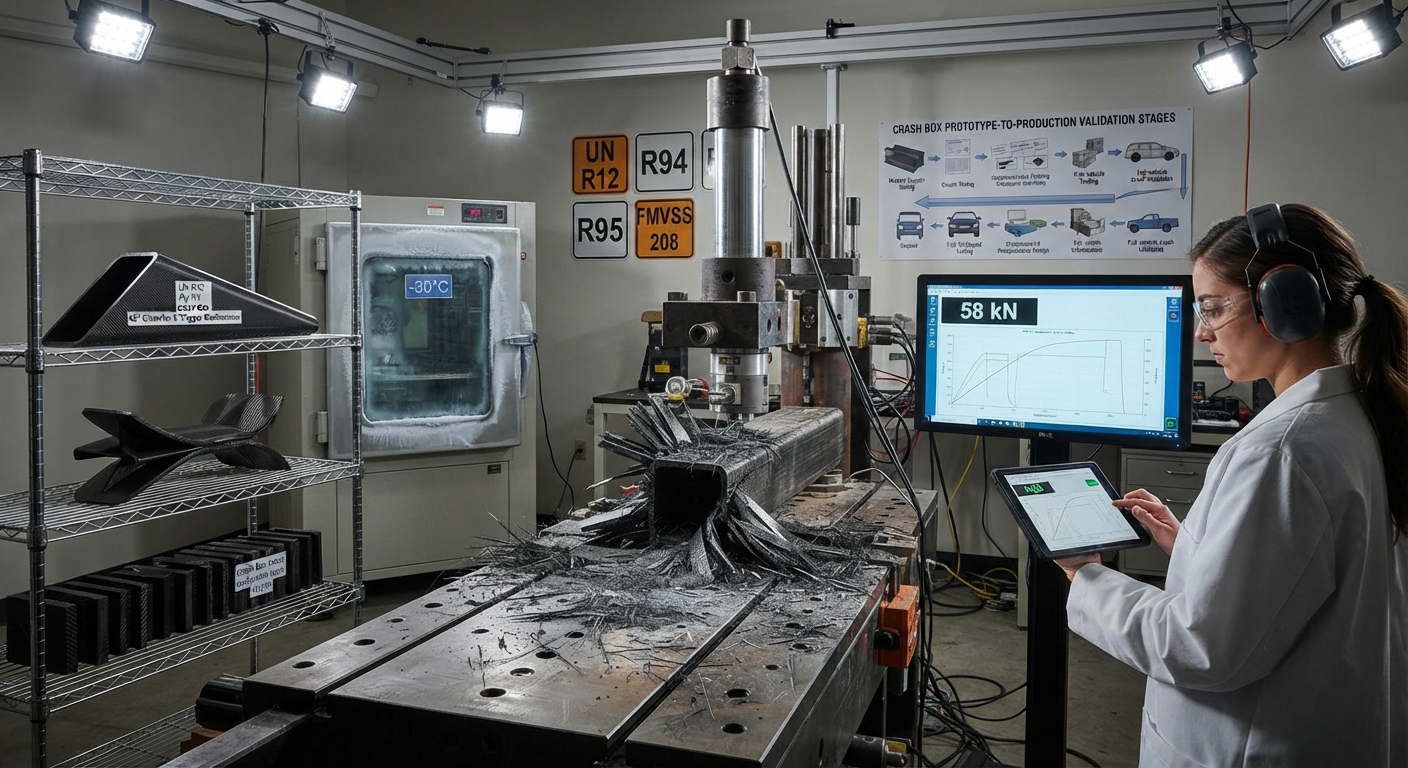
Engineering guide to carbon fiber automotive crash box design, testing, and production. Analysis of specific energy absorption (60–120 kJ/kg), trigger mechanisms (45° chamfer, groove, tulip designs), cross-sectional geometry optimization, and manufacturing processes (braiding+RTM, filament winding, compression molding). Includes OEM case studies from BMW, Audi, Volvo, BYD, and NIO with crash test data and cost analysis.
The Role of Crash Boxes in Automotive Impact Energy Management
Crash boxes are the front-line energy-absorbing components in modern automotive body structures. Positioned between the bumper beam and the front side rail, a crash box is designed to collapse in a controlled, predictable manner during low- to moderate-speed impacts (typically 15–50 km/h), absorbing kinetic energy through progressive deformation while transmitting the remaining load to the main structural rails. In electric vehicles, rear crash boxes serve an equally critical function, protecting the high-voltage battery pack from intrusion during rear-end collisions.
The transition from mild steel and aluminum to carbon fiber composites for crash box applications is driven by three converging requirements: (1) stringent pedestrian protection regulations (UN R127, Euro NCAP) that mandate low front-end stiffness, (2) mass reduction targets of 30–50% per vehicle platform to extend EV range, and (3) the need for consistent, predictable crush behavior across temperature extremes (-30°C to +85°C). Carbon fiber crash boxes offer the unique ability to tailor energy absorption characteristics through fiber architecture, ply orientation, and trigger geometry — capabilities that metallic crash boxes cannot match through material substitution alone.
Design Principles for Carbon Fiber Crash Boxes
Carbon fiber crash box design diverges fundamentally from metallic crash box design. While steel and aluminum crash boxes rely on plastic deformation (bending, folding, and tearing) to absorb energy, carbon fiber composites absorb energy through a combination of crushing mechanisms including fiber fracture, matrix cracking, delamination, and friction between fragments. The specific energy absorption (SEA) — energy absorbed per unit mass — of carbon fiber composites can reach 60–120 kJ/kg, compared to 15–25 kJ/kg for mild steel and 20–35 kJ/kg for aluminum alloys.
Key design parameters for carbon fiber crash boxes include:
- Cross-sectional geometry: Square, circular, and conical cross-sections are most common. Conical tubes with a 2–5° taper angle produce the most stable crush, reducing the initial peak load by 25–40% compared to straight tubes while maintaining comparable total energy absorption. Octagonal and corrugated cross-sections have shown 10–20% higher SEA than equivalent square sections in recent studies.
- Wall thickness and ply stacking sequence: Optimal wall thickness for automotive crash boxes ranges from 1.5 to 4.0 mm, depending on the fiber architecture. A [±45/0₂/±45] layup — with 0° plies aligned with the crush axis — provides an optimal balance of axial stiffness (for normal service loads) and progressive crushing (for impact energy absorption). Increasing the proportion of ±45° plies to 50–60% of total laminate thickness improves crush stability but reduces total energy absorption by 10–20%.
- Trigger mechanisms: Crash boxes require intentional weak points — triggers — to initiate stable crushing at a controlled load level. Common trigger designs include 45° chamfers at the crush end (simplest, 15–30% peak load reduction), circumferential grooves or notches (20–40% reduction), and tulip-shaped or stepped crush initiators (30–50% reduction). Multi-stage triggers that decouple the initial peak from the sustained crush load are preferred in production applications.
- Fiber-matrix system selection: Epoxy matrices dominate current production applications, but polyamide (PA6, PA66) and polypropylene (PP) matrices are gaining ground for their superior energy absorption at elevated temperatures. Thermoplastic matrices offer 15–30% higher SEA at 80°C compared to epoxy systems, which lose significant crushing capacity above their Tg.
| Parameter | Mild Steel | Aluminum 6061-T6 | CF/Epoxy | CF/PA6 |
|---|---|---|---|---|
| Density (g/cm³) | 7.85 | 2.70 | 1.55 | 1.24 |
| SEA (kJ/kg) | 15–25 | 20–35 | 60–90 | 75–120 |
| Crush load efficiency (%) | 70–85 | 65–80 | 55–75 | 60–80 |
| Peak load (kN, 2 mm wall) | 110–140 | 60–85 | 45–70 | 40–60 |
| Mass (kg per box, 300 mm length) | 1.85 | 0.72 | 0.38 | 0.31 |
| Energy absorption per box (kJ) | 3.5–5.0 | 2.8–4.2 | 4.0–6.5 | 4.5–7.0 |
| Temperature sensitivity (80°C vs 23°C) | -5% | -8% | -30% | -10% |
| Relative cost per box | 1.0x | 1.8x | 4.5x | 3.5x |
Crash Testing Protocols and Standards
Carbon fiber crash boxes must satisfy the same regulatory and OEM-specific crash test requirements as their metallic counterparts. The primary testing protocols include quasi-static axial crush tests, dynamic impact tests, and full-vehicle crash tests:
Quasi-static crush tests (10–50 mm/min crosshead speed) are used for material characterization and design validation. A 300 mm crash box specimen is crushed to 60–70% of its original length while force-displacement data is recorded at 1 kHz minimum sampling rate. Key metrics include peak crush force (PCF), mean crush force (MCF), crush load efficiency (MCF/PCF), and total energy absorption (EA = ∫F·dx over the crush distance). Acceptance criteria for production designs typically require MCF/PCF ≥ 0.65 and EA variation of ≤ 10% across five consecutive specimens.
Dynamic impact tests (10–50 km/h impact speeds) simulate real-world crash scenarios using drop towers, hydraulic impactors, or sled test systems. UN R12 (steering wheel protection), UN R94 (frontal collision), and UN R95 (lateral collision) define the regulatory framework for passenger car crashworthiness in most markets. Carbon fiber crash boxes must demonstrate stable, progressive crushing without catastrophic (brittle) failure at impact speeds up to 50 km/h and temperatures from -30°C to +85°C. A particularly demanding test is the 40% offset deformable barrier (ODB) crash per UN R94, where the crash box experiences combined axial and bending loads — a loading condition that can trigger premature failure in poorly designed composite crush structures.
Full-vehicle crash testing is the final validation step, conducted at OEM proving grounds. Carbon fiber crash boxes in production vehicles have passed full-vehicle frontal impact tests (56 km/h into rigid barrier per FMVSS 208), front offset tests (64 km/h into 40% ODB per Euro NCAP), and rear impact tests (50 km/h into mobile deformable barrier per UN R32). BMW's i3 and i8 were among the first production vehicles to use carbon fiber crash structures, establishing proof of concept for the material in production automotive crash applications.
Manufacturing Processes for Crash Box Production
Three manufacturing processes dominate carbon fiber crash box production, each offering different trade-offs between cost, mechanical performance, and production volume:
- Braiding with resin transfer molding (RTM): 2D or 3D braided carbon fiber preforms are produced on circular braiding machines at 200–500 mm/min, then infused with epoxy or PA6 resin via RTM. Braided architecture provides excellent torsional stability and crush damage tolerance. Production capacity: 10,000–50,000 units per year per machine. Tooling investment: $50,000–$150,000 per mold set.
- Filament winding: Continuous carbon fiber tow is wound onto a mandrel at precisely controlled angles (typically ±30° to ±60° relative to the tube axis), then cured in an oven or autoclave. Filament winding offers the lowest material waste (2–5% scrap) and highest design repeatability, but is limited to straight or slightly tapered geometries. Production capacity: 5,000–20,000 units per year per winding station. Tooling investment: $30,000–$80,000 per mandrel set.
- Compression molding of woven prepreg: Stacks of woven carbon fiber prepreg are formed into crash box geometry using matched metal dies in a hydraulic press at 120–180°C and 50–150 bar pressure. This process offers the fastest cycle times (2–5 minutes per part) and highest surface quality, but produces 10–20% scrap from trim waste. Production capacity: 20,000–100,000 units per year per press. Tooling investment: $80,000–$250,000 per mold set.
OEM Adoption and Production Applications
Several automotive manufacturers have progressed carbon fiber crash boxes from research projects to production applications. BMW has been the industry leader, introducing carbon fiber crash structures in the i3 (2013) and i8 (2014), and expanding to the 7 Series (2015) and iX (2021). BMW's 7 Series uses carbon fiber crash boxes as part of its Carbon Core architecture, achieving a 30% weight reduction in the front-end structure compared to the previous steel-intensive design while passing all regulatory crash tests with margin. Impact absorption performance was validated at 56 km/h full-frontal barrier impact (FMVSS 208) and 64 km/h 40% offset (Euro NCAP).
Audi has evaluated carbon fiber crash boxes for its MLB Evo platform (A4, A6, Q7 segments), publishing data showing 45% mass reduction versus aluminum and a 20% improvement in specific energy absorption. Volvo's Scalable Product Architecture (SPA) platform — used in the XC90, S90, and V90 — incorporates carbon fiber-reinforced front crash structures in hybrid and electric variants, with particular focus on compatibility with pedestrian protection requirements.
Chinese OEMs including BYD, NIO, and Geely have accelerated carbon fiber crash box development for their electric vehicle platforms, where battery pack protection is paramount. BYD's e-Platform 3.0 uses carbon fiber front and rear crash boxes reported to absorb 1.5× the impact energy of equivalent aluminum designs at 40% lower mass. NIO's NT 2.0 platform integrates carbon fiber crash structures as part of its battery pack perimeter protection, achieving a 5-star safety rating in both C-NCAP and Euro NCAP.
Frequently Asked Questions
Can carbon fiber crash boxes be repaired after a low-speed impact?
Unlike metallic crash boxes, which can be visually inspected and in some cases straightened, carbon fiber crash boxes are designed as single-use, sacrificial energy-absorbing structures. After any impact that activates the trigger mechanism — typically detectable by visible crushing, cracking, or delamination at the trigger zone — the crash box must be replaced entirely. This is because composite damage (microcracking, fiber breakage, delamination) is often subsurface and not reliably detectable by visual inspection alone. OEM service procedures for vehicles with carbon fiber crash boxes (e.g., BMW 7 Series Carbon Core) mandate replacement after any impact exceeding 15 km/h, with the replacement process taking approximately 30–45 minutes per side at a dealership service center. The replacement cost is partially offset by the crash box's lower mass (reducing shipping and handling costs) and simplified bolted attachment design (no welding, no riveting). Insurance classification and repair protocols for carbon fiber crash structures have been standardized under the I-CAR RTS (Repairability Technical Subcommittee) guidelines since 2020.
How do carbon fiber crash boxes perform at low temperatures (-30°C)?
Low-temperature performance is a critical concern for carbon fiber crash boxes, particularly for vehicles sold in northern European, Canadian, and north Chinese markets. Epoxy matrix composites become more brittle below their glass transition temperature (typically 120–200°C for aerospace-grade epoxies, but only 80–120°C for automotive-grade crash box formulations), which can reduce crush load efficiency by 15–30% at -30°C compared to room temperature. The failure mode shifts from progressive crushing to brittle splitting and splaying, reducing total energy absorption by 20–40%. Thermoplastic matrices (PA6, PA66, PP) perform significantly better at low temperatures, with only 5–15% reduction in SEA at -30°C compared to 23°C baseline. The industry recommendation for cold-climate vehicle platforms is to specify thermoplastic matrix systems (particularly impact-modified PA6) and to validate crash box performance through full-temperature-range dynamic impact testing per OEM standard (typically -30°C, 23°C, and +85°C). Heated battery pack enclosures in electric vehicles provide some thermal benefit for rear crash boxes, which reside near the battery pack, but front crash boxes remain fully exposed to ambient conditions.
What is the cost premium for carbon fiber crash boxes compared to aluminum, and when does it become economically viable?
At current production scales (10,000–50,000 units per year), carbon fiber crash boxes carry a 2.5–5× cost premium over equivalent aluminum designs on a per-part basis: $35–65 per carbon fiber crash box versus $10–20 per aluminum box and $6–12 per steel box. However, the total system cost comparison is more nuanced. Carbon fiber crash boxes enable secondary weight savings throughout the front-end structure — lighter bumper beams, smaller crush cans in the side rails, and reduced fastener requirements — that can offset 15–30% of the crash box premium. For high-volume production (>100,000 units per year), compression molding of woven prepreg and automated braiding + RTM processes can reduce per-unit costs to $22–38, narrowing the premium to 1.5–3×. The economic viability threshold for carbon fiber crash boxes is typically reached when: (1) the vehicle platform must achieve a specific mass target that cannot be met with metallic crash boxes, (2) the vehicle is an EV where an extra 2–3 kg mass reduction in the front end translates directly to 1–2 km additional WLTP range, or (3) the brand positioning justifies the cost for marketing differentiation (as in BMW i-series, NIO ET7). Lifecycle analysis shows that for EV platforms, the carbon fiber crash box's mass reduction saves approximately 0.3–0.5 kWh of battery capacity per vehicle, which at $130/kWh pack cost offsets roughly $40–65 of the added component cost.
Part of topic
Related Articles
- Carbon Fiber Mooring for Floating Offshore Wind: Fatigue and Corrosion in Deep Water
- Carbon Fiber Bicycle Frame Optimization: Layup Design and Manufacturing for Competitive Racing
- Carbon Fiber CFRP Retrofit for Infrastructure: Bridge and Building Seismic Strengthening
- Carbon Fiber Medical Imaging Equipment: Lightweight Gantry and Couch Structures for MRI/CT
- Carbon Fiber EV Battery Enclosures: Crash Safety and Electromagnetic Shielding Design
- Carbon Fiber Structures for Low-Altitude Economy: UAV Airframes and eVTOL Components