
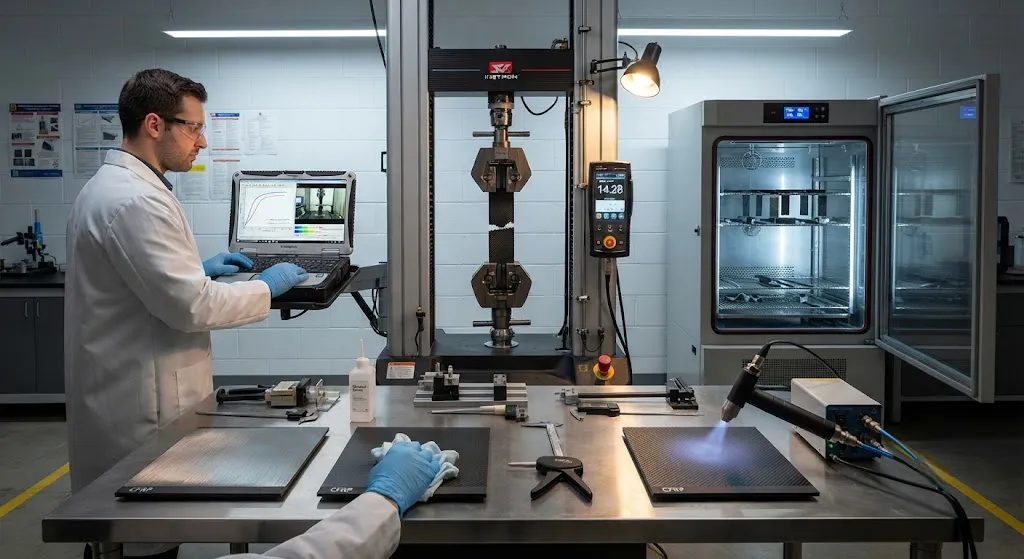
Structural adhesive bonding has become a primary joining method for carbon fiber reinforced polymer composites in aerospace, automotive, and wind energy applications. Unlike mechanical fasteners, which require drilled holes that interrupt fiber continuity and create stress concentrations, adhesive...
Introduction
Structural adhesive bonding has become a primary joining method for carbon fiber reinforced polymer composites in aerospace, automotive, and wind energy applications. Unlike mechanical fasteners, which require drilled holes that interrupt fiber continuity and create stress concentrations, adhesive bonds distribute loads continuously across the joint area, preserving the inherent strength and stiffness of the composite laminate. A properly designed bonded joint can transfer higher loads per unit area than a bolted connection while adding negligible weight.
The engineering challenge lies in joint design, surface preparation, and adhesive selection. Bonded CFRP joints must withstand cyclic fatigue, thermal cycling, moisture ingress, and impact loads throughout the service life of the structure. This article reviews the fundamental principles of structural adhesive bonding for carbon fiber composites, compares the adhesive systems available for different applications, and presents the testing protocols used to validate joint integrity.
Joint Design Fundamentals
The geometry of a bonded joint determines how effectively load transfers from one adherend to the other. The most common joint configurations for CFRP structures include:
- Single lap joint: Two overlapping plates bonded together. Simple to manufacture but introduces peel stresses at the joint edges due to eccentricity. Suitable for secondary structures and non-critical load paths where peel loads are minimal.
- Double lap joint: A central adherend sandwiched between two outer adherends. Symmetric loading eliminates peel stresses, making this configuration ideal for primary structural applications. Load transfer capacity is approximately twice that of a single lap joint.
- Scarf joint: Tapered adherends bonded at an angle, creating a gradual load transfer path that minimizes stress concentrations. This is the preferred joint design for aerospace primary structures because it preserves laminate stiffness continuity and produces the most uniform stress distribution.
- T-bonded joint: A perpendicular member bonded to a flat adherend surface. Common in frame-to-skin connections and rib-to-panel joints. Requires careful fillet design to manage peel and cleavage stresses at the bond line termination.
- Butt joint: Two adherends bonded end-to-end. The simplest geometry but the weakest under tension due to the small bond area. Used primarily in non-structural or lightly loaded applications.
Joint design must account for the anisotropic nature of CFRP. The coefficient of thermal expansion differs by a factor of 10 or more between the fiber direction and the thickness direction, creating interlaminar stresses during thermal cycling that can initiate delamination at the bond edge.
Adhesive Selection Criteria
The adhesive system must match the mechanical requirements of the joint, the manufacturing process constraints, and the service environment. The table below compares the major structural adhesive categories used for CFRP bonding:
| Adhesive Type | Shear Strength (MPa) | Peel Strength (N/mm) | Service Temperature (C) | Cure Schedule | Primary Application |
|---|---|---|---|---|---|
| Toughened epoxy film | 30-40 | 15-25 | -55 to 180 | 120-180C, 1-2 hours | Aerospace primary structures |
| Room-temperature cure epoxy paste | 20-30 | 10-18 | -40 to 120 | 23C, 24-72 hours | Field repair, automotive body |
| Phenolic structural adhesive | 25-35 | 8-15 | -55 to 200 | 150-180C, 1-3 hours | High-temperature aerospace |
| Polyurethane structural adhesive | 15-25 | 20-40 | -40 to 130 | 80-120C, 30-60 min | Automotive crash structures |
| Acrylic structural adhesive | 20-30 | 15-30 | -40 to 150 | 23C, 10-60 min | Automotive assembly |
| Cyanacrylate (instant bond) | 15-25 | 5-10 | -30 to 80 | 23C, seconds | Temporary fixturing, non-structural |
Toughened epoxy film adhesives dominate aerospace applications because they provide the best combination of shear strength, fatigue resistance, and environmental durability. For automotive high-rate production, acrylic and polyurethane adhesives offer faster cure cycles and more forgiving surface preparation requirements.
Surface Preparation for Bonding
Surface preparation is the single most critical factor in bonded joint performance. Untreated CFRP surfaces have low surface energy and may contain mold release agents, contamination, or weak boundary layers that drastically reduce bond strength. The preparation sequence for aerospace-grade bonding follows these steps:
- Solvent degreasing: Acetone or isopropanol wipe to remove loose contamination and oils. This step alone provides less than 50% of achievable bond strength.
- Abrasive treatment: Manual or automated sanding with 180-320 grit aluminum oxide paper to abrade the surface, removing the resin-rich layer and exposing fresh fiber. This increases mechanical interlocking and surface area by 200-400%.
- Peel ply removal: If the CFRP was cured with a nylon or polyester peel ply, removal exposes a clean, textured surface ready for bonding. Peel ply treatment typically achieves 80-90% of maximum bond strength without additional abrasion.
- Plasma or corona treatment: Atmospheric or low-pressure plasma treatment increases surface energy from 30-40 mN/m to 60-75 mN/m, dramatically improving adhesive wetting and chemical bonding. This step is essential for thermoplastic composites and recommended for thermoset CFRP in high-reliability applications.
- Primer application: A thin layer of coupling agent or primer (typically silane-based) provides chemical bonding between the organic adhesive and the inorganic fiber surface, improving moisture resistance and long-term durability.
Abrasive peel ply systems are increasingly preferred in production environments because they combine cleaning, abrasion, and surface activation in a single step, reducing handling time and contamination risk.
Testing and Quality Assurance
Bonded joint quality is validated through a combination of process monitoring, non-destructive testing, and mechanical testing. The standard test methods for CFRP adhesive bonds include:
- Lap shear test (ASTM D1002 / ISO 4587): Measures shear strength of the bonded overlap under quasi-static loading. The baseline quality metric for adhesive bond qualification.
- Peel test (ASTM D1876 / ISO 11339): Measures the force required to propagate a crack along the bond line under 90-degree or 180-degree peeling. Indicates bond toughness and resistance to crack propagation.
- Cleavage test (ASTM D3433): Measures Mode I fracture toughness (critical strain energy release rate, G1c) using a double cantilever beam specimen. Essential for predicting delamination resistance under impact loads.
- Flatwise tension test (ASTM C297): Measures tensile strength perpendicular to the bond plane, validating through-thickness load transfer capability.
- Fatigue testing (ASTM D3166): Cyclic shear loading at specified R-ratio and frequency to determine fatigue life and stiffness degradation rate.
- Environmental conditioning: Bonded specimens are exposed to temperature-humidity cycles (typically 70C/85% RH for 1000 hours) before mechanical testing to verify durability under service conditions.
Non-destructive evaluation methods include ultrasonic C-scan for void detection, thermography for bond line integrity assessment, and acoustic emission monitoring during proof testing.
Frequently Asked Questions
When should adhesive bonding be preferred over mechanical fastening for CFRP joints?
Adhesive bonding is preferred when the joint must transfer high shear loads across a large area, when weight reduction is critical, when fatigue life requirements exceed 100,000 cycles, or when the joint must provide sealing against moisture or fuel ingress. Mechanical fasteners remain preferred when the joint must be disassembled for maintenance, when peel loads dominate the loading spectrum, or when the design allows for easy inspection of the fastener condition. In practice, many aerospace structures use hybrid joints that combine adhesive bonding with selective fasteners for damage tolerance and inspection access.
What are the main failure modes in bonded CFRP joints?
Four primary failure modes occur in bonded joints. Adhesive failure is separation at the adhesive-adherend interface, usually indicating inadequate surface preparation. Cohesive failure is fracture within the adhesive layer itself, which is the desired failure mode because it indicates the bond surface preparation was adequate. Substrate failure is fiber tear-out or delamination within the CFRP adherend near the bond line, indicating the adhesive bond is stronger than the composite. Finally, mixed-mode failure combines two or more of these mechanisms and is the most common in real structures, reflecting the complex stress state at the bond edge.
How does thermal cycling affect the long-term durability of bonded CFRP joints?
Thermal cycling creates interlaminar stresses due to the mismatch in coefficient of thermal expansion between the carbon fiber direction (near zero) and the resin thickness direction (30-50 ppm/C). These stresses are highest at the bond edge and can initiate micro-cracking in the adhesive or delamination in the adherend near the bond line. Over hundreds of thermal cycles, micro-cracks coalesce into larger defects that reduce joint stiffness and load transfer capacity. Mitigation strategies include tapering the adherend edges, using toughened adhesives with higher strain-to-failure, and designing joints that minimize peel stresses at the bond terminus.
Conclusion
Structural adhesive bonding provides carbon fiber composite joints with superior load transfer efficiency, fatigue resistance, and weight savings compared to mechanical fastening. The engineering discipline required encompasses joint geometry design matched to the loading spectrum, surface preparation sequences validated for the specific adhesive-adherend combination, and adhesive systems selected for the service environment and manufacturing rate. As composite structures grow larger and more complex in aerospace and automotive applications, bonded joint technology will continue to evolve with tougher adhesives, improved surface preparation methods, and advanced non-destructive evaluation techniques.
For engineers selecting adhesive systems and surface preparation methods for CFRP bonding, the critical parameters are adhesive shear and peel strength, service temperature range, and cure cycle compatibility with production throughput. Explore our carbon fiber prepreg and adhesive film range, including aerospace-grade toughened epoxy systems optimized for structural bonding, or contact our technical team to discuss joint design and material qualification for your application.
Part of topic
Related Articles
- Bio-Based Carbon Fiber Precursors: Lignin and Polyethylene for Low-Cost Production
- Large-Tow Carbon Fiber Cost Analysis: 48K vs 60K Price-Performance Comparison
- Carbon Fiber-Resin Interface Bonding: Surface Treatment and Coupling Agent Optimization
- Digital Twin for Carbon Fiber Manufacturing: Real-Time Process Monitoring and Defect Prevention
- Thermoplastic Carbon Fiber Welding for Automotive: Ultrasonic and Induction Welding Process Windows
- Large-Tow Carbon Fiber Wet Spinning: Process Optimization for 48K/60K Production Efficiency
Interested in Our Products?
Contact our team for competitive pricing and technical specifications.
Get a QuoteRelated Products

Carbon Fiber Plate — 3K Twill T700 3.0mm
Medium-thickness 3.0mm carbon fiber plate offering significantly higher load capacity while maintaining attractive 3K twill finish. Suitable for structural brackets, reinforcement plates, and load-bearing panels.

Square Carbon Fiber Tube — 3K Twill T700
Square cross-section carbon fiber tube manufactured with 3K twill weave for torsional strength. Preferred for structural frames, trusses, and support columns where rectangular geometry offers design flexibility.
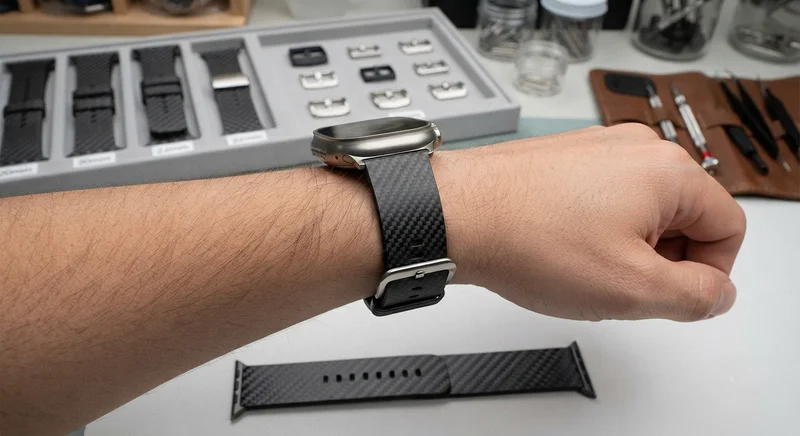
Carbon Fiber Watch Strap — 20mm/22mm Quick-Release
Premium carbon fiber watch strap with quick-release spring bars. Woven from T700 3K twill prepreg with a flexible resin system that conforms to the wrist. Available in 20mm and 22mm lug widths, compatible with Apple Watch, Samsung Galaxy Watch, Garmin, and traditional mechanical watches. Features a stainless steel buckle and carbon fiber keepers. The natural weave pattern makes each strap unique.
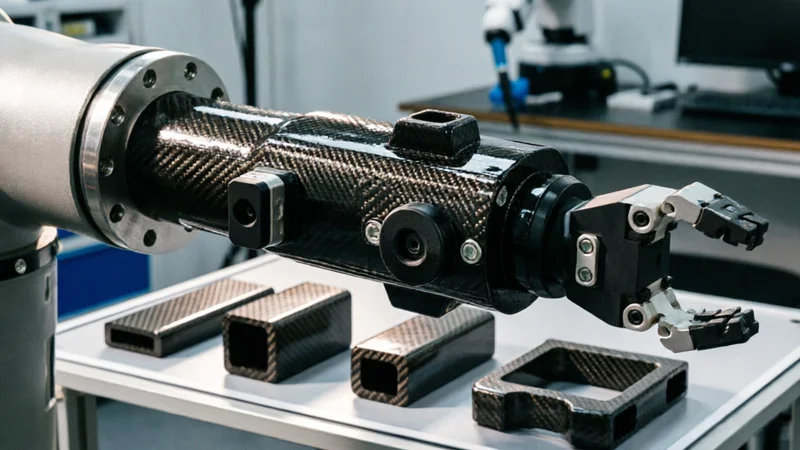
Carbon Fiber Robot End Effector Link — Custom Shape & Sensor Integration
Custom-shaped carbon fiber end effector links for robotic arms. Designed for automation integrators and research labs requiring lightweight, rigid connections between the robot wrist and gripper/tool. Can incorporate sensor mounting bosses, cable routing channels, and quick-change interfaces.

Custom Carbon Fiber Musical Instrument Parts
Carbon fiber components for musical instrument manufacturing offering superior dimensional stability, low weight, and consistent acoustic properties. We produce carbon fiber bows, guitar necks, violin chin rests, drum shells, and wind instrument bodies. Carbon fiber instruments are immune to humidity changes and temperature fluctuations that affect wooden instruments.