
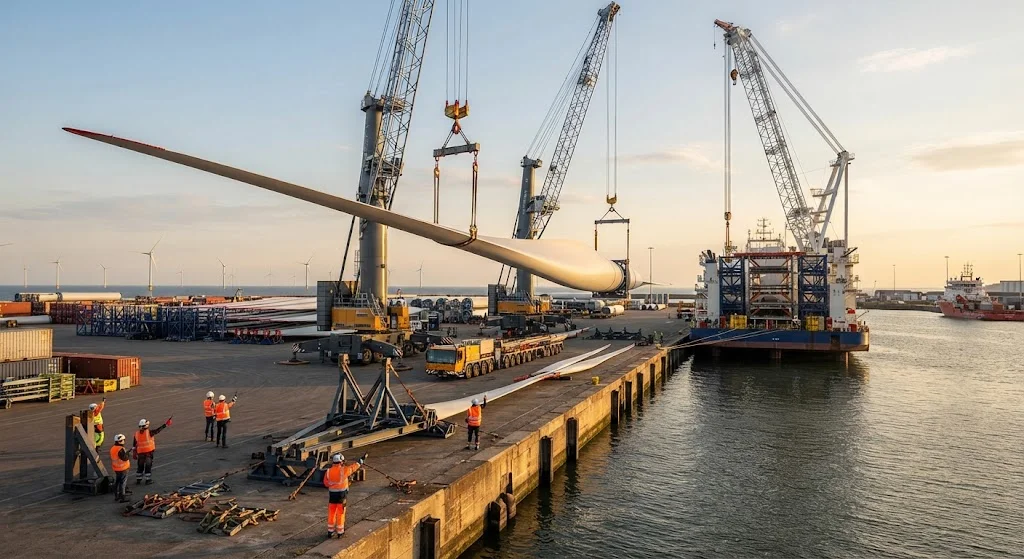
A wind turbine blade is the most awkward object in modern industrial logistics. It is long, hollow, fragile in bending and growing without pause: the largest blades in commercial service now pass 107 meters, and every generation of turbines since has required the supply chain to handle
Introduction
A wind turbine blade is the most awkward object in modern industrial logistics. It is long, hollow, fragile in bending and growing without pause: the largest blades in commercial service now pass 107 meters, and every generation of turbines since has required the supply chain to handle something longer than anything it handled before. The blade cannot be folded, stacked or containerized. It moves essentially as one continuous, cantilevered beam, and every element of the journey — the truck and trailer, the roundabout, the bridge, the port quay, the crane, the vessel deck — was designed when blades were shorter.
This is why blade logistics has graduated from an operations footnote to a strategic planning discipline. Where a blade factory can be built, which ports can serve it, and which installation vessels can pick up its output are now decisions made years before the first blade is laid up, and they determine whether a project is feasible at all. This article walks the chain from factory floor to offshore installation, quantifies where the 100-meter threshold changes the rules, and explains the port and vessel upgrades that are reshaping the wind industry's geography.
The Land Corridor: Where the Blade Meets the Road
The journey begins on the road, and the road is where the 100-meter threshold becomes a planning problem of exceptional difficulty. A 107-meter blade on its transport frame is a load that reaches far beyond the trailer bed, requiring blade-yaw carriages that pivot the blade to follow corners, corridor surveys that map every roundabout, bridge, sign gantry and power line along the route, and special permits issued at regional and national levels. Speed limits drop, convoy escorts become mandatory, and in extreme cases the blade travels upright over the cab of its own tractor unit to clear obstacles that a horizontal load cannot pass.
The practical ceiling of land transport is not officially fixed, but it is real: each additional meter of blade length removes route options and stretches trip times, and a route that worked for an 80-meter blade may be physically impassable for a 110-meter one. Where shortening the land leg is impossible, the solution is to shorten the blade's time on land — factories are sited within reach of deep-water ports, and load-out jetties are built so that blades pass from factory to vessel with the minimum possible road travel.
Port Capacity: Quay Strength, Crane Reach and Storage
At the port, three resources must all be present for a 100-meter-plus blade to pass through. The quay must be strong enough for the extreme concentrated loads of blade cradles and the heavy transporters that carry them. The crane must reach over the vessel's deck and over the blade's own length at the hub height of the lift — a reach problem that favors mobile harbor cranes and heavy-lift vessels with their own cranes. And the terminal needs a blade holding area large enough for long-term storage and staging, because shipments of large blades are batched in numbers that a single vessel call can load and unload.
The table below summarizes how the logistics chain tightens as blades grow:
| Blade length | Dominant land constraint | Dominant port constraint | Installation approach |
|---|---|---|---|
| Up to 80 m | Standard oversized-load corridors; some route hardening | Conventional quay and mobile crane | Crane vessels and standard jack-up fleet |
| 80-100 m | Corridor surveys; blade-yaw transport; permit regimes | Quay strengthening; large mobile harbor cranes | Modern lift cranes; clearance planning |
| 100-107 m | Severe route restriction; convoy escort; factory-to-port distance decisive | Heavy-lift capability; dedicated blade staging areas | New-generation jack-ups with high crane capacity |
| Above 110 m | Multi-modal or sea-fed logistics; segmented options considered | Purpose-built load-out jetties; deep-water access | Ultra-class vessels; floating installation in some cases |
Ports that handle the largest blades are effectively investing in a niche: deep-water access, strengthened quays, large mobile harbor cranes and wide staging grounds are expensive, immovable assets that concentrate this trade in a small number of specialized terminals.
Installation Vessels: The Offshore Bottleneck
Offshore, the blade must be lifted from a vessel deck and bolted to a nacelle at hub heights that now exceed 150 meters, with the blade swinging through a controlled arc in wind that does not cooperate. The tools for this work are self-propelled jack-up vessels with heavy-lift cranes, and the crane's capacity and reach at height are the binding constraints. A 107-meter blade weighs 50-60 tons or more, needs a substantial lifting height above 150 meters, and must be handled by a crane whose curve at that reach is trusted — which is why the newest offshore installation vessels are specified around cranes of 1,500 to 3,000 tonnes and lifting heights that earlier fleets cannot match.
The vessel market is the hardest bottleneck in the entire chain. Jack-up installation vessels are expensive, take years to build and are booked years ahead; the current cycle has seen utilization rise sharply as projects queue for the few vessels that can handle the largest machines. For a blade factory or a project developer, vessel availability is not a procurement detail but a strategic fact: a project whose blades cannot be installed by an available vessel is a project without a schedule, and ports that cannot accept the chosen vessel class are ports that cannot serve the project at all.
Factory Siting and the Modular Option
Because the land leg is the least forgiving, the single most important logistics decision is where the factory sits. Coastal blade plants with direct water access can move blades by barge or sea on short, controlled corridors; inland plants must amortize long, risky road movements against lower land and labor costs. The industry's answer has been to concentrate the largest blade production near deep-water load-out facilities, accepting higher plant costs in exchange for logistics certainty at the scale that matters most.
The alternative that keeps growing in attention is the modular blade — building the 100-meter-plus blade as two or three segments that are bolted together at or near the installation site. Segmented blades shrink the transport problem to segments that move on ordinary corridors, but they add a structural joint, a bolting and alignment operation on site, and weight at the joint that a continuous blade does not carry. The trade is a live engineering debate, and the logistics pressure of the largest blades is precisely what makes the modular option worth the joint penalty.
The Logistics Planning Checklist
For anyone scoping a factory, port or project around 100-meter-plus blades, the planning discipline reduces to a few hard questions:
- Map the corridor before the site: survey every bridge, roundabout and overhead line between factory and quay; a single impassable structure can disqualify a site.
- Verify quay and crane reach at design weight: confirm the terminal can physically lift the largest blade at the required radius before committing to it.
- Reserve installation vessels early: vessel slots are the long-lead item; lock availability before the project schedule locks.
- Design for batching: stage blade deliveries so each vessel call loads a full set, minimizing quay congestion and weather exposure.
- Keep a modular fallback in the plan: a segmented-assembly option preserves route flexibility if land transport limits harden.
Answers to these questions, more than blade cost curves, decide whether a 100-meter-plus project is buildable — and where.
Frequently Asked Questions
Why can't 100-meter-plus blades just be transported in pieces like other cargo?
Blades are single-piece structures designed to carry bending loads along their full length; cutting them into pieces for transport would require a structural joint, which is exactly what segmented blade concepts add. Continuous blades are stronger, lighter and cheaper per meter, so the industry transports them whole and pays the logistics price. Segmented blades are a growing alternative, but they exist precisely because whole-blade transport has a hard physical ceiling.
How much does blade logistics actually cost?
Logistics is a significant share of total blade delivered cost and grows with blade length. Specialist transports, escorts, route works and port upgrades all scale with the effort required; for the largest blades the factory-to-port logistics investment can rival the cost of the factory extension itself. The exact figures vary by geography and route, but the trend is consistent: as blades grow, logistics is where an increasing share of project cost and risk concentrates.
Are there enough installation vessels for the largest blades?
Not comfortably. The fleet of jack-up vessels capable of installing 100-meter-plus blades at high hub heights is limited, newbuilds take several years, and the current project pipeline has driven vessel utilization sharply upward. Securing a vessel slot for a large-blade project now needs to happen long before construction start, and vessel availability is increasingly treated as a project-gating constraint alongside grid and permitting.
Will the 100-meter threshold force all future blade plants to the coast?
It pushes them strongly that way, though not absolutely. A plant with reliable water access and a short, hardened corridor can serve the largest blades; a plant without either is effectively limited to smaller products. The economics still allow exceptions where land and labor savings are huge, but for the biggest blades, logistics certainty at the port and corridor level has become a precondition, not an optimization.
Conclusion
Blades of 107 meters and beyond have turned logistics from a support function into a strategic planning discipline at the center of wind energy geography. Land corridors decide where factories can sit, port quays and cranes decide which terminals can serve them, and jack-up installation vessels decide which projects can be built offshore at all. Each step of the chain was sized for shorter blades, and the 100-meter threshold is where those limits bind hardest — the industry's response has been coastal factory clusters, specialized load-out ports and a vessel fleet specified around ever-larger cranes. For anyone planning a factory, a port investment or an offshore project, the lesson is simple: start with the corridor, the quay and the vessel, because the blade follows where logistics allows it to go.
If you supply composites into large blade structures or the logistics chain around them, explore our carbon fiber and fabric range, or contact our team to discuss materials for next-generation blades and the infrastructure that moves them.
Part of topic
Related Articles
- Carbon Fiber Mooring for Floating Offshore Wind: Fatigue and Corrosion in Deep Water
- Carbon Fiber Bicycle Frame Optimization: Layup Design and Manufacturing for Competitive Racing
- Carbon Fiber CFRP Retrofit for Infrastructure: Bridge and Building Seismic Strengthening
- Carbon Fiber Medical Imaging Equipment: Lightweight Gantry and Couch Structures for MRI/CT
- Carbon Fiber EV Battery Enclosures: Crash Safety and Electromagnetic Shielding Design
- Carbon Fiber Structures for Low-Altitude Economy: UAV Airframes and eVTOL Components