
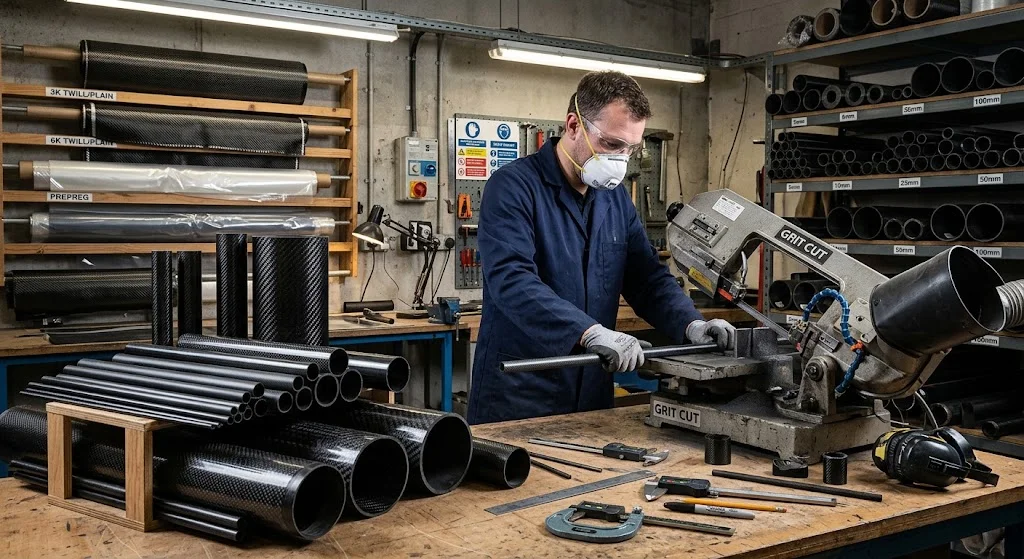
Carbon fiber tubes and rods are the two workhorse stock shapes of composite engineering, and for most projects the choice between them comes down to a single question: does the part carry bending and torsion, or does it carry axial load? A tube places material at the circumference, where it resists
Introduction
Carbon fiber tubes and rods are the two workhorse stock shapes of composite engineering, and for most projects the choice between them comes down to a single question: does the part carry bending and torsion, or does it carry axial load? A tube places material at the circumference, where it resists bending and torsional stiffness most efficiently; a rod puts material through the whole section, where it resists axial tension, compression, and the concentrated loads of clamping and fastening. Getting that distinction right is the first and most important decision in specifying carbon fiber tubes and rods.
This guide explains how the two shapes differ, the fiber grades and manufacturing methods that determine their properties, the specifications that actually matter when you order, and how to size a tube or rod for the load it will see. It is written for engineers, product designers, and serious hobbyists who need to move from a rough idea to a purchase order with confidence.
Carbon Fiber Tubes and Rods: How the Two Shapes Differ
A carbon fiber tube is a hollow cylinder made by pultrusion, roll-wrapping, or filament winding. Its defining property is a high second moment of area for its mass, because the material sits far from the neutral axis. For the same outer diameter and weight, a tube is dramatically stiffer in bending than a solid rod and carries a far higher polar moment in torsion. A carbon fiber solid rod, by contrast, fills the entire section. It is heavier for the same diameter, but it offers a solid surface for threading, drilling, tapping, and press-fit inserts, and it is the natural choice when the load path runs straight down the axis.
The practical rule is simple. Use a tube when stiffness matters and the load is bending or torsion: wing spars, drone arms, robot links, tripod legs, drive shafts, and pushrods. Use a solid rod when the part is short, when it must be machined, when it is loaded in pure tension or compression, or when a fastener passes through it. Many assemblies use both, with solid rods as local inserts where joints and clamps bear down on the structure.
Key Specifications of Carbon Fiber Tubes and Rods
The table below compares a typical pultruded tube and a unidirectional solid rod against an aluminium rod of the same nominal size. The numbers are representative of standard commercial products and show why carbon fiber wins on specific properties.
| Property | Carbon Fiber Tube (T700, pultruded) | Carbon Fiber Solid Rod (T700, UD) | Aluminium 6061-T6 Rod |
|---|---|---|---|
| Tensile strength | 3,000-3,500 MPa | 3,800-4,200 MPa | 310 MPa |
| Density | 1.55-1.60 g/cm³ | 1.55 g/cm³ | 2.70 g/cm³ |
| Elastic modulus | 180-230 GPa | 230-290 GPa | 69 GPa |
| Specific stiffness (E/rho) | roughly 120 GPa-cm³/g | roughly 160 GPa-cm³/g | roughly 26 GPa-cm³/g |
| Typical diameter range | 3-100 mm | 3-50 mm | 10-100 mm |
| Maximum standard length | 6 m | 3 m | 6 m |
Two specifications deserve special attention when you order. The fiber volume fraction, typically 55-65 percent for pultruded stock, controls how much of the strength the section actually delivers. The wall thickness of a tube, or the exact diameter of a rod, controls fit with the mating part. For a carbon fiber tube 23mm in diameter, for example, wall thickness commonly runs from 1 mm to 3 mm, and the choice changes stiffness and strength by a factor of several even though the outer dimension is fixed.
Manufacturing Methods
The manufacturing route determines the internal fiber architecture and therefore the properties you can rely on.
- Pultrusion: Continuous fibers are pulled through a resin bath and a heated die, producing a constant cross-section with highly aligned axial fibers. It is the most economical method for tubes and rods and reaches fiber volume fractions of 60-70 percent. Pultruded parts are excellent in axial tension and bending.
- Filament winding: Continuous tow is wound over a mandrel at a programmed angle, so hoop and axial strength can be tuned to the load. It is the standard method for pressure and torsion-critical tubes and can reach burst pressures above 250 bar.
- Roll wrapping: Prepreg fabric is rolled onto a mandrel to build the wall, giving a woven cosmetic surface and moderate, more balanced properties. It is common for visible tubes and lower-volume parts.
- Extrusion (short fiber): Chopped fiber is compounded with a thermoplastic and extruded into rod. It is the cheapest option, with lower mechanical properties, and suits non-structural and decorative parts.
Applications
The same two stock shapes appear across very different industries, which is why they are stocked so widely.
- Aerospace: Control pushrods, satellite booms, and UAV frame spars built from tubes, with solid rods used at end fittings.
- Robotics: Articulated arm links, lightweight shafts, and parallel-mechanism struts where stiffness per kilogram governs reach and payload.
- Automotive and motorsport: Drive shafts, roll structures, and suspension links, often as tubes with bonded or bolted ends.
- Sporting goods: Fishing rod blanks, arrow shafts, bicycle frame reinforcement, and golf shafts.
- Consumer and industrial: Tripod legs, carbon fiber rod handles for tools and umbrellas, sensor housings, and conveyor supports.
Sizing and Selecting Carbon Fiber Tubes and Rods
Selection follows the load path. Work through these criteria in order, because each one narrows the field.
- Load type: Bending and torsion point to a tube; axial tension, compression, and machining point to a solid rod.
- Fiber grade: T300 is the economical general-purpose choice, T700 balances performance and availability for most structural parts, and T1000 or high-modulus grades are reserved for stiffness-critical aerospace and sports work.
- Wall thickness and diameter: Increase wall thickness before diameter when the envelope is fixed; roughly, bending stiffness rises with the cube of diameter but only linearly with wall thickness.
- Environment: Specify a UV-resistant finish or paint for outdoor service, and use insulating inserts or isolating washers wherever carbon fiber meets metal to prevent galvanic corrosion.
- End use: Plan the joint early. Bonded sleeves, machined inserts, and clamped nodes all need to be designed alongside the tube, not added later.
Frequently Asked Questions
Is a carbon fiber tube stronger than a solid carbon fiber rod?
Neither is universally stronger; the winner depends on the load. For bending and torsion, a tube of the same outer diameter and mass is far stiffer, because its material is further from the neutral axis. For axial tension and compression in a short member, or where the part must be drilled and threaded, a solid carbon fiber rod is stronger and more robust because the whole section carries the load and there is material for fasteners. Choose by load path rather than by a blanket rule.
Can carbon fiber tubes and rods be glued into metal joints?
Yes, and structural bonding is one of the most common ways to join them. Prepare the tube surface by abrading it and wiping with a solvent such as acetone, use a toughened two-part epoxy, and design the joint so the load is carried in shear over a generous overlap. Always isolate carbon from aluminium with a barrier layer, because the two form a galvanic couple in the presence of moisture. A well-designed bonded joint can exceed the strength of the tube itself.
How do I choose between T300, T700, and T1000?
T300 offers the lowest cost and is enough for most consumer, hobby, and general industrial parts. T700 gives noticeably higher strength and stiffness and is the default for structural tubes and rods where weight matters. T1000 and high-modulus grades add further stiffness but cost more and are less tolerant of handling damage, so they are reserved for aerospace, high-end sports equipment, and stiffness-critical designs where the extra performance is worth the price.
Conclusion
Carbon fiber tubes and rods cover an enormous range of engineering needs from a single family of stock shapes. The tube wins wherever bending and torsion dominate and weight is critical; the solid rod wins where the part is machined, clamped, or loaded axially. Once you know the load path, the rest of the specification follows from fiber grade, diameter, and wall thickness, and the joint design ties it together safely.
YongXian manufactures carbon fiber tubes and rods in T300, T700, and T1000 grades, with pultrusion, filament winding, and roll-wrapping capability, in diameters from 3 mm to 100 mm and custom lengths. View our carbon fiber tube and rod range or request a quote with your diameter, wall thickness, grade, length, and quantity.
Part of topic
Related Articles
- Carbon Fiber Tube Chassis: Space Frames for Vehicles and Drones
- Carbon Fiber Tube Connect: Complete Assembly Guide
- Carbon Fiber Tube Connection: Sleeves, Inserts and Adhesive Joints
- Carbon Fiber Tube T-Joint: Bonding and Mechanical Assembly Options
- Carbon Fiber Tube Clamps: Joint Design and Hardware Selection
- Carbon Fiber Sheets for Sale 1mm: Grade and Thickness Buying Guide
Interested in Our Products?
Contact our team for competitive pricing and technical specifications.
Get a QuoteRelated Products

Carbon Fiber Plate — 3K Twill T700 1.5mm
Thin 1.5mm carbon fiber plate with 3K twill weave surface. Lightweight and stiff, commonly used for covers, panels, drone bodies, and applications requiring a premium aesthetic appearance.

Carbon Fiber Plate — 3K Twill T700 3.0mm
Medium-thickness 3.0mm carbon fiber plate offering significantly higher load capacity while maintaining attractive 3K twill finish. Suitable for structural brackets, reinforcement plates, and load-bearing panels.

Square Carbon Fiber Tube — 3K Twill T700
Square cross-section carbon fiber tube manufactured with 3K twill weave for torsional strength. Preferred for structural frames, trusses, and support columns where rectangular geometry offers design flexibility.
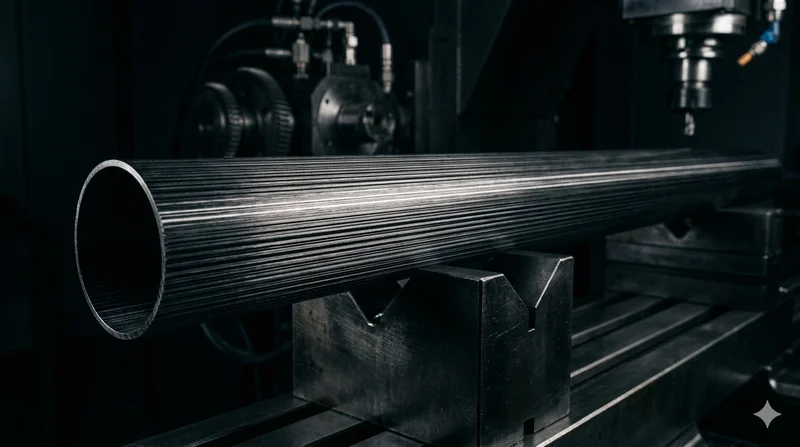
Round Carbon Fiber Tube — UD Unidirectional T700
Unidirectional (UD) round tube with all fibers aligned axially for maximum longitudinal stiffness. Ideal for applications requiring high bending rigidity with minimal weight, such as shafts, struts, and structural reinforcements.
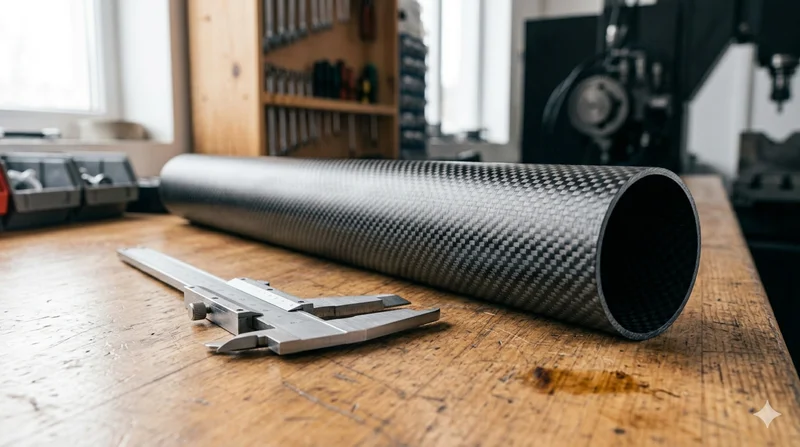
Round Carbon Fiber Tube — 3K Plain Weave T700
Standard round carbon fiber tube manufactured from Toray T700 grade fiber with 3K plain weave. Offers balanced strength and stiffness for general industrial applications including robotics, automation, sports equipment, and aerospace structures.