
Choosing the right carbon fiber tube connection is often the difference between a structure that behaves exactly as predicted and one that fails at its most loaded point. Carbon fiber carries load beautifully along its fibers, but every joint interrupts that path and concentrates stress, so a weak c
Introduction
Choosing the right carbon fiber tube connection is often the difference between a structure that behaves exactly as predicted and one that fails at its most loaded point. Carbon fiber carries load beautifully along its fibers, but every joint interrupts that path and concentrates stress, so a weak connection can waste the entire weight saving the material was chosen for. A drone arm, a bicycle frame, a racing chassis and a robotic link all depend on joining tubes end to end, at an angle, or to a metal fitting.
There is no single best way to connect carbon fiber tubes. The practical options fall into four families: adhesive bonded joints, sleeve-and-insert connections, mechanical clamps, and hybrid joints that combine bonding with a fastener. Each trades strength, weight, cost and the ability to take the assembly apart. This guide explains how each family works, the design rules that keep it reliable, and a comparison table to guide the choice for a given load case.
Carbon Fiber Tube Connection Methods: An Overview
Before comparing methods, it helps to understand why joints on composites behave differently from joints on steel or aluminum. A metal joint can yield and redistribute an overload; a carbon fiber laminate cannot, so a composite joint must be designed to keep stress below the elastic limit at every point. The second defining constraint is that carbon fiber is brittle in compression and carries a bearing load poorly, so bolts that crush a thin tube wall are usually avoided unless local reinforcement is added.
The four connection families cover almost every application:
- Adhesive bonded joints: two tubes joined with a structural adhesive, either butted with a sleeve or scarfed. Load transfers through shear in a thin bond line.
- Sleeve and insert connections: an internal or external sleeve bridges the two tubes, often bonded, and can also hold a metal insert for a threaded or pinned fitting.
- Mechanical clamps and bolted joints: split clamps, flanges or brackets grip the tube, allowing disassembly but adding metal and weight.
- Hybrid joints: bonding combined with a mechanical fastener to resist peel and to survive fatigue.
Adhesive Bonded Joints for Carbon Fiber Tube Connection
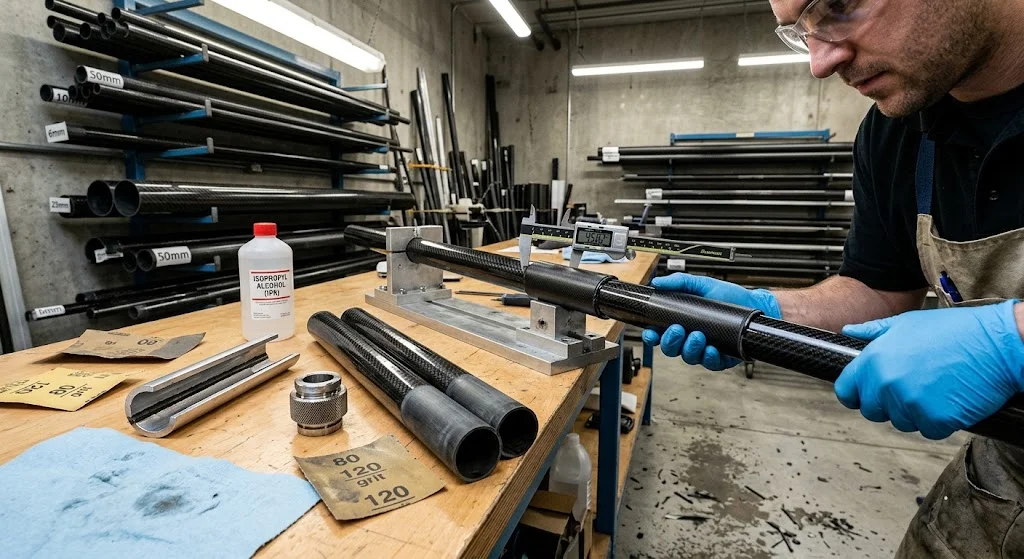
Adhesive bonding is the most common carbon fiber tube connection because it spreads load over a large area, adds almost no weight, and does not cut the fibers. The key quantity is the overlap length: for a bonded sleeve, an overlap of one to one and a half tube diameters is typical, and beyond about two diameters the extra length adds little strength, because the bond line is already fully loaded at its ends. The bond line itself should be thin and uniform, usually 0.1 to 0.3 millimetres, controlled with glass beads or a gap-filling adhesive.
Surface preparation dominates the result. The bond area is abraded with 80 to 120 grit paper, cleaned with solvent, and often primed. A toughened epoxy paste adhesive is the usual choice for structural joints; methyl methacrylate adhesives cure faster and tolerate less careful preparation but are more flexible. A scarf joint, where the tube ends are machined to a shallow taper, is stronger than a simple butt joint because it converts peel into shear, though it costs machining time. The classic failure mode to avoid is peel at the end of the overlap, which is why a small chamfer on the sleeve edge and a fillet of adhesive both help.
Sleeve and Insert Connections
A sleeve is a short length of tube, either inside or outside the members, that carries the load across the gap. An external sleeve is easier to bond and inspect; an internal sleeve keeps the outside diameter smooth and suits telescopic and modular designs. Wrapping the joint with a few layers of carbon fiber fabric and curing in place gives a continuous-fiber connection that is lighter than a thick sleeve but needs an oven or vacuum bag. The sleeve wall should be thick enough that it, and not the bond line, sets the joint strength.
Inserts solve a different problem: providing a hard point for a bolt, a thread or a bearing in a soft, thin-walled tube. A metallic insert is bonded into the tube bore, and its length should be at least one and a half diameters so the adhesive carries the load in shear rather than the insert tipping under load. A potted insert, where a plug of adhesive fills the tube end, is simple and strong in tension but heavier. Where a carbon fiber tube T joint or a bolted bracket is needed, an insert is the usual way to avoid crushing the wall.
Mechanical Clamps, Bolted and T-Joint Connections
Mechanical clamping is chosen when the structure must come apart, when a connection is adjusted on site, or when a metal fitting is required. Split clamps and flanges grip the tube by friction; the clamping pressure must be controlled, because over-tightening crushes the wall and under-tightening allows slip. A rubber or composite shim spreads the pressure and protects the laminate. Bolted joints through the tube require local reinforcement, either a bonded insert or a thickened wall, or the bolt will fail the laminate in bearing.
A T-joint, where one tube meets another at right angles, is the hardest connection to make light. The load arrives as bending and peel, which composites resist poorly. Practical solutions include a molded or bonded saddle, a metal yoke, or a short sleeve through which the cross tube passes and is bonded. Every T-joint should be tested as a joint, not as two tubes, because the failure almost always begins at the intersection.
Off-the-shelf carbon fiber tube clamps are convenient, but their rated load assumes a specific tube diameter and wall. A clamp sized for a metal tube of the same outer diameter may crush a thinner composite wall, so the wall thickness must be checked against the clamp specification before it is trusted with a structural load.
How to Choose a Carbon Fiber Tube Connection Method
The right method depends on whether the joint must be permanent, how much load it carries, and whether it can add metal. The table compares the four families on the criteria that matter most in a lightweight structure.
| Method | Weight added | Typical strength | Disassembly | Best use |
|---|---|---|---|---|
| Adhesive bonded | Very low | High (shear-limited) | No | Permanent frames, drive shafts |
| Sleeve and insert | Low | High with correct overlap | No | Telescopic tubes, hard points |
| Mechanical clamp | Medium to high | Moderate (friction) | Yes | Adjustable, field-serviced joints |
| Hybrid bonded + bolted | Medium | Very high, peel-resistant | Partial | High-fatigue, safety-critical joints |
A useful rule is to design the joint for a load 20 to 30 percent above the tube's own capacity, so the joint never becomes the weak link without warning. If the structure must come apart, a mechanical clamp is worth its weight; if it does not, adhesive bonding or a sleeve almost always gives a lighter and stiffer result.
Frequently Asked Questions
Is adhesive bonding strong enough for a structural carbon fiber tube connection?
Yes, when the overlap and surface preparation are correct. A well-made bonded sleeve carries more load than a bolted joint of the same size and adds far less weight, because the adhesive spreads the load over the whole overlap in shear. The limiting factors are the overlap length, the bond-line thickness and the cleanliness of the surfaces, not the adhesive alone.
Can I bolt through a carbon fiber tube?
Only with local reinforcement. A bolt through an unreinforced thin wall will crush the laminate in bearing, because carbon fiber has low transverse and bearing strength. Bond a metallic insert, thicken the wall locally, or use a sleeve so the bolt clamps metal or a reinforced section rather than the bare tube.
Why does a carbon fiber tube T joint fail so often?
A T-joint loads the tube in peel and bending, the two modes composites resist least. The stress concentrates at the intersection, so the joint fails well below the tube's own strength. Adding a bonded saddle, a metal yoke or a through-sleeve spreads the load and is the usual fix.
Conclusion
The carbon fiber tube connection is where a lightweight design is won or lost. Adhesive bonding and sleeve-and-insert joints give the best strength-to-weight ratio for permanent structures, mechanical clamps trade weight for adjustability, and hybrid joints buy fatigue resistance at a small weight cost. Whichever method is used, overlap length, surface preparation and control of peel decide how well it performs.
YongXian supplies carbon fiber tubes, sleeves, inserts and bonding accessories for structural assemblies. Browse our carbon fiber tube range or contact our engineering team to discuss the right connection method for your project.
Part of topic
Related Articles
- Carbon Fiber Tubes and Rods: Sizing and Selection for Projects
- Carbon Fiber Tube Chassis: Space Frames for Vehicles and Drones
- Carbon Fiber Tube Connect: Complete Assembly Guide
- Carbon Fiber Tube T-Joint: Bonding and Mechanical Assembly Options
- Carbon Fiber Tube Clamps: Joint Design and Hardware Selection
- Carbon Fiber Sheets for Sale 1mm: Grade and Thickness Buying Guide
Interested in Our Products?
Contact our team for competitive pricing and technical specifications.
Get a QuoteRelated Products

Carbon Fiber Plate — 3K Twill T700 1.5mm
Thin 1.5mm carbon fiber plate with 3K twill weave surface. Lightweight and stiff, commonly used for covers, panels, drone bodies, and applications requiring a premium aesthetic appearance.
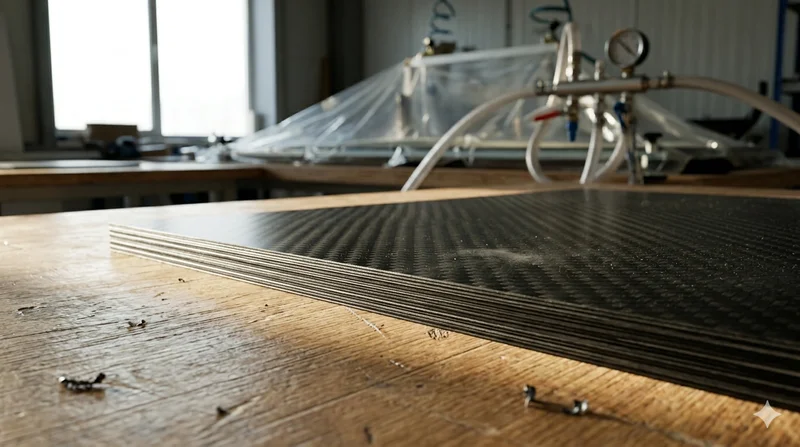
Carbon Fiber Plate — 3K Twill T700 3.0mm
Medium-thickness 3.0mm carbon fiber plate offering significantly higher load capacity while maintaining attractive 3K twill finish. Suitable for structural brackets, reinforcement plates, and load-bearing panels.

Square Carbon Fiber Tube — 3K Twill T700
Square cross-section carbon fiber tube manufactured with 3K twill weave for torsional strength. Preferred for structural frames, trusses, and support columns where rectangular geometry offers design flexibility.
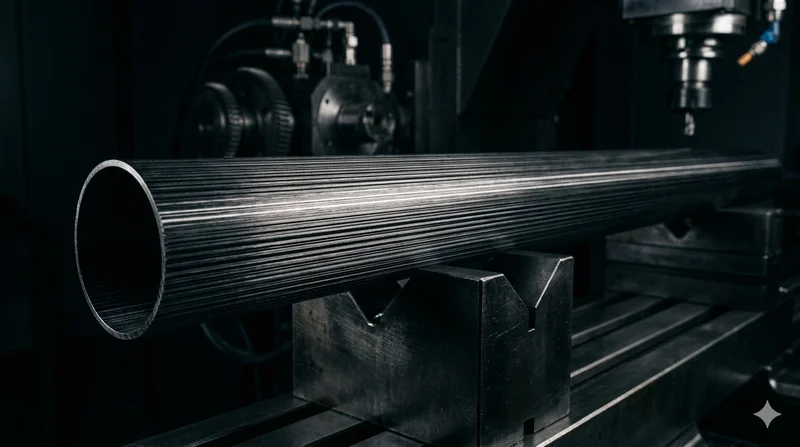
Round Carbon Fiber Tube — UD Unidirectional T700
Unidirectional (UD) round tube with all fibers aligned axially for maximum longitudinal stiffness. Ideal for applications requiring high bending rigidity with minimal weight, such as shafts, struts, and structural reinforcements.
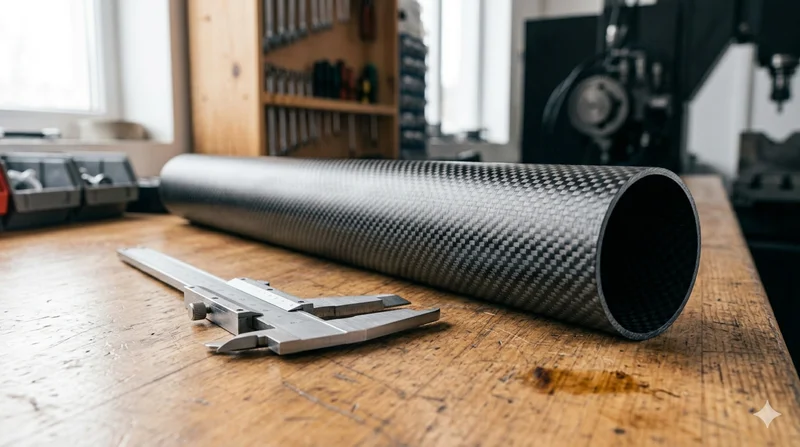
Round Carbon Fiber Tube — 3K Plain Weave T700
Standard round carbon fiber tube manufactured from Toray T700 grade fiber with 3K plain weave. Offers balanced strength and stiffness for general industrial applications including robotics, automation, sports equipment, and aerospace structures.