
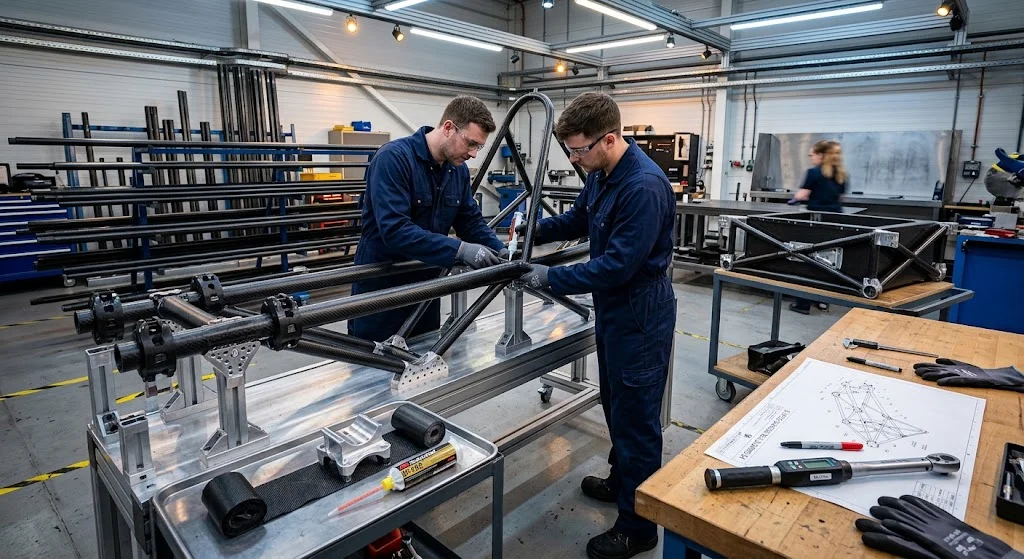
A carbon fiber tube chassis built as a space frame is one of the purest expressions of composite engineering: a set of thin tubes joined at load-spreading nodes, carrying bending and torsion through triangulation rather than heavy sheet. Where a monocoque molds bodywork and structure together into o
Introduction
A carbon fiber tube chassis built as a space frame is one of the purest expressions of composite engineering: a set of thin tubes joined at load-spreading nodes, carrying bending and torsion through triangulation rather than heavy sheet. Where a monocoque molds bodywork and structure together into one expensive shell, a tube space frame stays light, repairable and adaptable, which is why it appears in racing cars, electric vehicles, drones, lightweight rail and robotics.
The tube chassis also suits the way carbon fiber is actually manufactured. Pultruded and roll-wrapped carbon fiber tubes and rods are inexpensive, continuous, and available in dozens of diameters and wall thicknesses, and they can be bonded into a frame at room temperature with no oven the size of a car. This article explains the mechanics that make a carbon fiber tube chassis work, how vehicles and drones use it differently, how to join the nodes, and where the material beats metal.
What Makes a Carbon Fiber Tube Chassis: Space Frame Mechanics
A space frame carries load through a network of tubes loaded in tension and compression, with as little bending as possible. Each member is a strut; the joints, or nodes, redirect the forces into the next member; and triangulation makes the network stiff without gusset plates or heavy sections. The dominant loads are global bending and torsion, and a tube is the most efficient section for both, because material placed at the circumference resists torsion far better than the same material near the axis.
Carbon fiber fits this logic better than any metal. A pultruded tube has its fibers aligned along the axis, exactly where a space frame member loads it, giving an axial modulus of 70 to 180 GPa at a density around 1.55 grams per cubic centimetre. Because the tube is loaded only along its axis, the weak transverse properties of the laminate rarely matter, and the notorious cost of carbon fiber is spent on the fibers that actually carry the load. That is why a carbon fiber tube chassis can beat steel on stiffness per kilogram while using less than a third of the material mass.
Carbon Fiber Tube Chassis in Drones and UAVs
Drones were the first mass users of the carbon fiber tube chassis, and the geometry is simple: two or four parallel booms joined to a central body, carrying the motors at the corners. The arms work in bending and torsion from every flight maneuver, the chassis must be light enough for a long hover time, and the whole frame snaps together from stock tubes and bonded joints.
- Quadcopter and fixed-wing booms: a 12 to 25 millimetre tube at 1 to 2 millimetre wall is typical; stiffness, not raw strength, sets the size.
- Central node plates: drilled or molded plates clamp and bond the arms, keeping the chassis flat and true without a welded jig.
- Payload bays and landing gear: short tube sections and clamps extend the same frame tools to accessories, keeping manufacturing to one tube supplier.
Because drone frames are built from stock carbon fiber tubes and rods, a prototype can be re-cut and re-bonded in hours, and a crashed arm can be replaced without rebuilding the frame. The same logic scales up: the booms and central structure of cargo drones and eVTOL demonstrators are tube chassis enlarged rather than fundamentally different designs.
Carbon Fiber Tube Chassis for Vehicles and Motorsport
In road vehicles and racing cars, the carbon fiber tube chassis appears in two distinct roles. The first is a pure space frame for low-volume and racing vehicles, where a bonded tube chassis with a composite body shell gives torsional rigidity close to a monocoque at a fraction of the mold cost. The second is a subframe or cage inside or around a monocoque, used for crash structures, for mounting points that must stay stiff, and for prototype or low-run builds.
Motorsport chassis also exploit the tube frame's repairability: a damaged node is cut out and a new tube bonded in place, whereas a damaged monocoque is usually beyond repair. For electric vehicles, the tube chassis provides the open central space and stiff mounting faces that battery boxes need, which is why several EV startups use bonded aluminum-to-carbon or all-carbon tube frames for the cell bay.
Joining and Building a Carbon Fiber Tube Chassis
A space frame lives or dies at its nodes, and the joints in a carbon fiber tube chassis differ from a welded steel frame:
- Bonded tube ends at node plates: each tube is cut square, abraded, cleaned and bonded into a machined pocket or onto a plate with the overlap one to one and a half diameters.
- Carbon fiber tube T joint and cross nodes: a saddle, a yoke or a through-sleeve spreads the branch load, keeping the joint in shear.
- Carbon fiber tube clamps and bolted inserts: an insert or clamp provides the disassembly point and the attachment for suspension, motor and battery hardware without crushing the thin wall.
- Wrapped joints: wetted carbon fabric over the node distributes the load and hides the joint stress risers.
Because every joint is bonded at room temperature, the frame can be assembled on a simple alignment jig rather than in a bonding oven, which keeps tooling costs a small fraction of a monocoque mold. The trade-off is that each joint relies on surface preparation, so the frame is only as good as the discipline of the bonding line.
Carbon Fiber Tube Chassis vs Steel and Aluminum Space Frames
The comparison below holds the geometry constant: a space frame of round tubes, the carbon version sized to the same stiffness as the metal versions. Figures are typical ranges for pultruded standard-modulus tubes.
| Criterion | Carbon fiber tube | Aluminum tube | Steel tube |
|---|---|---|---|
| Density (g/cm³) | 1.5-1.6 | 2.70 | 7.85 |
| Axial modulus (GPa) | 70-180 | 69-72 | 200-210 |
| Mass for equal stiffness | Baseline | 1.6-2.0 times | 1.8-2.4 times |
| Manufacturing | Bonded, room temperature | Welded or bonded | Welded |
| Repairability | Cut out, re-bond | Re-weld or replace | Re-weld |
| Crash energy absorption | Brittle, needs design care | Good | Excellent |
| Relative material cost | 5-15 times steel | 3-5 times steel | Baseline |
The carbon tube chassis wins where stiffness per kilogram and low inertial mass matter more than cost and crash tolerance: drones, racing cars, lightweight rail and robotics. Steel remains the default where the frame must absorb crash energy cheaply, and aluminum sits between, offering welded convenience and corrosion resistance at a moderate weight penalty.
Frequently Asked Questions
Is a carbon fiber tube chassis stiffer than a steel one?
At equal weight, yes, significantly. Carbon fiber has a higher specific stiffness than steel, so a carbon tube frame sized to the same stiffness weighs roughly half to two thirds as much as a steel frame. At equal geometry, steel carries more load per centimetre of tube, but the carbon frame reaches the same rigidity at far lower mass, which is what matters for a vehicle or drone.
Can a carbon fiber tube chassis be repaired?
Yes, and this is one of its advantages over a monocoque. A damaged tube or node is cut out and a new section bonded in place at room temperature, restoring the frame strength without a mold or an autoclave. The repair is only as strong as the bond, so the work follows the same abrasion, cleaning and overlap rules as the original build.
Why use a tube chassis instead of a carbon fiber monocoque?
Cost and flexibility. A monocoque needs a large mold and an autoclave or oven, so it is only economical at volume or in elite motorsport. A tube chassis is built from stock carbon fiber tubes and rods, bonded on a simple jig, so it suits low-volume vehicles, prototypes, drones and racing cars where a monocoque would never pay for its tooling.
Conclusion
The carbon fiber tube chassis is a space frame that turns stock tubes and rods into a vehicle-grade structure: light, stiff in bending and torsion, repairable at the joint instead of discarded as a shell, and cheap to tool compared with a monocoque. Its joints are its weak points, so every node must be bonded with the same care as any structural joint, but a well-built tube frame can match the performance of a molded shell in the geometries where a frame belongs.
YongXian supplies carbon fiber tubes, rods, sleeves and inserts for space frame construction. Browse our tube and rod range or contact our engineering team for help sizing members and nodes for your chassis project.
Part of topic
Related Articles
- Carbon Fiber Tubes and Rods: Sizing and Selection for Projects
- Carbon Fiber Tube Connect: Complete Assembly Guide
- Carbon Fiber Tube Connection: Sleeves, Inserts and Adhesive Joints
- Carbon Fiber Tube T-Joint: Bonding and Mechanical Assembly Options
- Carbon Fiber Tube Clamps: Joint Design and Hardware Selection
- Carbon Fiber Sheets for Sale 1mm: Grade and Thickness Buying Guide
Interested in Our Products?
Contact our team for competitive pricing and technical specifications.
Get a QuoteRelated Products

Carbon Fiber Plate — 3K Twill T700 1.5mm
Thin 1.5mm carbon fiber plate with 3K twill weave surface. Lightweight and stiff, commonly used for covers, panels, drone bodies, and applications requiring a premium aesthetic appearance.

Carbon Fiber Plate — 3K Twill T700 3.0mm
Medium-thickness 3.0mm carbon fiber plate offering significantly higher load capacity while maintaining attractive 3K twill finish. Suitable for structural brackets, reinforcement plates, and load-bearing panels.

Square Carbon Fiber Tube — 3K Twill T700
Square cross-section carbon fiber tube manufactured with 3K twill weave for torsional strength. Preferred for structural frames, trusses, and support columns where rectangular geometry offers design flexibility.
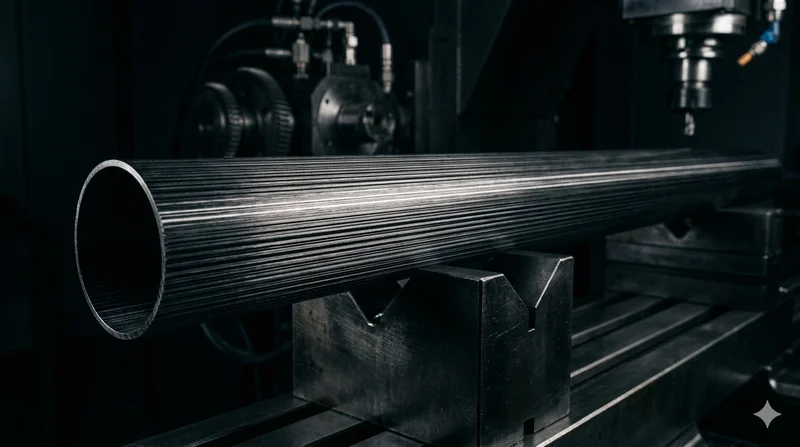
Round Carbon Fiber Tube — UD Unidirectional T700
Unidirectional (UD) round tube with all fibers aligned axially for maximum longitudinal stiffness. Ideal for applications requiring high bending rigidity with minimal weight, such as shafts, struts, and structural reinforcements.
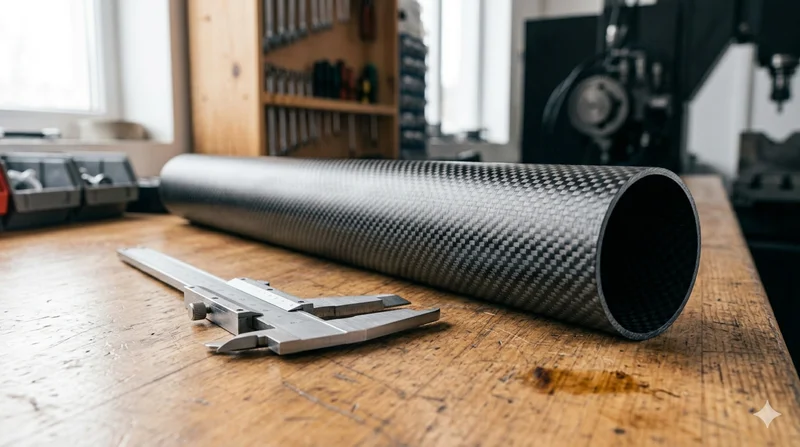
Round Carbon Fiber Tube — 3K Plain Weave T700
Standard round carbon fiber tube manufactured from Toray T700 grade fiber with 3K plain weave. Offers balanced strength and stiffness for general industrial applications including robotics, automation, sports equipment, and aerospace structures.