
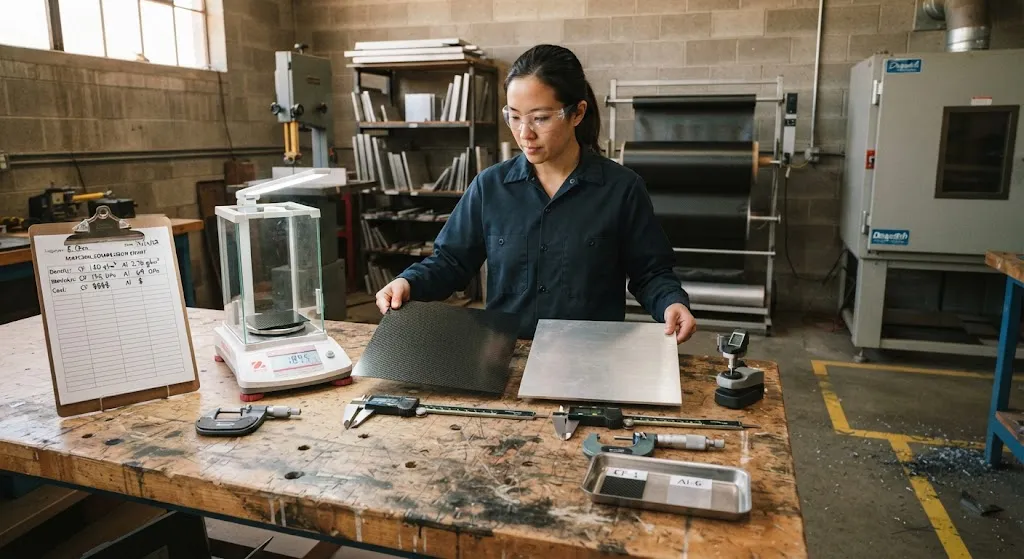
Carbon fiber sheet vs aluminum is the comparison behind a large share of lightweight parts, from drone frames and robot arms to automotive brackets and sports equipment. Both materials are light, stiff and strong, and both are sold as flat panels, yet they behave very differently once load, cost and
Introduction
Carbon fiber sheet vs aluminum is the comparison behind a large share of lightweight parts, from drone frames and robot arms to automotive brackets and sports equipment. Both materials are light, stiff and strong, and both are sold as flat panels, yet they behave very differently once load, cost and environment are taken seriously. A cured carbon fiber sheet weighs roughly 40 percent less than the same volume of aluminum, but it costs many times more per kilogram and its stiffness is directional. This guide compares carbon fiber sheet and aluminum on density, stiffness, strength, thermal expansion, corrosion and cost, and it shows where each material wins.
The short answer is that carbon fiber sheet beats aluminum whenever weight and stiffness per kilogram dominate, while aluminum stays the better choice when cost, isotropic behaviour and easy machining matter most. The rest of this article works through the numbers that a designer or buyer can apply directly.
Carbon Fiber Sheet vs Aluminum: The Core Property Gap
The central difference between a carbon fiber sheet and an aluminum plate is the relationship between stiffness and density. Aluminum 6061-T6 has a tensile modulus of about 69 gigapascals and a density of 2.70 grams per cubic centimetre. A cured carbon fiber sheet has a density of only 1.55 to 1.60 grams per cubic centimetre, and its modulus depends on lay-up: a quasi-isotropic sheet reaches about 70 gigapascals, while a unidirectional sheet aligned with the load can exceed 130 gigapascals.
Because specific stiffness is modulus divided by density, carbon fiber sheet delivers roughly 44 gigapascals per gram per cubic centimetre in quasi-isotropic form, versus about 26 for aluminum. In unidirectional form the figure can reach 80 or more. That ratio, not the absolute modulus, is what makes carbon fiber sheet attractive: a panel of the same weight can be far stiffer, or a panel of the same stiffness can be far lighter. The same ranking carries over to a carbon fiber plate vs aluminum plate, and to a carbon fiber tube vs aluminum tube, because the density and modulus gap follows the fibre grade rather than the part shape.
Weight, Stiffness and Strength Compared
The table below sets out the figures that decide most carbon fiber sheet vs aluminum decisions. Values are typical for a standard-modulus epoxy laminate and for aluminum 6061-T6.
| Property | Carbon Fiber Sheet (CFRP) | Aluminum 6061-T6 |
|---|---|---|
| Density | 1.55-1.60 g/cm³ | 2.70 g/cm³ |
| Tensile modulus | 70 GPa quasi-isotropic; up to 135 GPa unidirectional | 69 GPa |
| Specific stiffness | 44-84 GPa per g/cm³ | 26 GPa per g/cm³ |
| Tensile strength | 600-1,500 MPa | 310 MPa |
| Specific strength | 375-940 MPa per g/cm³ | 115 MPa per g/cm³ |
| Thermal expansion | Close to zero; tunable to 0-2 ppm per °C | 23 ppm per °C |
| Corrosion | Inert alone; galvanic couple with metals | Corrodes; needs coating or anodising |
| Typical material cost | 30-100+ USD per kg | 2.5-4 USD per kg |
Two rows deserve emphasis. The first is specific strength: carbon fiber sheet is three to eight times stronger per kilogram, which is why a thin carbon sheet can replace a much thicker aluminum plate. The second is thermal expansion: aluminum grows by about 23 parts per million per degree Celsius, while a carbon fiber sheet can be laid up to expand almost not at all, or even to shrink slightly along the fibres. For a metrology frame or a satellite panel, that difference alone can settle the choice.
Cost and Fabrication: Where Carbon Fiber Sheet vs Aluminum Diverges
Aluminum wins on cost and on the ease of conventional manufacturing. The main trade-offs are:
- Material cost: Carbon fiber sheet costs roughly ten to thirty times more per kilogram than aluminum, so the material is chosen only where its performance pays for it.
- Machining: Aluminum can be cut, drilled, tapped and welded with simple tooling. Carbon fiber sheet must be cut with diamond or carbide tools, generates abrasive dust, and cannot be welded.
- Joining: Aluminum joints are straightforward; carbon fiber sheet needs adhesive bonding or inserts, because drilling it severs the fibres that carry load.
- Lead time: Aluminum plate is a stock item, while a carbon fiber sheet is often laid up and cured to order, which lengthens lead time.
The practical rule is that aluminum is the default for brackets, housings and prototypes, and carbon fiber sheet takes over once the weight saving justifies the premium, typically in moving parts, aerospace structures and high-end consumer products.
It is worth noting how the price gap narrows as a part gets smaller. A carbon fiber sheet is often bought as a cut blank rather than a full panel, and the labour of cutting, kitting and inspection is similar for both materials. On a small bracket the material cost may be only part of the total, so the premium can look smaller than the headline fifteen times. On a large panel, where material dominates, the premium is close to the raw ratio. Comparing total cost per finished part rather than price per kilogram avoids both over- and under-estimating the carbon fiber sheet premium. The same logic applies when a buyer weighs a carbon fiber plate vs aluminum plate, or a tube against a tube, because the comparison should always be made on the delivered part, not the stock material alone.
Thermal Expansion, Corrosion and Galvanic Effects
Beyond stiffness and cost, three environmental effects separate the materials. Thermal expansion is the first: aluminum expands and contracts ten times more than carbon fiber sheet, which matters whenever a part must hold its dimensions across a temperature swing. The second is corrosion: aluminum needs anodising or coating, while carbon fiber sheet is inert on its own. The third is galvanic coupling: when carbon fiber sheet touches aluminum in the presence of moisture, the carbon acts as a cathode and accelerates corrosion of the aluminum, so the two are usually separated by a layer of glass fibre, a coating or a non-metallic washer. Carbon fiber sheet thickness matters here as well, because a thin sheet offers little material to spread a bolt load and needs more care around holes.
Frequently Asked Questions
Is a carbon fiber sheet stronger than aluminum?
Yes, on a per-kilogram basis. A cured carbon fiber sheet typically reaches 600 to 1,500 megapascals of tensile strength at a density of 1.55 to 1.60 grams per cubic centimetre, while aluminum 6061-T6 sits near 310 megapascals at 2.70 grams per cubic centimetre. Per unit weight the carbon sheet is three to eight times stronger. In absolute terms a thick aluminum plate can still out-perform a thin carbon sheet, so the comparison only makes sense at equal weight or equal stiffness.
Is a carbon fiber sheet lighter than aluminum?
A carbon fiber sheet is about 40 percent lighter than aluminum for the same volume. At 1.55 to 1.60 grams per cubic centimetre against 2.70 for aluminum, the weight saving at equal thickness is substantial, and it grows further when the higher specific stiffness allows a thinner sheet to do the same job.
Why not use carbon fiber sheet everywhere instead of aluminum?
Cost, fabrication and isotropy. Carbon fiber sheet costs many times more per kilogram, is harder to cut and join, and is only stiff in the fibre directions. Aluminum is cheap, uniform in all directions and easy to machine. The right choice is carbon fiber sheet where weight and stiffness dominate, and aluminum where cost and manufacturability dominate. Many designs use both, matching each material to the loads it serves best.
Conclusion
Carbon fiber sheet vs aluminum comes down to a clear trade: carbon fiber sheet wins on specific stiffness, specific strength and thermal stability, while aluminum wins on cost, isotropy and ease of fabrication. The density gap of roughly 40 percent and the specific stiffness gap of nearly two times are the numbers that justify carbon fiber sheet in weight-critical parts, and the ten-to-thirty-times price premium is the number that keeps aluminum in everything else. Choosing between them is not a matter of fashion but of which constraint binds hardest in a given application.
If you need carbon fiber sheet supplied with clear density, modulus and thickness data, browse our carbon fiber sheet range, or contact our team for material datasheets and selection support.
Part of topic
Related Articles
- Carbon Fiber Tube Repair: Methods, Limits and When to Replace
- Carbon Fiber Tube Thick Walled: Design Considerations and Applications
- Carbon Fiber Tube Weight: How to Estimate Weight per Meter
- Carbon Fiber Rod vs Fiberglass: Stiffness, Fatigue and Cost
- Carbon Fiber Rod vs Graphite: Key Differences Explained
- Carbon Fiber Tube vs Steel: Strength-to-Weight Analysis
Interested in Our Products?
Contact our team for competitive pricing and technical specifications.
Get a QuoteRelated Products

Carbon Fiber Plate — 3K Twill T700 1.5mm
Thin 1.5mm carbon fiber plate with 3K twill weave surface. Lightweight and stiff, commonly used for covers, panels, drone bodies, and applications requiring a premium aesthetic appearance.

Carbon Fiber Plate — 3K Twill T700 3.0mm
Medium-thickness 3.0mm carbon fiber plate offering significantly higher load capacity while maintaining attractive 3K twill finish. Suitable for structural brackets, reinforcement plates, and load-bearing panels.

Square Carbon Fiber Tube — 3K Twill T700
Square cross-section carbon fiber tube manufactured with 3K twill weave for torsional strength. Preferred for structural frames, trusses, and support columns where rectangular geometry offers design flexibility.
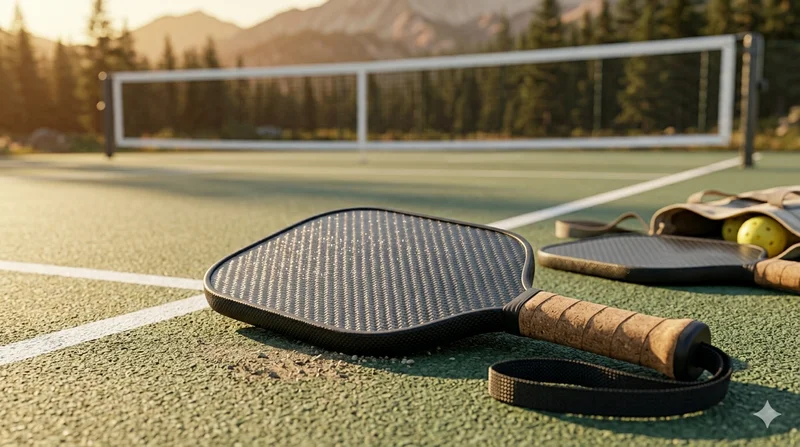
Carbon Fiber Pickleball Paddle
High-performance pickleball paddle with Toray T700 carbon fiber face and polypropylene honeycomb core. Delivers excellent power-to-weight ratio, spin generation, and vibration dampening for competitive play.

Carbon Fiber Trekking Pole
Lightweight carbon fiber trekking pole manufactured from high-grade carbon fiber tube. Weighs only 160g per pole while providing superior shock absorption and durability for hiking, trail running, and backpacking.