
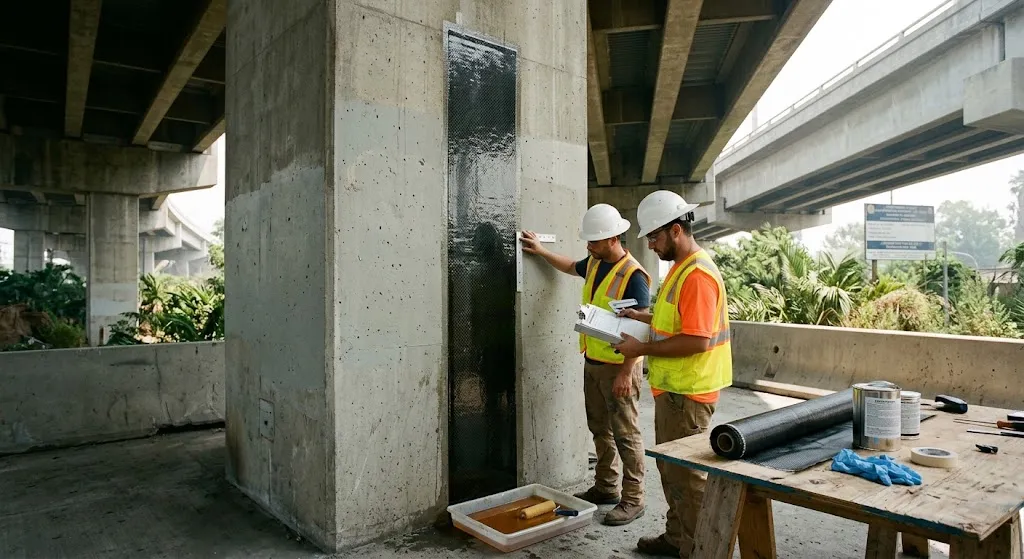
The phrase carbon fiber sheet do DPWH shows up in procurement searches because Department of Public Works and Highways projects across the Philippines have started specifying CFRP laminates for bridge strengthening, coastal protection and seismic retrofitting — and contractors need to source sheets
Introduction
The phrase carbon fiber sheet do DPWH shows up in procurement searches because Department of Public Works and Highways projects across the Philippines have started specifying CFRP laminates for bridge strengthening, coastal protection and seismic retrofitting — and contractors need to source sheets that clear both the technical annex and the bidding documents. As of 2026, DPWH's annual infrastructure budget exceeds 300 billion pesos, and a growing share of that pipeline calls for composite reinforcement rather than steel plate bonding. This article maps how those specifications are written, what test certificates a carbon fiber sheet manufacturer must supply, and how to price and classify the material for import.
Winning a DPWH supply line is less about material science than document discipline: mill certificates traceable to a heat number, tensile test reports to ASTM D3039, customs classification settled before the container ships, and a landed carbon fiber sheet price that survives a bid comparison against aluminium and GFRP alternatives.
How DPWH Specifications Reference Carbon Fiber Sheet
DPWH contracts are issued through the Philippine Government Electronic Procurement System, and technical requirements live in the contract's Bill of Technical Specifications rather than a single national material standard. For retrofitting work the specifications typically converge on the following demands:
- Fibre grade and architecture: most retrofits specify 3K or 12K tow, quasi-isotropic layup, areal weights from 200 to 600 grams per square metre, supplied as dry fabric or pre-impregnated sheet.
- Mechanical properties: tensile strength of at least 3,500 MPa and tensile modulus of 230-240 GPa per filament lot, verified to ASTM D3039 for sheets and ASTM D4018 for fibre.
- Resin system compatibility: when the contractor supplies the matrix, the specification usually names an epoxy with a glass transition temperature above 60 degrees Celsius for tropical service.
- Traceability: every roll or sheet must carry a manufacturer lot number cross-referenced to the certificate of analysis shipped with the batch.
Bid evaluators check these documents before price, so a technically compliant sheet with missing certificates loses to a weaker sheet with a complete dossier.
Material Certificates a Carbon Fiber Sheet Manufacturer Must Provide
For a DO-awarded project the supplier's document pack is the product as much as the laminate itself. The standard set requested in 2025-2026 bid notices:
| Document | Standard / Reference | Why the bid committee asks for it |
|---|---|---|
| Mill test certificate | ISO 9001 lot traceability | Links sheet batch to fibre heat number |
| Tensile test report (sheet) | ASTM D3039 | Verifies ultimate strength and modulus claims |
| Fibre tensile certificate | ASTM D4018 / ISO 10618 | Confirms 3,500 MPa-class fibre grade |
| Tg and cure data | DSC or DMA report | Ensures resin survives 35-40 °C service |
| Compliance certificate | Contract BTS annex | Formal sign-off against each clause |
| Import permit support | Bureau of Customs filing | Prevents clearance delays at Manila or Cebu |
A carbon fiber sheet manufacturer used to government tenders will issue this pack pre-emptively with the quotation; one that cannot is usually a trading desk rather than a converter, and the delivery risk sits with the bidder.
Pricing and the Carbon Fiber Sheet Price Philippines Benchmark
Landed cost for structural CFRP sheet into Manila in 2026 clusters by grade and thickness. Quasi-isotropic 300 gsm prepreg-style sheet (2 mm finished) typically lands at 45-70 USD per square metre, while pultruded plate for anchor zones runs 90-140 USD per square metre. Freight and duty add 12-18 percent: ocean freight from East Asia is roughly 900-1,400 USD per cubic metre, Philippine most favoured nation duty on carbon fibre is 1-3 percent depending on classification, and a 12 percent VAT applies at clearance. GFRP and steel-plate alternatives remain cheaper per square metre, which is why DPWH technical evaluation weights service life and corrosion — areas where carbon wins — rather than first cost alone.
Customs Classification: HSN Code for Carbon Fiber Sheet Imports
Importer guidance has converged over the past two years. Cured flat CFRP sheet, cut to size, is most often declared under heading 3926.90 as finished articles of plastics, with Bureau of Customs rulings landing on 3926.90.99 at roughly a 3 percent duty rate. Dry carbon fibre fabric, by contrast, is declared under subheading 6815.10.90. Prepreg rolls can fall on either side depending on whether they ship as material for further processing or as finished goods, which is exactly the ambiguity that triggers inspection. Get a prior ruling before shipping; reclassification at the port is the single most common cause of DPWH supply delays.
Working With a Supplier: Practical Checklist
Shortlist carbon fiber sheet manufacturers that can ship full test documentation, hold stock in standard 1000 × 500 or 1200 × 250 millimetre formats, and quote in USD or PHP with a validity window matching the bid period. Confirm the resin system suits tropical humidity, ask for a sample lot with certificates before the bid submission, and lock the HS classification in writing. For sheets, plates and cut-to-size laminates engineered for Philippine public works, browse our carbon fiber sheet range or contact our technical team with your bill of quantities.
Frequently Asked Questions
What tensile properties does DPWH typically require for carbon fiber sheet?
Most bridge and seismic retrofit specifications published 2024-2026 specify fibre tensile strength of at least 3,500 MPa and a sheet-level tensile modulus of 230-240 GPa, tested to ASTM D3039, with certificates traceable to the manufacturing lot. Some coastal protection packages also set a minimum elongation at break around 1.5 percent to handle thermal movement.
Which HSN code should I declare for a carbon fiber sheet import into the Philippines?
Cured, flat CFRP sheet is most commonly declared under HS 3926.90.99 (finished articles of plastics) after Bureau of Customs rulings, with duty around 3 percent plus 12 percent VAT. Dry carbon fibre fabric ships under 6815.10.90. The correct code depends on the form presented at the port, so request a prior ruling before the container departs.
How does the carbon fiber sheet price in the Philippines compare to steel plate bonding?
Per square metre of strengthened surface, CFRP sheet plus installed epoxy costs more than steel plate bonding — typically 45-140 USD per square metre for the sheet alone versus 20-45 USD for steel plate and adhesive. Lifecycle cost flips the comparison in marine and coastal exposure: carbon does not corrode, so DPWH evaluations that weight a 25-year service life routinely select CFRP despite the higher first cost.
Conclusion
Selling carbon fiber sheet into a DPWH project is a documentation exercise wrapped around a material purchase: ASTM D3039 certificates, lot traceability, tropical-rated resin, and a customs classification settled before shipping are what separate a winning bid from a stuck container. Price the landed cost honestly — 45-140 USD per square metre depending on grade — and let corrosion resistance carry the technical argument. For DPWH-grade sheets and plates with a full certificate pack, browse our carbon fiber sheet range or contact our technical team with your project's bill of specifications.
Part of topic
Related Articles
- Carbon Fiber Tube - 25mm x 23mm x 1000mm: Custom Size Sourcing
- Carbon Fibre Tubes Ltd: UK Supplier Landscape Guide
- Carbon Fiber Road Glide Windshield: Frame and Trim Options
- Carbon Fiber Road Glide Parts: Aftermarket Sourcing Guide
- Carbon Fiber Road E-Bikes: Weight and Range Tradeoffs
- Carbon Fiber Rods Hobby Lobby: Retail Availability Guide
Interested in Our Products?
Contact our team for competitive pricing and technical specifications.
Get a QuoteRelated Products

Carbon Fiber Plate — 3K Twill T700 1.5mm
Thin 1.5mm carbon fiber plate with 3K twill weave surface. Lightweight and stiff, commonly used for covers, panels, drone bodies, and applications requiring a premium aesthetic appearance.

Carbon Fiber Plate — 3K Twill T700 3.0mm
Medium-thickness 3.0mm carbon fiber plate offering significantly higher load capacity while maintaining attractive 3K twill finish. Suitable for structural brackets, reinforcement plates, and load-bearing panels.

Carbon Fiber Pickleball Paddle
High-performance pickleball paddle with Toray T700 carbon fiber face and polypropylene honeycomb core. Delivers excellent power-to-weight ratio, spin generation, and vibration dampening for competitive play.

Square Carbon Fiber Tube — 3K Twill T700
Square cross-section carbon fiber tube manufactured with 3K twill weave for torsional strength. Preferred for structural frames, trusses, and support columns where rectangular geometry offers design flexibility.

Carbon Fiber Trekking Pole
Lightweight carbon fiber trekking pole manufactured from high-grade carbon fiber tube. Weighs only 160g per pole while providing superior shock absorption and durability for hiking, trail running, and backpacking.