
Carbon fiber road glide parts sit in a market where fitment matters more than material claims. A touring fairing that is 2 kg lighter but sits 3 mm proud of the inner dash, rattles at 3,000 rpm, or blisters above the exhaust is not an upgrade — it is a warranty claim. This guide is for buyers sourci
Introduction
Carbon fiber road glide parts sit in a market where fitment matters more than material claims. A touring fairing that is 2 kg lighter but sits 3 mm proud of the inner dash, rattles at 3,000 rpm, or blisters above the exhaust is not an upgrade — it is a warranty claim. This guide is for buyers sourcing independent aftermarket components: what the category covers, which parts justify carbon, how mould choice drives MOQ and unit price, and what to inspect before raising a purchase order. Weight and price figures are indicative and vary with part complexity, tooling ownership and order volume. Road Glide is a Harley-Davidson model designation used descriptively here; we are an independent composites supplier, not affiliated with or endorsed by Harley-Davidson.
What Carbon Fiber Road Glide Parts Cover in the Aftermarket
The independent aftermarket concentrates on bolt-on body and trim components rather than structural or powertrain parts. The usual catalogue includes:
- Front and rear fenders — the highest-volume item, and the most sensitive to mounting-hole tolerance.
- Outer and inner fairing shells plus dash panels, where mass and heat resistance both matter.
- Windshields and deflectors, typically carbon-trimmed or carbon-skinned rather than fully structural.
- Side covers, saddlebag lids and tank console trim — small parts with a high visual return per gram saved.
- Brackets, gauge bezels and small mounting hardware, where carbon is chosen for stiffness and appearance together.
Carbon replaces ABS, sheet steel and, in some cases, fibreglass, at a typical saving of 45–60% of component mass. On a fully dressed touring bike, replacing every available panel removes roughly 8–14 kg — meaningful, but not transformative.
Carbon Fiber Road Glide Fender: Fitment and Layup Decisions
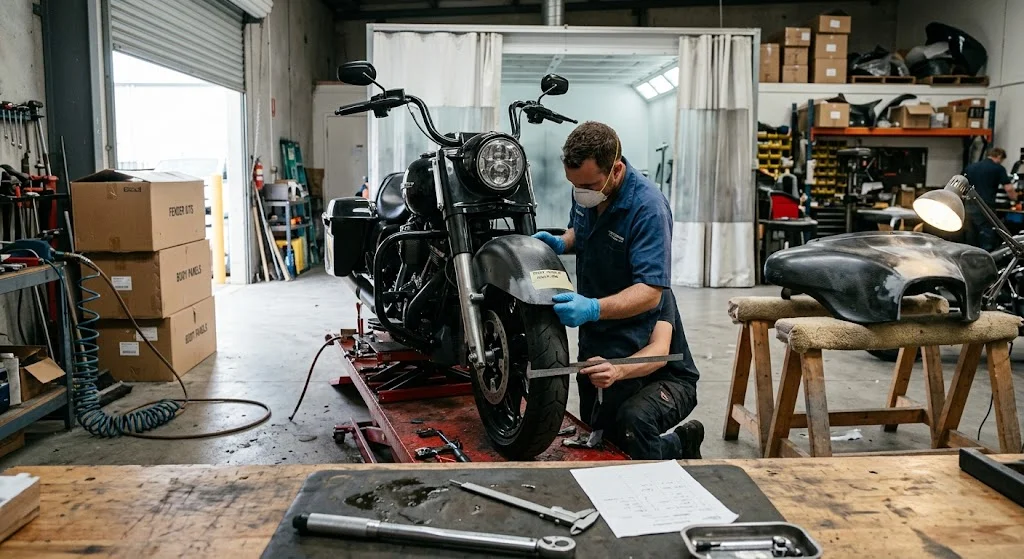
Fenders are where buyer complaints concentrate, because a fender interacts with the fork legs, the tyre envelope and the brake caliper at once. Specify it by mounting-hole pattern and tyre clearance for the exact model year and wheel size: touring platforms have changed fender and wheel dimensions across generations, so "fits Road Glide" is not a specification. Wall thickness is normally 1.8–2.5 mm with thickened bosses at the mounting points; below roughly 1.5 mm the part flexes at speed and cracks paint at the tab edges.
| Component | Typical stock mass | Carbon version | Indicative unit price, USD FOB |
|---|---|---|---|
| Front fender | 1.9–2.6 kg | 0.8–1.2 kg | 180–420 |
| Outer fairing shell | 4.5–6.0 kg | 2.0–2.9 kg | 450–1,100 |
| Inner fairing and dash | 1.4–2.0 kg | 0.6–0.9 kg | 220–520 |
| Windshield | 0.9–1.3 kg | 0.5–0.8 kg | 120–320 |
| Saddlebag lids, pair | 2.2–3.0 kg | 1.0–1.5 kg | 260–600 |
| Side covers, pair | 0.8–1.2 kg | 0.35–0.6 kg | 140–340 |
Carbon Fiber Road Glide Fairing: Structure, Heat and Vibration
A fairing is the most demanding body part in the catalogue: it carries windshield load at highway speed, absorbs engine and road vibration through the mounting points, and sits close to exhaust and cylinder heat. Three requirements follow. First, the mounting tabs need local reinforcement rather than uniform thickness — 3.0–4.0 mm at the tab roots against 2.0–2.5 mm on the shell face. Second, the resin must tolerate sustained surface temperatures around 120–150 °C near the lower fairing, which points to a high-temperature epoxy rather than a general-purpose laminating resin. Third, the inner shell needs clearance for wiring, the gauge cluster and the steering sweep at full lock, checked on a fixture before the mould is approved. With a vented inner fairing, confirm the vent geometry does not load the outer shell at speed.
Sourcing Carbon Fiber Road Glide Parts: Moulds, MOQ and Tooling
Process choice sets both unit price and minimum order quantity, and it is the most common point of misunderstanding between buyer and supplier. Compression moulding gives the best surface and shortest cycle time but is only economic at volume; wet layup is cheap to tool but inconsistent in thickness, which is unacceptable for a fairing that must align with an inner dash. Vacuum bagging and resin transfer moulding are the usual compromise at 50–500 units.
| Process | Tooling, indicative USD | Typical MOQ | Surface quality | Best suited to |
|---|---|---|---|---|
| Wet layup | 1,500–5,000 | 1–10 | B | Prototypes |
| Vacuum bagging | 3,000–12,000 | 20–100 | B+ | Fenders, small covers |
| Prepreg and autoclave | 15,000–60,000 | 50–200 | A− | Structural brackets |
| Resin transfer moulding | 12,000–45,000 | 100–500 | A− | Fairing shells |
| Compression moulding | 25,000–120,000 | 500–5,000 | A | Volume programmes |
Two commercial terms decide the real cost. Tooling ownership: if the supplier holds the mould, switching vendors later means paying for tooling twice, so buy the tool outright when volume justifies it. Exclusivity: a mould paid for by one buyer should not appear in a competitor's catalogue six months later.
Quality Checks Before You Commit
Inspect a pre-production sample against a checklist rather than a photograph:
- Measure wall thickness at the shell face and each mounting tab root; a 0.3 mm batch deviation signals poor process control.
- Cross-hatch a scrap part to test paint adhesion, and heat-cycle a sample near the lower fairing to check for resin softening, print-through or blistering.
- Test-fit on a donor machine with the windshield, inner dash and wiring in place — not on a bare bench.
- Confirm fastener grade, rubber isolators and torque values; the mounting kit causes as many failures as the panel.
- Request the layup record, resin system designation and cure cycle for the production lot.
Frequently Asked Questions
Do carbon fiber Road Glide parts fit every model year?
No. Fender and wheel dimensions, fairing mounting points and dash layouts changed across touring generations, so fitment must be specified by model year and wheel size. Ask which model years the mould was developed against, and test-fit on a donor machine of your exact year before ordering volume.
Is a carbon fiber Road Glide fairing lighter than fibreglass?
Typically 20–30% lighter for the same shell geometry, because a carbon laminate reaches the required stiffness with fewer plies. The bigger saving is against steel and ABS stock parts, where 45–60% reductions are realistic. Impact behaviour is comparable, but carbon deforms less visibly before failing, so inspect mounting areas after any drop.
Should I order exposed weave or painted parts?
Exposed weave demands a defect-free cosmetic laminate and a UV-stable clear coat, raising unit cost by roughly 15–30% and making repairs visible. Painted carbon is more forgiving and hides minor weave variation, so it is the lower-risk choice for high-volume programmes. For a colour-matched fender or fairing, order it primed and let your painter finish it.
Conclusion
Sourcing carbon fiber road glide parts comes down to three controls that have little to do with the material: fitment defined by model year and wheel size rather than model name, process and mould choice matched to expected volume, and an inspection checklist applied to a pre-production sample before tooling is paid for. Get those right and carbon delivers a credible 45–60% mass reduction on body panels with better stiffness at the mounting points than stock ABS or steel. Get them wrong and the same parts generate returns, paint cracking and fitment disputes. To review fitment data, mould options or quality documentation for a specific platform, contact our team with your model year, wheel size and expected annual volume.
Part of topic
Related Articles
- Carbon Fiber Road Glide Windshield: Frame and Trim Options
- Carbon Fiber Road E-Bikes: Weight and Range Tradeoffs
- Carbon Fiber Rods Hobby Lobby: Retail Availability Guide
- Carbon Fiber Sheets eBay: Buying and Selling on Marketplace
- Carbon Fiber Tube 23mm: Standard Sizes and Supplier Sourcing
- Carbon Fiber Tube HSN Code in India: Importer's Classification Guide
Interested in Our Products?
Contact our team for competitive pricing and technical specifications.
Get a QuoteRelated Products

Carbon Fiber Plate — 3K Twill T700 1.5mm
Thin 1.5mm carbon fiber plate with 3K twill weave surface. Lightweight and stiff, commonly used for covers, panels, drone bodies, and applications requiring a premium aesthetic appearance.

Carbon Fiber Plate — 3K Twill T700 3.0mm
Medium-thickness 3.0mm carbon fiber plate offering significantly higher load capacity while maintaining attractive 3K twill finish. Suitable for structural brackets, reinforcement plates, and load-bearing panels.

Square Carbon Fiber Tube — 3K Twill T700
Square cross-section carbon fiber tube manufactured with 3K twill weave for torsional strength. Preferred for structural frames, trusses, and support columns where rectangular geometry offers design flexibility.
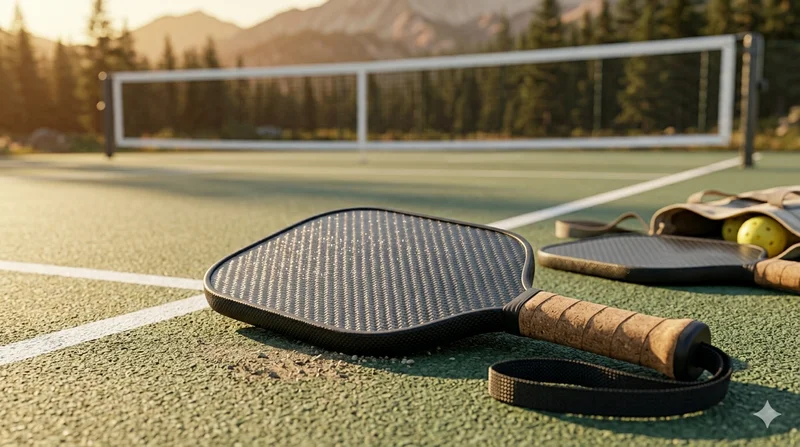
Carbon Fiber Pickleball Paddle
High-performance pickleball paddle with Toray T700 carbon fiber face and polypropylene honeycomb core. Delivers excellent power-to-weight ratio, spin generation, and vibration dampening for competitive play.

Carbon Fiber Trekking Pole
Lightweight carbon fiber trekking pole manufactured from high-grade carbon fiber tube. Weighs only 160g per pole while providing superior shock absorption and durability for hiking, trail running, and backpacking.