
A carbon fiber tube 23mm in outer diameter is one of the most common mid-size stock tubes in the composites trade, and for good reason. At 23mm it is large enough to develop real bending stiffness and load capacity, yet small enough to fit the envelopes of racing drones, robotic arms, camera rigs, a
Introduction
A carbon fiber tube 23mm in outer diameter is one of the most common mid-size stock tubes in the composites trade, and for good reason. At 23mm it is large enough to develop real bending stiffness and load capacity, yet small enough to fit the envelopes of racing drones, robotic arms, camera rigs, and compact automated machinery. Buyers usually arrive at this size either because a design calls for exactly 23mm outer diameter, or because they are matching an existing tube and need the same fit.
The challenge is rarely finding a 23mm tube; it is specifying the right wall thickness, fiber grade, and construction, then sourcing it from a supplier who can actually deliver consistent dimensions and documentation. This guide covers the standard dimensions of a 23mm carbon fiber tube, the properties you can expect, common applications, and what to check when comparing carbon fiber tube suppliers.
What Carbon Fiber Tube 23mm Means in Standard Sizing
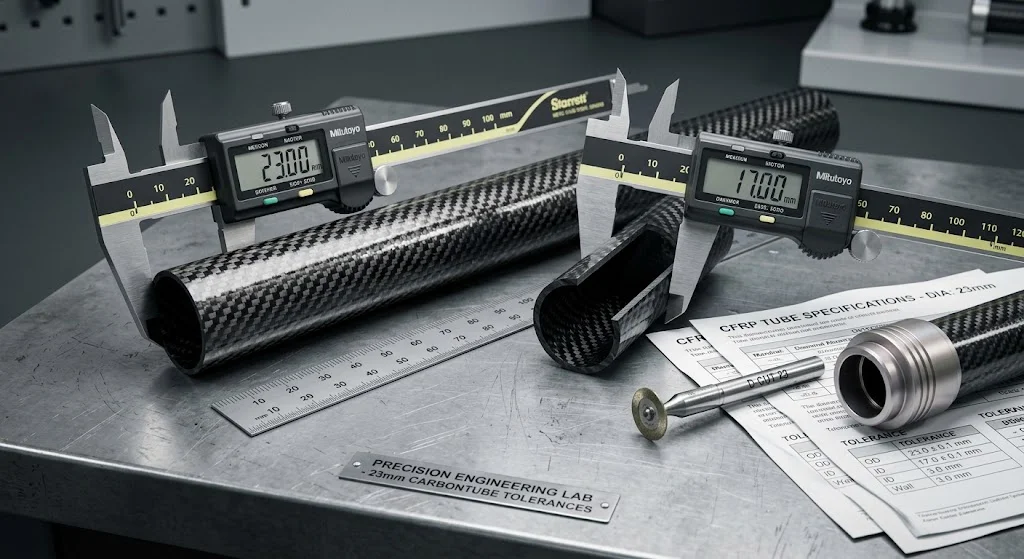
In the composites trade, the tube size is given by its outer diameter (OD), and 23mm is a nominal size that appears in the standard ranges of pultruded and roll-wrapped tubes. The inner diameter (ID) then follows from the wall thickness, and that is where most of the engineering choice lives. A 23mm tube with a 1mm wall has a 21mm ID; with a 2mm wall the ID is 19mm; with a 3mm wall the ID drops to 17mm. The outer dimension stays what a fixture or clamp sees, while the wall sets stiffness, weight, and internal clearance.
Because 23mm is close to the imperial 7/8 inch and 0.9 inch sizes, it is often interchanged with tubes quoted in inches. Always confirm which dimension a supplier is quoting, the OD or the ID, and whether the tolerance is on the outside, inside, or both. A tube described only as "23mm" without a stated reference surface is ambiguous and should be clarified before ordering.
Standard Dimensions and Mechanical Properties
The table below summarises typical configurations of a 23mm carbon fiber tube and how they compare with a solid steel rod of similar bending stiffness. Values are representative of commercial T700 pultruded and filament-wound stock.
| Specification | 23mm Pultruded T700 | 23mm Filament-Wound T700 | 23mm Pultruded T300 |
|---|---|---|---|
| Outer diameter | 23.0 mm | 23.0 mm | 23.0 mm |
| Inner diameter | 17.0 mm | 18.5 mm | 16.5 mm |
| Wall thickness | 3.0 mm | 2.25 mm | 3.25 mm |
| Fiber volume fraction | 60 percent | 55 percent | 55 percent |
| Tensile strength | 3,200 MPa | 2,800 MPa | 2,400 MPa |
| Elastic modulus | 230 GPa | 225 GPa | 210 GPa |
| Density | 1.60 g/cm³ | 1.62 g/cm³ | 1.58 g/cm³ |
| Typical standard length | 3 m | 3 m | 3 m |
For the same bending stiffness as a 23mm carbon fiber tube, a solid steel rod would weigh roughly four to five times more, which is the core reason this size appears in weight-sensitive designs. The choice between pultruded and filament-wound construction then comes down to the load: pultruded tubes carry axial and bending load efficiently and hold tight tolerances, while filament-wound tubes add hoop strength for torsion and internal pressure.
Thin-Wall, Standard, and Thick-Walled 23mm Tube
Wall thickness is the single specification that most changes what a 23mm tube can do, and suppliers usually offer several grades.
- Thin-wall (0.75-1.5mm): Maximum internal clearance and lowest weight, used where the tube is a fairing, a spacer, or a lightly loaded structural member and internal fit matters.
- Standard wall (2-2.5mm): The everyday compromise for drone booms, robot links, and camera poles, balancing stiffness against internal diameter.
- Thick-walled (3-4mm): Selected when the tube is a carbon fiber tube thick walled for high bending or crush load, for high-torque drive components, or where fasteners pass through the wall and need material to bear on.
As a rule, increasing wall thickness raises stiffness almost linearly and strength almost linearly, while increasing diameter raises bending stiffness with the cube of diameter. When the outer size is fixed at 23mm, wall thickness is the only lever left, so thick-walled stock is the correct answer whenever the design is bending-limited.
Applications for 23mm Tubes
The 23mm size is popular across several application families at once.
- Drone and UAV frames: Booms and arms for multirotors, where 23mm gives adequate stiffness for propellers in the 8 to 15 inch range with low rotational inertia.
- Robotic arms and gantries: Link members and rails for medium-reach manipulators and camera sliders, where stiffness per kilogram drives payload.
- Compact machinery: Replacement shafts, rollers, and guides where a steel shaft would be unnecessarily heavy.
- Sports and outdoor gear: Tent pole sections, tripod legs, and hiking pole tubes where the 23mm fit matches common hardware.
- Marine and transport: Pushrods, grab rails, and frame members subject to corrosion, where a resin-rich finish resists salt and moisture.
Sourcing Carbon Fiber Tube Suppliers
Once the specification is settled, sourcing is about consistency and traceability rather than finding the lowest headline price. A reliable carbon fiber tube suppliers shortlist should be judged on four things: whether they stock the exact 23mm OD and wall combination you need, whether they publish dimensional tolerances, whether they can supply the fiber grade and construction consistently from lot to lot, and whether they provide documentation such as material data sheets or test reports for structural work.
For volume buyers, the practical differences between suppliers show up in lead time and finish quality rather than in the tube itself. Pultruded stock is the most widely available and cheapest to source at 23mm; filament-wound stock narrows the field but is worth it when torsion or pressure matters. Ask for a sample length before a large order, measure the OD, ID, and wall at several points, and check straightness, because a tube that is nominally 23mm but bowed or oval will not fit the fixture it was specified for.
Frequently Asked Questions
Is a 23mm carbon fiber tube strong enough for a drone arm or robotic link?
For typical loads, yes, with margin. A 23mm T700 pultruded tube with a 3mm wall handles the bending from propellers in the 8 to 15 inch class and from medium-reach robot links, provided the joints are designed correctly. The limiting factor is usually the bonded or bolted joint rather than the tube, so design the end fittings to spread load into the wall. For heavier or freestyle duties, step up to a 25mm tube or a thicker wall rather than increasing only the fiber grade.
How do I confirm a supplier is quoting outer diameter and not inner diameter?
Ask directly, in writing, and request the OD, ID, and wall thickness for the specific part number. Reputable suppliers list all three and state the tolerance reference surface. If a listing gives only one number, treat it as unverified until confirmed. When the first sample arrives, measure the OD with a caliper at three points along the length and compare with the drawing; a discrepancy of more than the stated tolerance is a reason to reject the lot before it reaches production.
Should I choose pultruded or filament-wound 23mm tube?
Choose pultruded when the load is mainly axial and bending, when you need the tightest dimensional control, and when cost and availability matter, which is most drone, robot, and machinery work. Choose filament-wound when the tube sees significant torsion, internal pressure, or combined hoop and axial loading, since the wound architecture adds hoop strength that pultrusion cannot match. For a 23mm tube used as a drive shaft or pressure-carrying member, filament winding is the correct construction.
Conclusion
A 23mm carbon fiber tube is a versatile, widely stocked size that suits drones, robotics, machinery, and outdoor gear wherever a steel shaft would be too heavy. The outer diameter fixes the fit; the wall thickness and fiber grade decide the performance; and the construction method decides whether the tube is best in bending and axial load or in torsion and pressure. Sourcing comes down to confirming the dimensions precisely and choosing a supplier who documents tolerance and consistency.
YongXian manufactures carbon fiber tubes in 23mm and the full neighbouring range, in T300 and T700 grades, with pultruded and filament-wound constructions and custom wall thicknesses. View our carbon fiber tube range or request a quote with your outer diameter, wall thickness, grade, length, and quantity.
Part of topic
Related Articles
- Carbon Fiber Rods Hobby Lobby: Retail Availability Guide
- Carbon Fiber Sheets eBay: Buying and Selling on Marketplace
- Carbon Fiber Tube HSN Code in India: Importer's Classification Guide
- Carbon Fiber Sheet HSN Code in India: Full Import Classification Guide
- Carbon Fiber Tube HS Code: Export and Import Classification Guide
- Carbon Fiber Tube Australia: Complete Guide
Interested in Our Products?
Contact our team for competitive pricing and technical specifications.
Get a QuoteRelated Products

Carbon Fiber Plate — 3K Twill T700 1.5mm
Thin 1.5mm carbon fiber plate with 3K twill weave surface. Lightweight and stiff, commonly used for covers, panels, drone bodies, and applications requiring a premium aesthetic appearance.

Carbon Fiber Plate — 3K Twill T700 3.0mm
Medium-thickness 3.0mm carbon fiber plate offering significantly higher load capacity while maintaining attractive 3K twill finish. Suitable for structural brackets, reinforcement plates, and load-bearing panels.

Square Carbon Fiber Tube — 3K Twill T700
Square cross-section carbon fiber tube manufactured with 3K twill weave for torsional strength. Preferred for structural frames, trusses, and support columns where rectangular geometry offers design flexibility.
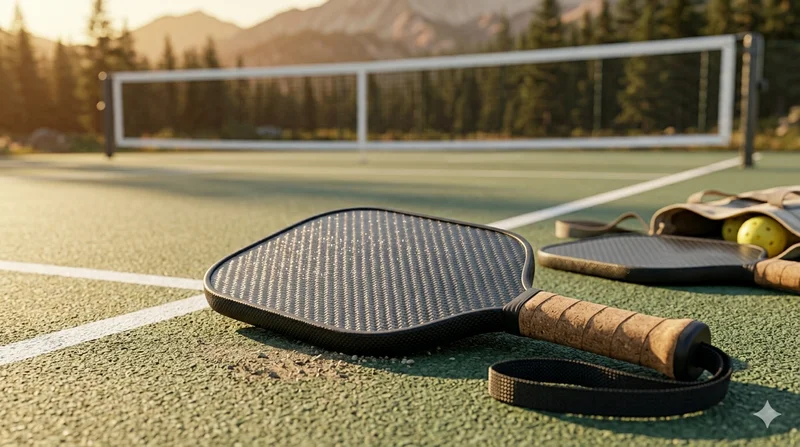
Carbon Fiber Pickleball Paddle
High-performance pickleball paddle with Toray T700 carbon fiber face and polypropylene honeycomb core. Delivers excellent power-to-weight ratio, spin generation, and vibration dampening for competitive play.

Carbon Fiber Trekking Pole
Lightweight carbon fiber trekking pole manufactured from high-grade carbon fiber tube. Weighs only 160g per pole while providing superior shock absorption and durability for hiking, trail running, and backpacking.