
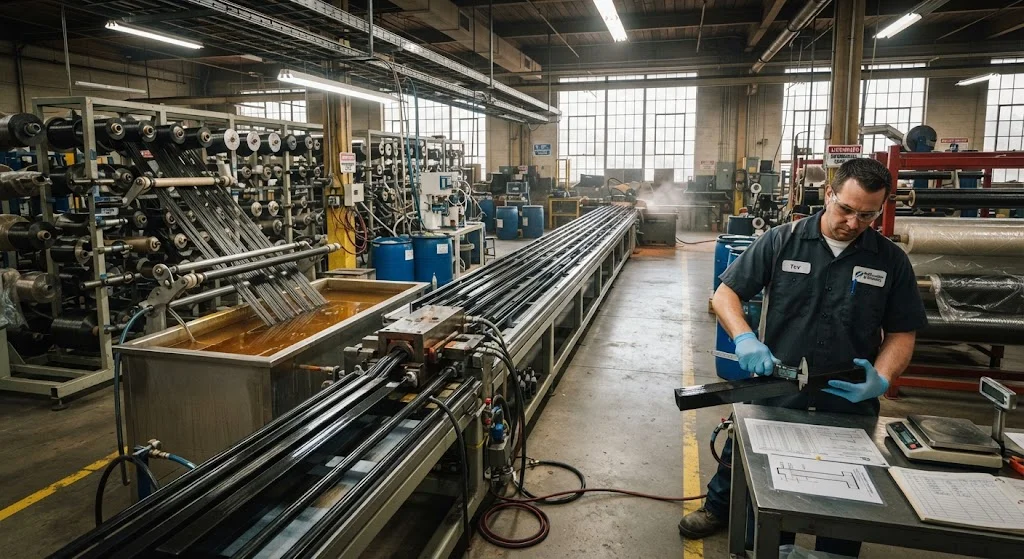
The search for carbon fiber pultrusion suppliers USA engineering teams can depend on has grown steadily as infrastructure, transportation, and industrial applications adopt composite profiles. Pultrusion is a continuous process that pulls fiber through a resin bath and a heated die to produce consta
Introduction
The search for carbon fiber pultrusion suppliers USA engineering teams can depend on has grown steadily as infrastructure, transportation, and industrial applications adopt composite profiles. Pultrusion is a continuous process that pulls fiber through a resin bath and a heated die to produce constant-cross-section profiles — rods, tubes, angles, channels, and custom shapes — with unidirectional fiber aligned along the length. Carbon fiber pultruded profiles deliver the highest stiffness-to-weight ratio of any pultrusion material system, making them the default choice for lightweight structural members, long-span cable supports, and dimensionally stable machine components.
The decision between domestic and overseas carbon fiber pultrusion suppliers hinges on three variables: lead time, tooling and freight cost, and technical support. US-based suppliers offer shorter lead times and direct engineering collaboration but charge higher material premiums. Overseas suppliers offer lower unit prices but add weeks of transit time and complicate specification control. This article compares the two sourcing routes and provides a framework for selecting carbon fiber pultrusion suppliers USA programs can work with across the full product lifecycle.
The US Carbon Fiber Pultrusion Supply Landscape
The United States hosts an established pultrusion industry built originally on fiberglass and increasingly on carbon fiber and hybrid systems. Major domestic pultruders include Strongwell in Bristol, Virginia, one of the largest pultrusion specialists in the world; Bedford Reinforced Plastics in Bedford, Pennsylvania; Creative Pultrusions in Alum Bank, Pennsylvania; and Fibergrate Composite Structures in Dallas, Texas, which focuses on grating and industrial flooring. International groups such as Exel Composites also operate US facilities, adding global capacity to the domestic base.
Several characteristics define the domestic supply landscape:
- Tooling depth: US pultruders maintain large die inventories and custom tooling expertise, with typical die lead times of 3-6 weeks for new profiles.
- Aerospace and defense qualification: Several US pultruders hold AS9100 certification and supply carbon fiber profiles for aircraft secondary structures and defense hardware.
- Hybrid capability: Domestic suppliers commonly combine carbon and glass reinforcement in one profile to tune stiffness and cost, a hybrid capability every CFRP pultrusion manufacturer should be asked to confirm.
- Standards alignment: US suppliers produce to ASTM D3917 and D3918 dimensional standards and can provide full material traceability.
The domestic base is smaller than the fiberglass pultrusion market in terms of carbon-specific capacity, so buyers with high-volume carbon programs should verify actual machine availability rather than assume spare capacity. Several domestic pultruders run dedicated carbon lines with controlled fiber tension and resin chemistry, which matters for dimensional consistency across long production runs of structural profiles.
Comparing Carbon Fiber Pultrusion Suppliers USA: Capabilities and Lead Times
When comparing carbon fiber pultrusion suppliers USA, buyers should evaluate five dimensions: fiber grades offered, profile complexity, quality systems, lead time, and minimum order quantities. The table below summarizes typical ranges for domestic suppliers:
| Evaluation Dimension | Typical Domestic Range | What to Verify |
|---|---|---|
| Fiber grades | 3K, 12K, 24K tow; standard and intermediate modulus | Availability of high-modulus fiber and hybrid carbon-glass systems |
| Profile complexity | Simple rods to complex multi-void custom shapes | Die design capability and dimensional tolerance control |
| Quality systems | ISO 9001 baseline; AS9100 for aerospace suppliers | Current certificates and lot-level test documentation |
| Lead time (custom profile) | 4-8 weeks after tooling acceptance | Current backlog and confirmed production slots |
| MOQ | 500-2,000 linear feet per profile run | Waste factor on first runs and split-run availability |
Lead time deserves particular attention. For a custom profile, the buyer must budget for 3-6 weeks of die manufacturing before production even begins, then 4-8 weeks for the first production run. Buyers comparing carbon fiber pultrusion suppliers USA should request a written production slot commitment, because machine availability — not material cost — is the most common bottleneck in domestic pultrusion. For stiffness-critical applications, the modulus gap between carbon and glass profiles is the deciding factor, and intermediate-modulus carbon fiber narrows the weight penalty further.
Carbon Fiber Pultrusion vs Fiberglass Pultrusion
Carbon and glass pultrusion serve different cost-performance niches, and the wrong choice wastes either money or structural performance. The comparison below highlights the key differences:
| Property | Carbon Fiber Pultrusion | Fiberglass (E-Glass) Pultrusion |
|---|---|---|
| Tensile modulus | 120-230 GPa (standard to intermediate modulus) | 35-50 GPa |
| Tensile strength | 1,500-2,400 MPa (unidirectional) | 700-1,000 MPa |
| Density | 1.55-1.60 g/cm³ | 1.90-2.10 g/cm³ |
| Material cost | $25-60 per pound depending on grade | $3-8 per pound |
| Stiffness-to-weight | Highest available in pultrusion | Moderate |
| Typical applications | Lightweight structural members, cable trays, robotic arms, antenna masts | Corrosion-resistant gratings, handrails, electrical insulators |
Carbon pultrusion is justified when weight reduction, dimensional stability, or stiffness drives the design. For corrosion-resistant industrial parts where stiffness is secondary, fiberglass remains the economical choice. Hybrid carbon-glass profiles let buyers capture partial carbon performance at a controlled cost.
Sourcing Strategy: Domestic US Suppliers vs Overseas Imports
For buyers weighing carbon fiber pultrusion suppliers USA against import routes, the tradeoff is predictable. A domestic custom profile typically costs 20-40% more per unit than an equivalent import, but arrives in 4-8 weeks rather than 12-18 weeks, avoids ocean freight and customs handling, and comes with direct engineering support for die design and specification changes.
Import sourcing makes sense when the profile is standard, the volume is high enough to amortize tooling and freight, and specification control can be maintained remotely — the same three tests any evaluation of a pultruded carbon fiber supplier should apply before tooling commitment. Freight and handling also favor domestic supply for long profile sections, since 20-40 foot profile bundles are costly to ship internationally and vulnerable to handling damage. Buyers should also consider tariff and duty exposure on carbon fiber products, which has shifted several programs back to domestic suppliers in recent years. A practical approach for many buyers is to use a domestic supplier for prototypes and first production runs, then evaluate imports once the design and quality baseline are locked.
Frequently Asked Questions
How long does it take to get a custom carbon fiber pultrusion profile from a US supplier?
Budget 3-6 weeks for die manufacturing and 4-8 weeks for the first production run after tooling acceptance, for a total of roughly 8-14 weeks for a custom profile. Standard profiles already in the supplier's die library can ship in 2-4 weeks. Confirm a production slot in writing, since machine availability is the most common bottleneck.
What is the cost difference between domestic and imported carbon fiber pultrusion?
Domestic custom profiles typically cost 20-40% more per unit than imports, but imports add 6-10 weeks of transit and customs time, freight cost, and potential tariff exposure. For low-volume or specification-sensitive programs, the domestic premium is often offset by shorter lead time and direct engineering support.
Can carbon fiber pultruded profiles replace aluminum extrusions?
In many structural applications, yes. Carbon fiber pultrusion offers up to three times the specific stiffness of aluminum at lower density, with better fatigue resistance and no galvanic corrosion issues when paired with composite or coated hardware. The tradeoffs are higher material cost and different joining methods, which the design team must address early.
Conclusion
Selecting among carbon fiber pultrusion suppliers USA programs depend on requires evaluating fiber grades, profile complexity, quality systems, lead time, and total cost including freight and tooling. Domestic suppliers deliver shorter lead times and closer technical collaboration, while imports offer lower unit prices for standard profiles at higher logistics cost. Matching the sourcing route to the product lifecycle stage controls both cost and risk.
YongXian supplies carbon fiber pultruded profiles, fabrics, and reinforcement materials with full technical support. Explore our carbon fiber product range or contact our engineering team to discuss profile specifications for your application.
Part of topic
Related Articles
- Carbon Fiber Tube Manufacturers: Procurement Guide for Engineering Buyers
- Carbon Fibre Manufacturers UK: NCC Research Hub and Supply Chain Layout
- Carbon Fiber Manufacturers USA: Aerospace-Grade Capacity and Certification Status
- Carbon Fiber Supplier Philippines: Southeast Asian Manufacturing Hub Emergence
- US Carbon Fiber Manufacturers: Hexcel, MAGNA and Emerging Domestic Capacity
- Carbon Fiber Products Manufacturer Guide: Evaluating Certification, Capacity, and Delivery Capabilities
Interested in Our Products?
Contact our team for competitive pricing and technical specifications.
Get a QuoteRelated Products
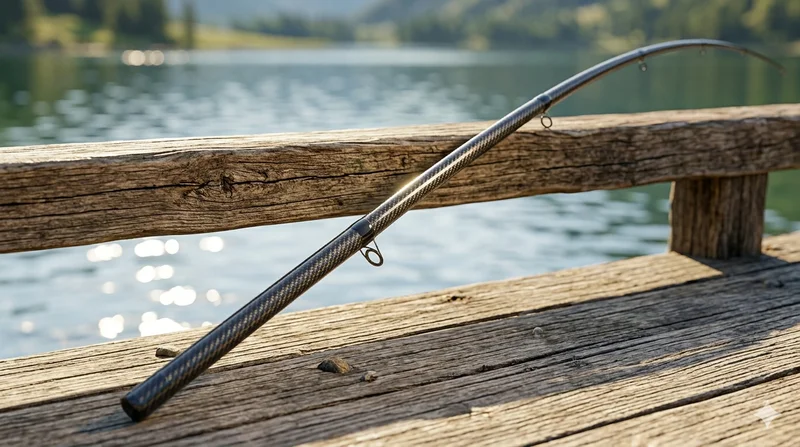
Carbon Fiber Fishing Rod Blank
High-quality carbon fiber fishing rod blank manufactured from multiple grades of Toray carbon fiber cloth. Available in a wide range of lengths, powers, and actions for freshwater and saltwater applications. Suitable for OEM rod building.

Carbon Fiber Plate — 3K Twill T700 1.5mm
Thin 1.5mm carbon fiber plate with 3K twill weave surface. Lightweight and stiff, commonly used for covers, panels, drone bodies, and applications requiring a premium aesthetic appearance.

Carbon Fiber Plate — 3K Twill T700 3.0mm
Medium-thickness 3.0mm carbon fiber plate offering significantly higher load capacity while maintaining attractive 3K twill finish. Suitable for structural brackets, reinforcement plates, and load-bearing panels.
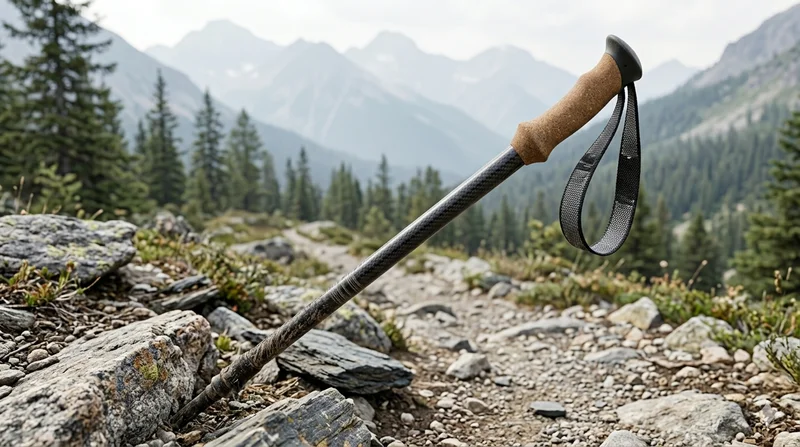
Carbon Fiber Trekking Pole
Lightweight carbon fiber trekking pole manufactured from high-grade carbon fiber tube. Weighs only 160g per pole while providing superior shock absorption and durability for hiking, trail running, and backpacking.

Square Carbon Fiber Tube — 3K Twill T700
Square cross-section carbon fiber tube manufactured with 3K twill weave for torsional strength. Preferred for structural frames, trusses, and support columns where rectangular geometry offers design flexibility.