
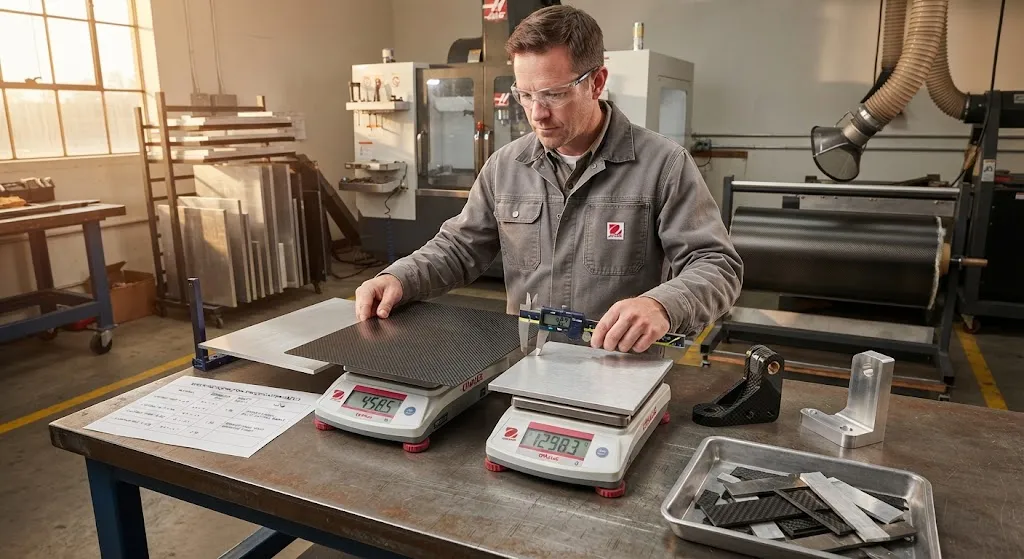
Carbon fiber plate vs aluminum is the comparison a buyer runs whenever a bracket, base plate, gasket or machined spacer has to be light and stiff. Both materials arrive as flat stock measured in millimetres of thickness, and both can be sawn, drilled and bolted, so the choice looks simple until dens
Introduction
Carbon fiber plate vs aluminum is the comparison a buyer runs whenever a bracket, base plate, gasket or machined spacer has to be light and stiff. Both materials arrive as flat stock measured in millimetres of thickness, and both can be sawn, drilled and bolted, so the choice looks simple until density, stiffness, thermal behaviour and price are placed side by side. A cured carbon fiber plate has a density of 1.55 to 1.60 grams per cubic centimetre against 2.70 for aluminum, and that gap drives everything else. This guide compares the two from a buyer's point of view, with the figures that decide a purchase order.
The conclusion in advance: a carbon fiber plate wins where weight and stiffness drive the design, and aluminum wins where cost, isotropy and easy machining drive it. The sections below show how to tell which case applies to a given part.
Carbon Fiber Plate vs Aluminum: What the Buyer Needs to Know
A carbon fiber plate is a cured laminate, usually epoxy reinforced with standard-modulus carbon fibre, supplied in thicknesses from about 1 millimetre to 12 millimetres or more. An aluminum plate is a rolled or cast product, most often 6061-T6, supplied in the same thickness range. The two look interchangeable in a stock list, yet their density differs by 40 percent and their stiffness is directional in one case and uniform in the other. A buyer who treats them as drop-in equivalents will either pay far too much for stiffness that was never needed, or order a plate that is too flexible once the load direction is taken into account. Clarifying the load case before comparing prices is the single most useful step a buyer can take.
Carbon Fiber Plate Density and Stiffness-to-Weight
Carbon fiber plate density is typically 1.55 to 1.60 grams per cubic centimetre, against 2.70 for aluminum 6061-T6. The practical consequence is easy to work out: a 4 millimetre carbon fiber plate weighs about 6.4 kilograms per square metre, while a 4 millimetre aluminum plate of the same size weighs about 10.8 kilograms per square metre. At equal thickness the carbon plate saves roughly 40 percent of the mass, and because its specific stiffness is higher, a 3 millimetre carbon plate can often do the job of a 4 millimetre aluminum plate, widening the saving further.
The stiffness of a carbon fiber plate depends on how the fibres are arranged. A quasi-isotropic plate, with fibres running in several directions, reaches a flexural modulus of about 50 to 70 gigapascals. A plate with more fibres aligned to the bending direction goes higher, and one with fewer goes lower. Aluminum, by contrast, offers the same 69 gigapascals in every direction. For a part loaded mainly in one direction, that difference is exactly what makes a carbon fiber plate efficient.
Mechanical and Physical Data at a Glance
The table compares a 4 millimetre carbon fiber plate with a 4 millimetre aluminum 6061-T6 plate of the same footprint.
| Property | Carbon Fiber Plate (4 mm) | Aluminum 6061-T6 (4 mm) |
|---|---|---|
| Density | 1.55-1.60 g/cm³ | 2.70 g/cm³ |
| Areal mass | 6.2-6.4 kg/m² | 10.8 kg/m² |
| Flexural modulus | 50-70 GPa quasi-isotropic | 69 GPa |
| Flexural strength | 600-1,200 MPa | 330 MPa |
| Specific stiffness | 31-44 GPa per g/cm³ | 26 GPa per g/cm³ |
| Thermal expansion | 0-3 ppm per °C | 23 ppm per °C |
| Machining | Diamond or carbide tooling; abrasive dust; no welding | Standard carbide tooling; weldable |
| Relative plate cost | 6-15 times aluminum | Baseline |
Two figures matter most to a buyer. The areal mass shows the direct weight saving at equal thickness, and the relative cost shows what that saving costs. A carbon fiber plate at six to fifteen times the price of aluminum is justified only when the removed mass is valuable, which is why the two materials rarely compete head-on in the same part.
Carbon Fiber Plate vs Aluminum in Machining and Assembly
Machining and assembly separate the two materials as much as density does. The key points are:
- Cutting: Aluminum is cut and drilled with ordinary high-speed steel or carbide. Carbon fiber plate demands diamond or carbide tooling, controlled feed rates and dust extraction, because the dust is abrasive and conductive.
- Threads and fasteners: Aluminum can be tapped directly. Carbon fiber plate usually needs a threaded insert or a bonded boss, because a bare thread in the laminate is weak and can delaminate.
- Joining: Aluminum can be welded or bolted; carbon fiber plate is bonded or bolted through inserts and must be isolated from aluminum to avoid galvanic corrosion.
- Tolerance: Both machine to tight tolerance, but carbon fiber plate can chip at edges and needs sharp tooling and light finishing passes.
For a buyer this means the total cost of a carbon fiber part includes tooling, dust handling and inserts, not just the plate price. Factoring those in early avoids the common surprise where a cheap-looking carbon plate becomes expensive once machining is added.
Sheet, Plate and Tube: Reading the Product Names
The same logic covers neighbouring products. A carbon fiber sheet vs aluminum sheet comparison uses exactly the numbers above, and only the thickness range changes. A carbon fiber tube vs aluminum tube comparison adds geometry: a round tube carries bending and torsion far more efficiently than a flat section, so tube-versus-tube differences in stiffness per kilogram are even larger than plate-versus-plate. When specifying, state thickness, fibre orientation and load direction, because these three variables, not the material name alone, decide whether the part meets its stiffness target.
One further point for buyers: request the lay-up schedule and the fibre volume fraction, not just the thickness. Two plates of the same 4 millimetre thickness can differ in stiffness by 30 percent or more depending on fibre orientation, and a supplier who cannot state the schedule cannot guarantee the stiffness. Where a part is loaded in a single direction, a plate with more axial fibres can meet the target at lower mass, but it will be weaker across the other directions, so the load case must be clear before the plate is ordered.
Frequently Asked Questions
How heavy is a 4 mm carbon fiber plate compared with aluminum?
A 4 millimetre carbon fiber plate weighs about 6.2 to 6.4 kilograms per square metre, while a 4 millimetre aluminum 6061-T6 plate weighs about 10.8 kilograms per square metre. The saving is roughly 40 percent at equal thickness, and it can grow further if the higher specific stiffness of the carbon plate allows a thinner plate to be used.
Is a carbon fiber plate stiffer than aluminum?
Per kilogram, yes; per millimetre of thickness, not necessarily. A quasi-isotropic carbon fiber plate reaches a flexural modulus of about 50 to 70 gigapascals, close to the 69 gigapascals of aluminum, but at 1.55 to 1.60 grams per cubic centimetre its specific stiffness is higher. A plate aligned with the bending direction can be much stiffer still, which is why fibre orientation must be specified alongside thickness.
Can I machine a carbon fiber plate like aluminum?
You can cut and drill it, but not with the same ease. Carbon fiber plate needs diamond or carbide tooling, dust extraction and careful feeds and speeds, and it cannot be welded. Threads are usually replaced by inserts or bonded bosses. Budget for those extra steps when comparing the price of a carbon fiber plate with an aluminum one.
Conclusion
Carbon fiber plate vs aluminum is a trade between mass and money. The carbon plate is about 40 percent lighter at equal thickness and offers higher stiffness per kilogram, but it costs six to fifteen times more and requires more careful machining and joining. Aluminum remains the sensible default for prototypes, high-volume brackets and parts where cost and isotropy come first. A buyer who knows the load direction, the thickness and the value of the removed mass can place any given part on the right side of that line.
If you need carbon fiber plate supplied with clear density, thickness and stiffness data, browse our carbon fiber plate range, or contact our team for datasheets and buyer support.
Part of topic
Related Articles
- Carbon Fiber Tube Repair: Methods, Limits and When to Replace
- Carbon Fiber Tube Thick Walled: Design Considerations and Applications
- Carbon Fiber Tube Weight: How to Estimate Weight per Meter
- Carbon Fiber Rod vs Fiberglass: Stiffness, Fatigue and Cost
- Carbon Fiber Rod vs Graphite: Key Differences Explained
- Carbon Fiber Tube vs Steel: Strength-to-Weight Analysis
Interested in Our Products?
Contact our team for competitive pricing and technical specifications.
Get a QuoteRelated Products

Carbon Fiber Plate — 3K Twill T700 1.5mm
Thin 1.5mm carbon fiber plate with 3K twill weave surface. Lightweight and stiff, commonly used for covers, panels, drone bodies, and applications requiring a premium aesthetic appearance.

Carbon Fiber Plate — 3K Twill T700 3.0mm
Medium-thickness 3.0mm carbon fiber plate offering significantly higher load capacity while maintaining attractive 3K twill finish. Suitable for structural brackets, reinforcement plates, and load-bearing panels.

Square Carbon Fiber Tube — 3K Twill T700
Square cross-section carbon fiber tube manufactured with 3K twill weave for torsional strength. Preferred for structural frames, trusses, and support columns where rectangular geometry offers design flexibility.
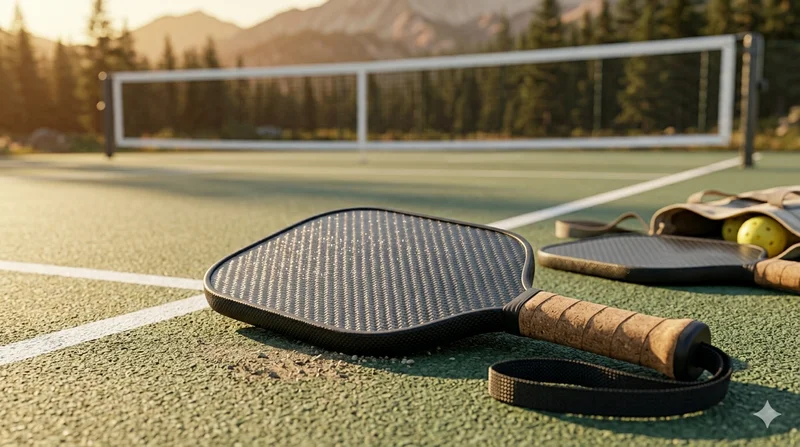
Carbon Fiber Pickleball Paddle
High-performance pickleball paddle with Toray T700 carbon fiber face and polypropylene honeycomb core. Delivers excellent power-to-weight ratio, spin generation, and vibration dampening for competitive play.

Carbon Fiber Trekking Pole
Lightweight carbon fiber trekking pole manufactured from high-grade carbon fiber tube. Weighs only 160g per pole while providing superior shock absorption and durability for hiking, trail running, and backpacking.