
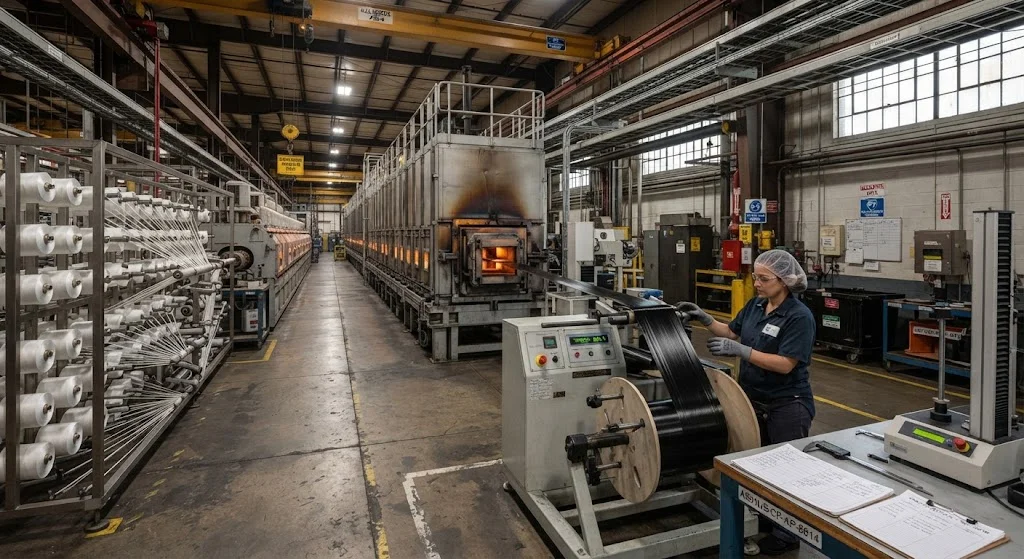
Evaluating carbon fiber manufacturers USA for an aerospace program is a different exercise from buying industrial tow. Aerospace-grade material sits behind a qualification wall that few producers clear, and the list of carbon fiber manufacturers USA that can ship to a commercial or defense airframe
Introduction
Evaluating carbon fiber manufacturers USA for an aerospace program is a different exercise from buying industrial tow. Aerospace-grade material sits behind a qualification wall that few producers clear, and the list of carbon fiber manufacturers USA that can ship to a commercial or defense airframe program is short. Demand in 2026 comes from three directions at once: the commercial aircraft build-rate recovery, defense programs that require domestic material under supply-security rules, and large-tow industrial consumption from wind and hydrogen that keeps the standard-modulus lines full. This article maps the aerospace-grade producers, their capacity and expansion status, and the certification framework that governs who may supply.
The purpose is practical. Engineering and procurement teams need a working map of American CFRP manufacturing capability, not a promotional overview. The sections below separate fiber producers from converters, list the grades each supplies, and set out the certification evidence to request during supplier evaluation.
Aerospace-Grade Carbon Fiber Manufacturers USA: Who Produces What
The aerospace-grade base is concentrated in a handful of producers, most of them subsidiaries of global groups but with genuine US production sites. Hexcel, headquartered in Stamford, Connecticut, runs carbon fiber production in Salt Lake City, Utah and Casa Grande, Arizona, and is the largest US producer of aerospace-grade fiber under the HexTow brand, supplying AS4 and IM7 grades used in commercial airframe structures. Toray Composite Materials America operates a large plant in Decatur, Alabama, producing standard-modulus fiber for wind, pressure vessels, and industrial use while running a multi-year expansion announced after Zoltek was folded into the Toray group.
Teijin Carbon America runs carbon fiber production in the southeastern United States and supplies its Tenax brand to aerospace, automotive, and industrial customers. Syensqo, the former Solvay specialty polymers business, produces aerospace-grade carbon fiber and prepreg in Greenville, South Carolina, and remains a primary supplier for secondary aircraft structures. Mitsubishi Chemical Carbon Fiber and Composites operates in Sacramento, California, completing the dedicated aerospace tier. The table below summarizes the aerospace-relevant producers and what they actually sell:
| Producer | US Production Base | Core Products | Typical Grade Focus |
|---|---|---|---|
| Hexcel | Salt Lake City, UT; Casa Grande, AZ | PAN tow, prepreg, honeycomb | Aerospace: AS4, IM7, HexTow |
| Toray Composite Materials America | Decatur, AL | Standard-modulus tow, prepreg | Industrial and wind: T700 class, 24K-60K |
| Teijin Carbon America | Southeastern United States | Standard and intermediate-modulus fiber | Tenax: automotive, aerospace, industrial |
| Syensqo (formerly Solvay) | Greenville, SC | Aerospace-grade fiber and prepreg | Airframe and space structures |
| Mitsubishi Chemical CF & Composites | Sacramento, CA | Fiber, prepreg, composite parts | Aerospace and specialty industrial |
| Zoltek (Toray group) | HQ in St. Louis; production in Hungary and Mexico | Low-cost large tow (48K-50K) | PX35 class: wind, automotive, infrastructure |
The pattern is clear: aerospace-grade capability sits in a few specialized plants, while standard-modulus capacity is larger and more closely tied to wind and hydrogen programs. Buyers with airframe requirements should expect a qualification cycle measured in months; industrial buyers can move far faster, especially with large-tow material.
USA Carbon Fiber Production Capacity and Expansion
USA carbon fiber production capacity is expanding for the first time in a decade, and the driver is domestic supply security rather than commercial optimism alone. Defense programs have created the strongest pull: the Department of Defense has identified domestic carbon fiber and PAN precursor as critical supply-chain gaps and has funded multiple expansion and qualification projects since 2023, including efforts to restart or scale precursor production inside the United States. On the energy side, growth in southeastern wind-blade manufacturing and Type IV hydrogen pressure-vessel construction has lifted demand for standard-modulus tow, supporting the Decatur expansion and similar investments across the supply chain.
Two emerging dynamics deserve buyer attention. First, the boundary between American brand and American production is narrowing: more of the fiber sold by US-headquartered companies is actually made onshore, which changes the math for programs with domestic-content requirements. Second, new entrants and specialty producers are appearing at the edges, often in recycled carbon fiber, aerospace-grade tow from novel precursor routes, or large-tow formats optimized for pultrusion and additive manufacturing. These emerging sources rarely displace established producers in critical programs, but they raise competition on price and lead time at the industrial end of the market.
Certification Status: What Aerospace Buyers Must Verify
Certification status is where aerospace sourcing succeeds or fails. The first layer is the quality management system: an aerospace-grade producer should hold AS9100 certification, and its special processes should be Nadcap-approved, with fiber production covered under the composites accreditation and prepreg under its own audit category. The second layer is material qualification: aerospace buyers require mechanical test data generated against the same methods used for the published datasheet, batch-level traceability back to precursor lots, and often a formal qualification program aligned to OEM specifications. The third layer is compliance, where defense work adds ITAR and domestic-content obligations that must be confirmed before any award.
A practical sequence for a new aerospace program begins well before design freeze. Buyers should confirm the following:
- AS9100 certification and the scope of registration, verified against the certification body's current record rather than a supplier-provided copy.
- Nadcap approvals for the relevant special processes, including composite fiber and prepreg audit categories.
- Batch-level mechanical data for tensile, modulus, and strain to failure, with the test method and sample population disclosed.
- Precursor traceability from PAN lot through carbonization to the shipped tow, so that a field issue can be traced to its source.
- Export-control status of the grade, since high-modulus and high-tensile fiber can fall under dual-use regulation.
Suppliers who clear a strict audit share three habits: they publish clear batch documentation, they maintain documented environmental control for wet-lay and prepreg material, and they respond to formal corrective-action requests without friction.
Supply Chain and Qualification Pathways
The American CFRP manufacturing base is best understood as three layers. Fiber and tow producers sell carbon fiber in its raw form, defined by grade, tow size, and mechanical properties. Intermediate processors convert tow into fabrics, prepreg, pultruded profiles, and molded parts, and most US composite manufacturers work at this layer. System integrators buy finished components and run programs, sending demand signals back through the first two layers. For most buyers reading this guide, the practical conclusion is simple: identify the grade and form you need, then choose the supply-chain layer that matches your volume and technical requirement. A supplier for a prototype part and a supplier for a 100,000-unit program are different companies even when they sit in the same state.
Frequently Asked Questions
Who are the largest carbon fiber manufacturers USA?
Hexcel is the largest US producer of aerospace-grade carbon fiber, with plants in Utah and Arizona. Toray Composite Materials America in Alabama is the largest domestic producer of standard-modulus industrial tow, followed by Teijin Carbon America in the Southeast. The aerospace tier is completed by Syensqo and Mitsubishi Chemical.
What certification do aerospace carbon fiber suppliers need?
An aerospace-grade producer should hold AS9100 quality certification and Nadcap approval for its composite special processes, plus material qualification data generated against aerospace test methods and batch-level traceability. Defense programs add ITAR and domestic-content obligations that must be verified before award.
Why is USA carbon fiber production expanding in 2026?
Defense programs require domestic material under supply-security rules, wind and hydrogen demand consumes large volumes of standard-modulus tow, and the Department of Defense has funded precursor and fiber expansion projects since 2023. These three forces together are drawing new capacity into the United States.
How long does it take to qualify a US carbon fiber supplier for aerospace?
Aerospace qualification typically runs for months, not weeks. Material qualification, Nadcap special-process approval, and OEM specification alignment all require calendar time that cannot be compressed after production dates are fixed. Starting the qualification conversation before design freeze is the single most effective way to protect a schedule.
Conclusion
The map of carbon fiber manufacturers USA is now clear enough for disciplined decisions. Aerospace-grade capability is concentrated in Hexcel, Syensqo, and Mitsubishi Chemical; standard-modulus volume sits with Toray in Alabama and Teijin in the Southeast; Zoltek supports low-cost large-tow supply; and defense and energy programs are drawing new capacity onshore every quarter. For buyers, the deciding factor is the discipline of the qualification process, which separates programs that buy well from those that save at purchase and pay later.
YongXian supplies carbon fiber fabrics, prepregs, profiles, and finished composite components with full engineering support. Explore our carbon fiber product range or contact our engineering team to match a domestic or international source to your program.
Part of topic
Related Articles
- Carbon Fiber Tube Manufacturers: Procurement Guide for Engineering Buyers
- Carbon Fibre Manufacturers UK: NCC Research Hub and Supply Chain Layout
- Carbon Fiber Supplier Philippines: Southeast Asian Manufacturing Hub Emergence
- US Carbon Fiber Manufacturers: Hexcel, MAGNA and Emerging Domestic Capacity
- Carbon Fiber Pultrusion Suppliers USA: Domestic Capacity and Lead Time Comparison
- Carbon Fiber Products Manufacturer Guide: Evaluating Certification, Capacity, and Delivery Capabilities
Interested in Our Products?
Contact our team for competitive pricing and technical specifications.
Get a QuoteRelated Products
Carbon Fiber Fishing Rod Blank
High-quality carbon fiber fishing rod blank manufactured from multiple grades of Toray carbon fiber cloth. Available in a wide range of lengths, powers, and actions for freshwater and saltwater applications. Suitable for OEM rod building.

Carbon Fiber Plate — 3K Twill T700 1.5mm
Thin 1.5mm carbon fiber plate with 3K twill weave surface. Lightweight and stiff, commonly used for covers, panels, drone bodies, and applications requiring a premium aesthetic appearance.

Carbon Fiber Plate — 3K Twill T700 3.0mm
Medium-thickness 3.0mm carbon fiber plate offering significantly higher load capacity while maintaining attractive 3K twill finish. Suitable for structural brackets, reinforcement plates, and load-bearing panels.

Carbon Fiber Trekking Pole
Lightweight carbon fiber trekking pole manufactured from high-grade carbon fiber tube. Weighs only 160g per pole while providing superior shock absorption and durability for hiking, trail running, and backpacking.

Square Carbon Fiber Tube — 3K Twill T700
Square cross-section carbon fiber tube manufactured with 3K twill weave for torsional strength. Preferred for structural frames, trusses, and support columns where rectangular geometry offers design flexibility.