
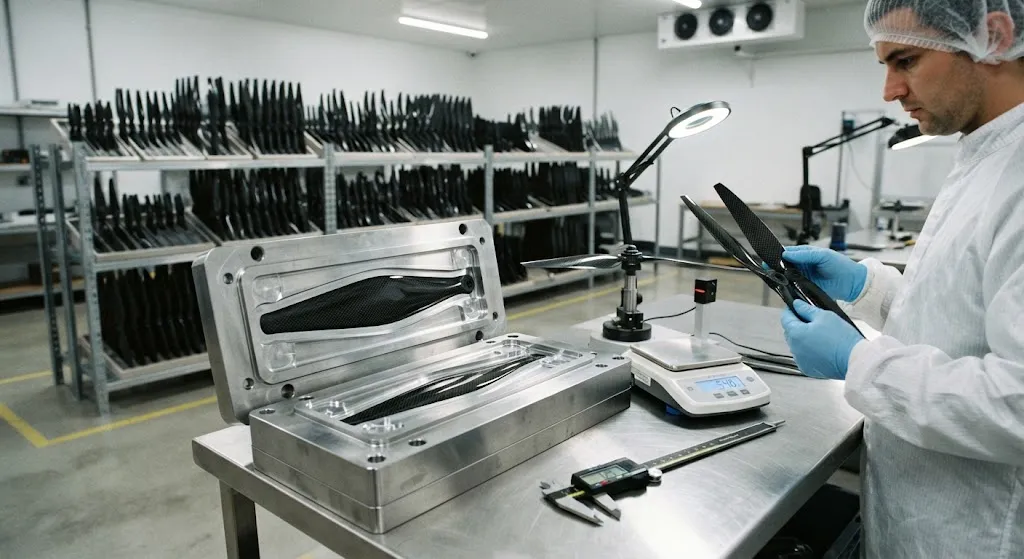
Carbon fiber drone blades have become the standard upgrade for pilots who need predictable thrust, crisp control response, and endurance from their aircraft. A molded plastic propeller flexes under load, and that flex changes the blade pitch angle as rpm changes, which limits how accurately the flig
Introduction
Carbon fiber drone blades have become the standard upgrade for pilots who need predictable thrust, crisp control response, and endurance from their aircraft. A molded plastic propeller flexes under load, and that flex changes the blade pitch angle as rpm changes, which limits how accurately the flight controller can hold a hover or execute a maneuver. Carbon fiber drone blades hold their geometry because the material is roughly three to four times stiffer than nylon or polycarbonate at a fraction of the weight, so the propeller that leaves the balancing station is the same propeller that flies at the end of the flight.
This article covers the construction of CFRP propeller blades, the layup and curing choices that determine their performance, the dynamic balancing that makes a matched set, and the noise-reduction strategies that matter for urban, inspection, and racing operations.
Why Carbon Fiber Drone Blades Outperform Molded Plastic Props
Propeller performance is governed by the relationship between stiffness, mass, and aerodynamic loading. A prop blade is a cantilever beam: every gram of material at the tip contributes to centrifugal and bending loads, and every degree of twist deformation reduces the efficiency of the whole disc. The key numbers tell the story:
| Blade Material | Tensile Modulus | Density | Typical Blade Set Weight (7-10 inch) |
|---|---|---|---|
| Carbon fiber / epoxy composite | 60-135 GPa | 1.4-1.6 g/cm³ | 3-6 g |
| Glass-filled nylon | 4-9 GPa | 1.35-1.6 g/cm³ | 5-9 g |
| Polycarbonate | 2.2-2.4 GPa | 1.2 g/cm³ | 5-8 g |
| Aluminum | 69-72 GPa | 2.7 g/cm³ | 8-14 g |
The composite blade offers stiffness comparable to aluminum at roughly half the density, with the fatigue resistance that a metal prop lacks after repeated ground strikes. Because the fibers run along the span, a carbon fiber drone prop resists bending and retains its pitch under load, which keeps the motor efficiency curve stable from takeoff to landing.
CFRP Propeller Blade Construction and Layup
A high-performance CFRP propeller blade is built as a thin, tapered laminate, typically using unidirectional carbon fiber tow oriented along the blade span, with a ±45-degree fabric layer at the root to carry the twisting loads generated by aerodynamic forces. The layup is cured in a matched metal mold under heat and pressure, which gives both surfaces their aerodynamic profile and controls the blade-to-blade consistency that plastic molding cannot match.
- Spanwise unidirectional fibers: Provide bending stiffness along the blade, so the pitch angle holds under load without added weight.
- ±45-degree root plies: Carry torsion and absorb the moments where the blade meets the hub, the most highly stressed zone.
- Thin, tapered section: Lowers tip mass, which reduces centrifugal load and improves responsiveness of the motor.
- Matched-metal molding: Reproduces the airfoil within tight tolerance on every blade, so a set flies as one unit.
Resin selection matters as much as fiber orientation. Epoxy systems with a glass transition temperature above 120°C keep the blade dimensionally stable even when motors and afternoon sun push hub temperatures up, and toughened epoxies resist the microcracking that comes from repeated flexing and ground contact.
Balancing Carbon Fiber Drone Props for Smooth Flight
Dynamic balance is where carbon fiber drone blades prove their value over cheaper options. An out-of-balance prop produces a vibration at rotor frequency that the flight controller cannot fully correct, because the vibration excites the frame and the gyroscopes at the same time. For a composite rotor blade, balancing happens in two stages:
- Static balance: Each blade is weighed and matched within a small tolerance against the other blades in the set, typically within 0.1 g for small props.
- Dynamic balance: The assembled rotor is spun on a balancing fixture, and any residual vibration is corrected by removing material at the tip or adding a balancing patch at the hub.
Because the composite layup is symmetric and the mold is precise, carbon fiber props need far less corrective material than plastic blades, which warp as they cool and vary from shot to shot. The result is a rotor that spins true at high rpm, extends motor and bearing life, and produces less vibration-induced image blur on camera platforms.
Composite Rotor Blade Design: Noise Reduction
Noise from small drones is dominated by the rotor blades, and the design freedom of a composite rotor blade gives engineers several levers to quiet a platform. Tip shape is the most effective: a swept or tapered tip reduces the tip vortex strength that creates the characteristic whine. Blade tip speed is the second lever — reducing rpm by a few percent by using a larger, stiffer carbon blade cuts noise dramatically while maintaining thrust, because the carbon fiber drone prop holds its pitch at the lower rpm where a plastic blade would stall.
Thickness and trailing-edge treatment round out the toolkit. A thinner blade section with a sharp trailing edge reduces broadband noise, and serrated trailing edges, which are practical to mold in carbon fiber but difficult in plastic, scatter the wake and lower the tonal peak. On a typical 7-inch platform, these measures can reduce measured noise by 3-6 dB while keeping hover efficiency within a few percent.
Manufacturing Consistency and Quality Control
Consistency separates a carbon fiber propeller manufacturer from a workshop that happens to make blades. The controls that matter most are the incoming fiber and resin batch records, the cure cycle traceability for every blade, dimensional checks of chord, thickness, and twist against the mold master, and a final balance report shipped with each set. A serious supplier also performs sample testing of tensile and flexural properties per batch, so the stiffness number printed on the spec sheet is backed by data rather than by hope.
Buyers of carbon fiber drone blades for commercial fleets should ask for the balance tolerance, the fiber volume fraction, and the glass transition temperature of the resin system. These three numbers predict most of the behavior that matters in service: smoothness, stiffness retention, and thermal stability.
Frequently Asked Questions
Are carbon fiber drone blades worth the higher price over plastic props?
For most serious flying, yes. Carbon fiber drone blades hold their pitch under load, which makes throttle response crisper, hovers steadier, and battery consumption slightly lower because the motor does not waste energy deforming the blade. They also survive minor strikes better than brittle plastic and stay true to shape for hundreds of flights. The main trade-off is cost and the need to inspect for delamination after hard impacts, since a damaged composite blade can fail without obvious bending first.
How do I balance a new set of carbon fiber drone props?
Start with static balancing: weigh each blade and pair the lightest with the heaviest across the hub, then fine-tune by sanding the inner surface near the hub or adding a thin balancing tape patch on the light blade. Follow with a spin test on a balancer or a filtered vibration check through the flight controller logs. A matched set should show no dominant vibration peak at rotor frequency when spooled up on the bench.
What makes carbon fiber drone blades quieter?
Three factors: a swept or tapered tip that weakens the tip vortex, a lower tip speed made possible by the blade's stiffness, and a thin airfoil with a sharp trailing edge. Serrated trailing edges, which are easy to mold in composite but not in plastic, scatter the wake and further reduce the tonal whine. Together these measures typically cut measured noise by 3-6 dB on a small multirotor without a meaningful thrust penalty.
Conclusion
Carbon fiber drone blades and propellers are the clearest example of material science paying for itself at the component level. The stiffness of CFRP propeller blades keeps pitch true under load, matched-metal molding and careful balancing make a set fly as one unit, and composite rotor blade design freedom reduces noise while holding efficiency. For fleet operators, the practical payoff is steadier flight, longer component life, and quieter operation in urban environments.
If you are evaluating carbon fiber drone blades for a commercial platform or need a custom composite rotor blade for a specialized airframe, browse our carbon fiber drone components or contact our engineering team to discuss blade geometry, balancing, and qualification for your UAV program.
Related Articles
- Fiberglass Filament Wound Tubes: Cost-Effective Alternative to Carbon Fiber
- Filament Wound Epoxy Tube Design: Wall Thickness, Fiber Angle and Load Optimization
- Filament Wound Epoxy Tubes: Testing Standards and Quality Assurance
- Filament Wound Epoxy Tubes Manufacturing: Process and Quality Control
- Filament Wound Fiberglass Tube: Process Parameters and Performance vs Carbon Fiber
- Pultruded Carbon Fiber Rods: Mechanical Properties and Industrial Applications
Interested in Our Products?
Contact our team for competitive pricing and technical specifications.
Get a QuoteRelated Products
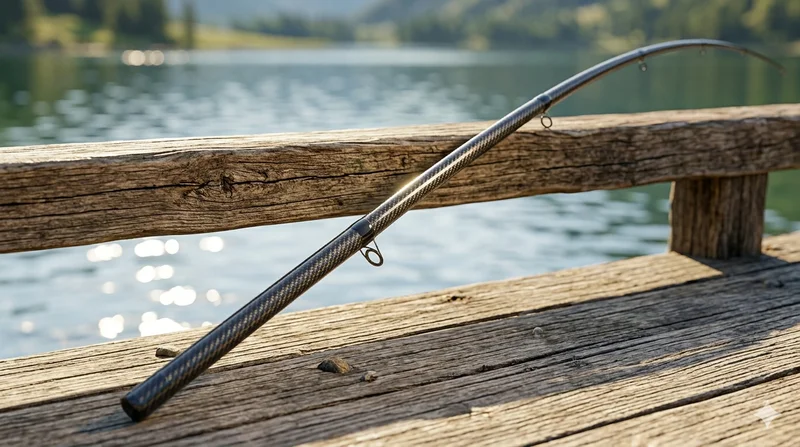
Carbon Fiber Fishing Rod Blank
High-quality carbon fiber fishing rod blank manufactured from multiple grades of Toray carbon fiber cloth. Available in a wide range of lengths, powers, and actions for freshwater and saltwater applications. Suitable for OEM rod building.

Carbon Fiber Plate — 3K Twill T700 3.0mm
Medium-thickness 3.0mm carbon fiber plate offering significantly higher load capacity while maintaining attractive 3K twill finish. Suitable for structural brackets, reinforcement plates, and load-bearing panels.

Carbon Fiber Plate — 3K Twill T700 1.5mm
Thin 1.5mm carbon fiber plate with 3K twill weave surface. Lightweight and stiff, commonly used for covers, panels, drone bodies, and applications requiring a premium aesthetic appearance.
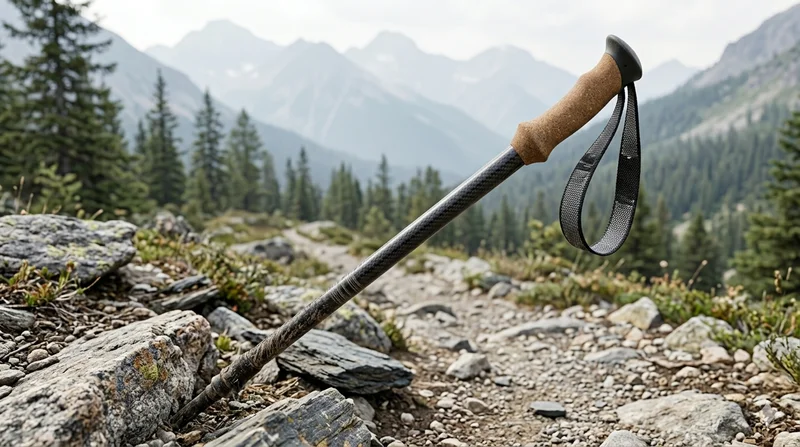
Carbon Fiber Trekking Pole
Lightweight carbon fiber trekking pole manufactured from high-grade carbon fiber tube. Weighs only 160g per pole while providing superior shock absorption and durability for hiking, trail running, and backpacking.

Square Carbon Fiber Tube — 3K Twill T700
Square cross-section carbon fiber tube manufactured with 3K twill weave for torsional strength. Preferred for structural frames, trusses, and support columns where rectangular geometry offers design flexibility.