
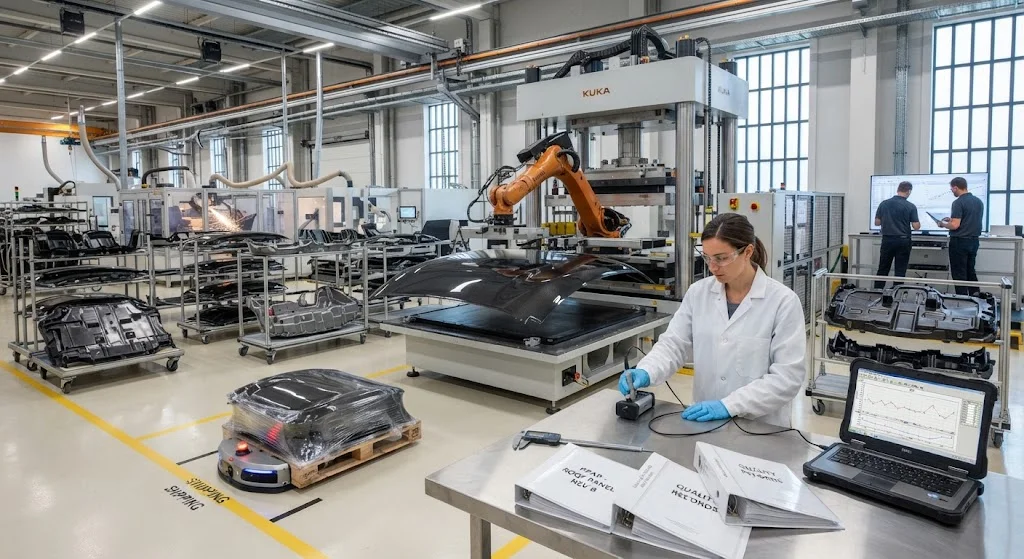
Choosing the right carbon fiber car parts manufacturers is a qualification exercise, not a shopping decision, because automotive CFRP supplier performance determines warranty costs, launch timing and vehicle weight targets. The automotive industry manages this risk through IATF 16949, the global qua
Introduction
Choosing the right carbon fiber car parts manufacturers is a qualification exercise, not a shopping decision, because automotive CFRP supplier performance determines warranty costs, launch timing and vehicle weight targets. The automotive industry manages this risk through IATF 16949, the global quality management standard for automotive production and service parts, together with the Production Part Approval Process, or PPAP. A manufacturer that holds IATF 16949 certification and demonstrates PPAP discipline has proven it can hold tolerances, control its process and document every step — the minimum bar for exterior panels, structural components and lightweight chassis parts. This article explains what IATF 16949 actually requires of composite car parts makers, how to structure an audit of a CFRP automotive manufacturer, and which manufacturing processes genuinely scale to mass production volumes.
Why IATF 16949 Matters for Carbon Fiber Car Parts Manufacturers
IATF 16949:2016 is the automotive extension of ISO 9001, adding industry-specific requirements that matter enormously for composite parts. It demands a robust corrective action system, product safety procedures, and full traceability of lots — all critical when a carbon fiber part carries crash loads. For a CFRP automotive manufacturer, three clauses carry most of the weight:
- Product safety: parts classified as safety-critical must have documented failure mode analysis, special characteristics and traceability to raw material batches.
- Process control: parameters such as cure temperature, pressure and cycle time must be controlled with statistical evidence, not spot checks.
- Contingency planning: the supplier must demonstrate it can maintain production through equipment failure, power loss or raw material shortages.
Certification itself is issued by an IATF-recognized certification body and audited annually with a full re-certification every three years. Buyers should always verify the certificate number against the IATF database, because some workshops claim IATF 16949 compliance without holding valid certification.
What to Verify in an Automotive CFRP Supplier Audit
An effective audit of carbon fiber car parts manufacturers goes beyond checking the certificate. The audit team should verify that IATF requirements are actually practiced on the shop floor, not just documented in the quality manual. The checklist below reflects the evidence that distinguishes a qualified composite car parts maker from a job shop with a certificate on the wall:
| Audit area | Evidence to collect | Red flags |
|---|---|---|
| PPAP submission | Approved PPAP at levels 3-5 for current parts, including dimensional results and material certificates | PPAP documents generated only after customer request |
| Process capability | Cpk values for critical dimensions and cure parameters across production lots | No statistical data, only final inspection results |
| Material traceability | Fiber and resin lot numbers linked to each production batch | Material certificates without batch linkage |
| NDT and testing | Ultrasonic or tap-test records, mechanical test results per lot | Testing outsourced with no in-house capability |
| Change management | Documented process change control and customer notification procedure | Process changes made without records |
PPAP at level 3 is the industry default and includes eighteen required elements, from design records and FMEAs to initial process capability studies. When selecting carbon fiber car parts manufacturers, request the level-3 PPAP package of an existing part and read it as you would a design review — it tells you more about the supplier than any facility tour.
Manufacturing Processes That Scale to Mass Production
Not every composite process scales to automotive volumes. Autoclave curing, for example, delivers the best mechanical properties but cycles in hours and consumes high energy, making it suitable for low-volume supercar parts rather than mainstream production. The table below compares the processes used by carbon fiber car parts manufacturers serving the automotive industry:
| Process | Cycle time | Volume suitability | Typical applications |
|---|---|---|---|
| Prepreg autoclave | 2-6 hours per cycle | Low volume (1-5k parts/year) | Supercar body panels, structural prototypes |
| Compression molding (sheet molding compound) | 3-10 minutes | Medium volume (10-100k/year) | Underbody shields, seat structures |
| High-pressure resin transfer molding (HP-RTM) | 3-8 minutes | High volume (50-500k/year) | Roof panels, floor structures, beams |
| Thermoplastic overmolding | 1-3 minutes | Highest volume (100k+/year) | Battery enclosures, brackets, trim |
HP-RTM has become the workhorse of high-volume CFRP automotive manufacturing because it combines short cycle times with high fiber volume fractions of 50-60 percent and Class-A surface capability. A manufacturer's process portfolio tells you which programs it can realistically serve: a supplier that only runs autoclaves cannot hold the takt times of a mass-produced vehicle program, regardless of its certification.
Evaluating Carbon Fiber Car Parts Manufacturers' Mass Production Capability
Mass production capability is more than owning HP-RTM presses. When qualifying carbon fiber car parts manufacturers for a volume program, verify four operational dimensions that determine whether the supplier can sustain output over years rather than months:
- Capacity reservation: confirm that press, autoclave and trim capacity is reserved for your program, with documented peak-season planning.
- Supply chain depth: check that fiber, resin and core material sources are dual-sourced or contracted with firm allocation, since carbon fiber supply remains tight.
- Automation level: robotic layup, automated trimming and automated inspection reduce variability and support high takt rates.
- Launch history: request references from previous mass-production launches, including ramp-up curves and lessons learned documents.
Beyond these four dimensions, a qualified CFRP automotive manufacturer demonstrates continuous improvement through annual IATF surveillance audits and management reviews. Request the most recent internal audit findings and corrective action records; the speed with which a supplier closes nonconformities is a reliable predictor of launch behavior. Suppliers that treat PPAP as a one-time submission rather than a living requirement often struggle during ramp-up, when dimensional drift, cure variation and supplier quality issues surface simultaneously. A manufacturer that maintains statistically controlled cure ovens, calibrated presses and validated trim cells — and can show the process capability studies that prove it — is the kind of partner that protects launch dates and warranty budgets over the life of the program.
These factors separate a CFRP automotive manufacturer that can launch a 100,000-part-per-year program from one that can only build prototypes. The certification proves the quality system; the operational evidence proves the throughput.
Frequently Asked Questions
Is IATF 16949 required for all carbon fiber car parts manufacturers?
For production parts sold to automotive OEMs and their tier-one suppliers, IATF 16949 certification is effectively mandatory in practice. Most OEMs require their direct suppliers to hold certification and flow the requirement down through the supply chain. For low-volume specialty programs such as supercars and motorsport, some customers accept ISO 9001 with PPAP discipline, but any manufacturer aiming at mainstream automotive volumes should treat IATF 16949 as the entry ticket.
What is the difference between IATF 16949 and ISO 9001 for composite parts?
ISO 9001 is a general quality management standard applicable to any organization, while IATF 16949 adds automotive-specific requirements: product safety procedures, PPAP, advanced product quality planning (APQP), statistical process control and full lot traceability. For carbon fiber parts, the practical difference is evidence: an ISO 9001 workshop can document a quality system, but an IATF 16949 manufacturer must demonstrate process capability data, failure mode analysis and traceability for every production lot.
How long does it take to qualify a new CFRP automotive supplier?
A typical qualification runs 6-12 months from initial audit to approved PPAP, depending on part complexity and volume. The process includes a system audit against IATF 16949 requirements, a process audit on the shop floor, sample production runs, dimensional and mechanical testing, and the PPAP submission. Automotive OEMs usually parallel this with their own capability assessments, so starting supplier evaluation early in the program timeline is essential.
Conclusion
Carbon fiber car parts manufacturers earn their place in automotive supply chains through IATF 16949 certification backed by genuine PPAP discipline, process capability evidence and production processes that match the required volume. Autoclave-only workshops remain valuable for prototypes and supercars, while HP-RTM and thermoplastic molding deliver the takt times of mass production. When evaluating an automotive CFRP supplier, audit the shop floor, read a level-3 PPAP package and verify operational capacity — certification opens the door, but evidence of sustained production closes the deal.
If you are developing lightweight automotive components, browse our carbon fiber fabrics, tows and prepregs, or contact our engineering team for material selection and qualification support for your CFRP program.
Related Articles
- Carbon Fiber Supplies Near Me: Local Sourcing Without Compromising Spec
- Carbon Fiber for Sale: Online Platforms and Direct Sales Channel Comparison
- Carbon Fibre Suppliers UK: Post-Brexit Supply Chain Reorganization
- Carbon Fiber Suppliers Canada: North American Supply Chain Diversification Options
- Filament Wound Epoxy Tubes Suppliers: Specifications, Certification and Bulk Purchasing
- Carbon Fiber Tube Manufacturers: Procurement Guide for Engineering Buyers
Interested in Our Products?
Contact our team for competitive pricing and technical specifications.
Get a QuoteRelated Products

Carbon Fiber Fishing Rod Blank
High-quality carbon fiber fishing rod blank manufactured from multiple grades of Toray carbon fiber cloth. Available in a wide range of lengths, powers, and actions for freshwater and saltwater applications. Suitable for OEM rod building.

Carbon Fiber Plate — 3K Twill T700 3.0mm
Medium-thickness 3.0mm carbon fiber plate offering significantly higher load capacity while maintaining attractive 3K twill finish. Suitable for structural brackets, reinforcement plates, and load-bearing panels.

Carbon Fiber Plate — 3K Twill T700 1.5mm
Thin 1.5mm carbon fiber plate with 3K twill weave surface. Lightweight and stiff, commonly used for covers, panels, drone bodies, and applications requiring a premium aesthetic appearance.

Carbon Fiber Trekking Pole
Lightweight carbon fiber trekking pole manufactured from high-grade carbon fiber tube. Weighs only 160g per pole while providing superior shock absorption and durability for hiking, trail running, and backpacking.

Square Carbon Fiber Tube — 3K Twill T700
Square cross-section carbon fiber tube manufactured with 3K twill weave for torsional strength. Preferred for structural frames, trusses, and support columns where rectangular geometry offers design flexibility.