
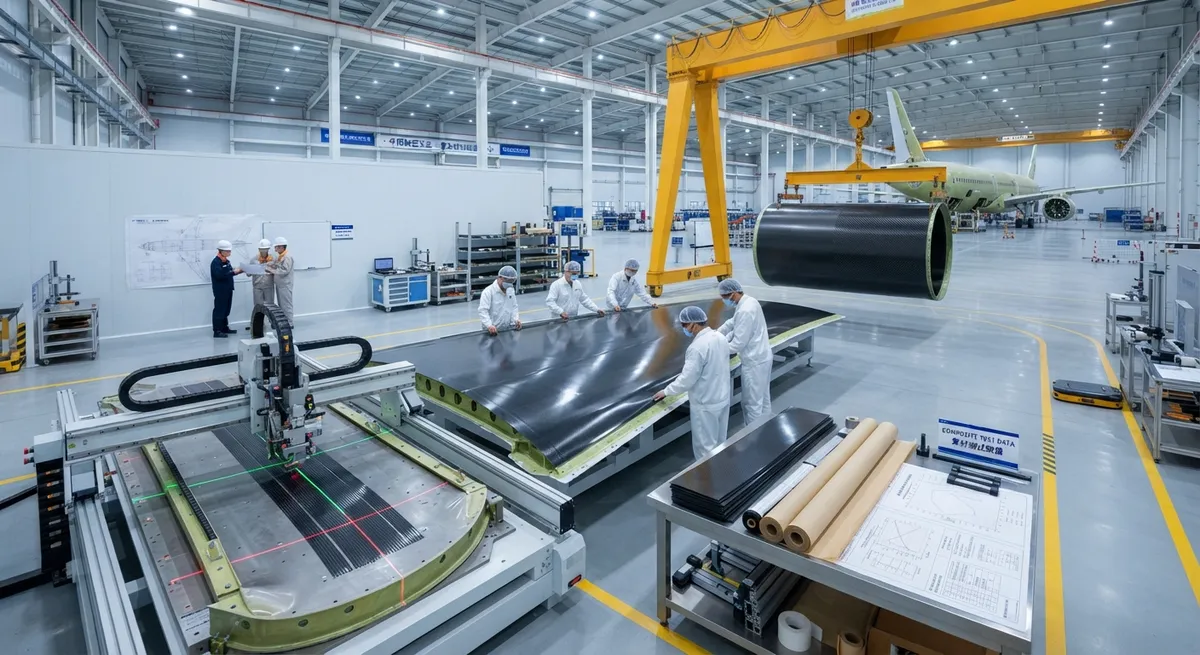
China's commercial aircraft program passed a quiet but decisive milestone in 2025: the COMAC C919, the narrowbody that opened the domestic airliner era, moved into higher-rate production while attention shifted to the larger C929 widebody still on the drawing board. The C929 matters far
Introduction
China's commercial aircraft program passed a quiet but decisive milestone in 2025: the COMAC C919, the narrowbody that opened the domestic airliner era, moved into higher-rate production while attention shifted to the larger C929 widebody still on the drawing board. The C929 matters far beyond aviation. With a reported composite airframe target around 50% of structural weight, the program is positioned to become the single largest demand channel for aerospace-grade carbon fiber in China between 2026 and 2030, and the most visible test of whether the domestic composites supply chain can close the gap with Toray, Hexcel, and Solvay.
COMAC has stated its intent to localize the C929 supply chain aggressively, learning from the C919 experience where core materials and systems remained heavily import-dependent. For Chinese carbon fiber producers, prepreg processors, and composite part manufacturers, the C929 represents a multi-year qualification cycle that ends in multi-decade production contracts. This article examines the program timeline, the composite content comparison, the suppliers already in the qualification pipeline, and the specific structural components where localization opportunities are concentrated.
The C929 Program and Timeline
The C929 is COMAC's widebody twin-aisle aircraft, targeting the 250-350 seat market segment currently served by the Airbus A330neo, Boeing 787, and (at the lower end) the A350. The program was originally developed as the CR929 joint venture with Russia's UAC, but after the joint venture unwound, COMAC took over full program leadership and continued development on its own. The aircraft is planned in two versions: a base variant around 280 seats and a shorter-range derivative, with a design range in the region of 12,000 kilometers.
- First flight target: Industry reports place the C929 first flight around 2029, with entry into service targeted in the early 2030s, several years later than COMAC's original plan.
- Composite airframe: The design targets roughly 50% composite share of structural weight, including a composite wing and fuselage, versus roughly 12% for the C919.
- Engine sourcing: Early aircraft are expected to use a Western engine solution, while the domestic CJ-2000 program is developed in parallel as the long-term alternative.
- Manufacturing footprint: Final assembly is planned for a new COMAC facility, with major subassemblies distributed across the AVIC industrial network, including wing manufacture in Xi'an and fuselage sections in Shanghai and elsewhere.
The significance of the timeline is that qualification decisions made between 2026 and 2028 lock in suppliers for the entire production run. COMAC has publicly emphasized localization, but it has also repeatedly delayed the program, which gives domestic suppliers a longer runway to achieve the material quality and process capability that aerospace certification demands.
Composite Content: C929 in Context
To understand the scale of the C929 opportunity, it helps to compare its composite content against the aircraft it competes with and the one it follows:
| Aircraft | Class | Composite Share (structural weight) | Composite Wing | Composite Fuselage |
|---|---|---|---|---|
| C919 | Narrowbody (158-192 seats) | ~12% | No (aluminum) | No |
| Boeing 787 | Widebody (242-330 seats) | ~50% | Yes | Yes |
| Airbus A350 | Widebody (350-410 seats) | ~53% | Yes | Yes |
| C929 (planned) | Widebody (250-350 seats) | ~50% | Yes | Yes |
The comparison shows that the C929 is not a modest step up from the C919 but a step change. A 50% composite share on a widebody translates to tens of tonnes of carbon fiber per aircraft, an order of magnitude more than the C919's roughly 12% share. If COMAC reaches production rates of one aircraft per month by the early 2030s, the program alone would consume hundreds of tonnes of aerospace-grade carbon fiber per year — a quantity that Chinese producers are only beginning to be able to supply at the required quality and consistency.
Where Localization Opportunity Concentrates
Not all composite content offers the same localization potential. The value chain breaks down into distinct tiers with different barriers:
- Carbon fiber precursor and fiber: Aerospace-grade fiber at T700-T800 class and above remains the highest barrier tier. Zhongfu Shenying, Guangwei, and Jilin's Sinofibers are the domestic leaders, with some already supplying qualified or trial material to aviation programs.
- Prepreg and resin systems: High-temperature and toughened epoxy systems historically came from Hexcel, Solvay, and Toray. Domestic prepreg capacity exists, but qualification against the C929's damage-tolerance requirements is the gating step.
- Composite parts and subassemblies: Fuselage barrels, wing covers, and spars are being planned within the AVIC network — companies such as AVIC Composites (AVIC CPMC) and the Chengdu, Xi'an, and Harbin aviation plants — which represent the largest addressable value for domestic processors.
- Fasteners and ancillary materials: Titanium and composite fasteners, adhesives, and honeycomb core remain partly import-dependent and represent lower-value but high-volume localization opportunities.
For upstream carbon fiber producers, the strategic question is whether to position for the C929's high-end fiber grades or to treat the program as a volume channel for T700-class material. For part manufacturers outside the AVIC system, the near-term opportunity is the supply chain that surrounds COMAC: tooling, test fixtures, sub-tier parts, and materials that enter the assembly flow from second- and third-tier suppliers.
Qualification: The Real Bottleneck
The technical capability of Chinese composites manufacturing is no longer in question; the bottleneck is qualification. Aerospace material qualification requires years of testing — physical and mechanical properties, environmental resistance, batch-to-batch consistency, and full traceability — against specifications that Western suppliers spent decades building. COMAC's qualification regime for the C929 follows international practice, and every material and process must demonstrate reproducibility at production scale, not just in the laboratory.
For domestic suppliers, the qualification cycle is both an obstacle and a moat. Companies that enter the C929 qualification pipeline between 2026 and 2028, hold their quality through audit cycles, and scale production without variance will be difficult to displace for the program's life. Suppliers that wait for the program to prove itself will find the door largely closed, because aircraft programs do not re-qualify materials lightly once production begins.
Frequently Asked Questions
When will the C929 first fly and enter service?
Industry reports currently place the C929 first flight around 2029, with entry into service targeted in the early 2030s. The program has slipped from COMAC's original schedule, which reflected both the complexity of a widebody development and the shift from the original joint venture structure to sole COMAC leadership. The engines, supply chain readiness, and certification progress in China, the EASA, and the FAA remain the variables that will determine whether the timeline holds. For carbon fiber suppliers, the important point is that material and part qualification must begin years before first flight, so the decision window is effectively 2026-2028 regardless of the exact flight date.
How much carbon fiber does a single C929 need versus a C919?
Reported figures are not official, but engineering estimates give a widebody with a ~50% composite share roughly 20-30 tonnes of carbon fiber per aircraft, while the C919's ~12% composite share corresponds to roughly 3-5 tonnes. The exact numbers depend on final design decisions, part count, and the split between carbon fiber and other composites such as glass and aramid. The key takeaway is the scale: a widebody program at meaningful production rates consumes aerospace-grade carbon fiber an order of magnitude faster than the C919, which is why Chinese producers view the C929 as the anchor customer for their aerospace fiber expansion.
Which Chinese companies are candidates for the C929 composite supply chain?
The AVIC industrial network is the primary candidate for major structural subassemblies — wing and fuselage composite components are planned within companies such as AVIC Composites and the regional aircraft plants in Xi'an, Chengdu, and Harbin. For carbon fiber itself, the leading domestic candidates are Zhongfu Shenying, Guangwei, and Jilin's Sinofibers, all of which have invested in aerospace-grade fiber lines and aviation qualification programs. Prepreg and resin system makers, fastener manufacturers, and tooling suppliers are also positioning for the program. The competition is not only domestic: COMAC may continue to source certain materials internationally, which is precisely why localization announcements and qualification milestones from domestic firms are closely watched signals.
Conclusion
The C929 is the defining aerospace demand event for China's carbon fiber industry in the 2026-2030 window. Its roughly 50% composite airframe target represents a step change over the C919, a qualification cycle that begins now, and production volumes that will anchor domestic aerospace-grade fiber demand for decades. For Chinese composites companies, the strategic window is the next two to three years: enter the qualification pipeline, demonstrate reproducibility at scale, and secure a position before the program's supplier base is locked in.
For suppliers and buyers evaluating materials for aviation-qualified composites, explore our aerospace-grade carbon fiber range, or contact our engineering team to discuss material selection, specification compliance, and qualification support for aerospace programs.
Part of topic
Related Articles
- Carbon Fibre Sheet Supplier UK: Sourcing Options and Specification Checklist
- Carbon Fiber Sheets Near Me Suppliers: Local Stock vs Factory Direct
- Filament Wound Epoxy Tubes: Industry Standards and Compliance Requirements
- Carbon Fiber Dealers Near Me: What a Good Dealer Actually Adds
- Carbon Fiber Supplies Near Me: Local Sourcing Without Compromising Spec
- Carbon Fiber for Sale: Online Platforms and Direct Sales Channel Comparison
Interested in Our Products?
Contact our team for competitive pricing and technical specifications.
Get a QuoteRelated Products
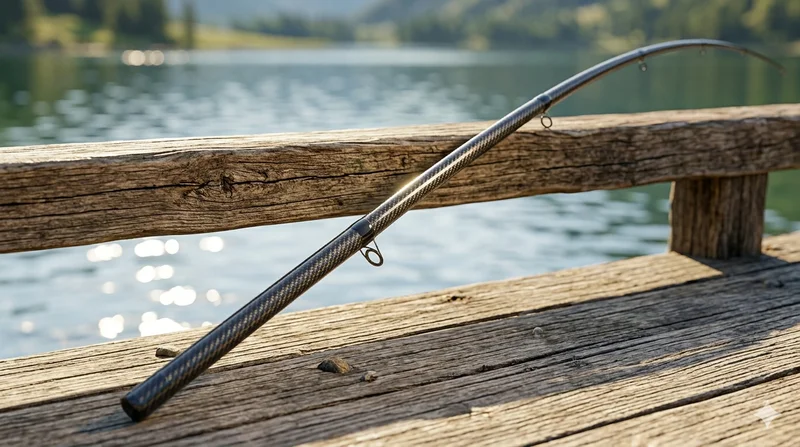
Carbon Fiber Fishing Rod Blank
High-quality carbon fiber fishing rod blank manufactured from multiple grades of Toray carbon fiber cloth. Available in a wide range of lengths, powers, and actions for freshwater and saltwater applications. Suitable for OEM rod building.
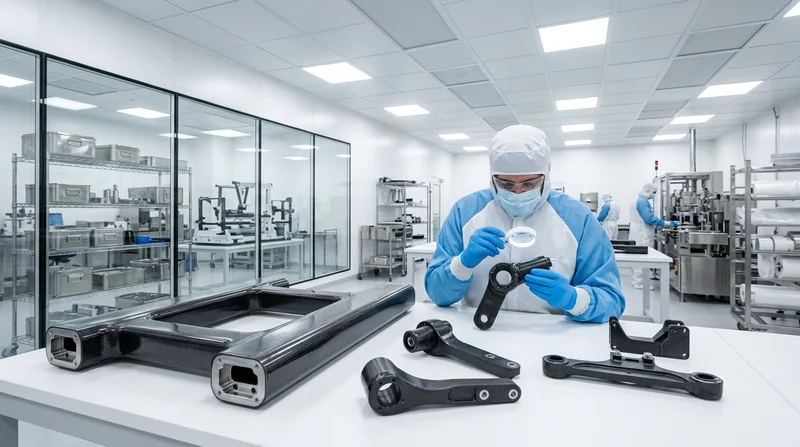
Custom Carbon Fiber Medical Device Components
Medical-grade carbon fiber components manufactured for imaging equipment, surgical instruments, and patient support systems. Carbon fiber's radiolucency (X-ray transparency) and high strength-to-weight ratio make it ideal for CT scanner beds, wheelchair frames, surgical robot arms, and MRI-compatible accessories. Biocompatible resin systems available.
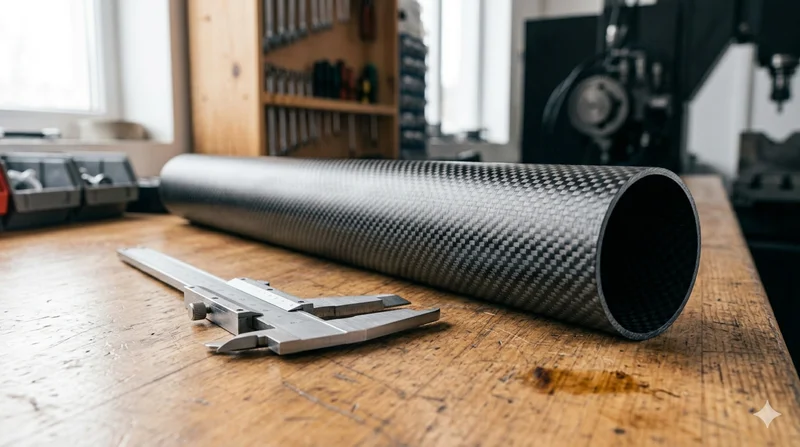
Round Carbon Fiber Tube — 3K Plain Weave T700
Standard round carbon fiber tube manufactured from Toray T700 grade fiber with 3K plain weave. Offers balanced strength and stiffness for general industrial applications including robotics, automation, sports equipment, and aerospace structures.
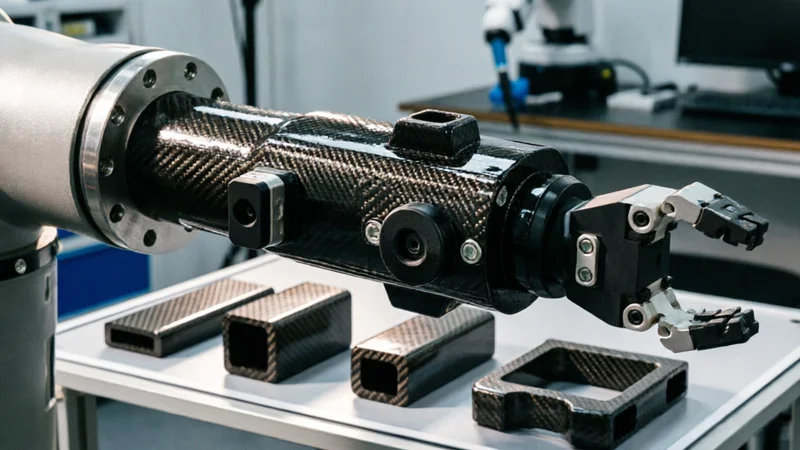
Carbon Fiber Robot End Effector Link — Custom Shape & Sensor Integration
Custom-shaped carbon fiber end effector links for robotic arms. Designed for automation integrators and research labs requiring lightweight, rigid connections between the robot wrist and gripper/tool. Can incorporate sensor mounting bosses, cable routing channels, and quick-change interfaces.

Custom Carbon Fiber Musical Instrument Parts
Carbon fiber components for musical instrument manufacturing offering superior dimensional stability, low weight, and consistent acoustic properties. We produce carbon fiber bows, guitar necks, violin chin rests, drum shells, and wind instrument bodies. Carbon fiber instruments are immune to humidity changes and temperature fluctuations that affect wooden instruments.