
Introduction Carbon fiber reinforced polymer parts emerging from autoclave cure, resin transfer molding, or press molding typically require trimming to final dimensions. The cured laminate edges are rough, oversize, and may contain flash, resin bleed, or ply delamination that must be removed before
Introduction
Carbon fiber reinforced polymer parts emerging from autoclave cure, resin transfer molding, or press molding typically require trimming to final dimensions. The cured laminate edges are rough, oversize, and may contain flash, resin bleed, or ply delamination that must be removed before the part meets dimensional specifications. Traditionally, trimming has relied on CNC routers with diamond-coated end mills, abrasive waterjet cutting, or manual grinding — all of which introduce tool wear, dust generation, and quality variability that scale poorly at production volumes above 10,000 parts per year.
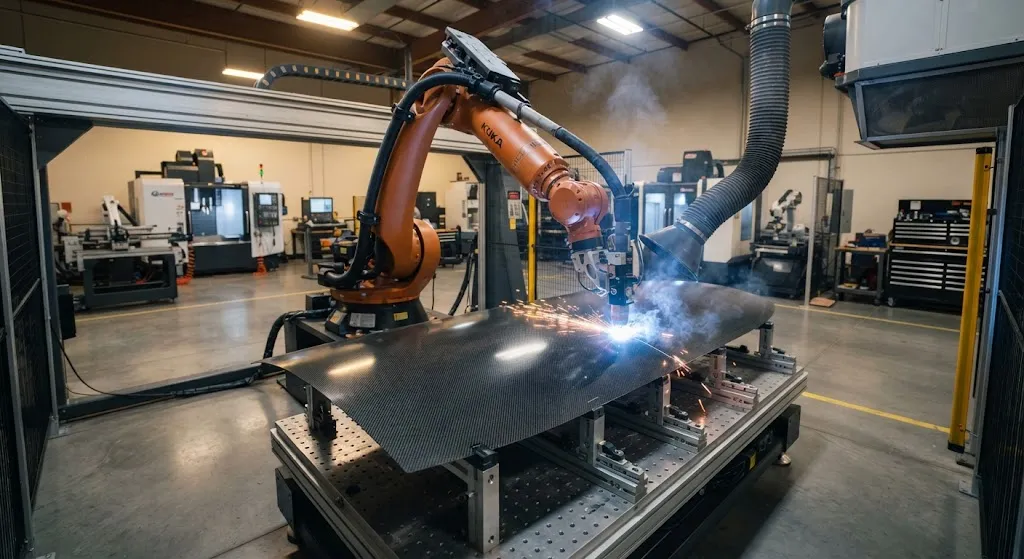
Carbon fiber laser cutting offers a fundamentally different approach: a non-contact thermal process that removes material through vaporization without physical tool contact. For high-volume production environments where consistent edge quality, tight dimensional tolerances, and minimal secondary finishing are required, laser trimming automation is increasingly the preferred solution. This article examines the laser technologies suited to carbon fiber trimming, the process parameters that determine cut quality, and the automation architectures that enable integrated production workflows.
Carbon Fiber Laser Cutting Technology Selection
Three laser types are used for carbon fiber trimming, each with distinct characteristics that determine suitability for different production scenarios:
- CO2 lasers (10.6 micrometers): The traditional choice for composite trimming, CO2 lasers deliver high power (200-6000 watts) at wavelengths well-absorbed by the polymer matrix. The resin matrix absorbs the infrared energy and vaporizes, while the carbon fibers — which have low absorption at 10.6 micrometers — are removed by the thermally decomposed matrix. CO2 lasers achieve cutting speeds of 5-20 meters per minute on thin laminates and produce clean edges with minimal heat-affected zone when properly focused.
- Fiber lasers (1.064 micrometers): Modern fiber lasers offer higher beam quality (B2 less than 1.5) and lower maintenance than CO2 systems. At the near-infrared wavelength, carbon fiber absorbs energy more directly, enabling faster cutting of thicker sections. Fiber lasers with 1000-3000 watts power can trim 2-6 mm carbon fiber laminates at 10-30 meters per minute, with the added advantage of fiber-optic delivery that simplifies integration with robotic motion systems.
- UV lasers (355 nanometers): Short-wavelength ultraviolet lasers offer cold ablation with minimal thermal damage, producing the cleanest edges and narrowest heat-affected zones. UV lasers are preferred for aerospace-grade parts where delamination, matrix recession, or fiber pull-out at the trimmed edge would compromise structural integrity. The tradeoff is lower material removal rates, limiting UV lasers to precision trimming of thin sections or critical edges rather than bulk material removal.
The selection among these technologies depends on the dominant failure mode for the specific application. For automotive and industrial parts where throughput is the priority, fiber and CO2 lasers dominate. For aerospace structural components where edge quality directly affects fatigue life and interlaminar strength, UV or ultra-short-pulse lasers provide the necessary precision.
Carbon Fiber Laser Cutting Process Parameters and Edge Quality
Laser trimming of carbon fiber is governed by four primary process parameters, each affecting cut quality in specific ways:
| Parameter | Typical Range | Effect on Cut Quality | Common Defect at Extremes |
|---|---|---|---|
| Laser power | 200-4000 W | Higher power increases cutting speed and depth capability | Excess power causes charring and matrix recession beyond cut line |
| Feed rate | 5-30 m/min | Faster feed reduces heat input per unit length | Too fast: incomplete cut, fiber pull-out, uncut bottom plies |
| Focus position | Surface to -2 mm below | Focus depth determines kerf width and taper angle | Off-focus: wide kerf, tapered edge, rough surface |
| Assist gas pressure | 5-20 bar | Gas jet clears debris and prevents re-deposition | Low pressure: redeposited char on surface; high: fiber blow-out |
The heat-affected zone is the critical quality metric for laser-trimmed carbon fiber. The HAZ extends 0.1-0.5 mm from the cut edge for optimized fiber laser parameters, and up to 1-2 mm for unoptimized CO2 conditions. Within the HAZ, the polymer matrix undergoes thermal decomposition, leaving exposed and weakened fibers. For structural parts, the HAZ must be characterized and accounted for in the design allowables, or minimized through parameter optimization.
Achieving consistent edge quality across a production run requires closed-loop process control. Modern laser trimming systems integrate beam position sensors, real-time thermal imaging, and adaptive power modulation to compensate for variations in laminate thickness, resin content, and fiber orientation that occur between parts and within a single part.
Automation Integration for Production Trimming
Converting a standalone laser into a production trimming cell requires integration of material handling, motion control, and quality verification subsystems. The typical architecture for high-volume carbon fiber trimming includes:
- Robotic motion platform: A 6-axis industrial robot (payload 10-50 kg) carries the laser processing head, providing the five or six degrees of freedom needed to follow complex three-dimensional part contours. Robot positioning accuracy of plus or minus 0.05 mm and repeatability of plus or minus 0.02 mm are standard requirements for automotive trim tolerances.
- Fixture and part presentation: Vacuum or pneumatic fixtures hold the part in a known coordinate frame. For parts arriving from an upstream molding cell, a datum referenced to the mold surface ensures trim paths align with the designed geometry. Quick-change fixtures enable model changeover in under five minutes for mixed-model production lines.
- Inline quality verification: Laser-trimmed edges are inspected immediately after cutting using machine vision cameras that measure edge position, detect delamination, and flag surface defects. Parts failing inspection are diverted to rework or scrap, preventing defective parts from progressing downstream.
- Dust extraction and filtration: Carbon fiber laser trimming generates fine particulate matter that must be captured at the source. Downdraft extraction tables with HEPA filtration and activated carbon stages are required to meet workplace exposure limits and prevent contamination of adjacent production areas.
The integration of these subsystems into a unified cell typically reduces trimming cycle time by 40-60% compared to manual or semi-automatic CNC router operations, while eliminating tool change downtime and reducing scrap rates from 3-5% to below 1%.
Production Economics and Comparison with Mechanical Trimming
The economic case for laser trimming versus mechanical trimming depends on production volume, part complexity, and quality requirements. At low volumes (below 1000 parts per year), CNC routers remain more cost-effective because the capital cost of a laser trimming cell (typically 200,000-500,000 euros) cannot be amortized over sufficient parts. However, above 5,000-10,000 parts per year, laser trimming offers compelling advantages:
- Zero tool wear: Unlike diamond-coated end mills that require replacement every 500-2000 parts, laser systems have no consumable cutting tools. Maintenance is limited to lens cleaning and replacement, with typical intervals of 2000-5000 operating hours.
- Consistent quality over time: Mechanical tools produce progressively rougher cuts as they wear, requiring frequent quality checks and tool replacements. Laser cut quality remains stable as long as optical components are maintained.
- Faster changeover: Changing trim paths for a new part variant requires only a software update, not new fixtures, tools, or programs. This flexibility is valuable for mixed-model production lines common in automotive applications.
- Reduced secondary finishing: Well-optimized laser trim edges typically require no deburring or edge sealing, eliminating a manual operation that adds 1-3 minutes per part in mechanical trimming workflows.
For manufacturers evaluating the transition from mechanical to laser trimming, the recommendation is to conduct a side-by-side cutting trial on production parts, measuring edge quality (surface roughness, delamination length, HAZ width), cycle time, and total cost per part over a statistically significant sample. The data from such trials typically shows that laser trimming achieves 20-40% lower cost per part at volumes above 10,000 units, with the advantage widening further at higher volumes.
Frequently Asked Questions
Does laser cutting cause delamination at carbon fiber laminate edges?
Delamination during laser cutting is caused by excessive heat input that degrades the matrix bonding between plies. When process parameters are optimized — particularly feed rate, power, and assist gas pressure — the heat-affected zone is confined to 0.1-0.5 mm from the cut edge, well within the typical design margin for trimmed laminates. For thick-section laminates (above 6 mm), multi-pass cutting with controlled interpass cooling is recommended to prevent heat accumulation that could trigger interlaminar failure. Ultrasonic inspection of trimmed edges confirms that properly executed laser cuts do not introduce delamination beyond the characterized HAZ.
What is the minimum radius achievable with laser trimming on carbon fiber parts?
The minimum internal radius is determined by the laser beam diameter at the focal point. For fiber lasers with typical spot sizes of 50-150 micrometers, internal radii as small as 0.2 mm are achievable. CO2 lasers with larger spot sizes (200-500 micrometers) are limited to radii above 0.5 mm. For applications requiring tighter radii, such as fastener holes or notch features, a secondary drilling or punching operation after laser trimming is more economical than attempting to cut small radii with the laser beam itself.
How does laser trimming affect the structural properties of carbon fiber laminates?
The primary structural effect is matrix degradation within the heat-affected zone, which reduces interlaminar shear strength and compressive strength locally at the trimmed edge. Testing shows that HAZ degradation typically reduces edge compressive strength by 5-15% over a depth of 0.2-0.5 mm from the cut surface. For parts where trimmed edges are load-bearing, design allowables must account for this reduction, or the trimmed edge must be subsequently sealed with a structural adhesive or edge closeout ply. In most automotive and industrial applications, trimmed edges are not primary load paths, and the HAZ effect is not structurally significant.
Conclusion
Carbon fiber laser cutting and trimming automation represents a mature, production-proven technology for high-volume CFRP part manufacturing. The non-contact thermal process eliminates tool wear, delivers consistent edge quality, and integrates readily with robotic automation cells for trim cycle times that are 40-60% faster than mechanical methods. At production volumes above 5,000-10,000 parts per year, laser trimming offers lower total cost per part, higher quality consistency, and greater flexibility for model changeover.
For manufacturers evaluating laser trimming systems, the critical considerations are laser technology selection (fiber for speed, UV for precision), process parameter optimization for the specific laminate construction, and integration of inline quality verification. Explore our carbon fiber products for high-volume applications, or contact our engineering team to discuss trimming process development and automation integration for your production requirements.
Related Articles
- Microwave-Assisted Carbonization for Carbon Fiber: Energy Savings and Quality Improvement
- Pyrolysis Recycled Carbon Fiber: Mechanical Property Retention and Reuse Applications
- Carbon Fiber Bio-Composites: Natural Fiber Hybrid Reinforcement for Sustainable Applications
- RFID Tracking for Carbon Fiber Supply Chain: Traceability and Quality Assurance
- Infrared Heating for Carbon Fiber Cure: Energy Efficiency and Cycle Time Reduction
- Out-of-Autoclave Carbon Fiber Processing: OoA Certification and Aerospace Qualification
Interested in Our Products?
Contact our team for competitive pricing and technical specifications.
Get a QuoteRelated Products
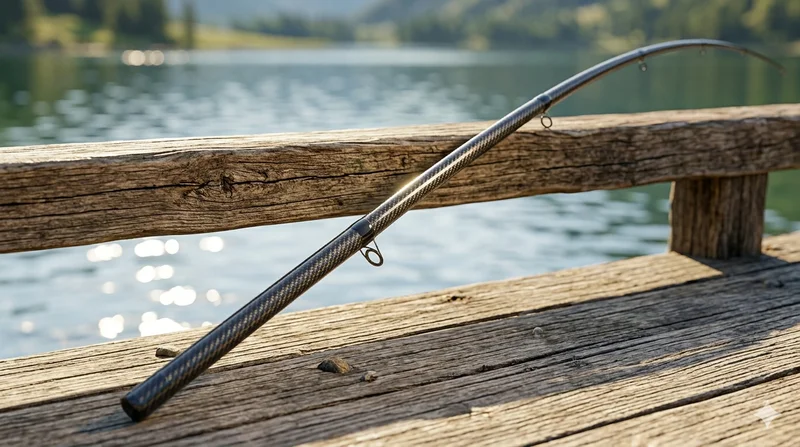
Carbon Fiber Fishing Rod Blank
High-quality carbon fiber fishing rod blank manufactured from multiple grades of Toray carbon fiber cloth. Available in a wide range of lengths, powers, and actions for freshwater and saltwater applications. Suitable for OEM rod building.

Carbon Fiber Plate — 3K Twill T700 1.5mm
Thin 1.5mm carbon fiber plate with 3K twill weave surface. Lightweight and stiff, commonly used for covers, panels, drone bodies, and applications requiring a premium aesthetic appearance.

Carbon Fiber Plate — 3K Twill T700 3.0mm
Medium-thickness 3.0mm carbon fiber plate offering significantly higher load capacity while maintaining attractive 3K twill finish. Suitable for structural brackets, reinforcement plates, and load-bearing panels.
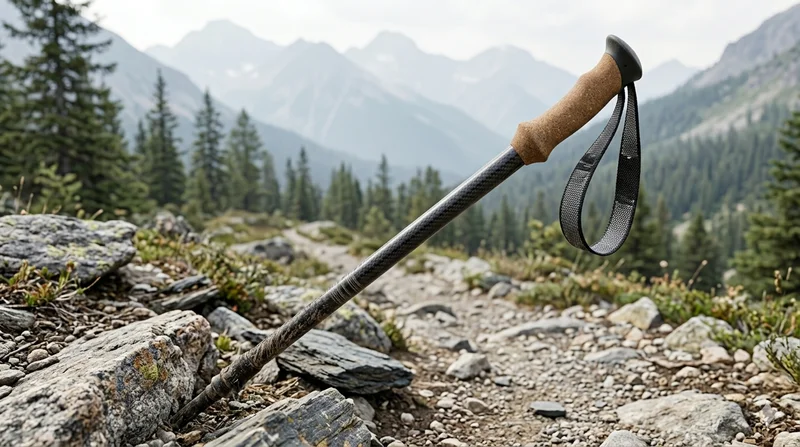
Carbon Fiber Trekking Pole
Lightweight carbon fiber trekking pole manufactured from high-grade carbon fiber tube. Weighs only 160g per pole while providing superior shock absorption and durability for hiking, trail running, and backpacking.

Square Carbon Fiber Tube — 3K Twill T700
Square cross-section carbon fiber tube manufactured with 3K twill weave for torsional strength. Preferred for structural frames, trusses, and support columns where rectangular geometry offers design flexibility.