
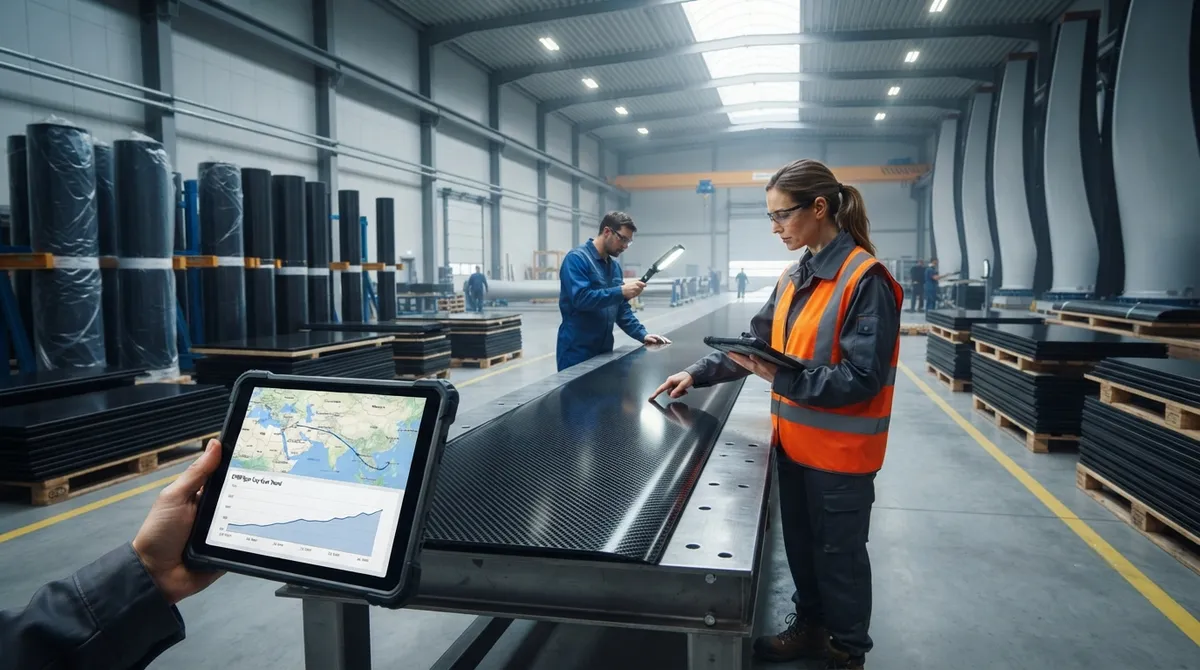
Wind turbine blades are the largest industrial consumer of large-tow carbon fiber in the world outside China. A modern 100-meter plus blade bends under gravity and wind loads, and its structural performance comes from layers of unidirectional carbon fiber in the spar caps and shear webs
Introduction
Wind turbine blades are the largest industrial consumer of large-tow carbon fiber in the world outside China. A modern 100-meter plus blade bends under gravity and wind loads, and its structural performance comes from layers of unidirectional carbon fiber in the spar caps and shear webs, which carry the bending moment. Where glass fiber could not reach the required stiffness at an acceptable weight, carbon fiber made the 15-20 MW blade class possible.
That fast adoption of carbon fiber created a structural dependence for Western OEMs. More than half of global carbon fiber capacity sits in China, and the largest producers have tuned their output to domestic demand and coordinated export channels. When an OEM builds a blade program that requires carbon fiber, it takes on supply risk, policy risk and price risk at the same time. This article examines the scale of the dependence, why it matters in the margin line, and what Western manufacturers are doing to diversify their supply chain toward 2030.
Why Large Blades Need Carbon Fiber
Carbon fiber is not an optional premium in blades above a certain size class, it is the key material. A 14-15 MW blade of more than 100 meters is roughly one third lighter when carbon reinforcement is used in the spar, and that weight saving then propagates into the size and cost of the tower, the hub and the foundation. Because of this, carbon blades are the de facto standard above about 14 MW, and OEMs continue to push towards 18-20 MW platforms.
- Unidirectional spar layers: carbon fiber is laid up as a unidirectional band along the flanges of the blade in the main load path.
- Shear webs: carbon laminate webs guide vertical shear forces between the two spar flanges.
- Plate pultrusion: many OEMs now buy pre-cured pultruded carbon plates; these arrive in planks and lamination quality is easier to control at scale.
- Root and transition: carbon reinforcement near the root and at the blade-to-hub joint manages both weight and local load transfer.
For today's 15 MW class, pultruded carbon plates commonly trade in a broad range of $160-260 per square meter depending on modulus, width, volume and delivery terms. Because carbon is the single most valuable purchase in the blade bill of materials, even a modest move in plate price shows up directly in the OEM's income statement.
China Concentration: Advantages and Risks
China operates roughly half of global carbon fiber capacity, and an even larger share of the large-tow tonnage that feeds today's blade plants. The strength of that concentration is a cost level that makes very large blades economically possible. The weakness is that an OEM that buys from a single large with a large share of capacity has little room to negotiate when supply tightens.
- Protection on domestic supply: in capacity-limited periods, the home market has the first claim on output, and export allocations are renegotiated last.
- Export policy risk: case of licensing step, control perimeter or export duty timing can reallocate tonnage across borders in one quarter.
- Margin coupling: because carbon is a visible share of the blade bill, an unplanned price step spreads instantly to the OEM, whose incremental margin is already low.
The income statement connection is direct. Wind OEMs have reported thin blade margins in recent quarters, partly because carbon fiber value changed as the lower-cost suppliers went to other markets during the supply tightening of 2024-2025. When the panel price moves up in the upper part of its range, the OEM pays and the margin next meets the drop.
The Margin Effect of a Concentrated Supplier
For a single 15 MW blade, the blade uses of the order of 30 to 40 tons of finished composite, of which a relevant share is carbon plate. Continued at $160-260 per square meter, a movement of 10-15% in the price translates to tens of thousands of dollars for a single blade. When multiplied by a serial production of hundreds of blades a year, it decides whether a project is profitable on the OEM side.
| Indicator | Low Case | Base Case | High Case |
|---|---|---|---|
| Carbon plate price (USD/m²) | 160 | 210 | 260 |
| Carbon share of blade BOM | 25% | 30% | 40% |
| Yield impact of price versus base | -2 pts | — | -8 to -12 pts |
| China share of the OEM's carbon basket | 40% | 55% | 75% |
The table is illustrative but it reflects the mechanism: the purchasing decision moves the margins directly, much more clearly than is the case for steel or aluminium. OEMs noticed this in the 2021-2022 price cycle and now manage exposure actively in a diversification mix.
Diversification strategies for 2026-2030
Western OEMs are pursuing five concrete tracks to reduce exposure to the China supplier without limiting blade performance:
- Multi-region sourcing: building second-source qualification with fiber producers in Japan, Korea, Europe and upcoming capacity in the Middle East.
- Long-term volume structure: signing 3-6 year carbon contracts with a flexible share formula, which puts procured into recognizably contracted buckets rather than spot.
- Recycling content in the mix: recycled carbon fiber (rCF) from scrap and end-of-life blades is used in non-critical layers and can reach 10-25% of a blade over time.
- Plate and layup configuration: optimizing the pultrusion plate width relative to the stress profile so that less carbon is used per blade while holding the same load capacity.
- Price indexing: contractual mechanisms that pass on index or energy movements are attaching price risk out of the OEM own margin.
No single one of these delivers a complete answer, but their combination visibly reduces the concentration. A healthy mix might be 50-60% share across two or three non-China or Chinese hubs and secondary sources kept warm, so that no single supplier event can stop a project.
Frequently Asked Questions
How much of the world's carbon fiber actually comes from China?
The common estimate is that China operates roughly half of global carbon fiber capacity, with a higher share for the large-tow tonnage used in wind application. Figures differ by data source and year, but the working level is agreed to be somewhere between 45% and 60% of global output. Because the number is high, the exposure disappears quickly in tight markets.
Why does a $160-260/m² panel price matter so much to wind OEM?
Because a large blade uses 30-40 tonnes of carbon and the plate is the single largest material value item in the BOM. A 10-15% price increase on that share translates into a margin drop that eats most of the profit on the blade if the drop is not contractually passed on. The numbers vary by project, but the concert mechanism is the same.
Can the wind industry achieve full independence from China by 2030?
Not in full. New fiber capacity requires 3-5 years and additional certification time, while Western capacity expansion is concentrated in a limited number of new lines. And the industry can reduce and diversify its risk more quickly: long contracts, recycled content, second sources and panel geometric optimization deliver immediate control. The objective is to manage dependence, not to eliminate it in a few years.
Conclusion
Wind blade carbon fiber is the visible dependency of the wind industry on China, and it runs through the margin line: plate prices of $160-260 per square meter, a 30-40% BOM share and low OEM margins. The realistic answer is not a complete exit of any single country, but a measured and balanced portfolio: multi-region shared sourcing, long-term contracted volumes, recycling content and price indexing. Those instruments buy time and make the risk manageable.
We supply wind-grade large-tow carbon fiber and pultruded carbon plate with documented traceability for OEM validation. Explore our wind carbon fiber solutions or contact our engineering team to build a blade supply strategy that balances source diversity and cost.
Part of topic
Related Articles
- Carbon Fibre Sheet Supplier UK: Sourcing Options and Specification Checklist
- Carbon Fiber Sheets Near Me Suppliers: Local Stock vs Factory Direct
- Filament Wound Epoxy Tubes: Industry Standards and Compliance Requirements
- Carbon Fiber Dealers Near Me: What a Good Dealer Actually Adds
- Carbon Fiber Supplies Near Me: Local Sourcing Without Compromising Spec
- Carbon Fiber for Sale: Online Platforms and Direct Sales Channel Comparison
Interested in Our Products?
Contact our team for competitive pricing and technical specifications.
Get a QuoteRelated Products
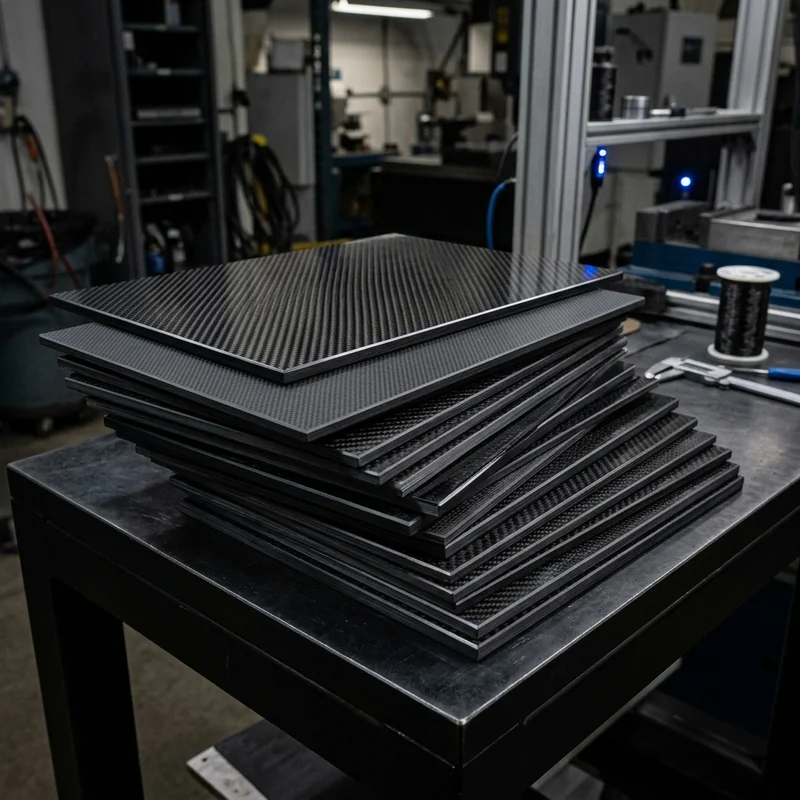
Carbon fiber standard plate-3k stripe
Lightweight, ultra-rigid standard sheets for drone fuselages, robot housings, facades and structural applications.
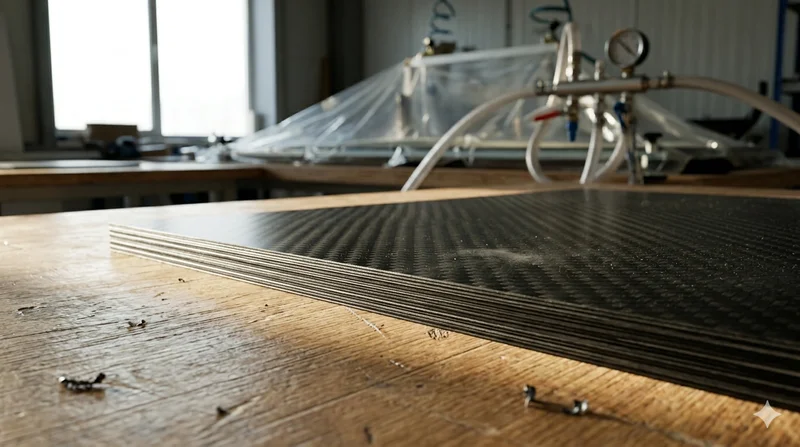
Carbon Fiber Plate — 3K Twill T700 3.0mm
Medium-thickness 3.0mm carbon fiber plate offering significantly higher load capacity while maintaining attractive 3K twill finish. Suitable for structural brackets, reinforcement plates, and load-bearing panels.
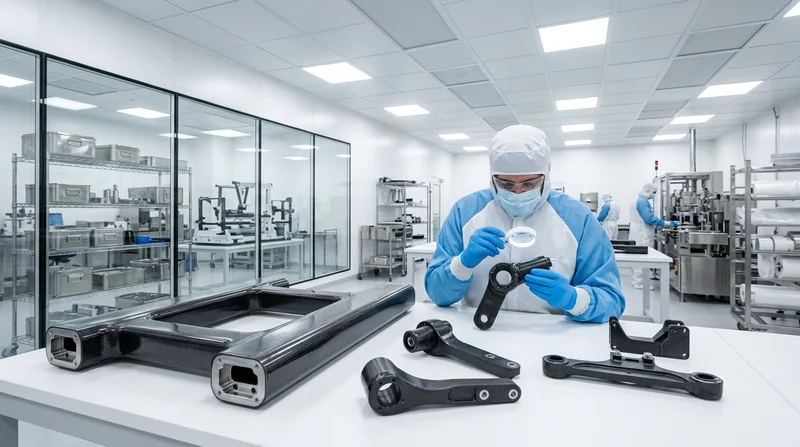
Custom Carbon Fiber Medical Device Components
Medical-grade carbon fiber components manufactured for imaging equipment, surgical instruments, and patient support systems. Carbon fiber's radiolucency (X-ray transparency) and high strength-to-weight ratio make it ideal for CT scanner beds, wheelchair frames, surgical robot arms, and MRI-compatible accessories. Biocompatible resin systems available.

Carbon Fiber Plate — 3K Twill T700 1.5mm
Thin 1.5mm carbon fiber plate with 3K twill weave surface. Lightweight and stiff, commonly used for covers, panels, drone bodies, and applications requiring a premium aesthetic appearance.
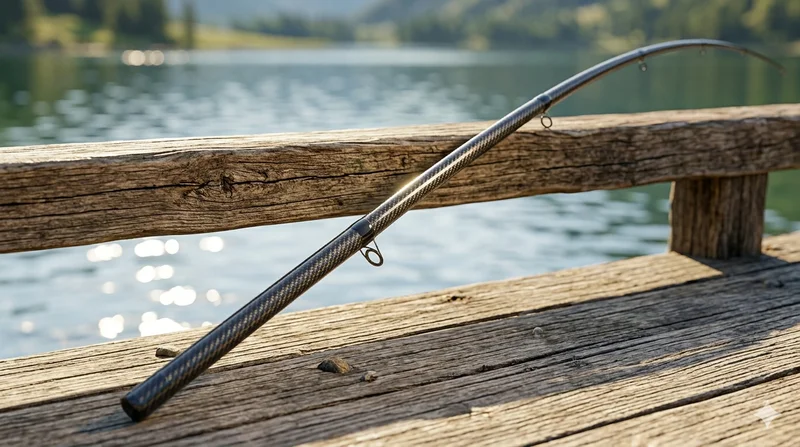
Carbon Fiber Fishing Rod Blank
High-quality carbon fiber fishing rod blank manufactured from multiple grades of Toray carbon fiber cloth. Available in a wide range of lengths, powers, and actions for freshwater and saltwater applications. Suitable for OEM rod building.