
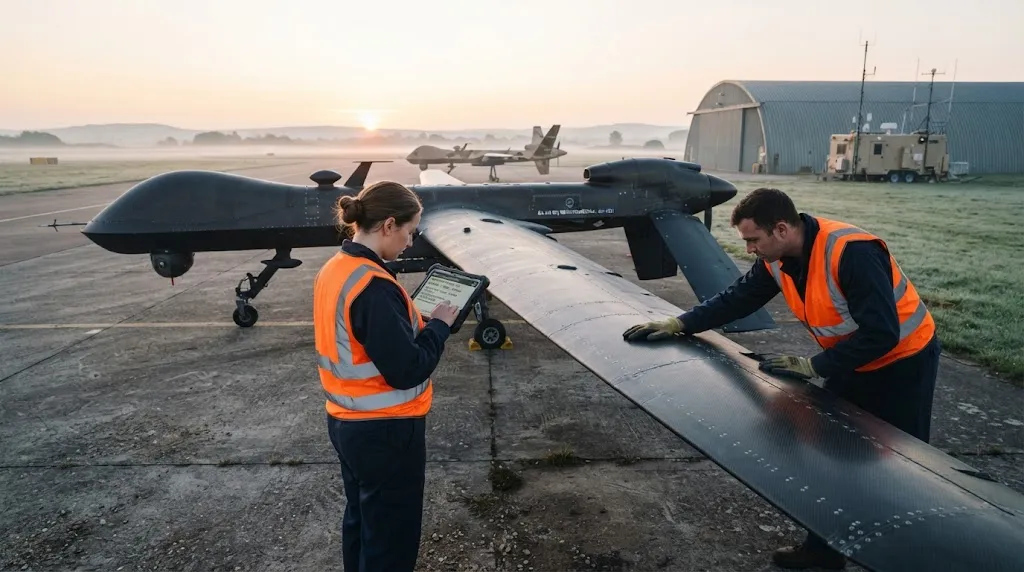
The defense and aerospace (A&D) sector has been a demanding but modest customer for carbon fiber for decades. That is changing. Unmanned aerial vehicles — from tactical drones to large, medium-altitude, long-endurance (MALE) platforms — consume composites at a rate that is beginning
Introduction
The defense and aerospace (A&D) sector has been a demanding but modest customer for carbon fiber for decades. That is changing. Unmanned aerial vehicles — from tactical drones to large, medium-altitude, long-endurance (MALE) platforms — consume composites at a rate that is beginning to rival crewed aircraft on a per-platform basis, and they are produced in far larger quantities. Industry surveys assembled by the Aerospace Industries Association (AIA) show A&D materials demand growing about 13.6 percent in the survey period, with unmanned systems and commercial space identified as the fastest segments.
For composite material suppliers, the significance is structural. An aerospace-grade carbon fiber tow sold into UAV programs carries a unit price near $80 per kilogram, roughly six to seven times the price of fiber destined for wind turbine blades. The gap is not a markup; it reflects specification, testing and traceability costs that military and civil certification demand. This article breaks down the volume trajectory, the price tier, and the new program-level supply chains that are reshaping how carbon fiber reaches the airframe.
The Volume Trajectory: UAVs as the New Volume Engine
Unlike crewed aircraft, which are produced in tens or hundreds per year, UAV fleets are produced in hundreds to thousands. A single MALE-class drone airframe can consume 300-600 kilograms of carbon fiber in wings, fuselage panels and empennage, and when a program orders several hundred airframes, the material demand becomes comparable to a small commercial aircraft program on a much shorter time scale.
- Tactical drones (25-150 kg class): typically 30-60% of structural weight is composite, driven by hand-launch weight limits and battery endurance requirements.
- MALE and HALE platforms (1-15 t class): large wing skins, spars and fuselage barrels dominated by carbon fiber, with 60-75% structural weight fraction.
- Vertical takeoff and landing (VTOL) cargo and logistics drones: rotor systems and stiffened fuselages that need high specific stiffness for hover performance.
- Expendable and loitering munitions: low-cost, high-rate production where rapid mold-to-part cycles favor out-of-autoclave processes.
The common thread is endurance economics: every kilogram of structure saved extends loiter time or payload range, so designers specify high-modulus carbon fiber where crewed aircraft might accept aluminum. The result is a demand curve that is steeper and less cyclical than the traditional defense procurement pattern.
A useful way to size the shift is program arithmetic. A single MALE drone program ordering 300 airframes at an average of 400 kilograms of carbon fiber per airframe requires 120 tons of fiber over its production run — roughly the annual output of a mid-size fiber line dedicated to aerospace grades. When three or four such programs overlap, as they do today in the United States, Europe and the Middle East, the combined demand is equivalent to a widebody aircraft program without its multi-year qualification delays. That overlap is what makes UAV demand attractive to fiber suppliers: it is lumpy enough to command premium pricing, yet large enough to justify dedicated intermediate-modulus grades and application-specific fabrics.
Why the $80/kg Price Tier Persists
Aerospace-grade carbon fiber trades at a large premium to wind-grade fiber, which typically sits in the $12-18/kg range. The aerospace tier carries costs that wind fiber never incurs:
- Specification control
- Tensile strength and modulus are controlled to tight bands; a tow that drifts outside the qualified range is rejected even if it is structurally adequate.
- Lot traceability
- Every spool is traceable to precursor, oxidation line and surface-treatment batch, enabling root-cause analysis if a part fails in service.
- Qualification and re-qualification
- Material systems are qualified against program specifications, and any process change triggers re-testing that costs months and significant test fees.
- Low-volume scheduling
- Aerospace buyers lift small, irregular volumes, so fiber producers run dedicated lines with high fixed costs per kilogram.
These costs are invisible in the fiber itself but dominate the price. Until UAV production volumes reach the scale where dedicated industrial-grade tow with full traceability can be priced as a commodity — a milestone that remains several years away — the $80/kg tier is the realistic baseline for military and civil drone supply.
Price Tiers Across End Markets
| End market | Typical price per kg | Grade | Key driver |
|---|---|---|---|
| Aerospace / defense (UAV, crewed) | $70-90 | Intermediate- and high-modulus, qualified | Specification, traceability, low volume |
| Commercial space | $60-80 | Qualified aerospace tow | Launch mass budgets, damage tolerance |
| Wind energy | $12-18 | Large-tow industrial fiber | Cost per blade, volume pricing |
| Automotive / industrial | $15-30 | Commercial tow, recycled grades | Cycle time and cost sensitivity |
The table shows why UAV suppliers do not simply switch to wind-grade fiber: the mechanical requirements overlap in modulus but the qualification, traceability and lot-release obligations are those of the aerospace tier. The price premium buys certainty, and in defense programs certainty is the product.
Drone Dominance and Program-Level Supply Chains
Government initiatives such as the US Army's Drone Dominance concept mark a departure from traditional defense procurement. Instead of a prime contractor managing a deep supplier tier, the initiative explicitly connects material suppliers, component manufacturers and military end users, with the goal of collapsing development timelines from years to months. For carbon fiber suppliers this means:
- Direct sourcing relationships: defense agencies and their fast-moving integrators purchase fiber and prepreg directly, compressing the traditional tiered supply chain.
- Open-architecture material pools: a small number of qualified fiber systems are shared across multiple airframe programs, increasing volume per qualification.
- Domestic production requirements: Buy American clauses push fiber, towpreg and prepreg production toward onshore capacity, changing sourcing patterns for international suppliers.
- Rate ramp obligations: contracts specify surge capacity, so suppliers must hold inventory positions and spare line capacity rather than build to order.
The implication for material buyers is that program-level relationships matter more than spot-market prices. A supplier that holds the right qualifications, can ramp output on short notice, and maintains traceability across the entire tow-to-part pipeline becomes part of the platform itself.
Sourcing Strategy for UAV Programs
Program teams deciding between fiber systems and suppliers should weight five factors beyond headline price: qualification status against the program specification, traceability coverage from precursor to finished tow, demonstrated surge capacity, consistency between production lots, and the supplier's willingness to co-develop application-specific fabrics such as unidirectional prepreg or spread tow for thin laminates. Because UAV programs iterate rapidly, a supplier that can release new lots quickly and maintain batch-to-batch property stability becomes an extension of the engineering team.
Frequently Asked Questions
Why is aerospace-grade carbon fiber about $80 per kilogram when wind fiber costs much less?
The gap reflects specification control, lot traceability, qualification testing and low-volume scheduling rather than material content. Aerospace buyers require tight property bands, full precursor-to-tow traceability and re-qualification on process changes, all of which add cost that wind-energy buyers never incur. The premium is effectively the price of certified certainty.
How much carbon fiber does a typical MALE drone use?
A medium-altitude, long-endurance drone airframe typically consumes 300-600 kilograms of carbon fiber in wings, fuselage panels and empennage. With structures representing 60-75% of airframe weight and multiple hundred-aircraft orders, a single program can drive material demand comparable to a small commercial aircraft program on a faster timeline.
What does the Drone Dominance initiative change for material suppliers?
It compresses the traditional tiered defense supply chain by connecting material suppliers, component manufacturers and military customers directly, requiring domestic production, open-architecture material pools and contractual surge capacity. For suppliers, program-level relationships, rapid lot release and rate-ramp capability become decisive competitive factors.
Can UAV programs use inexpensive wind-grade carbon fiber?
Not in most cases. While the modulus might overlap, UAV programs inherit aerospace qualification, traceability and lot-release obligations that wind-grade fiber is not produced to meet. Until UAV volume is large enough to justify a dedicated, commodity-priced industrial grade with full traceability, the aerospace price tier remains the baseline.
Conclusion
Unmanned systems have moved carbon fiber demand in the aerospace and defense sector from steady to sharply growing, with A&D materials demand up roughly 13.6 percent in recent survey periods and UAV programs among the fastest segments. The $80/kg aerospace price tier persists because it embeds specification, traceability and qualification value that wind-grade pricing does not, and government programs such as Drone Dominance are rewiring supply chains around direct, high-rate, domestic relationships. For buyers, the winning move is to qualify suppliers early, verify lot-to-lot consistency, and secure surge capacity alongside price.
YongXian supplies aerospace-grade carbon fiber fabrics, unidirectional prepregs and spread-tow materials built for program qualification and lot traceability. Explore our aerospace product range or contact our engineering team to discuss material systems for your UAV program.
Part of topic
Related Articles
- Recycled Carbon Fiber Market Forecast 2030: Technology Maturity and Commercialization Path
- South Korea Carbon Fiber Market 2026: Hydrogen Economy and Shipbuilding Innovation
- Wind Turbine Blade Leading Edge Protection 2026: Polyurethane, Tape, and Metallic Shield Solutions
- China Carbon Fiber Overcapacity 2026: Price War Impact and Industry Consolidation
- India Carbon Fiber Market 2026: Wind Energy, Aerospace, and Defense Expansion
- PAN Precursor Market 2026: Acrylonitrile Supply and Carbon Fiber Cost Structure
Interested in Our Products?
Contact our team for competitive pricing and technical specifications.
Get a QuoteRelated Products

Carbon Fiber Fishing Rod Blank
High-quality carbon fiber fishing rod blank manufactured from multiple grades of Toray carbon fiber cloth. Available in a wide range of lengths, powers, and actions for freshwater and saltwater applications. Suitable for OEM rod building.

Carbon Fiber Plate — 3K Twill T700 3.0mm
Medium-thickness 3.0mm carbon fiber plate offering significantly higher load capacity while maintaining attractive 3K twill finish. Suitable for structural brackets, reinforcement plates, and load-bearing panels.

Carbon Fiber Plate — 3K Twill T700 1.5mm
Thin 1.5mm carbon fiber plate with 3K twill weave surface. Lightweight and stiff, commonly used for covers, panels, drone bodies, and applications requiring a premium aesthetic appearance.

Square Carbon Fiber Tube — 3K Twill T700
Square cross-section carbon fiber tube manufactured with 3K twill weave for torsional strength. Preferred for structural frames, trusses, and support columns where rectangular geometry offers design flexibility.
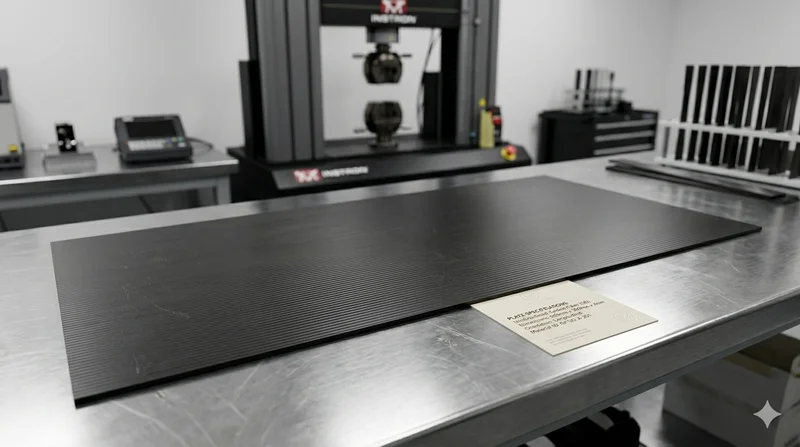
Carbon Fiber Plate — UD Unidirectional T700
Unidirectional carbon fiber plate with all fibers oriented in a single direction for maximum strength along the fiber axis. Essential for structural reinforcements, splints, and applications where load direction is predictable.