
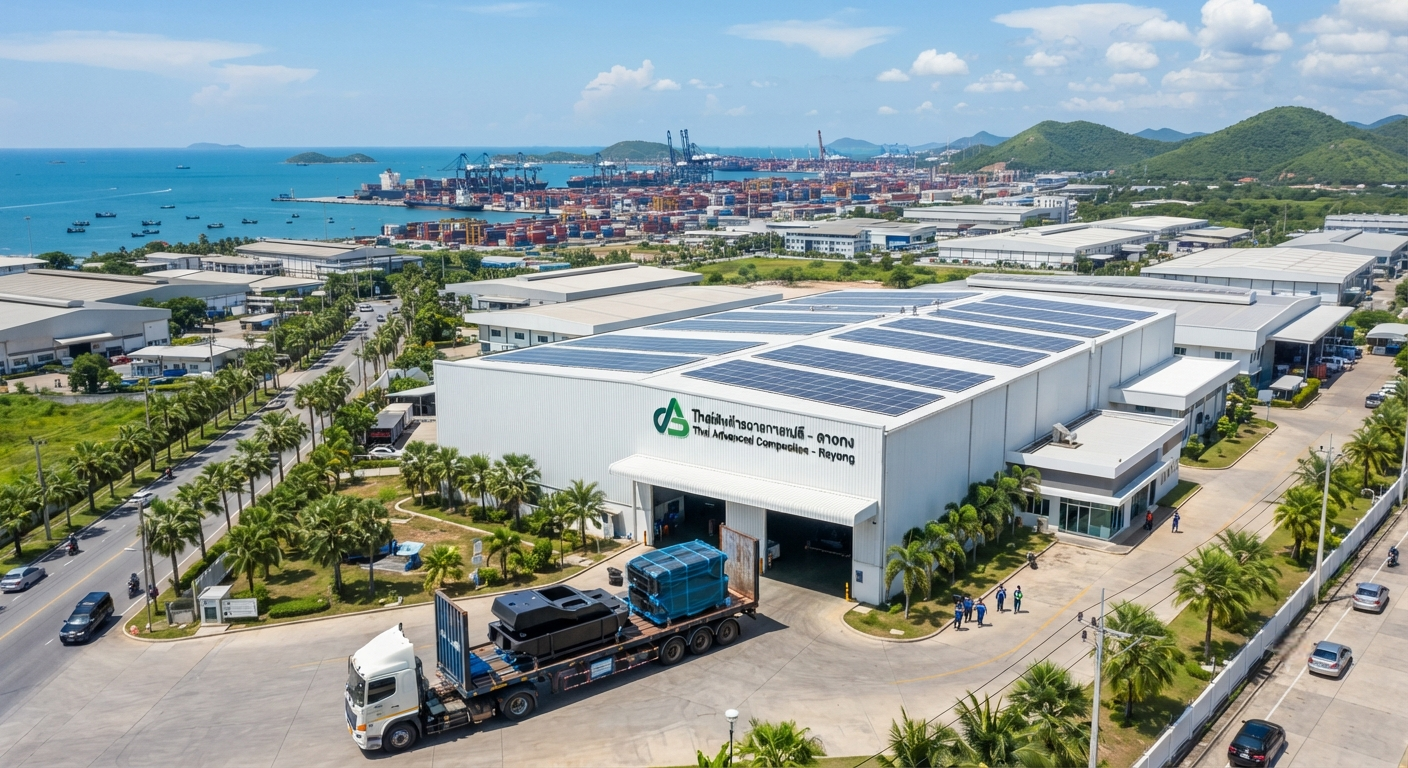
Thailand's carbon fiber demand is projected to reach 2,800 tonnes by 2027, driven by EV component manufacturing, hard disk drive (HDD) suspension arms, and aerospace MRO. This article analyzes the sources of demand, existing supply channels, and the business case for establishing CFRP fabrication capability in the Eastern Economic Corridor.
Introduction
Thailand has positioned itself as Southeast Asia's premier automotive and electronics manufacturing hub, with a combined GDP contribution of 12% from these two sectors. In 2025, Thailand produced 1.88 million vehicles (10th largest globally) and exported USD 45 billion in electronics — including 40% of the world's hard disk drives (HDDs). As global original equipment manufacturers (OEMs) diversify supply chains away from China under the "China+1" strategy, Thailand's Eastern Economic Corridor (EEC) is attracting significant investment in advanced manufacturing, with a growing proportion involving carbon fiber reinforced polymers (CFRP) across automotive, electronics, and aerospace applications.
This article provides a data-driven analysis of Thailand's emerging carbon fiber demand, examining three primary consumption sectors — automotive EV component manufacturing, HDD suspension arm production, and aerospace maintenance, repair, and overhaul (MRO) — and assessing the logistics and business case for CFRP material supply to the region.
| Sector | 2025 CF Demand (tonnes) | 2027 Projected (tonnes) | CAGR | Key Driver |
|---|---|---|---|---|
| Automotive (EV components) | 480 | 950 | 28.3% | EV battery enclosures, structural parts |
| Electronics (HDD arms, tooling) | 320 | 510 | 19.5% | Suspension arms, wafer handling ESD parts |
| Aerospace MRO | 140 | 200 | 15.1% | Interior repairs, radome refurbishment |
| Sporting goods & others | 550 | 680 | 9.8% | Tennis rackets, bicycle frames |
| Construction & infrastructure | 180 | 460 | 35.0% | Concrete reinforcement, seismic retrofitting |
| Total | 1,670 | 2,800 | 21.5% |
Automotive Sector: EV Component Manufacturing
Thailand's "30@30" policy — mandating that 30% of all vehicle production (725,000 units) be zero-emission vehicles by 2030 — is the primary catalyst for carbon fiber demand in the automotive sector. Major OEMs with existing or announced EV production lines in Thailand include:
- BYD (Sahil Factory, Rayong): 150,000 EVs per year capacity. The Dolphin and Atto 3 models use CFRP battery pack enclosures for thermal management and crash protection. Each BYD battery enclosure uses approximately 8–12 kg of CFRP (sheet molding compound, BMC grade).
- MG (SAIC-CP, Hemaraj Industrial Estate): 200,000 units annual capacity. MG's ZS EV and EP models incorporate CFRP rear seat backs and tailgate inner panels for weight reduction — approximately 3.5 kg CFRP per vehicle.
- Great Wall Motors (GWM, Rayong): 80,000 units initially, scaling to 120,000 by 2027. The Ora Good Cat uses a CFRP front-end module carrier replacing a 10.2 kg steel assembly with a 4.8 kg CFRP part.
- Toyota Thailand: The Hilux BEV concept (announced 2025) features a CFRP pickup bed structure, potentially requiring 25–35 kg of CFRP per vehicle if commercialized.
At current production rates and announced expansion plans, Thailand's automotive CFRP demand is projected to reach 950 tonnes by 2027. Notably, 85% of this demand is met through imported prepreg and sheet molding compound supplied by Toray Thailand (a local subsidiary of Toray Industries) and Mitsubishi Chemical, with limited local CFRP compounding capability.
Electronics Sector: HDD Suspension Arms and ESD Components
Thailand produces approximately 40% of the world's HDDs, with major factories operated by Seagate Technology (Korat, Teparuk) and Western Digital (Bang Pa-in, Navanakorn). HDD suspension arms — the precision component that positions the read/write head over the spinning platter — have transitioned from stainless steel to carbon fiber composites in next-generation designs for heat-assisted magnetic recording (HAMR) and microwave-assisted magnetic recording (MAMR) drives.
- CFRP suspension arms: Seagate's HAMR drives (introduced 2024) use a CFRP load beam in the suspension assembly to provide the necessary stiffness (modulus >130 GPa) and thermal stability (CTE <5 µm/m·°C) for sub-5 nm head positioning accuracy. Each HDD contains 3–5 CFRP suspension arms; with Seagate and WD producing 48 million HDD units in Thailand in 2025, this translates to approximately 240 tonnes of CFRP material demand.
- ESD-safe tooling: The same ESD-safe CFRP material used in wafer handling end-effectors (discussed in Article 9) is increasingly specified in Thai electronics factories for automated optical inspection (AOI) machine components, pick-and-place nozzle holders, and precision fixture plates. Western Digital's technology center in Bang Pa-in has qualified CFRP fixtures for HDD component assembly, reporting a 40% reduction in ESD-related yield loss.
- Semiconductor back-end: Thailand hosts 15 semiconductor assembly and test (OSAT) facilities, including UTAC (Lamlukka) and Hana Semiconductor (Ayutthaya). These facilities use CFRP test socket inserts and handling trays for strip-level testing — a niche but growing application consuming approximately 30 tonnes of CFRP annually.
Aerospace MRO and Regional Aviation
Thailand's aerospace sector, while smaller than automotive and electronics, is a strategically important consumer of carbon fiber. The U-Tapao International Airport and Eastern Airport City development within the EEC includes a dedicated MRO complex targeting 200 aircraft maintenance bays by 2029.
- Interior component repair: CFRP seat back shells, lavatory panels, and galley structures require specialized repair using certified prepreg materials. Airbus and Boeing have certified three MRO facilities in Thailand (Thai Airways Technical, Aircraft Maintenance Service, and SIA Engineering Thailand) for composite structural repairs up to class 3 (secondary structure).
- Radome and fairing refurbishment: Each radome refurbishment cycle consumes 8–15 kg of glass/carbon fiber hybrid prepreg. With 180 radome overhaul events per year across Thai-based operators, this segment alone generates 25–30 tonnes of annual CFRP material demand.
- UAV manufacturing: Thailand's Board of Investment (BOI) has promoted UAV manufacturing through its "Aerospace and Avionics" incentive scheme since 2023. At least four companies — including Siam AI and Aero Thai Defence — produce tactical and agricultural UAVs with CFRP airframes, consuming approximately 15 tonnes of carbon fiber prepreg annually and growing at 40% CAGR.
Supply Chain and Import Channels
Thailand has no domestic PAN precursor or carbon fiber production. All carbon fiber is imported through established channels:
| Supply Channel | Product Forms | Est. Market Share | Lead Time |
|---|---|---|---|
| Toray Thailand (Rayong) | Prepreg, woven fabric, tow | 35% | 4–6 weeks (local warehouse) |
| Mitsubishi Chemical (regional) | PAN fiber, chopped fiber, SMC | 22% | 6–8 weeks (Singapore hub) |
| Teijin / TenCate (imported) | Aerospace prepreg, thermoplastics | 15% | 8–12 weeks (Japan origin) |
| Chinese suppliers (Zhongfu Shenying, Weihai) | Standard modulus tow, fabric | 20% | 3–4 weeks (China rail/sea) |
| Other (Hyosung, SGL, Solvay) | Specialty grades | 8% | 6–10 weeks |
The Eastern Economic Corridor offers significant logistics advantages: Laem Chabang deep-sea port handles 90% of Thailand's containerized imports, with direct feeder services to Singapore — the region's carbon fiber redistribution hub. The EEC's Board of Investment provides an 8-year corporate income tax holiday for manufacturers producing advanced composite materials within designated industrial zones, including the EECi (Eastern Economic Corridor of Innovation) in Wang Chan, Rayong.
Frequently Asked Questions
Does Thailand have any domestic carbon fiber production capacity?
No. Thailand currently has no PAN precursor production or carbon fiber conversion capacity. All carbon fiber material — from standard modulus tow (230 GPa) to aerospace-grade prepreg — is imported through regional distributors or overseas suppliers. However, the Thai Board of Investment has classified "high-performance carbon fiber and advanced composite materials" as priority activities under its Thailand 4.0 industrial policy, offering incentives including up to 13-year tax holidays for investment exceeding THB 1 billion (approximately USD 28 million). In 2025, at least two feasibility studies were submitted to BOI for carbon fiber conversion plants in the EEC, but no construction has commenced. This creates an immediate market opportunity for foreign carbon fiber fabricators and processors to establish presence in Thailand's growing downstream market.
What are the key regulatory factors affecting carbon fiber imports to Thailand?
Carbon fiber imports to Thailand fall under HS code 6815.11 (carbon fibers and articles thereof). Key regulatory considerations: (1) Duty rates: Standard MFN (Most Favored Nation) import duty on carbon fiber is 5–10%, but ASEAN-China Free Trade Agreement (ACFTA) reduces duties to 0% for Chinese-origin carbon fiber. For Toray (Japan) and Mitsubishi (Japan), the Thailand-Japan Economic Partnership Agreement (JTEPA) reduces duties to 1–3%. (2) Dual-use controls: Carbon fiber with tensile modulus exceeding 395 GPa is classified as a dual-use item under Thai export control regulations (corresponding to Wassenaar Arrangement Category 1C). Imports require end-user certificates and BOI notification. (3) Customs valuation: The Thai Customs Department requires declared values to be supported by manufacturer invoices for carbon fiber imports — broker-declared values face 30–90 day verification holds.
What CFRP processing capabilities exist locally in Thailand?
Thailand has a developing but incomplete CFRP processing ecosystem. The following capabilities exist: (1) Compression molding — at least 8 Tier-1 automotive suppliers (including Summit Auto Body, Thai Summit, and AAPICO) operate compression molding lines for CFRP sheet molding compound (SMC), serving Toyota, Honda, and BYD. (2) Autoclave curing — only 3 facilities in Thailand have production-scale autoclaves certified for aerospace-grade composite curing (Thai Airways Technical, the Royal Thai Air Force's Wing 6 composite shop, and an independent facility at the Thailand Science Park). (3) Filament winding — no commercial-scale filament winding exists for pressure vessel or pipe applications. (4) Prepreg manufacturing — Toray Thailand's Rayong facility produces woven fabric prepreg but does not manufacture unidirectional (UD) tape prepreg domestically; all UD prepreg is imported from Japan. (5) RTM (resin transfer molding) — 5–6 tooling companies in the EEC offer RTM capability for medium-volume automotive and sporting goods production. The gap in UD tape prepreg supply and filament winding represents the most significant opportunities for foreign CFRP processors entering the Thai market.
Part of topic
Related Articles
- Recycled Carbon Fiber Market Forecast 2030: Technology Maturity and Commercialization Path
- South Korea Carbon Fiber Market 2026: Hydrogen Economy and Shipbuilding Innovation
- Wind Turbine Blade Leading Edge Protection 2026: Polyurethane, Tape, and Metallic Shield Solutions
- China Carbon Fiber Overcapacity 2026: Price War Impact and Industry Consolidation
- India Carbon Fiber Market 2026: Wind Energy, Aerospace, and Defense Expansion
- PAN Precursor Market 2026: Acrylonitrile Supply and Carbon Fiber Cost Structure
Interested in Our Products?
Contact our team for competitive pricing and technical specifications.
Get a QuoteRelated Products
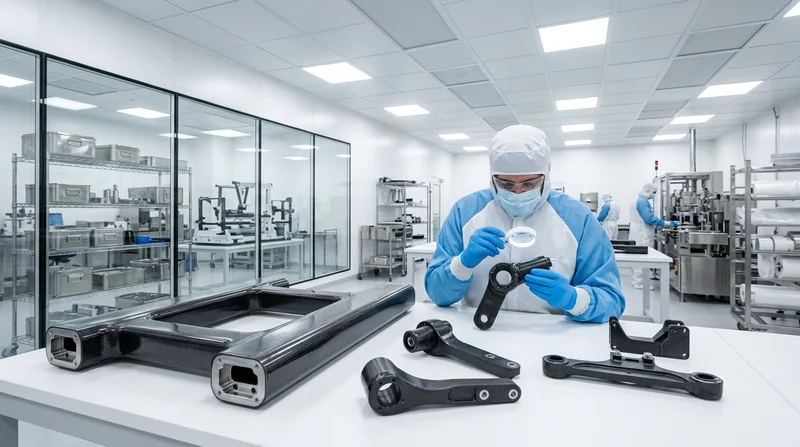
Custom Carbon Fiber Medical Device Components
Medical-grade carbon fiber components manufactured for imaging equipment, surgical instruments, and patient support systems. Carbon fiber's radiolucency (X-ray transparency) and high strength-to-weight ratio make it ideal for CT scanner beds, wheelchair frames, surgical robot arms, and MRI-compatible accessories. Biocompatible resin systems available.
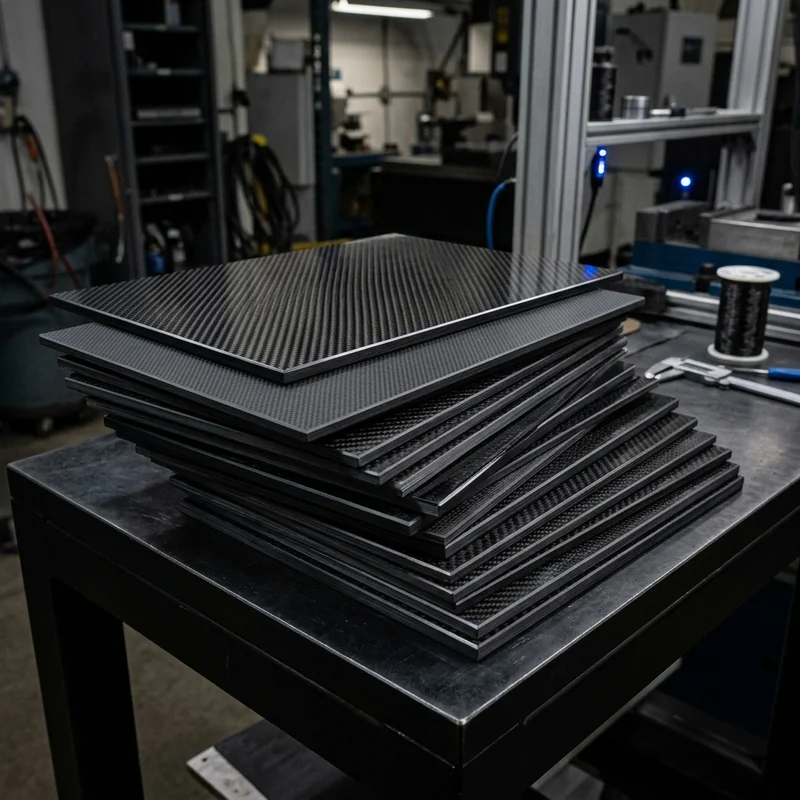
Carbon fiber standard plate-3k stripe
Lightweight, ultra-rigid standard sheets for drone fuselages, robot housings, facades and structural applications.

Square Carbon Fiber Tube — 3K Twill T700
Square cross-section carbon fiber tube manufactured with 3K twill weave for torsional strength. Preferred for structural frames, trusses, and support columns where rectangular geometry offers design flexibility.

Carbon Fiber Plate — 3K Twill T700 3.0mm
Medium-thickness 3.0mm carbon fiber plate offering significantly higher load capacity while maintaining attractive 3K twill finish. Suitable for structural brackets, reinforcement plates, and load-bearing panels.

Carbon Fiber Plate — 3K Twill T700 1.5mm
Thin 1.5mm carbon fiber plate with 3K twill weave surface. Lightweight and stiff, commonly used for covers, panels, drone bodies, and applications requiring a premium aesthetic appearance.