
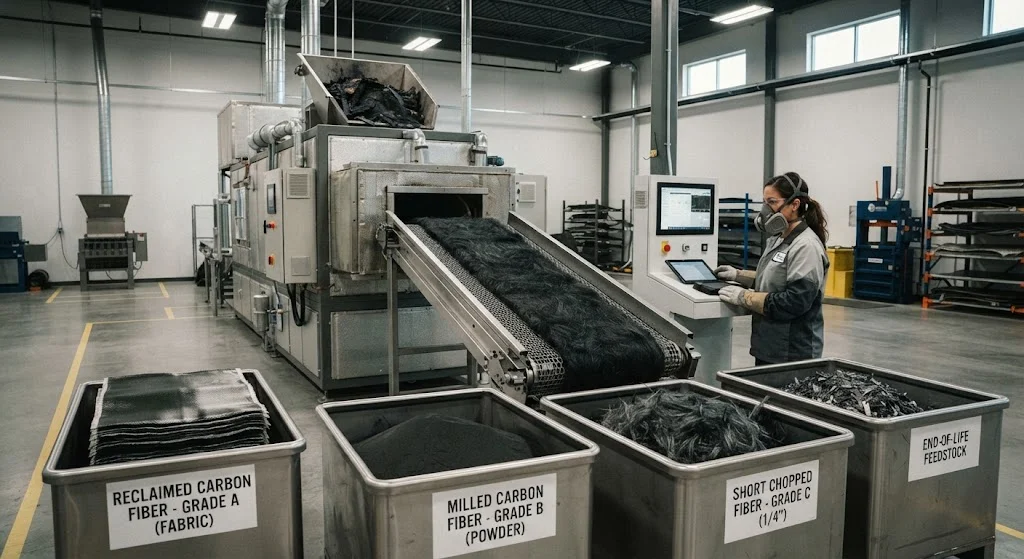
The recycled carbon fiber market is growing rapidly as manufacturers seek sustainable alternatives to virgin carbon fiber. This article examines recycling technologies, market drivers, applications, and the economic and environmental benefits of recycled carbon fiber.
Introduction
The carbon fiber industry faces a growing sustainability challenge: while carbon fiber reinforced polymers (CFRPs) offer exceptional performance in lightweighting applications, their end-of-life management has received limited attention. Unlike metals, which are readily recyclable, thermoset-based CFRPs cannot be simply remelted and reformed. This has driven interest in recycled carbon fiber as both an environmental solution and a cost-effective material source.
The recycled carbon fiber market has grown from a niche segment to a significant industry, with global capacity exceeding 20,000 tons annually. This growth reflects both increasing end-of-life composite volumes from wind energy, aerospace, and automotive applications, and expanding demand for cost-effective carbon fiber in less performance-critical applications.
Recycling Technologies
Several technologies have been developed to recover carbon fiber from composite waste:
Thermal recycling (pyrolysis): The most established method, pyrolysis heats composite waste to 400–700°C in an oxygen-free environment, decomposing the polymer matrix and recovering clean carbon fiber. Fiber strength retention is typically 80–95% of virgin fiber. The process produces oil and gas byproducts that can be used for energy recovery.
Chemical recycling (solvolysis): Chemical processes dissolve the polymer matrix using solvents at elevated temperature and pressure. This method produces cleaner fiber surfaces than pyrolysis and can potentially recover the matrix chemistry. However, it requires careful solvent management and waste treatment.
Microwave-assisted recycling: Emerging technology uses microwave energy to selectively heat and decompose the polymer matrix. Faster than conventional pyrolysis with potentially better fiber quality retention. Still in pilot-scale development for most applications.
Supercritical fluid processing: Uses supercritical water or other fluids to decompose the matrix at moderate temperatures. This approach can achieve high fiber quality while producing useful chemical byproducts. Limited commercial deployment to date.
Market Drivers
Several factors are driving growth in the recycled carbon fiber market:
Regulatory pressure: European Union end-of-life vehicle directives and emerging waste management regulations require composite manufacturers to address end-of-life disposal. Recycled carbon fiber provides a compliance pathway while creating value from waste.
Cost advantage: Recycled carbon fiber typically costs 40–70% less than virgin fiber, making carbon fiber technology accessible for price-sensitive applications that cannot justify virgin fiber costs.
Environmental sustainability: Corporate sustainability commitments and life cycle assessment (LCA) considerations drive demand for lower-carbon-footprint materials. Recycled carbon fiber production generates significantly less CO₂ than virgin fiber manufacturing.
Supply chain resilience: Recycled carbon fiber provides a domestic material source that reduces dependence on international virgin fiber supply chains, particularly important given the concentration of carbon fiber production in Asia.
Applications
Recycled carbon fiber is finding applications across multiple market segments:
Automotive: Non-structural and semi-structural automotive components — interior panels, underbody shields, battery enclosures — use recycled carbon fiber where virgin fiber performance exceeds requirements. The cost advantage makes recycled fiber competitive with glass fiber in some applications.
Consumer electronics: Device enclosures, laptop cases, and sporting goods manufacturers use recycled carbon fiber for products where the material's appearance and moderate performance benefits justify the cost premium over plastic.
Industrial applications: Tooling, fixtures, and non-critical structural components in manufacturing environments use recycled carbon fiber where its stiffness-to-weight advantage is valuable but virgin fiber performance is not required.
Construction: Carbon fiber reinforced concrete, structural reinforcement, and seismic retrofitting applications can use recycled fiber effectively, as the performance requirements are lower than aerospace or automotive primary structures.
Quality and Standardization
The recycled carbon fiber industry is developing quality standards and specifications:
Fiber characterization: Recycled fiber properties vary depending on the source composite, recycling process conditions, and post-processing. Standardized testing methods and material specifications are essential for consistent quality.
Process certification: Recycling facilities are developing quality management systems and certifications to meet customer requirements for material traceability and performance consistency.
Material specifications: Industry organizations are developing specifications for recycled carbon fiber products, enabling comparison and selection across suppliers and processes.
Future Outlook
The recycled carbon fiber market is projected to grow at 15–20% annually through 2030, driven by:
Increasing end-of-life volumes: As the first generation of wind turbine blades and composite automotive structures reach end of life, the availability of recyclable composite waste will increase significantly.
Technology improvements: Continued development of recycling technologies will improve fiber quality retention, reduce processing costs, and enable recycling of a wider range of composite types.
Market acceptance: Growing experience with recycled carbon fiber in applications, combined with quality standardization, will increase market acceptance and expand addressable applications.
Circular economy initiatives: Government and industry initiatives promoting circular economy principles will create additional demand for recycled materials, including carbon fiber.
Conclusion
The recycled carbon fiber market represents a significant opportunity to address sustainability challenges while creating economic value from composite waste. As recycling technologies mature, quality standards develop, and end-of-life volumes increase, recycled carbon fiber will play an increasingly important role in the global carbon fiber supply chain, enabling broader adoption of carbon fiber technology while reducing its environmental footprint.
Part of topic
Related Articles
- Recycled Carbon Fiber Market Forecast 2030: Technology Maturity and Commercialization Path
- South Korea Carbon Fiber Market 2026: Hydrogen Economy and Shipbuilding Innovation
- Wind Turbine Blade Leading Edge Protection 2026: Polyurethane, Tape, and Metallic Shield Solutions
- China Carbon Fiber Overcapacity 2026: Price War Impact and Industry Consolidation
- India Carbon Fiber Market 2026: Wind Energy, Aerospace, and Defense Expansion
- PAN Precursor Market 2026: Acrylonitrile Supply and Carbon Fiber Cost Structure
Interested in Our Products?
Contact our team for competitive pricing and technical specifications.
Get a QuoteRelated Products

Carbon Fiber Fishing Rod Blank
High-quality carbon fiber fishing rod blank manufactured from multiple grades of Toray carbon fiber cloth. Available in a wide range of lengths, powers, and actions for freshwater and saltwater applications. Suitable for OEM rod building.

Carbon Fiber Plate — 3K Twill T700 3.0mm
Medium-thickness 3.0mm carbon fiber plate offering significantly higher load capacity while maintaining attractive 3K twill finish. Suitable for structural brackets, reinforcement plates, and load-bearing panels.

Carbon Fiber Plate — 3K Twill T700 1.5mm
Thin 1.5mm carbon fiber plate with 3K twill weave surface. Lightweight and stiff, commonly used for covers, panels, drone bodies, and applications requiring a premium aesthetic appearance.

Square Carbon Fiber Tube — 3K Twill T700
Square cross-section carbon fiber tube manufactured with 3K twill weave for torsional strength. Preferred for structural frames, trusses, and support columns where rectangular geometry offers design flexibility.
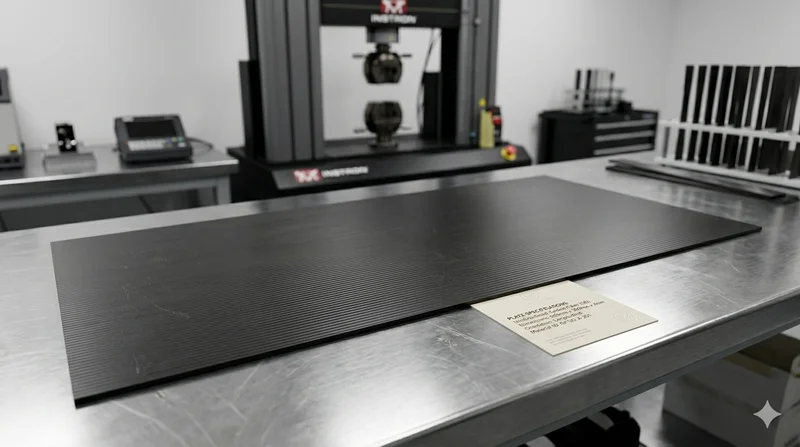
Carbon Fiber Plate — UD Unidirectional T700
Unidirectional carbon fiber plate with all fibers oriented in a single direction for maximum strength along the fiber axis. Essential for structural reinforcements, splints, and applications where load direction is predictable.