
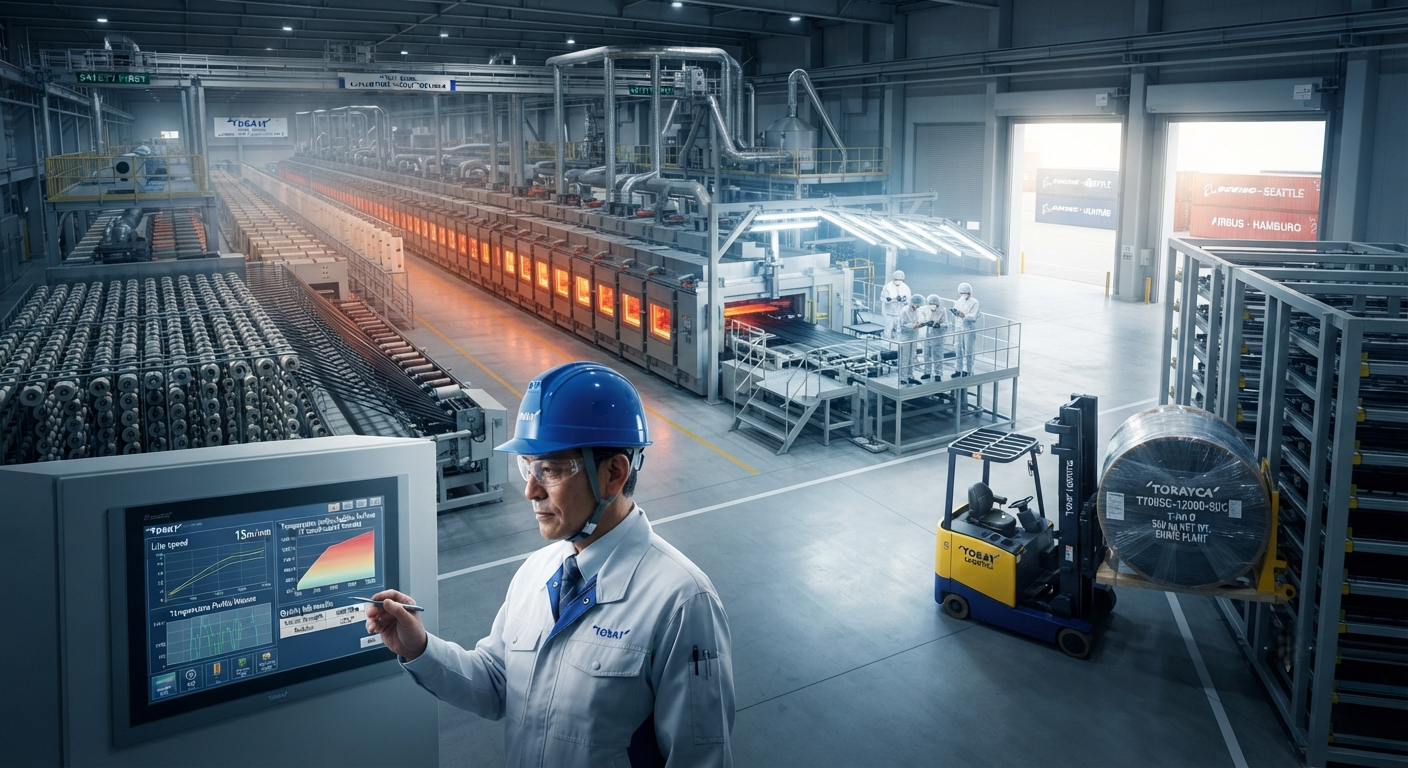
Comprehensive B2B analysis of Japan's carbon fiber export and import trade in 2026, covering Toray, Teijin, and Mitsubishi Chemical Group export strategies, trade patterns by region, supply chain resilience initiatives, trade policy factors including US-Japan critical minerals agreement and Chinese domestic competition, and detailed market projections through 2035.
Japan's Dominance in the Global Carbon Fiber Market
Japan remains the undisputed global leader in carbon fiber production, with Toray Industries, Teijin Limited, and Mitsubishi Chemical Group collectively controlling approximately 55–60% of worldwide carbon fiber manufacturing capacity as of 2026. These three Japanese conglomerates — often referred to as the "Big Three" of carbon fiber — operate production facilities across Japan, the United States, Europe, and Southeast Asia, supplying aerospace-grade and industrial-grade carbon fiber to manufacturers on every continent. Understanding Japan's export strategies, trade flows, and supply chain dynamics is essential for any B2B buyer seeking reliable carbon fiber supply in today's geopolitically complex market.
Japan's carbon fiber production capacity reached approximately 65,000 tonnes per year in 2025, representing roughly 35% of global nameplate capacity. Toray alone accounts for approximately 30,000 tonnes of this total, with major production sites at Ehime (Japan), Decatur (Alabama, USA), Abidos (France), and a recently expanded facility in Gumi (South Korea) that added 5,000 tonnes of annual capacity for industrial-grade T700-series fiber in 2024. Teijin operates production at Matsuyama (Japan), Mishima (Japan), and Greenwood (South Carolina, USA), with a combined capacity of approximately 18,000 tonnes. Mitsubishi Chemical operates through its subsidiary Mitsubishi Rayon, with production at Toyohashi (Japan), Otake (Japan), and a joint venture facility in Sacramento (California, USA) totaling approximately 17,000 tonnes annually.
The strategic importance of Japanese carbon fiber to global supply chains cannot be overstated. Japanese producers supply approximately 70% of the carbon fiber used in Boeing aircraft programs, 65% of the fiber used in Airbus commercial aircraft, and an estimated 40% of the industrial-grade fiber consumed by wind turbine blade manufacturers worldwide. This market position gives Japanese trading companies — Mitsubishi Corporation, Mitsui & Co., and Sumitomo Corporation — outsized influence over global carbon fiber pricing, allocation, and delivery terms.
Export Destinations and Trade Patterns
Japanese carbon fiber exports follow distinct geographic and product-tier patterns that reveal the strategic priorities of each producer. According to Japan Customs trade data for 2024–2025, Japanese carbon fiber exports totaled approximately 38,000 tonnes annually, with the following regional breakdown:
| Destination Region | Annual Volume (tonnes) | Share of Exports | Primary Grade | Key Buyers |
|---|---|---|---|---|
| North America (USA, Canada, Mexico) | 14,500–16,000 | 38–42% | Aerospace-grade (T800, T1100, IM7-class) | Boeing, Spirit AeroSystems, Hexcel, Solvay, GKN Aerospace |
| Europe (EU, UK, Switzerland) | 10,000–11,500 | 26–30% | Mixed aerospace/industrial (T700, T800, M-series) | Airbus, Safran, Vestas, Siemens Gamesa, BMW |
| China | 5,500–6,500 | 14–17% | Industrial-grade (T700, T300, 48K–60K tow) | Wind turbine OEMs, automotive Tier-1 suppliers, sports equipment |
| Southeast Asia (South Korea, Taiwan, Thailand, Vietnam) | 3,500–4,500 | 9–12% | Industrial-grade (T700, 24K–48K tow) | Samsung SDI, LG Energy Solution, bicycle frame OEMs |
| Middle East & Africa | 1,000–1,500 | 3–4% | Industrial-grade (T700, T300) | Oil & gas composite pipe manufacturers |
| Other (Oceania, South America, India) | 1,500–2,000 | 4–5% | Mixed grades | Defense programs, marine, sporting goods |
A notable trend in 2025–2026 is the accelerating shift in exports toward China and Southeast Asia. Between 2022 and 2025, Japanese carbon fiber exports to China grew by approximately 40% in volume terms, driven by Chinese wind turbine manufacturers' increasing preference for high-quality Japanese fiber over domestic alternatives for long-blade spar cap applications. Toray's T700-grade fiber — the industry workhorse — commands a 15–25% price premium over comparable Chinese-produced fiber in the Chinese market, yet Chinese buyers continue to allocate a significant portion of their procurement to Japanese material, citing superior batch-to-batch consistency, documented traceability, and reliable delivery performance.
Toray Industries: Market Leader and Innovation Driver
Toray Industries maintains its position as the world's largest carbon fiber producer through a combination of technological leadership, vertical integration, and strategic global capacity deployment. The company's carbon fiber business, organized under its Torayca brand, generated approximately ¥380 billion (USD $2.5 billion) in revenue in fiscal 2025, with operating margins of 15–18% in aerospace-grade products and 8–12% in industrial-grade products.
Toray's product portfolio spans the full performance spectrum:
- Aerospace-grade fibers: T800S (5,880 MPa tensile strength, 294 GPa modulus) — the primary material for Boeing 787 and Airbus A350 wing and fuselage structures. T1100G (7,000 MPa, 324 GPa) — the next-generation intermediate modulus fiber qualified on Boeing 777X and next-generation narrow-body programs. M-series high-modulus fibers (M40X, M55J, M60J) — used in satellite structures, space telescope components, and precision instrument applications.
- Industrial-grade fibers: T700S (4,900 MPa, 230 GPa) — the most widely consumed carbon fiber grade globally, used in wind turbine blades, automotive components, pressure vessels, and construction reinforcement. T300 (3,500 MPa, 230 GPa) — a lower-cost entry-level industrial grade for less demanding applications such as sporting goods and general industrial components.
- Large-tow fibers: Toray's 48K and 60K tow products — produced primarily at the Gumi, South Korea facility — target high-volume industrial applications where cost per kilogram is the primary procurement criterion. These fibers trade at $18–24/kg compared to $35–50/kg for aerospace-grade T800S.
Toray's export strategy is notable for its emphasis on local-for-local production. Rather than exporting finished fiber from Japan, Toray has established production facilities in the United States (Decatur, AL), France (Abidos), and South Korea (Gumi) that serve their respective regional markets. This localization strategy serves multiple objectives: it mitigates currency exchange risk, provides preferential access under domestic content regulations (particularly important for US defense and aerospace programs), reduces carbon footprint from trans-oceanic shipping, and insulates the supply chain from trade disruptions. Only the highest-value aerospace-grade fibers (T800S, T1100G, M-series) are still predominantly exported from Toray's Ehime, Japan, mother plant.
Teijin and Mitsubishi: Differentiated Strategies
Teijin Limited has adopted a more focused strategy, concentrating on automotive-grade carbon fiber and thermoplastic composite intermediates. Teijin's Tenax Carbon Fiber division generated approximately ¥180 billion (USD $1.2 billion) in revenue in fiscal 2025, with a strategic emphasis on carbon fiber-reinforced thermoplastic (CFRTP) for automotive structural applications. Teijin's Tenax TPUD (unidirectional tape) and Tenax TPWF (woven fabric) products — using PA6, PA66, PPS, and PEI thermoplastic matrices — have gained significant traction with European and Japanese automotive OEMs seeking recyclable, high-throughput composite solutions.
Teijin's export strategy differs markedly from Toray's in its focus on automotive supply chains. The company has positioned itself as a preferred supplier for BMW's Carbon Core program, supplying both carbon fiber and CFRTP pre-impregnated materials for the 7 Series and iX models. A notable development in 2025 was Teijin's expanded supply agreement with Ford Motor Company for carbon fiber drive shafts in the Ford F-150 Lightning and E-Transit commercial vehicles — an application requiring 2.5–3.5 kg of carbon fiber per vehicle at an estimated volume of 50,000–80,000 vehicles annually by 2027.
Mitsubishi Chemical Group's carbon fiber business, operating under the Mitsubishi Rayon brand, has carved a niche in wind energy and pressure vessel applications. The company's TR50S (4,900 MPa, 245 GPa) and TRH50 (5,500 MPa, 250 GPa) fibers are widely specified by Type IV hydrogen storage tank manufacturers, including Hexagon Purus, Faurecia, and Plastic Omnium. Mitsubishi's Pyrofil carbon fiber brand holds a particularly strong position in the Chinese wind energy market, where its cost-competitive 48K tow product competes directly with Chinese domestic producers. Mitsubishi's 2024 capacity expansion at its Otake plant added 3,000 tonnes per year of large-tow (48K) capacity specifically targeting the wind energy and pressure vessel markets.
Trade Policy and Geopolitical Factors
Japanese carbon fiber exports operate within a complex framework of trade policies, export controls, and geopolitical considerations that significantly influence supply availability and pricing for B2B buyers. Three factors are particularly relevant in 2026:
- Export controls on high-performance fibers: Japan's Ministry of Economy, Trade and Industry (METI) maintains export control classifications for carbon fibers with tensile strength exceeding 5,500 MPa and/or tensile modulus exceeding 350 GPa. These grades — which include Toray's T1100G, M40X, and M55J — require individual export licenses when destined for non-allied countries. In practice, this creates administrative delays of 30–90 days for B2B buyers in China, Russia, and certain Middle Eastern markets seeking high-performance Japanese fiber. Toray has responded by limiting T1100G exports to allied nations (USA, EU member states, Australia, South Korea) and fulfilling non-allied requests with T800S or lower-grade alternatives where permitted.
- US-Japan carbon fiber trade alignment: The US-Japan Critical Minerals Agreement, expanded in 2025 to include carbon fiber and its precursor materials, establishes a bilateral framework for coordinated export controls, joint stockpile management, and technology sharing. Under this agreement, Japanese carbon fiber producers have committed to maintaining minimum inventory levels for US defense and aerospace customers, while the US Department of Defense has designated Japanese-sourced carbon fiber as a "trusted source" eligible for simplified procurement under the Defense Production Act.
- Chinese domestic competition and trade friction: China's domestic carbon fiber production capacity has grown from approximately 30,000 tonnes in 2020 to an estimated 95,000 tonnes in 2025, creating overcapacity that has driven down industrial-grade fiber prices by 25–35% over the same period. Chinese producers — Zhongfu Shenying, Jiangsu Hengshen, Jilin Carbon Valley, and Sinofibers Technologies — have aggressively targeted markets traditionally dominated by Japanese exports, particularly in wind energy and sporting goods. This has led to anti-dumping petitions and intensified price competition in Southeast Asian markets, where Chinese industrial-grade fiber trades at $12–16/kg versus $18–26/kg for comparable Japanese product.
Supply Chain Resilience and Capacity Expansion
COVID-era disruptions (2020–2022) and subsequent logistics constraints prompted a fundamental reassessment of carbon fiber supply chain resilience among Japanese producers. All three companies have undertaken significant capacity expansion and diversification initiatives since 2023:
- Toray: USD $750 million investment (announced 2023, fully operational 2025) to double T1100G aerospace-grade capacity at the Ehime plant, add 7,000 tonnes of industrial-grade capacity at the Gumi, South Korea facility, and establish a precursor (PAN) production joint venture with a US-based chemical company to reduce dependence on Japanese-produced precursor.
- Teijin: EUR €280 million investment in a new carbon fiber production facility in Hamina, Finland (operational Q3 2025), producing 5,000 tonnes annually of automotive-grade fiber for European supply chains. This facility uses hydropower and biomass energy, achieving a 60% reduction in production carbon footprint compared to Japanese facilities — a key selling point for European automotive customers with net-zero supply chain commitments.
- Mitsubishi Chemical: USD $180 million expansion of large-tow capacity at the Otake plant (completed 2024) and a new joint venture with a Saudi Arabian partner for carbon fiber production in Jubail, targeting the Middle Eastern oil and gas composite pipe market with 3,000 tonnes of annual capacity (planned 2027).
Frequently Asked Questions
What are the minimum order quantities for direct carbon fiber purchases from Japanese producers?
Direct purchasing from Japanese carbon fiber producers — Toray, Teijin, or Mitsubishi Chemical — typically requires minimum order quantities (MOQs) that reflect their B2B-focused distribution model. For industrial-grade fibers (T700, T300, 48K–60K tow formats), the typical MOQ is 5–10 metric tonnes per order line item, with lead times of 8–16 weeks from order confirmation. For aerospace-grade fibers (T800S, T1100G, M-series), MOQs are substantially higher at 15–25 tonnes per order, reflecting the extended qualification and testing protocols required for each production lot. Buyers who cannot meet these MOQ thresholds are directed to authorized distributors and trading companies, including Mitsubishi Corporation, Mitsui & Co., Marubeni, and Toray's own network of regional distributors. These intermediaries typically accept orders as small as 500 kg for industrial-grade fiber, with a price premium of 10–25% over direct mill pricing. For B2B buyers in North America, Hexcel, Solvay, and Gurit serve as major value-added distributors that purchase Japanese carbon fiber in bulk and resell in smaller quantities, often with slitting, spooling, and prepreg conversion services included.
How do Japanese carbon fiber grades compare with Chinese-produced equivalents?
The comparison between Japanese and Chinese carbon fiber grades has narrowed significantly over the past five years, but meaningful differences persist across several dimensions. Tensile strength and modulus values for comparable grades — Toray T700 (4,900 MPa, 230 GPa) versus Zhongfu Shenying SYT45 (4,800–5,000 MPa, 230–240 GPa) — are now nearly equivalent in reported data sheet values. However, batch-to-batch consistency remains a distinguishing factor: Japanese producers maintain coefficient of variation (CV) values below 3% for tensile strength across production lots, while Chinese producers typically achieve 4–7% CV. For applications where consistent mechanical properties are critical — aerospace, certain automotive structural components, and Type IV pressure vessels — Japanese fiber commands a premium of 15–30% over Chinese equivalents. For less demanding applications — sporting goods, general industrial components, and non-structural automotive parts — Chinese-produced fiber offers a compelling value proposition at $12–18/kg versus $18–28/kg for Japanese fiber. It is worth noting that Toray's T700-grade production at its Gumi, South Korea, facility competes directly with Chinese fiber on price while maintaining Japanese-quality process controls, creating a mid-tier product option for value-conscious B2B buyers.
Will Japan maintain its leadership in the global carbon fiber market through 2035?
The trajectory of Japanese carbon fiber market leadership through 2035 depends on three interconnected factors: technology migration, cost competitiveness, and geopolitical positioning. On technology, Japanese producers maintain a clear advantage in high-performance fibers (intermediate modulus > 280 GPa and high modulus > 350 GPa), where their patent portfolios, production experience, and customer qualification heritage create formidable barriers to entry. Toray's T1100G, qualified on multiple next-generation aircraft programs, has a 5–7 year technology lead over any non-Japanese competitor. On cost competitiveness, the picture is more challenging. Chinese producers with access to low-cost coal-based energy, government subsidies, and rapidly improving process yields are producing industrial-grade fiber at $2–4/kg below Japanese production costs. This cost gap will likely persist through 2030, limiting Japanese producers' ability to compete in price-sensitive industrial segments. On geopolitical positioning, Japan's alignment with US and European supply chain security initiatives — particularly the US-Japan Critical Minerals Agreement and the EU's Critical Raw Materials Club — provides preferential market access in allied markets that offsets some cost disadvantages. The most likely trajectory is a bifurcated market: Japanese producers maintain leadership in aerospace, defense, and high-performance industrial applications (projected 55–65% share through 2030), while Chinese producers dominate the price-sensitive industrial segment (projected 60–70% share by 2030). Japanese producers' share of the overall global market by value is projected to decline from approximately 50% in 2025 to 35–40% by 2035, but their share of the highest-value tier will remain dominant.
Related Articles
- Recycled Carbon Fiber Market Forecast 2030: Technology Maturity and Commercialization Path
- South Korea Carbon Fiber Market 2026: Hydrogen Economy and Shipbuilding Innovation
- Wind Turbine Blade Leading Edge Protection 2026: Polyurethane, Tape, and Metallic Shield Solutions
- China Carbon Fiber Overcapacity 2026: Price War Impact and Industry Consolidation
- India Carbon Fiber Market 2026: Wind Energy, Aerospace, and Defense Expansion
- PAN Precursor Market 2026: Acrylonitrile Supply and Carbon Fiber Cost Structure