
| | Typical batch size | 50–500 parts | 500–5,000 parts | 1,000–20,000 parts | | Labor cost (composites technician, $/hr) | $32–38 | $42–50 | $18–25 | | Energy cost ($/kWh, industrial) | $0.18–0.22 | $0.15–0.19 | $0.10–0.15 | | Autoclave time cost ($/hr) | $85–120 | $65–95 | $40–70 | | Surface finis
| Estimated annual CF consumption | 120–180 tons | 30–50 tons | 50–80 tons | 800–1,200 tons | 1,000–1,510 tons |
|---|---|---|---|---|---|
| Primary forms used | Prepreg UD + fabric | Prepreg fabric | Prepreg UD + fabric | Prepreg + infusion | — |
| Cure method | Autoclave (80–90%) | Autoclave (70%) | Autoclave (85%) | Autoclave + OOA | — |
| Average scrap rate | 15–25% | 10–15% | 12–18% | 8–15% | — |
| Surface finish requirement | Functional (cosmetic secondary) | Functional | Functional | Class A painted | — |
| Key innovations | High-temp BMI, lightning strike | Impact-resistant toughened epoxy | Thin-ply (40–60 gsm) | Class A out-of-autoclave | — |
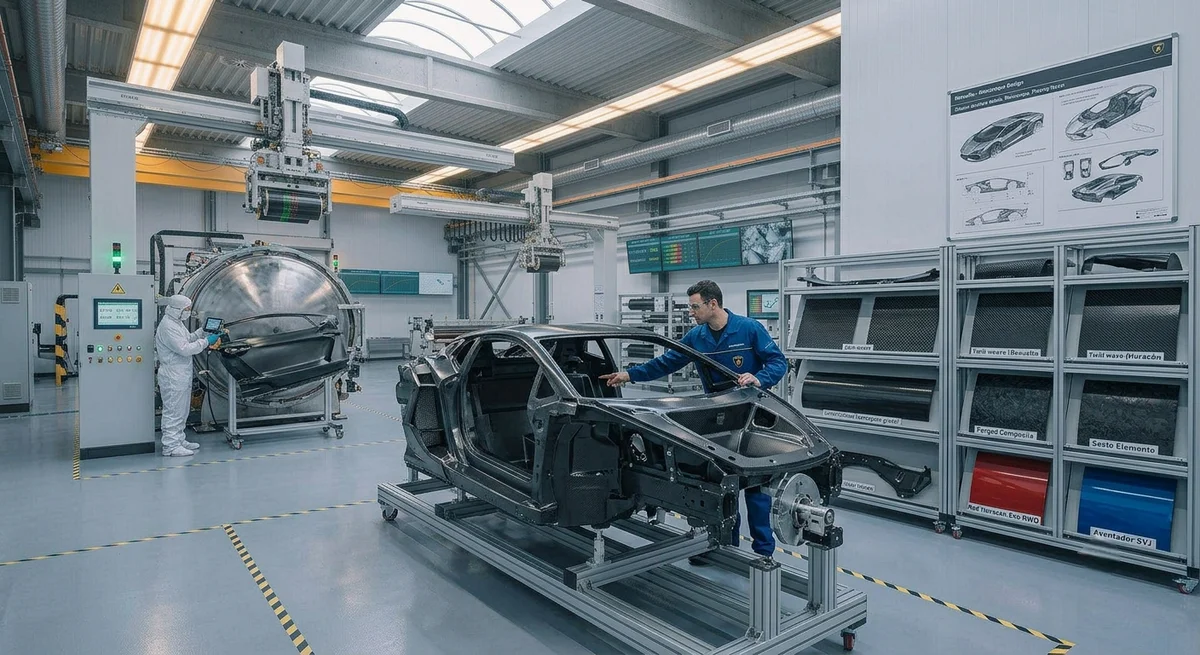
Ferrari alone consumes an estimated 80–120 metric tons of carbon fiber annually across its production and racing divisions. The Ferrari 488 Pista and SF90 Stradale each use approximately 35–45 kg of carbon fiber per vehicle. Ferrari's Scaglietti plant in Maranello operates one of the world's largest autoclaves for automotive carbon fiber (7 meters in diameter, 20 meters in length), capable of curing complete monocoque chassis in a single cycle.
Ducati and Aprilia in MotoGP have driven thin-ply carbon fiber technology (40–60 gsm areal weight prepregs) to achieve the precise stiffness-to-weight tuning required for competitive chassis performance. Ducati's Desmosedici GP uses carbon fiber in over 60% of its chassis components, including the main frame, swingarm, wheels, and braking system components.
Lamborghini, headquartered in Sant'Agata Bolognese, pioneered the use of forged composites (short carbon fiber compression molding) in series production with the Lamborghini Sesto Elemento, and continues to advance automated fiber placement (AFP) for structural components in models like the Revuelto and Aventador successor. Lamborghini's Centro Stile composites lab develops in-house carbon fiber aesthetic finishes, including the signature "Cavallo" forged carbon pattern.
Luxury Goods: The Aesthetics of Carbon Fiber
Italy is the world's leading producer of luxury carbon fiber goods, leveraging the country's heritage in leather craftsmanship, jewelry design, and fine furniture to create high-end products that use carbon fiber as a visible, aesthetic material rather than a hidden structural one.
| Market Segment | Estimated Annual CF Volume | Key Products | Premium Over Standard Materials |
|---|---|---|---|
| Luxury watches | 8–12 tons | Cases, bezels, dials (Panerai, Hublot, Audemars Piguet—Italian design) | 200–500% |
| Luggage & accessories | 15–25 tons | Suitcases, briefcases, wallet trim (Bric's, Prada, Valextra) | 100–300% |
| Furniture & interior design | 20–35 tons | Chairs, tables, lighting, wall panels (Poltrona Frau, Cassina, Minotti) | 150–400% |
| Eyewear | 5–8 tons | Sunglasses frames (Luxottica group: Ray-Ban, Oakley, Persol) | 100–250% |
| Marine (yacht interiors & fittings) | 30–50 tons | Interior trim, hatch covers, deck fittings (Ferretti, Azimut, Riva) | 80–200% |
| Bicycle components | 15–25 tons | Frames, wheels, handlebars, seatposts (Pinarello, Bianchi, Campagnolo) | 50–150% |
| Total luxury goods | 93–155 tons | — | — |
The Italian luxury carbon fiber approach emphasizes:
- Visible weave aesthetics: Intentional display of the carbon fiber weave pattern as a design element, with precise control of tow straightness, resin clarity, and surface gloss
- Color-infused resins: Translucent colored epoxy systems (red, blue, green, gold) that allow the carbon weave to remain visible while adding brand-specific color identity
- Hybrid materials: Carbon fiber combined with Italian leather (Poltrona Frau), titanium, precious metals, and exotic woods in single products
- Hand-finishing: Unlike the mass-production approach of other regions, Italian luxury carbon fiber goods typically undergo 40–80 hours of hand finishing per piece, including hand-sanding, polishing, and inspection
Industrial Design and Architecture
Italy's industrial design sector—the world's third-largest after the United States and Japan by design industry revenue—has increasingly integrated carbon fiber into furniture, lighting, and architectural elements.
Key companies and applications:
- Poltrona Frau: Carbon fiber-reinforced leather-backed structural chair shells for luxury hospitality
- Cassina (Lissone): Carbon fiber cantilevered tables and modular shelving systems
- Artemide: Carbon fiber suspension lighting with integrated LED systems
- Zaha Hadid Architects (Milan office): Carbon fiber architectural cladding and sculptural elements
- Mapei (Milan): CFRP structural strengthening systems for historic building retrofitting (an estimated 3,000+ Italian heritage buildings have been retrofitted with Mapei's carbon fiber systems)
The architectural conservation application is uniquely Italian: Italy has the world's largest collection of UNESCO World Heritage sites (59 as of 2026), and carbon fiber reinforcement offers a minimally invasive, reversible method for seismic retrofitting of historic masonry structures without altering their visible appearance.
Supply Chain: Sourcing Carbon Fiber in Italy
| Material Type | Domestic Supply | Import Sources | Lead Time | Typical MOQ |
|---|---|---|---|---|
| Standard modulus prepreg (230 GPa) | Limited (2–3 producers) | Germany (30–40%), Japan (20–25%), France (15–20%) | 4–8 weeks | 100 m² |
| Intermediate modulus prepreg (290–395 GPa) | Very limited | Japan (40–50%), USA (25–30%) | 8–16 weeks | 50 m² |
| High modulus prepreg (395 GPa+) | Minimal | Japan (60–70%) | 12–20 weeks | 20 m² |
| Dry carbon fabric | 4–6 Italian weavers | China (30–40%), Germany (20–25%) | 3–6 weeks | 200 m² |
| Carbon fiber tow (50K) | None | USA (35%), Japan (30%), China (25%) | 4–8 weeks | 500 kg |
| 3D-printed CF filament | 3–4 Italian producers | — | 2–4 weeks | 10 kg |
| Recycled CF materials | 2–3 Italian recyclers | — | 4–8 weeks | 100 kg |
Cost Structure: Italian vs. European Composites Manufacturing
| Cost Factor | Italy (Small Batch, High Customization) | Germany (Medium-Large Batch) | Eastern Europe (Large Batch, Low Cost) |
|---|---|---|---|
| Typical batch size | 50–500 parts | 500–5,000 parts | 1,000–20,000 parts |
| Labor cost (composites technician, $/hr) | $32–38 | $42–50 | $18–25 |
| Energy cost ($/kWh, industrial) | $0.18–0.22 | $0.15–0.19 | $0.10–0.15 |
| Autoclave time cost ($/hr) | $85–120 | $65–95 | $40–70 |
| Surface finishing labor (Class A, hrs/part) | 2–5 hours | 1–2 hours | 0.5–1 hour |
| Design & engineering support | Included in many contracts | Billed separately | Limited capability |
| Quality certification level | AS9100/ISO 9001 + OEM-specific | ISO 9001/AS9100 | ISO 9001 |
| Premium vs. lowest-cost producer | +40–80% | +20–50% | Baseline |
Case Study: Carbon Fiber Yacht Interior by Azimut-Benetti
Azimut-Benetti, the world's largest luxury yacht builder headquartered in Avigliana and Viareggio, Italy, launched its Benetti "The Court" series in 2025, featuring extensive use of visible carbon fiber in interior design elements. Key composite applications include:
- A 4.5-meter cantilevered carbon fiber staircase with integrated LED lighting (weighing 85 kg vs 320 kg in aluminum with tempered glass)
- Carbon fiber wall panels with alternating 1×1 and 2×2 weave patterns as decorative interior surfaces
- A carbon fiber flybridge hardtop (2.8 m × 4.2 m) weighing just 48 kg versus 180 kg in fiberglass
- Carbon fiber-framed windows with integrated structural glazing
The project consumed 1,200 kg of carbon fiber prepreg and fabric, sourced from Italian weaver Sequoia (based in Como) and prepreg manufacturer Gurit's Italian subsidiary. The decorative carbon fiber panels achieved zero visible defects across 180 m² of interior surface area, setting a new benchmark for luxury marine composites.
Frequently Asked Questions
Q: What makes Italian carbon fiber manufacturing different from German or French composites production?
A: Italian manufacturing focuses on smaller batches with higher customization, superior surface finish quality, and deep integration with the customer's design process. While German composites production tends to optimize for cost per part at high volumes (automotive structural components), Italian processors excel at low-to-medium volume production of visually demanding parts where surface aesthetics are as important as mechanical performance. Italian shops also typically offer more design-engineering collaboration, with many employing in-house industrial designers who work directly with client design teams. The average Italian composite processor produces 3–5× more distinct part numbers per year than a comparably sized German shop.
Q: Why is Italy so strong in visible-aesthetic carbon fiber applications?
A: Three factors: (1) Italy's deep heritage in design and visual arts creates a customer base that demands exceptional surface finish and pattern consistency—Italian luxury consumers reject cosmetic imperfections that would be acceptable in industrial applications; (2) The proximity to the luxury goods industry (fashion, automotive, yacht) in a concentrated geographic area (Milan, Turin, Emilia-Romagna, Veneto) creates a dense ecosystem of craftspeople skilled in hand-finishing; (3) The Italian approach to carbon fiber treats it as an aesthetic material first and a structural material second, which is the opposite of the aerospace-derived approach common in other markets.
Q: What are the most promising growth areas for carbon fiber in Italy through 2030?
A: Three growth areas stand out: (1) Architectural seismic retrofitting—Italy's ongoing national building safety program (Sismabonus) and the EU's Renovation Wave initiative are driving demand for CFRP structural strengthening systems, with projected 12–15% annual growth; (2) Electric vehicle lightweighting—with Italian EV production targets under the EU's 2035 ICE ban, Italian OEMs (Fiat, Alfa Romeo, Maserati) are increasingly specifying carbon fiber for EV structural components to offset battery weight; (3) Luxury goods expansion—Italian luxury brands are adopting carbon fiber across new product categories including jewelry, writing instruments, and smartphone accessories, with estimated 18–25% annual growth in carbon fiber demand from the luxury sector.
Q: What certifications should a carbon fiber supplier have to work with Italian OEMs?
A: For automotive OEMs (Ferrari, Lamborghini, Maserati): IATF 16949 (automotive quality management) plus the manufacturer's specific composites supplier qualification program—Ferrari's "Ferrari Approved Composites Supplier" certification is particularly rigorous. For motorsport: AS9100 Rev D (aerospace standard, widely adopted by F1 teams) and FIA homologation for safety-critical components. For luxury goods: ISO 9001 is typically sufficient, though individual brands may require additional aesthetic quality standards and sustainability certifications (carbon footprint documentation is increasingly mandatory). For architectural applications: European Technical Assessments (ETA) per EAD 340008 and Italian national certification (DM 14/01/2008).
Q: How does Italy's carbon fiber recycling infrastructure compare to other European countries?
A: Italy's carbon fiber recycling capacity is developing but still behind Germany, France, and the UK. As of 2026, Italy has approximately 3,500–4,500 tons/year of CF recycling capacity (versus 8,000–10,000 tons in Germany). The major Italian recyclers are in the Piedmont and Lombardy regions. However, Italy is a leader in mechanical recycling of SMC/BMC materials and has innovative programs for recovering carbon fiber from end-of-life boat hulls (a partnership between Azimut-Benetti and Mapei). The Italian government's circular economy incentives (Industria 4.0 and Transizione 5.0 tax credits) are accelerating investment in pyrolysis and solvolysis recycling facilities.
Conclusion
Italy's carbon fiber ecosystem is a unique blend of traditional craftsmanship and advanced materials technology. Rather than competing with the high-volume, cost-optimized production models of Germany and Eastern Europe, Italy has carved out a premium niche defined by design excellence, surface finish quality, and close collaboration between material suppliers, processors, and end-users.
For B2B buyers, Italy offers distinct advantages for applications where aesthetics, customization, and design integration matter more than the lowest per-part cost. Whether sourcing carbon fiber components for a limited-production supercar, a luxury yacht interior, an architectural statement piece, or a high-end consumer product, Italian manufacturers bring a level of surface finish, design sophistication, and attention to detail that is difficult to match.
The Italian carbon fiber industry is more than a manufacturing sector—it is a design culture. For B2B buyers who understand the value of that distinction, Italy represents one of the world's most dynamic and creative sources for high-end carbon fiber solutions.
Part of topic
Related Articles
- Recycled Carbon Fiber Market Forecast 2030: Technology Maturity and Commercialization Path
- South Korea Carbon Fiber Market 2026: Hydrogen Economy and Shipbuilding Innovation
- Wind Turbine Blade Leading Edge Protection 2026: Polyurethane, Tape, and Metallic Shield Solutions
- China Carbon Fiber Overcapacity 2026: Price War Impact and Industry Consolidation
- India Carbon Fiber Market 2026: Wind Energy, Aerospace, and Defense Expansion
- PAN Precursor Market 2026: Acrylonitrile Supply and Carbon Fiber Cost Structure
Interested in Our Products?
Contact our team for competitive pricing and technical specifications.
Get a QuoteRelated Products
Carbon fiber standard plate-3k stripe
Lightweight, ultra-rigid standard sheets for drone fuselages, robot housings, facades and structural applications.

Carbon Fiber Plate — 3K Twill T700 1.5mm
Thin 1.5mm carbon fiber plate with 3K twill weave surface. Lightweight and stiff, commonly used for covers, panels, drone bodies, and applications requiring a premium aesthetic appearance.

Square Carbon Fiber Tube — 3K Twill T700
Square cross-section carbon fiber tube manufactured with 3K twill weave for torsional strength. Preferred for structural frames, trusses, and support columns where rectangular geometry offers design flexibility.

Carbon Fiber Plate — 3K Twill T700 3.0mm
Medium-thickness 3.0mm carbon fiber plate offering significantly higher load capacity while maintaining attractive 3K twill finish. Suitable for structural brackets, reinforcement plates, and load-bearing panels.
Carbon Fiber Plate — UD Unidirectional T700
Unidirectional carbon fiber plate with all fibers oriented in a single direction for maximum strength along the fiber axis. Essential for structural reinforcements, splints, and applications where load direction is predictable.