
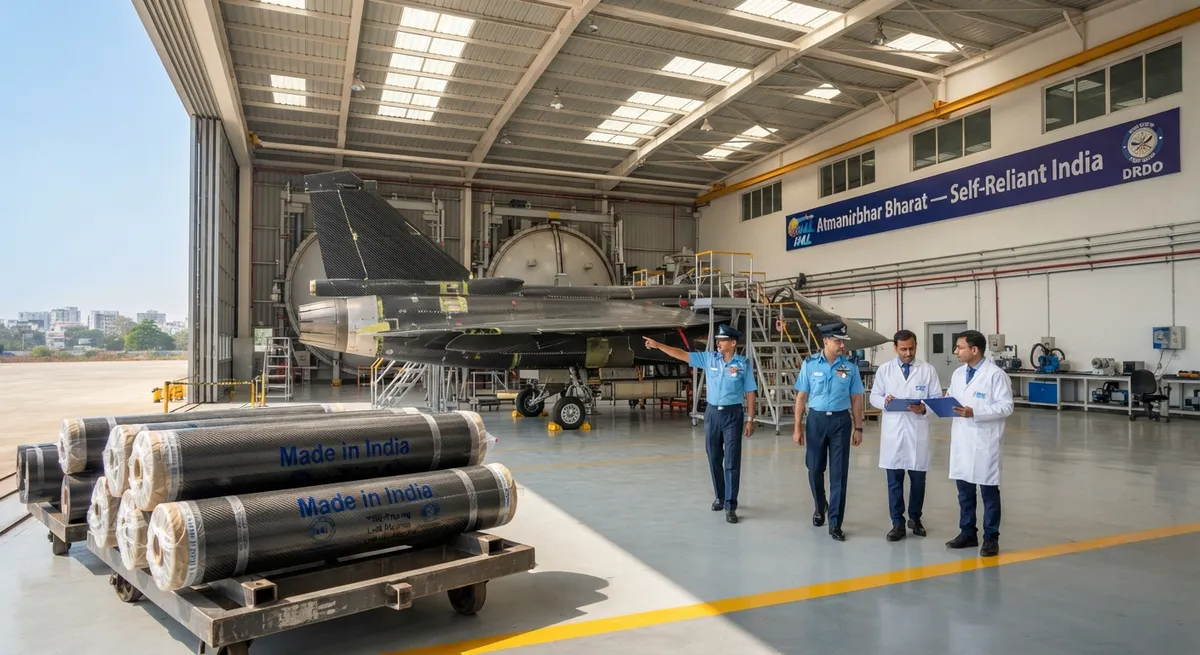
India carbon fiber market projected to reach 4,230 tons in 2026 (28% YoY growth), driven by defense indigenization (Tejas Mk2, AMCA), aerospace manufacturing expansion, and $1.4T National Infrastructure Pipeline spending.
India's Carbon Fiber Landscape in 2026
The Indian carbon fiber market has entered a transformative phase in 2026, driven by three converging forces: the accelerated indigenization of defense manufacturing under the Atmanirbhar Bharat (Self-Reliant India) initiative, the expansion of aerospace manufacturing capacity through both public-sector aerospace complexes and private OEM partnerships, and the government's unprecedented infrastructure spending program targeting a $1.4 trillion National Infrastructure Pipeline (NIP) through 2030.
India's total carbon fiber consumption is projected to reach approximately 4,200 metric tons in 2026, representing a year-over-year growth rate of approximately 28% and positioning India as one of the fastest-growing carbon fiber markets globally, behind only China and Southeast Asia in growth rate. Domestic production capacity, however, remains limited to approximately 1,800 metric tons across three operational facilities, necessitating significant imports—primarily from Japan (Toray, Teijin), the United States (Hexcel, Solvay), and China (Zhongfu Shenying, Guangwei Composites).
| Market Segment | 2025 Consumption (tons) | 2026E Consumption (tons) | YoY Growth | Primary Demand Driver |
|---|---|---|---|---|
| Defense & Aerospace | 950 | 1,280 | +34.7% | HAL, DRDO, Tejas Mk2, AMCA programs |
| Wind Energy (Blade Manufacturing) | 820 | 1,050 | +28.0% | Suzlon, Siemens Gamesa local production |
| Automotive & Transportation | 480 | 610 | +27.1% | EV lightweighting, luxury vehicle exports |
| Construction & Infrastructure | 320 | 440 | +37.5% | Seismic retrofitting, bridge rehabilitation |
| Sports & Consumer Goods | 210 | 270 | +28.6% | Golf shafts, bicycles, pro sports equipment |
| Pressure Vessels (CNG/H2 Storage) | 160 | 270 | +68.8% | CNG bus fleets, hydrogen mobility pilot |
| Oil & Gas (Pipelines & Risers) | 110 | 140 | +27.3% | ONGC, RIL deepwater exploration |
| Medical Devices | 70 | 90 | +28.6% | Imaging tables, surgical instrument imports |
| Marine & Shipbuilding | 60 | 80 | +33.3% | Indian Navy modernization, patrol vessels |
| Total | 3,280 | 4,230 | +28.0% |
Defense Indigenization Driving Composites Demand
The Atmanirbhar Bharat initiative has directly accelerated carbon fiber adoption in Indian defense programs. The most significant catalyst is the Hindustan Aeronautics Limited (HAL) Tejas Mk2 program, which increases composite content from approximately 45% in the original Tejas Mk1 to an estimated 60% in the Mk2 variant. The Tejas Mk2, expected to achieve initial operational clearance by late 2026, will require an estimated 2.8 metric tons of carbon fiber per aircraft across wing skins, control surfaces, vertical stabilizer, and radome structures.
The Advanced Medium Combat Aircraft (AMCA) program, currently in the detailed design phase, is projected to feature composite content exceeding 65% of structural weight—comparable to the Lockheed Martin F-35 Lightning II. DRDO laboratories have been developing indigenous carbon fiber prepreg systems specifically for these programs, with the goal of reducing import dependency from 85% to under 50% by 2029.
Key defense composite programs with active procurement in 2026:
- Tejas Mk2: 60% composite by structural weight, ~2.8 tons CFRP per aircraft, 40+ aircraft on order
- AMCA (5th Gen): 65% composite content, detailed design phase, prototype fabrication beginning 2027
- HAL HTT-40 Trainer: Composite wing and empennage, ~1.2 tons CFRP per aircraft, 70+ ordered
- Rustom-II HALE UAV: All-composite airframe, ~600 kg CFRP per unit, multiple units in production
- Indian Navy P-17A Frigates: Composite superstructure panels, radomes, ~15 tons per vessel
- Pinaka Multi-Barrel Rocket Launcher: Composite launch tube assemblies, weight reduction program
Aerospace Manufacturing Ecosystem Expansion
India's aerospace manufacturing sector has expanded significantly beyond traditional HAL and DRDO facilities. The establishment of the Aerospace and Defence Manufacturing Clusters in Karnataka (Bengaluru Aerospace Park), Telangana (Adibatla Aerospace Park), and Tamil Nadu (Sriperumbudur) has attracted foreign OEMs to establish local composite fabrication capabilities.
Boeing's India Engineering & Technology Center (BIETC) in Bengaluru and Airbus's engineering center in Hyderabad have both expanded their composites design teams by over 40% since 2024. Meanwhile, Tier-1 suppliers including TATA Advanced Materials, L&T Composites, and Mahindra Aerospace have invested a combined $320 million in new autoclave capacity (eight new production autoclaves ranging from 3-meter to 7-meter diameter), AFP/ATL deposition systems, and NDI equipment.
| Facility | Location | Investment ($M) | Key Capability | Target Sector |
|---|---|---|---|---|
| TATA Advanced Materials | Bengaluru, KA | $145 | AFP + 5×7m autoclave | Defense aerospace |
| L&T Composites (GPEC) | Vadodara, GJ | $98 | ATL + 4×6m autoclave | Commercial aero + space |
| Mahindra Aerospace | Bengaluru, KA | $77 | AFP + 3×4m autoclave | UAV + helicopter structures |
| ADANI Defence & Aerospace | Hyderabad, TS | $120 | Large-dia 7m autoclave | Fuselage + wing structures |
| Dynamatic Technologies | Bengaluru, KA | $52 | 3×3m autoclave + ATL | Aero engine components |
Infrastructure Spending and Construction Applications
The Government of India's National Infrastructure Pipeline (NIP), with over 9,000 projects worth $1.4 trillion, has created emerging demand for carbon fiber in civil engineering applications. The seismic rehabilitation of existing infrastructure in Zones IV and V (covering approximately 65% of India's land area) has driven adoption of CFRP wrapping systems for bridge columns, building shear walls, and elevated highway structures.
Major infrastructure projects incorporating carbon fiber composites in 2026 include:
- Mumbai-Nagpur Expressway: CFRP-reinforced concrete bridge decks at 14 major river crossings
- Delhi-Mumbai Industrial Corridor: Composite stay-cable sheathing on signature bridge structures
- Chennai Metro Phase II: CFRP wraps for seismic strengthening of elevated station columns
- National Bridge Rehabilitation Program: 2,800+ bridges assessed for CFRP strengthening, 450+ completed in FY2026
- Smart City Mission: Carbon fiber pedestrian bridges and roof structures in 35 smart cities
Frequently Asked Questions
What is the current state of domestic carbon fiber production in India?
India has three operational carbon fiber production facilities with a combined capacity of approximately 1,800 metric tons per year. The largest is Kemrock Industries in Gujarat (800 t/yr PAN-based), followed by Ceejay Enterprises in Karnataka (600 t/yr) and the recently commissioned facility by Avantha Advanced Materials in Maharashtra (400 t/yr). The quality of Indian-manufactured carbon fiber has improved significantly, with tensile strength reaching 4,200 MPa and modulus up to 260 GPa for standard modulus grades, though high-modulus (>350 GPa) grades and aerospace-grade intermediate modulus fibers remain primarily imported.
How does India's carbon fiber market compare to China and Southeast Asia?
India's carbon fiber market (projected 4,200 tons in 2026) is approximately one-sixth the size of China's market (estimated 68,000 tons) but is growing at a comparable or faster rate. Southeast Asia's combined market (excluding China) totals approximately 6,500 tons across major producers like Thailand (3,200 tons from Mitsubishi Chemical's DIALead facility), Vietnam (1,800 tons), and Indonesia (1,500 tons). India's growth rate of 28% positions it as one of the fastest-growing markets globally, driven by defense indigenization and infrastructure spending—demand drivers that are less pronounced in Southeast Asian markets where wind energy and consumer goods dominate.
What are the main challenges facing carbon fiber adoption in India?
Three primary challenges limit domestic carbon fiber adoption: (1) Limited domestic precursor production capacity—India produces only about 15% of its PAN precursor requirements domestically, with the remainder imported from Japan and South Korea; (2) High capital costs for aerospace-grade autoclave and AFP equipment, with 10–15% import duties on manufacturing equipment adding to already significant capital requirements; (3) Skilled workforce shortages—India currently has an estimated 2,800 trained composites engineers, well below the estimated requirement of 6,500 by 2028. The National Composites Mission launched in 2025 aims to address these gaps through targeted investment of INR 2,400 crore ($290 million) over five years.
Part of topic
Related Articles
- Recycled Carbon Fiber Market Forecast 2030: Technology Maturity and Commercialization Path
- South Korea Carbon Fiber Market 2026: Hydrogen Economy and Shipbuilding Innovation
- Wind Turbine Blade Leading Edge Protection 2026: Polyurethane, Tape, and Metallic Shield Solutions
- China Carbon Fiber Overcapacity 2026: Price War Impact and Industry Consolidation
- India Carbon Fiber Market 2026: Wind Energy, Aerospace, and Defense Expansion
- PAN Precursor Market 2026: Acrylonitrile Supply and Carbon Fiber Cost Structure
Interested in Our Products?
Contact our team for competitive pricing and technical specifications.
Get a QuoteRelated Products
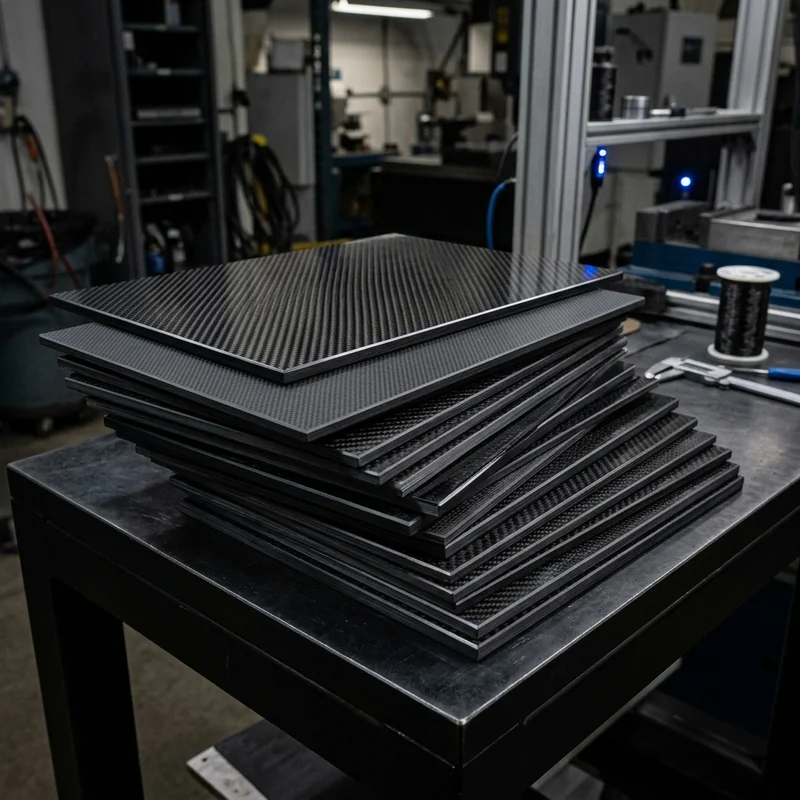
Carbon fiber standard plate-3k stripe
Lightweight, ultra-rigid standard sheets for drone fuselages, robot housings, facades and structural applications.

Carbon Fiber Plate — 3K Twill T700 3.0mm
Medium-thickness 3.0mm carbon fiber plate offering significantly higher load capacity while maintaining attractive 3K twill finish. Suitable for structural brackets, reinforcement plates, and load-bearing panels.

Carbon Fiber Plate — 3K Twill T700 1.5mm
Thin 1.5mm carbon fiber plate with 3K twill weave surface. Lightweight and stiff, commonly used for covers, panels, drone bodies, and applications requiring a premium aesthetic appearance.
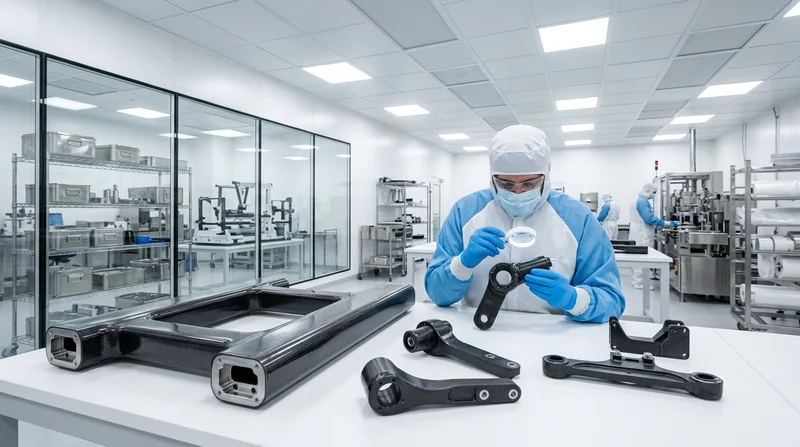
Custom Carbon Fiber Medical Device Components
Medical-grade carbon fiber components manufactured for imaging equipment, surgical instruments, and patient support systems. Carbon fiber's radiolucency (X-ray transparency) and high strength-to-weight ratio make it ideal for CT scanner beds, wheelchair frames, surgical robot arms, and MRI-compatible accessories. Biocompatible resin systems available.

Square Carbon Fiber Tube — 3K Twill T700
Square cross-section carbon fiber tube manufactured with 3K twill weave for torsional strength. Preferred for structural frames, trusses, and support columns where rectangular geometry offers design flexibility.