
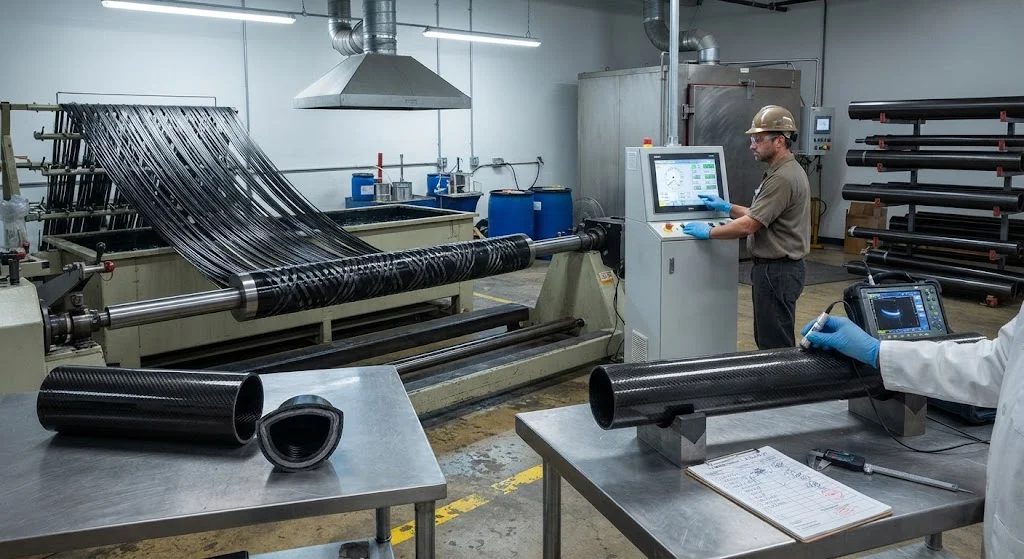
Filament wound epoxy tubes manufacturing is the process of producing high-performance tubular components by winding continuous carbon, glass, or aramid fiber onto a mandrel with epoxy resin. Epoxy is the resin of choice for engineering-grade tubes because it delivers the highest mechanical propertie
Introduction
Filament wound epoxy tubes manufacturing is the process of producing high-performance tubular components by winding continuous carbon, glass, or aramid fiber onto a mandrel with epoxy resin. Epoxy is the resin of choice for engineering-grade tubes because it delivers the highest mechanical properties, fatigue resistance, and service temperature of any production winding resin. The manufacturing process is precise and repeatable: fiber tension, resin temperature, winding angle, and cure cycle are all controlled to produce tubes with predictable strength, stiffness, and dimensional accuracy. This article explains each stage of filament wound epoxy tubes manufacturing, from raw material preparation through winding, curing, and finishing, and details the quality control practices that separate consistent production from variable output.
Understanding the process matters for buyers as much as for manufacturers. The same tube specification can be produced to very different quality levels depending on how carefully the winding parameters are controlled and how rigorously the cure cycle is verified. This article gives engineers the vocabulary and acceptance criteria to specify, audit, and verify filament wound epoxy tube production,
The Filament Wound Epoxy Tubes Manufacturing Process
Filament wound epoxy tubes manufacturing follows a fixed sequence of stages, each with defined process windows. The process begins at the creel, where fiber packages are tensioned uniformly, and ends at the machining station, where cured tubes are cut, faced, and finished to final dimensions.
- Creel and tensioning: Fiber rovings are drawn from packages through adjustable tensioners. Consistent tension — typically 10-50 N per roving — ensures straight fibers and uniform consolidation; tension drift produces wavy fibers and strength scatter.
- Resin bath: Fibers pass through a temperature-controlled resin bath containing the mixed epoxy system. Resin viscosity, bath temperature, and dwell time determine wet-out quality and resin content.
- Winding: The wetted fibers are laid onto a rotating mandrel by a traversing delivery eye at a programmed winding angle. Helical and hoop layers are combined in a designed sequence to produce the required strength distribution.
- Cure: The wound mandrel is cured in an oven or via heated tooling. Epoxy systems typically cure at 120-180°C for 1-4 hours, with a controlled ramp rate to avoid exotherm and residual stress.
- Mandrel extraction: After cure, the tube is removed from the mandrel, either by hydraulic extraction for steel mandrels or by removal of a soluble/blowable core.
- Machining and finishing: Tubes are cut to length, faced, and machined at the ends for bonding or mechanical joints, then inspected and packaged.
The sections below examine the two stages that most strongly influence final quality — winding and curing — followed by the quality control practices that verify them.
Epoxy Tube Winding Process: Materials and Resin Systems
The epoxy tube winding process begins with material selection, which fixes the ceiling of achievable performance. Fiber choice determines stiffness and strength: standard-modulus carbon fiber (230-240 GPa) is the workhorse for structural tubes; intermediate and high-modulus grades (290-440 GPa) serve stiffness-critical applications; E-glass and S-glass remain cost-effective where carbon is unnecessary.
Epoxy resin selection is equally important. Filament winding requires low-viscosity, long-pot-life systems that wet out fiber quickly and cure to a tough, high-Tg matrix. Three families dominate:
- Standard bisphenol-A/F epoxy: The general-purpose choice, curing at 120-150°C to a Tg of 100-140°C with balanced mechanical properties and good chemical resistance.
- High-temperature epoxy: Multifunctional or novolac systems that cure at 160-200°C to a Tg above 180°C, used where elevated service temperatures or high hot-wet performance are required.
- Toughened epoxy: Formulations with rubber or thermoplastic modifiers that raise interlaminar toughness and impact resistance.
Resin content is controlled by the ratio of fiber speed to resin delivery and by bath viscosity. For structural tubes, a fiber volume fraction of 60-68% is typical; resin-rich inner and outer layers provide corrosion protection but contribute little to stiffness.
FW Tube Production: Winding Parameters and Tooling
In FW tube production, the winding parameters translate material quality into structural performance. The winding angle is the single most powerful design lever. A 54-degree helical angle produces the classic balanced biaxial tube used for pressure vessels, while lower angles bias strength axially and higher angles favor hoop strength.
Tooling design is the second determinant. Steel mandrels with a slight taper and a release coating are standard for production; they are machined to tight tolerances because the inner diameter of the tube replicates the mandrel surface. Mandrel straightness, surface finish, and thermal mass all affect the final tube: a mandrel that is out of straightness by more than 0.1 mm per meter transfers that error directly to the tube.
| Parameter | Typical Range | Quality Impact |
|---|---|---|
| Winding angle | 10-90 degrees | Sets axial/hoop strength split; 54° = balanced biaxial |
| Fiber volume fraction | 60-68% | Raises stiffness and strength; higher risks voids |
| Roving tension | 10-50 N | Controls fiber straightness and consolidation |
| Cure temperature | 120-200°C | Determines Tg and hot-wet performance |
| Mandrel straightness | max 0.1 mm/m | Transfers directly to tube straightness |
| Resin content by weight | 25-40% | Balances mechanicals vs corrosion barrier |
In production, these parameters are recorded per run and retained as part of the batch record. This traceability is what allows a manufacturer to demonstrate that a tube meets its specification — and what allows a buyer to audit the claim.
Composite Tube Manufacturing: Quality Control
Quality control in composite tube manufacturing verifies that the process produced what the design intended. It operates at three levels: in-process monitoring, physical testing, and non-destructive inspection.
- In-process monitoring: Continuous recording of tension, resin temperature, winding angle, and cure temperature. Deviations are flagged in real time and logged to the batch record.
- Physical testing: Coupon and tube-level testing on a sampling basis. Typical tests include axial tensile strength and modulus, hoop tensile strength (NOL ring test), fiber volume fraction by acid digestion, Tg by DSC, and burst pressure.
- Non-destructive inspection: Ultrasonic testing detects voids, delaminations, and fiber waviness; dimensional checks verify inner/outer diameter, wall thickness, straightness, and concentricity against the drawing.
Acceptance criteria are defined in the specification and typically require: fiber volume fraction within ±2%, wall thickness within ±0.1-0.2 mm, straightness within 0.5-1.0 mm per meter, and no detectable delamination in the ultrasonic scan.
Testing and Certification for Filament Wound Epoxy Tubes
Testing requirements scale with application risk. For structural and pressure-rated tubes, testing follows recognized standards. The table below summarizes common test methods.
| Test | Standard / Method | Purpose |
|---|---|---|
| Axial tensile test | ASTM D2105 (pipes) / D3039 | Axial strength and modulus |
| Hoop tensile test | ASTM D2290 (NOL ring) | Circumferential strength |
| Fiber volume fraction | ASTM D3171 (acid digestion) | Verifies resin/fiber ratio |
| Glass transition temperature | ASTM E1356 / ISO 11357 (DSC) | Confirms cure completeness and Tg |
| Ultrasonic inspection | ASTM E2580 (guided wave) / manual UT | Detects voids and delaminations |
| Burst pressure | ASTM D1599 | Verifies pressure rating (pressure tubes) |
For aerospace and defense applications, manufacturers typically add material traceability, documented process control, and third-party witness testing to the certification package.
Frequently Asked Questions
What wall thickness and diameter ranges are typical for filament wound epoxy tubes?
Filament wound epoxy tubes are commonly produced with outer diameters from 10 mm to 1,500 mm and wall thicknesses from 1.5 mm to 50 mm. Small-diameter structural tubes (10-100 mm) are typical for actuators, drone arms, and shafts; medium diameters (100-500 mm) serve hydraulic cylinders, rollers, and pressure vessels; large diameters (500-1,500 mm) are used for pipes, tanks, and wind turbine components. Wall thickness is built up by adding helical and hoop passes, so the practical range is broad — limited mainly by cure time and exotherm management.
How is the quality of filament wound epoxy tubes verified before delivery?
Verification follows a defined inspection plan agreed at the specification stage. In-process records confirm that winding parameters stayed within window. Coupon tests from the same run verify axial and hoop strength, modulus, fiber volume fraction, and Tg. Non-destructive testing — typically ultrasonic inspection — checks the full tube for voids and delaminations, and dimensional inspection verifies inner and outer diameter, wall thickness, straightness, and concentricity. For pressure-rated tubes, a burst or proof-pressure test is performed on a sample basis.
What is the typical lead time and minimum order quantity for custom filament wound epoxy tubes?
For standard diameters with common fiber and resin systems, production lead time is typically 4-8 weeks from order, driven mainly by mandrel availability and cure scheduling. Custom mandrels add 4-10 weeks depending on size and complexity. Minimum order quantities vary by diameter: small-diameter tubes (under 50 mm) often have MOQs of 20-100 pieces because setup and creel changeover dominate cost; larger tubes are quoted per piece. Prototype quantities (1-10 pieces) are usually available at a premium.
Can filament wound epoxy tubes be machined, bonded, or joined after cure?
Yes. Cured epoxy tubes can be cut, faced, and turned with carbide tooling, and holes can be drilled with proper support. Threads are generally not machined into the tube wall — bonded metal inserts, flanges, or end fittings are the standard approach. Bonded joints with structural adhesives routinely achieve 80-95% of tube strength with bond lengths of 20-30 times the wall thickness. All post-cure machining should be performed with dust extraction, as cured epoxy-carbon dust is abrasive and conductive.
Conclusion
Filament wound epoxy tubes manufacturing is a precise, controllable process that produces high-performance tubular components for the most demanding structural applications. The combination of epoxy resin's mechanical and thermal performance with the design freedom of filament winding — variable angles, layer sequences, and fiber types — gives engineers a material system that can be tuned to almost any tubular load case. Success depends on disciplined control of tension, winding angle, resin content, and cure cycle, verified through in-process monitoring, physical testing, and non-destructive inspection.
When sourcing filament wound epoxy tubes, specify the winding angle, fiber volume fraction, resin system, and the acceptance criteria for testing and inspection — and require the batch records that prove they were met. Explore our filament wound tube and composite product range for standard options, or contact our engineering team to discuss custom winding angles, fiber grades, and qualification testing for your application.
Related Articles
- Fiberglass Filament Wound Tubes: Cost-Effective Alternative to Carbon Fiber
- Filament Wound Epoxy Tube Design: Wall Thickness, Fiber Angle and Load Optimization
- Filament Wound Epoxy Tubes: Testing Standards and Quality Assurance
- Filament Wound Fiberglass Tube: Process Parameters and Performance vs Carbon Fiber
- Pultruded Carbon Fiber Rods: Mechanical Properties and Industrial Applications
- Filament Wound Epoxy Tubes Cost: Materials, Process and Volume Pricing
Interested in Custom Carbon Fiber Products?
Contact our team for competitive pricing and technical specifications.
Get a QuoteRelated Products
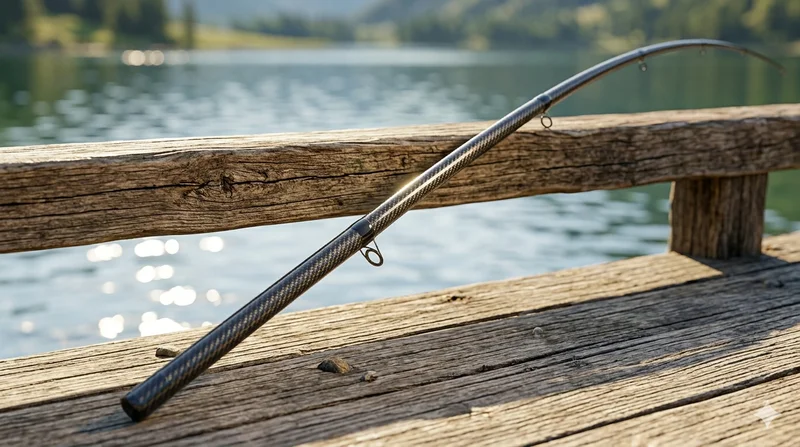
Carbon Fiber Fishing Rod Blank
High-quality carbon fiber fishing rod blank manufactured from multiple grades of Toray carbon fiber cloth. Available in a wide range of lengths, powers, and actions for freshwater and saltwater applications. Suitable for OEM rod building.
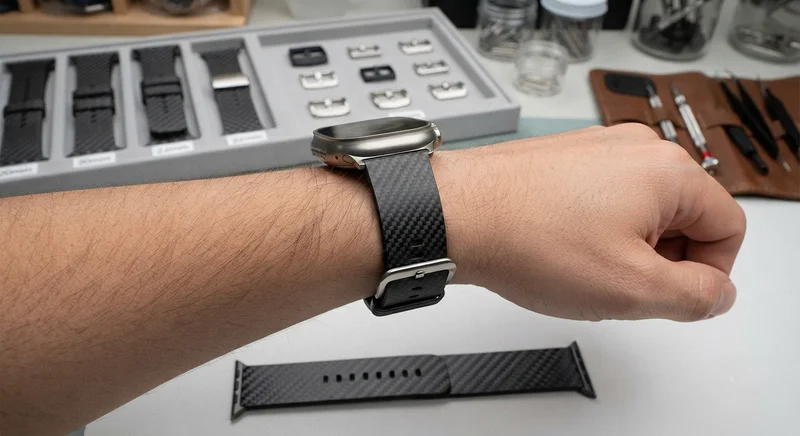
Carbon Fiber Watch Strap — 20mm/22mm Quick-Release
Premium carbon fiber watch strap with quick-release spring bars. Woven from T700 3K twill prepreg with a flexible resin system that conforms to the wrist. Available in 20mm and 22mm lug widths, compatible with Apple Watch, Samsung Galaxy Watch, Garmin, and traditional mechanical watches. Features a stainless steel buckle and carbon fiber keepers. The natural weave pattern makes each strap unique.
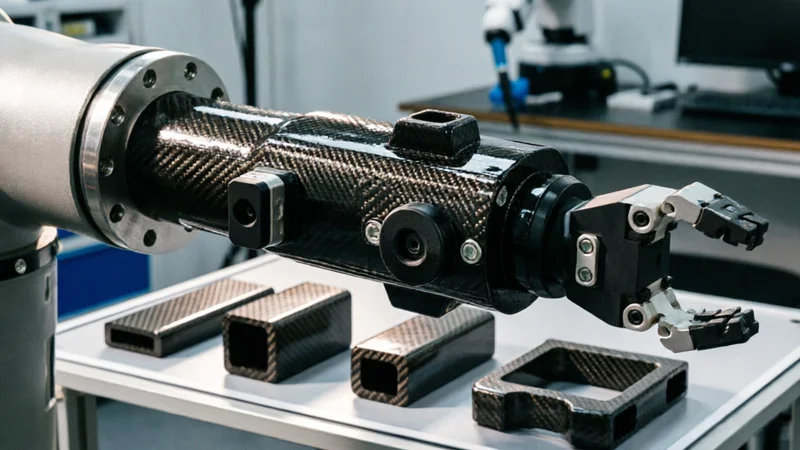
Carbon Fiber Robot End Effector Link — Custom Shape & Sensor Integration
Custom-shaped carbon fiber end effector links for robotic arms. Designed for automation integrators and research labs requiring lightweight, rigid connections between the robot wrist and gripper/tool. Can incorporate sensor mounting bosses, cable routing channels, and quick-change interfaces.
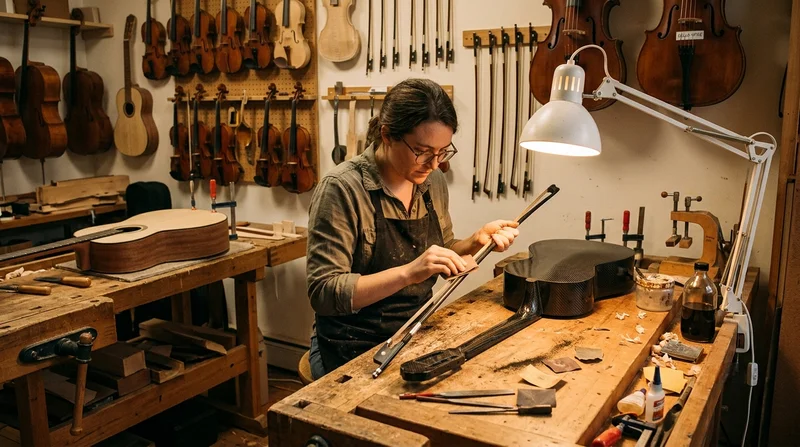
Custom Carbon Fiber Musical Instrument Parts
Carbon fiber components for musical instrument manufacturing offering superior dimensional stability, low weight, and consistent acoustic properties. We produce carbon fiber bows, guitar necks, violin chin rests, drum shells, and wind instrument bodies. Carbon fiber instruments are immune to humidity changes and temperature fluctuations that affect wooden instruments.
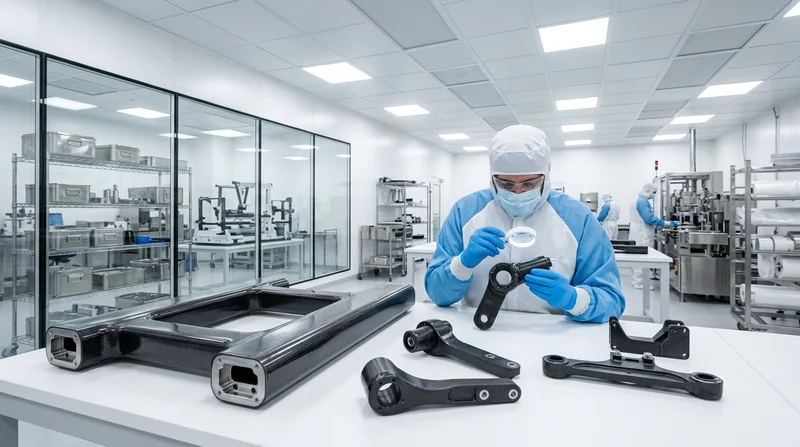
Custom Carbon Fiber Medical Device Components
Medical-grade carbon fiber components manufactured for imaging equipment, surgical instruments, and patient support systems. Carbon fiber's radiolucency (X-ray transparency) and high strength-to-weight ratio make it ideal for CT scanner beds, wheelchair frames, surgical robot arms, and MRI-compatible accessories. Biocompatible resin systems available.