
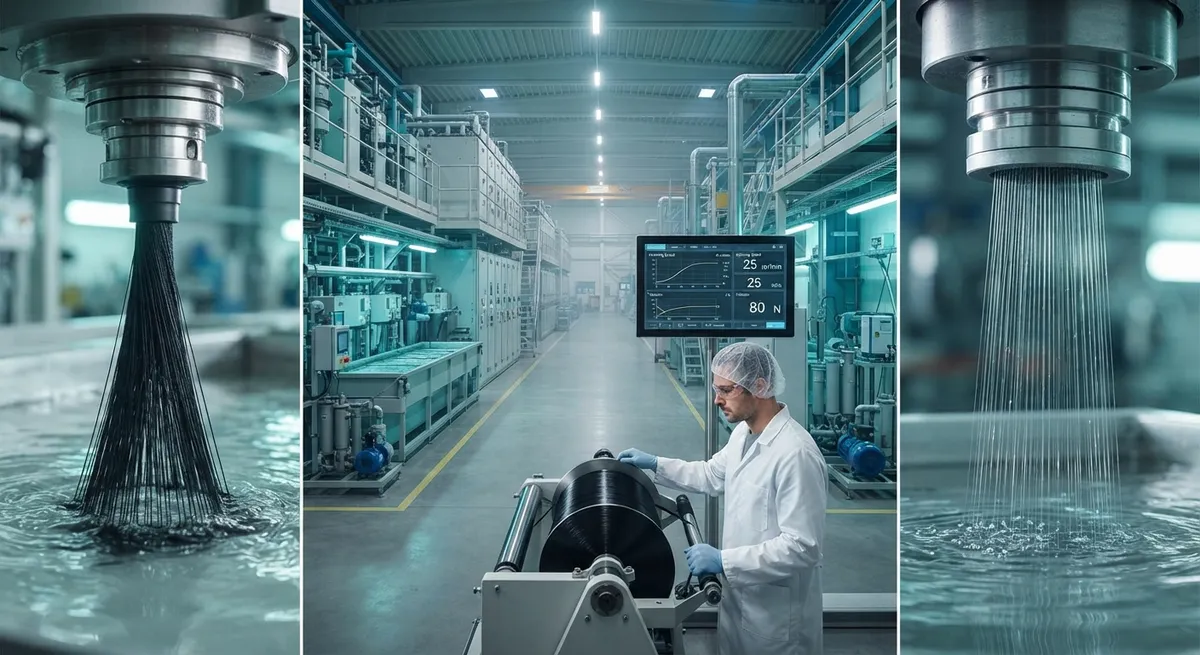
T1100-grade carbon fiber — defined by tensile strength in the 6,500-7,000 MPa range — has historically been produced almost exclusively by dry-jet wet spinning (DJWS). The process, in which the spinning dope exits the spinneret through an air gap before entering the coagulation bath, wa
Introduction
T1100-grade carbon fiber — defined by tensile strength in the 6,500-7,000 MPa range — has historically been produced almost exclusively by dry-jet wet spinning (DJWS). The process, in which the spinning dope exits the spinneret through an air gap before entering the coagulation bath, was considered the only route capable of the molecular orientation and surface perfection needed for such extreme strength. Wet spinning, the older and simpler process, was widely believed to cap out below T800-class performance.
That assumption is being tested. In August 2026 a Chinese producer completed technical appraisal of wet-spun T1100-grade fiber with a declared tensile strength of 6,600 MPa and modulus of 335 GPa, backed by 5,000 tonnes per year of planned capacity. If verified in production, this would be the first large-volume T1100-grade line based on conventional wet spinning rather than DJWS. For composite engineers and procurement teams, the practical question is not which process is "better" in the abstract, but what the two routes each deliver in strength, productivity, cost, and defect control.
How the Two Processes Differ
Both processes start with the same chemistry: PAN copolymer is dissolved in a solvent (typically DMSO, DMAc, or NaSCN) to form a viscous spinning dope, which is extruded through a spinneret containing hundreds or thousands of capillaries. The difference begins at the exit of the spinneret.
In wet spinning, the spinneret is submerged directly in the coagulation bath. Filaments exit the capillaries straight into the liquid, where solvent is extracted and the gel structure forms immediately. In dry-jet wet spinning, the spinneret sits 5-20 mm above the bath surface; the filaments pass through an air gap before entering the coagulant. The brief air exposure allows the filaments to relax and the dope to develop higher orientation under gravity and draw tension before coagulation locks the structure.
The air gap is the decisive difference. It permits higher spin draw ratios, produces a smoother filament skin, and reduces the "skin-core" heterogeneity that forms when coagulation is too rapid. These factors translate directly into fewer surface flaws and better molecular alignment — exactly the parameters that govern tensile strength in carbon fiber.
Side-by-Side Process Comparison
The table below summarizes the key differences between the two routes as practiced in industrial-scale precursor production:
| Parameter | Wet Spinning | Dry-Jet Wet Spinning |
|---|---|---|
| Air gap before coagulation | None (spinneret in bath) | 5-20 mm |
| Spin draw ratio | 2-4x | 5-10x |
| Filament surface quality | Higher flaw density | Smoother, fewer flaws |
| Skin-core heterogeneity | More pronounced | Reduced |
| Typical spinneret hole count | 1,000-12,000 | 1,000-6,000 |
| Line speed | Generally higher | Moderate |
| Process control complexity | Lower | Higher (gap tension critical) |
| Capital cost per tonne | Lower | Higher |
| Historical strength ceiling | T700-class | T1100-class |
Wet spinning has always offered the economic advantages: higher filament counts per spinneret, faster line speeds, simpler tension control, and lower equipment cost. Its historical disadvantage was a strength ceiling imposed by surface flaws and structural inhomogeneity. The recent T1100 result suggests that the ceiling itself can be moved when the downstream conversion — oxidation, carbonization, and surface treatment — is tightly controlled and paired with optimized coagulation chemistry.
What Makes T1100-Level Strength Possible in Wet Spinning
Reaching 6,600 MPa from a wet-spun precursor required several developments rather than a single breakthrough:
- Ultra-high-molecular-weight dope formulation: Higher molecular weight PAN reduces chain-end defects that act as fracture initiation sites, at the cost of higher dope viscosity that must be managed in spinning.
- Controlled coagulation kinetics: Lower bath temperature and tuned solvent concentration slow solvent extraction, shrinking the dense skin and reducing internal voids that weaken the fiber.
- High-temperature carbonization profiles: Carefully staged carbonization up to 1,400-1,500 °C aligns the turbostratic structure and grows crystallites without introducing microcracks.
- In-line defect detection: On-line diameter, optical, and tension monitoring allows off-spec filament to be rejected before it reaches the winder.
None of these elements is unique to either process. What the T1100 wet-spinning result demonstrates is that process engineering has closed much of the gap that was once considered intrinsic to the spinning route itself.
Mechanical Properties Comparison
The practical relevance of the two routes can be judged by the properties actually achieved at scale. The following figures compare declared properties of the new wet-spun T1100-grade fiber against established grades:
| Grade | Process Route | Tensile Strength (MPa) | Tensile Modulus (GPa) | Elongation (%) |
|---|---|---|---|---|
| T700S-class | Wet or DJWS | 4,900 | 230 | 2.1 |
| T800S-class | DJWS | 5,880 | 294 | 2.0 |
| T1100-class (DJWS) | DJWS | 7,000 | 294 | 2.0 |
| T1100-class (wet-spun, 2026 trial) | Wet spinning | 6,600 | 335 | ~2.0 |
The wet-spun fiber's 6,600 MPa sits below the 7,000 MPa reference of the leading DJWS grade but above every other commercial grade, and its 335 GPa modulus is notably high — stiffer than both T800S and the DJWS T1100 reference. For stiffness-critical applications this combination is attractive even where absolute strength is slightly lower.
Production Feasibility at Scale
The most consequential aspect of the wet-spun T1100 result is capacity. The producer's 5,000 tonnes per year plan is roughly an order of magnitude larger than the volumes usually associated with premium high-strength fiber lines. Wet spinning supports this scale economically because of its higher throughput per line and lower capital intensity. If those economics hold during full-scale validation, the cost structure of high-strength fiber could shift significantly — a development directly relevant to buyers who currently pay a substantial premium for T800 and T1100 grades.
The open questions are consistency and yield. Premium fiber is sold not on average properties but on guaranteed specification bands with traceability. Whether a wet-spun process can maintain 6,600 MPa-class strength across hundreds of tonnes with acceptable yield will determine whether the route becomes a true commercial alternative or remains a demonstration-scale achievement.
Frequently Asked Questions
Is wet spinning cheaper than dry-jet wet spinning for carbon fiber production?
Yes, at the level of the spinning line itself. Wet spinning uses simpler tension control, allows larger spinnerets with more holes, and operates at higher line speeds, so capital cost per tonne of precursor is lower. The overall production cost difference narrows when downstream carbonization, surface treatment, and quality assurance are included, and it narrows further if a wet-spun line requires more re-runs to hold tight specification bands. The economic case depends on whether the process can sustain consistent high-strength output in volume.
Can wet-spun carbon fiber match dry-jet wet spun fiber in all applications?
Not automatically. The wet-spun T1100 trial demonstrates comparable tensile strength and even higher modulus, but application suitability also depends on properties such as compressive strength, interfacial shear strength after sizing, fatigue behavior, and lot-to-lot consistency. For aerospace load-bearing parts, designers will need full characterization and qualification data — not just headline tensile numbers — before switching fiber routes. For industrial and many commercial applications, the property combination may already be sufficient.
Does the T1100 wet-spinning result change which grades are worth specifying?
It adds a new option and a pricing signal. Procurement teams that were forced into DJWS-only supply for high-strength fiber now have a potential second source with different economics. Even before the wet-spun product reaches full commercial availability, the announced capacity puts downward pressure on high-strength fiber pricing and improves supply security. Engineers should continue specifying by required properties and qualified suppliers, but re-benchmarking prices and lead times for T800/T1100-class materials is worthwhile.
Conclusion
The completion of wet-spun T1100-grade fiber trials at 6,600 MPa and 335 GPa, supported by 5,000 tonnes of planned capacity, is a meaningful challenge to the assumption that dry-jet wet spinning is the only route to extreme-strength carbon fiber. Wet spinning brings higher throughput and lower capital intensity to a product category historically defined by scarcity and premium pricing. The two processes now overlap at the top of the performance range, and the deciding factors are shifting from "which route" to "whose quality assurance" and "at what price."
For buyers, the near-term implication is a wider choice set: if you need high-strength fiber for structural parts, pressure vessels, or aerospace structures, the new supply landscape may justify revisiting specifications. Review our carbon fiber and composite material range, or contact our engineering team to discuss grade selection and qualification planning for your program.
Part of topic
Related Articles
- Carbon Fiber Drone Blades and Propellers: Stiffness, Balance and Noise Reduction
- Fiberglass Filament Wound Tubes: Cost-Effective Alternative to Carbon Fiber
- Filament Wound Epoxy Tube Design: Wall Thickness, Fiber Angle and Load Optimization
- Filament Wound Epoxy Tubes: Testing Standards and Quality Assurance
- Filament Wound Epoxy Tubes Manufacturing: Process and Quality Control
- Filament Wound Fiberglass Tube: Process Parameters and Performance vs Carbon Fiber
Interested in Our Products?
Contact our team for competitive pricing and technical specifications.
Get a QuoteRelated Products
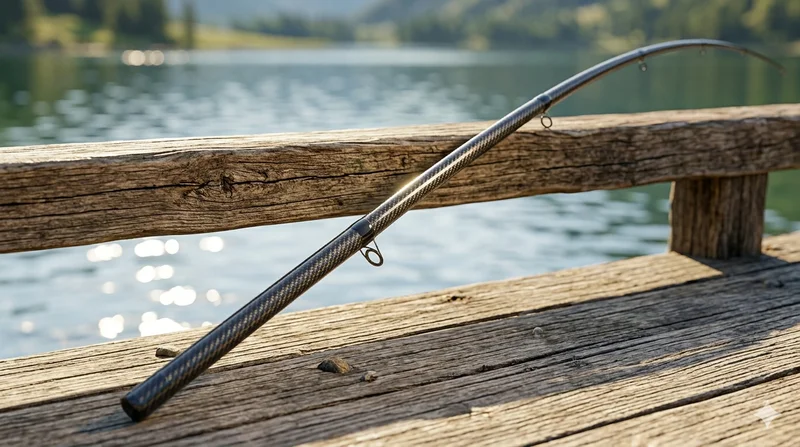
Carbon Fiber Fishing Rod Blank
High-quality carbon fiber fishing rod blank manufactured from multiple grades of Toray carbon fiber cloth. Available in a wide range of lengths, powers, and actions for freshwater and saltwater applications. Suitable for OEM rod building.

Carbon Fiber Plate — 3K Twill T700 1.5mm
Thin 1.5mm carbon fiber plate with 3K twill weave surface. Lightweight and stiff, commonly used for covers, panels, drone bodies, and applications requiring a premium aesthetic appearance.

Carbon Fiber Plate — 3K Twill T700 3.0mm
Medium-thickness 3.0mm carbon fiber plate offering significantly higher load capacity while maintaining attractive 3K twill finish. Suitable for structural brackets, reinforcement plates, and load-bearing panels.
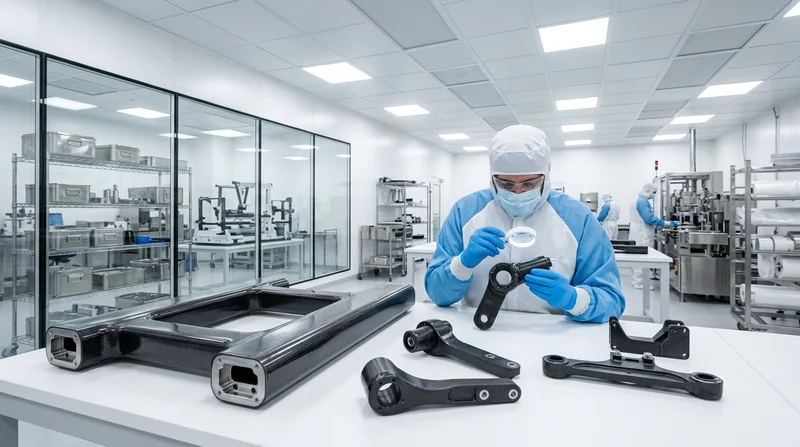
Custom Carbon Fiber Medical Device Components
Medical-grade carbon fiber components manufactured for imaging equipment, surgical instruments, and patient support systems. Carbon fiber's radiolucency (X-ray transparency) and high strength-to-weight ratio make it ideal for CT scanner beds, wheelchair frames, surgical robot arms, and MRI-compatible accessories. Biocompatible resin systems available.

Square Carbon Fiber Tube — 3K Twill T700
Square cross-section carbon fiber tube manufactured with 3K twill weave for torsional strength. Preferred for structural frames, trusses, and support columns where rectangular geometry offers design flexibility.