
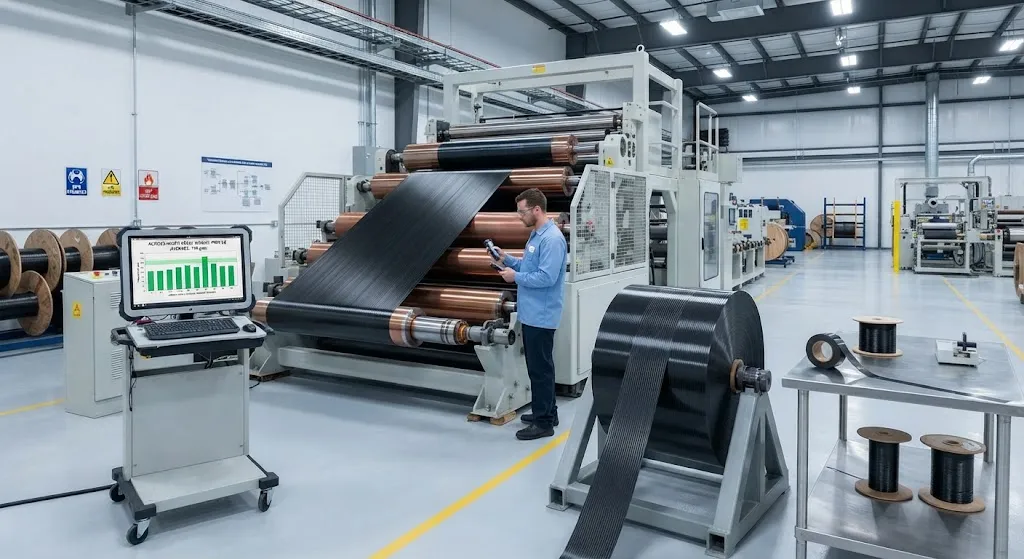
The economics of thermoplastic composite spars for wind turbine blades turns on a deceptively simple variable: the width of the unidirectional (UD) tape semi-finished product. Wider tape means fewer tape passes to build a spar cap, shorter layup cycles and lower handling cost, but it al
Introduction
The economics of thermoplastic composite spars for wind turbine blades turns on a deceptively simple variable: the width of the unidirectional (UD) tape semi-finished product. Wider tape means fewer tape passes to build a spar cap, shorter layup cycles and lower handling cost, but it also demands larger calandering or melt-coating equipment, higher investment and careful control of fiber straightness and areal weight uniformity across the full width. Fraunhofer IMWS has recently demonstrated a tenfold scale-up in thermoplastic UD tape width and transferred the process to pilot production, providing a concrete benchmark for how far the semi-finished width economics can be pushed in support of automated CONTIjoin spar manufacturing.
This article explains what the width scale-up means for blade manufacturers, how tape width drives layup cycle time and cost, and where the crossover point sits between narrow-tape flexibility and wide-tape productivity.
The Fraunhofer IMWS Width Scale-Up
Fraunhofer IMWS, based in Halle, Germany, has developed and transferred to pilot scale a process that increases the width of thermoplastic continuous-fiber tape semi-finished products tenfold. Conventional thermoplastic UD tape for structural applications is typically produced in widths of 12-150 millimeters, reflecting the capability limits of coating and calandering lines designed for narrow formats. The scale-up moves the semi-finished product into a width class several hundred millimeters wide, closer to the format of thermoset prepreg rolls used in wind blade spar manufacturing.
The technical challenge in the scale-up is uniformity. As width grows, maintaining consistent fiber areal weight, matrix content and fiber straightness across the full tape cross-section becomes harder, because thermal gradients in the coating or melting zone and tension variations across the web grow with width. The pilot-transfer confirms that these parameters can be held within the tolerances required for structural spar cap layup. The table below compares the conventional and scaled-up formats:
| Parameter | Conventional UD tape | Scaled-up UD tape |
|---|---|---|
| Typical width | 12-150 mm | Several hundred mm |
| Width increase | Baseline | Tenfold |
| Fiber areal weight control | Within tolerance at narrow width | Maintained across full width |
| Matrix system | Thermoplastic (PA, PP, PEEK, LM-PAEK) | Thermoplastic (same families) |
| Primary driver | Flexibility, narrow parts | Layup throughput |
| Status | Commercial | Pilot production |
How Tape Width Drives Layup Cycle Time
In automated spar cap manufacturing, layers are built by laying tape strips side by side across the width of the spar cap. The number of passes required to cover a given cap width is inversely proportional to the tape width: a 300-millimeter cap laid with 100-millimeter tape needs three passes per layer, while the same cap laid with 300-millimeter tape needs one. This reduction propagates through the entire layup process:
- Layer count per hour: Fewer passes per layer raise the effective layers-per-hour rate of the layup cell, directly lifting spar throughput.
- Handling steps: Each tape spool change, splice and startup pause happens per pass, so fewer passes cut peripheral time as well as core layup time.
- Consolidation passes: Wider tape reduces the number of inter-layer seams, lowering the compaction and consolidation effort at each layer interface.
- Automation reliability: Automated CONTIjoin-style layup benefits from fewer, more predictable passes, reducing the opportunities for placement errors and rework.
The cycle time saving is multiplicative rather than additive, because it shortens the critical path of spar production as a whole.
The Cost Curve: Tape Price versus Layup Cost
Wider tape does not come for free. The semi-finished product is made on larger, more expensive coating and calandering lines, and the initial investment must be amortized across production volume. The trade-off between tape cost and layup cost defines the economics of width scale-up:
| Layup scenario | Narrow tape (12-150 mm) | Wide tape (hundreds of mm) |
|---|---|---|
| Relative semi-finished cost | Baseline | Similar to baseline on maturity |
| Layup passes per 300 mm cap layer | 3-25 | 1 |
| Layup cycle time per layer | High | Low |
| Capital intensity | Lower (existing lines) | Higher (new coating capacity) |
| Breakeven volume | Baseline | Higher volume required |
The crossover point depends on annual spar production volume. For low-rate programs, narrow tape keeps capital cost down and flexibility high. For the high-rate automated blade programs that CONTIjoin enables, the layup time saving from wide tape outweighs the semi-finished cost premium, pulling the total part cost below the narrow-tape baseline. The wider format also raises the feasible layup rate of the automation cell, so the same machine investment produces more spars per shift.
Quality and Process Control at Full Width
Scaling tape width makes quality control more demanding in three areas:
- Fiber straightness: Across a several-hundred-millimeter width, fiber misalignment of fractions of a degree can accumulate into measurable knockdowns in spar cap modulus and strength. Process control must keep fiber paths parallel within tighter angular limits.
- Areal weight uniformity: Variations in fiber areal weight across the width create local thickness and stiffness differences after consolidation, which must be held to structural tolerance for blade certification.
- Edge quality: Tape edges carry the risk of stray fibers and porosity after consolidation. At wider widths, edge defects represent a smaller fraction of the material, but each defect is longer and may propagate differently through the layup.
The Fraunhofer pilot transfer specifically addresses these points, since the same tolerances that govern narrow-tape structural use must be demonstrated at tenfold width before blade programs will accept the material.
Implications for Blade and Material Buyers
For wind blade manufacturers evaluating thermoplastic spar options, the width scale-up changes the comparison:
- Specification flexibility: Wide tape reopens the choice between multiple narrow strips and single wide strips, letting designers balance fiber architecture freedom against layup speed.
- Supplier qualification: Wide-format tape must be qualified against the same mechanical property database as narrow formats, including full-width sampling for areal weight and fiber volume fraction.
- Automation alignment: Layup cells configured for wide tape have different handling, splicing and tension control equipment, so the tape width choice must be locked before automation investment.
- Volume planning: Because wide format favors higher throughput, buyers who can plan spar production at scale capture the full width benefit, while lower-volume buyers may stay with narrow tape.
The tenfold scale-up therefore represents not just a technical demonstration but a shift in the cost structure of thermoplastic blade production, moving the break-even volume for automated spar manufacturing downward.
Frequently Asked Questions
Why does wider UD tape reduce spar manufacturing cost?
Wider tape cuts the number of layup passes needed to cover a given spar cap width, and every pass carries handling time, spool changes and consolidation effort. Reducing passes from several to one per layer shortens the layup cycle time multiplicatively, so the same automation cell produces more spars per shift. The saving outweighs the higher semi-finished cost of wide tape once annual production volume passes the crossover point, which the Fraunhofer IMWS scale-up brings within reach of automated blade programs.
What is the trade-off between narrow and wide tape formats?
Narrow tape (12-150 mm) offers flexibility, lower capital cost and simpler process control, suited to low-volume programs and narrow parts. Wide tape (several hundred millimeters) reduces layup passes and cycle time but requires larger coating and calandering investment and tighter full-width quality control. The optimal format depends on annual spar volume: below the crossover, narrow tape is cheaper; above it, wide tape wins on total part cost and automation throughput.
What quality parameters become critical when tape width scales up tenfold?
Three parameters dominate: fiber straightness, because small misalignments across a wide web accumulate into stiffness and strength knockdowns; fiber areal weight uniformity across the width, which drives local thickness and stiffness variation after consolidation; and edge quality, where defects grow longer as the web widens. The Fraunhofer IMWS pilot transfer demonstrates that these parameters can be held within structural tolerances at tenfold width, which is the precondition for blade-program acceptance.
Conclusion
The tenfold width scale-up of thermoplastic UD tape semi-finished products, demonstrated by Fraunhofer IMWS and moved to pilot production, changes the economics of automated spar cap manufacturing. Wider tape cuts layup passes per layer, shortens cycle time and raises automation cell throughput, while the higher semi-finished cost and capital intensity are amortized once volume passes the crossover point. For blade manufacturers and their material suppliers, the direction is clear: tape width is no longer a fixed process constraint but a strategic variable that trades layup productivity against semi-finished cost.
YongXian supplies carbon fiber tows and reinforcement materials for wind blade spar applications. Explore our carbon fiber product range or contact our engineering team to discuss materials for your thermoplastic spar program.
Part of topic
Related Articles
- Bio-Based Carbon Fiber Precursors: Lignin and Polyethylene for Low-Cost Production
- Large-Tow Carbon Fiber Cost Analysis: 48K vs 60K Price-Performance Comparison
- Carbon Fiber-Resin Interface Bonding: Surface Treatment and Coupling Agent Optimization
- Digital Twin for Carbon Fiber Manufacturing: Real-Time Process Monitoring and Defect Prevention
- Thermoplastic Carbon Fiber Welding for Automotive: Ultrasonic and Induction Welding Process Windows
- Large-Tow Carbon Fiber Wet Spinning: Process Optimization for 48K/60K Production Efficiency
Interested in Custom Carbon Fiber Products?
Contact our team for competitive pricing and technical specifications.
Get a QuoteRelated Products
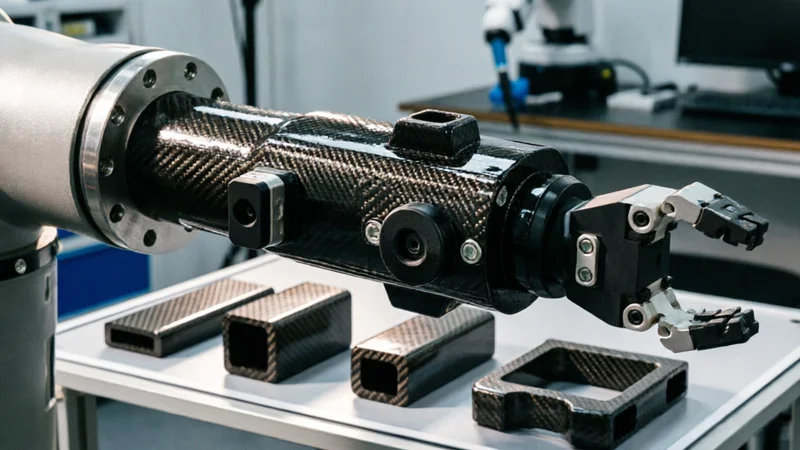
Carbon Fiber Robot End Effector Link — Custom Shape & Sensor Integration
Custom-shaped carbon fiber end effector links for robotic arms. Designed for automation integrators and research labs requiring lightweight, rigid connections between the robot wrist and gripper/tool. Can incorporate sensor mounting bosses, cable routing channels, and quick-change interfaces.

Custom Carbon Fiber Musical Instrument Parts
Carbon fiber components for musical instrument manufacturing offering superior dimensional stability, low weight, and consistent acoustic properties. We produce carbon fiber bows, guitar necks, violin chin rests, drum shells, and wind instrument bodies. Carbon fiber instruments are immune to humidity changes and temperature fluctuations that affect wooden instruments.
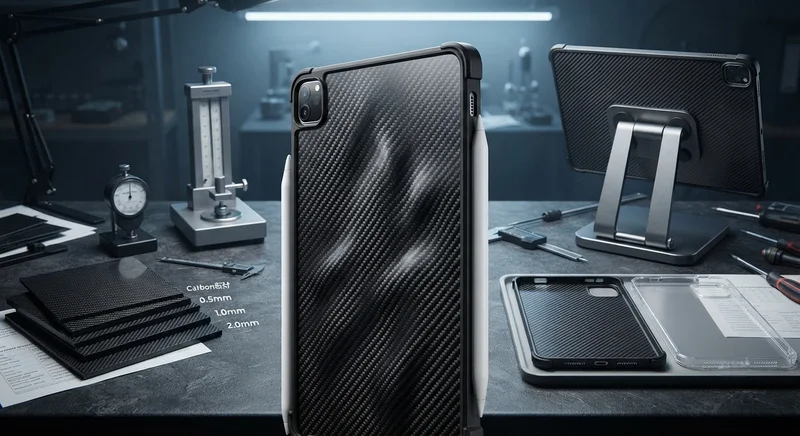
Carbon Fiber Tablet Case — Ultra-Light Protective Shell
Lightweight carbon fiber protective case for tablets and iPads. Molded from T700 3K prepreg with reinforced corner protection. Adds minimal weight while providing superior rigidity and drop protection compared to polycarbonate or silicone cases. Ideal for field workers, enterprise deployments, and professionals requiring durable tablet protection.

Custom Carbon Fiber Medical Device Components
Medical-grade carbon fiber components manufactured for imaging equipment, surgical instruments, and patient support systems. Carbon fiber's radiolucency (X-ray transparency) and high strength-to-weight ratio make it ideal for CT scanner beds, wheelchair frames, surgical robot arms, and MRI-compatible accessories. Biocompatible resin systems available.
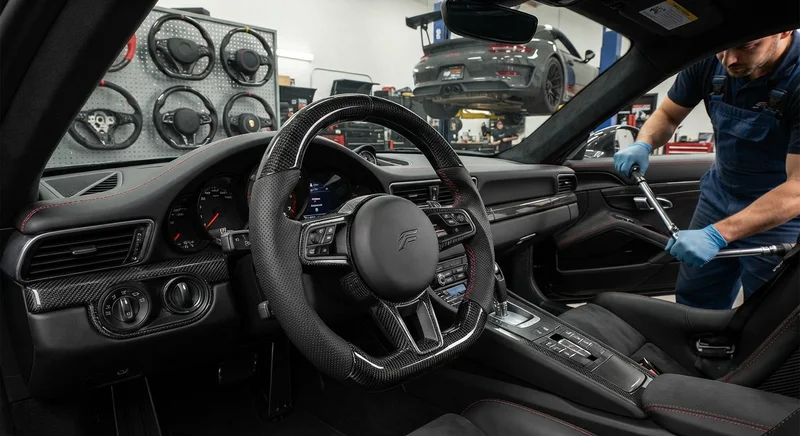
Carbon Fiber Steering Wheel — Custom Leather-Wrapped with CF Inlay
Custom carbon fiber steering wheel with genuine leather wrapping and carbon fiber inlay sections. Molded from T700 3K prepreg for maximum rigidity with a 30% weight reduction over OEM wheels. Available in D-shape (flat bottom) and round profiles. Direct bolt-on fitment for popular sports car and performance vehicle models. Custom stitching color and leather grade available.