
A technical examination of Type V fully composite hydrogen storage tanks — covering filament winding processes, linerless design challenges, manufacturing tolerances, and cost-volume analysis.
Introduction
Type V hydrogen storage tanks represent the cutting edge of composite pressure vessel technology. Unlike Type IV tanks — which use a polymer liner wrapped with carbon fiber — Type V tanks are entirely linerless, with the carbon fiber composite itself serving as both the structural shell and the permeation barrier. This design eliminates the liner weight (typically 15–25 kg for a 70 MPa automotive tank) and increases the gravimetric hydrogen storage density from approximately 5.5 wt% (Type IV) to 6.5–7.2 wt% (Type V). However, the manufacturing challenges are substantial: achieving near-zero hydrogen permeation through a composite-only wall requires precise fiber architecture design, advanced resin systems with inherently low gas permeability (≤1 × 10⁻¹⁵ m³·m/m²·s·Pa), and ultra-low void content (≤0.5%).
The global Type V hydrogen tank market is projected to grow from USD 52 million in 2025 to USD 480 million by 2032 (CAGR 37.4%), driven by fuel cell electric vehicle (FCEV) adoption, hydrogen refueling infrastructure expansion, and advances in carbon fiber manufacturing. BMW's recent iX5 Hydrogen demonstration — featuring a flat, floor-integrated hydrogen storage system — has accelerated interest in Type V architectures that can conform to vehicle packaging constraints while maintaining 70 MPa (10,000 psi) working pressure.
| Parameter | Type IV (Polymer Liner) | Type V (Linerless) | Improvement |
|---|---|---|---|
| Gravimetric Capacity | 5.0–5.7 wt% | 6.5–7.2 wt% | +28% |
| Volumetric Efficiency | 28–32 g H₂/L | 34–38 g H₂/L | +19% |
| System Weight (70 MPa, 5 kg H₂) | 88–100 kg | 69–77 kg | −22% |
| Cycle Life (0–87.5 MPa) | 11,000 cycles | 13,000 cycles (target) | +18% |
Filament Winding Process Optimization
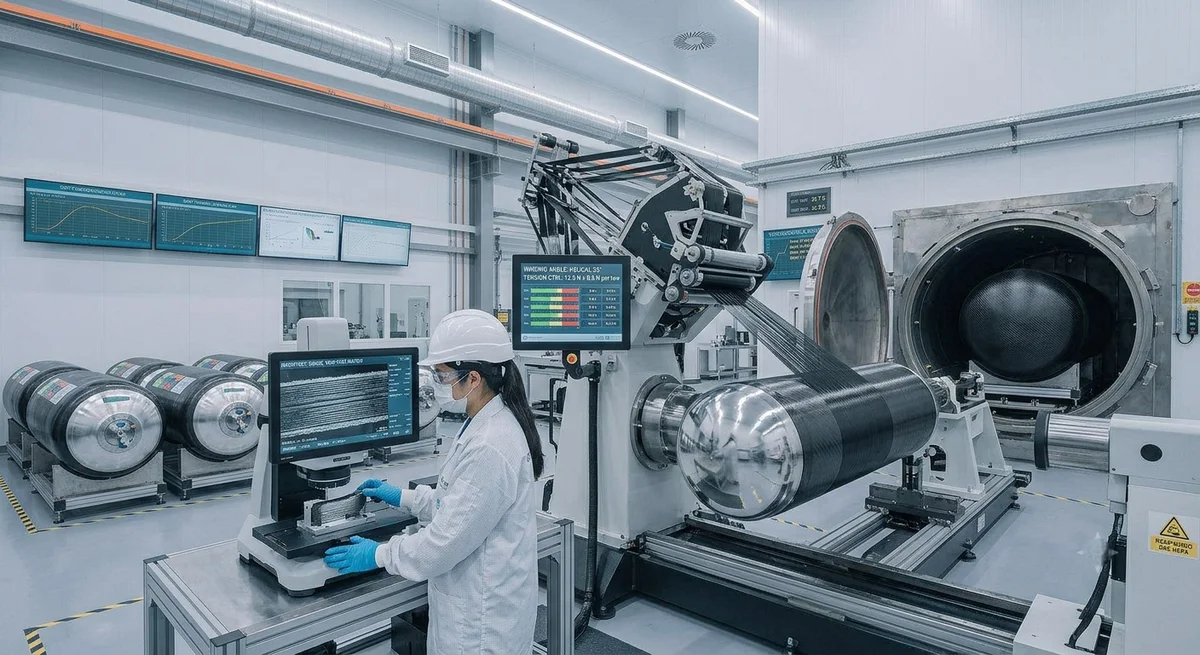
Type V tank manufacturing relies on precision filament winding with specialized process controls:
- Winding Pattern Design: Geodesic and non-geodesic winding trajectories are combined to achieve dome reinforcement at the boss ends. Typical winding angles range from ±10° (hoop layers) to ±90° (helical layers), with layer sequences optimized through finite element analysis (FEA). A 50-liter Type V tank requires approximately 40–60 individual layers with a total fiber thickness of 12–18 mm.
- Tension Control: Fiber tension must be maintained at 8–15 N per tow (12K T700 grade) with ±1 N accuracy. Tension variation beyond ±2 N causes fiber waviness that reduces burst pressure by 10–18%. Active closed-loop tensioners with load cell feedback are standard for production-grade winding machines.
- Resin Content Management: The fiber-to-resin ratio must be controlled to 65:35 by weight (±2%) to achieve the optimal balance of structural strength and permeation resistance. Resin bath temperature is maintained at 35–50°C to achieve 300–800 mPa·s viscosity for proper fiber wet-out.
- Curing Cycle: A staged cure profile — 80°C for 2 hours (pre-gel), 150°C for 4 hours (full cure), controlled cool-down at 1°C/min — minimizes residual thermal stresses in the thick composite wall. Autoclave pressure of 5–8 bar is applied during curing to reduce void content.
Linerless Design Challenges
Eliminating the polymer liner introduces several engineering challenges that directly impact manufacturing feasibility:
- Permeation Barrier: Without a polymer liner, the composite wall must achieve a hydrogen permeation rate below 0.05 cc/h per liter of tank volume. This requires void content below 0.5% and the use of permeation-reducing resin additives such as exfoliated nanoclays (1–3 wt%) or graphene oxide platelets (0.5–1.0 wt%).
- Boss-to-Composite Interface: The metal boss (typically 6061-T6 aluminum or 316L stainless steel) must form a gas-tight seal with the composite structure. Interlayer shear strength at the interface must exceed 25 MPa to prevent delamination under cyclic pressure loading. Surface treatment of the boss — plasma cleaning followed by silane coupling agent application — improves adhesion strength by 35–50%.
- Damage Tolerance: Type V tanks exhibit lower damage tolerance than Type IV because there is no liner to act as a secondary containment barrier. Impact energy thresholds for visible damage are 8–12 J for Type V vs 15–20 J for Type IV. Protective outer layers or impact-resistant coatings (2–3 mm polyurethane or elastomeric layer) are typically applied.
Cost Analysis for B2B Buyers
For companies evaluating Type V tank technology for hydrogen storage systems, the following cost factors are critical:
- Carbon Fiber Cost: T700-grade carbon fiber represents 55–65% of total tank cost at current market prices ($25–35/kg). Moving to higher-strength T800 fiber ($50–70/kg) can reduce fiber usage by 20–25% but increases material cost by 40–60%.
- Manufacturing Throughput: Current production rates for Type V tanks range from 1–3 tanks per winding station per day (8-hour shift). Automated multi-spindle winding machines can increase throughput to 6–10 tanks per station per day, reducing per-tank labor cost by 35–50%.
- Burst Pressure Safety Factor: Industry standards require a minimum burst-to-working pressure ratio of 2.25:1 (157.5 MPa burst for 70 MPa working). Each 0.25 increase in safety factor adds approximately 8–12% to material cost.
Frequently Asked Questions
How does Type V tank manufacturing differ from Type IV?
The fundamental difference is the absence of a polymer liner. Type V tanks are wound directly onto a dissolvable or extractable mandrel, and after curing, the mandrel is removed — leaving a pure composite structure. This eliminates the liner winding step but requires precise internal surface finishing (Ra ≤ 1.6 µm) to prevent micro-crack initiation. The winding tension is typically 20–30% higher for Type V to achieve tighter fiber packing (fiber volume fraction ≥68% vs 62–65% for Type IV).
What certification standards apply to Type V hydrogen tanks?
Type V tanks are regulated under UN GTR No. 13 (global technical regulation for hydrogen vehicles), ECE R134 (European Union), and FMVSS No. 304a (U.S.). The absence of a liner means additional leak-before-burst (LBB) validation testing is required. Current certification tests include: hydraulic burst test (2 samples), ambient cyclic fatigue (11,000 cycles, 0–125% working pressure), extreme temperature cycles (−40°C to +85°C), fire resistance (2-minute localized flame), and permeation aging (1,000-hour hydrogen exposure). Compliance with EC79/2009 (EU pressure equipment directive) is mandatory for European market entry.
What are the minimum production volumes for cost-effective Type V manufacturing?
Type V tank production becomes economically viable at annual volumes above 5,000 units per manufacturing line. Below this threshold, Type IV tanks remain more cost-effective due to lower tooling costs and more mature manufacturing processes. A dedicated Type V production line requires capital investment of $3–8 million (winding machine $1.5–3M, autoclave $0.8–1.5M, curing oven $0.3–0.6M, NDE equipment $0.4–0.8M, mandrel tooling $0.2–0.4M). At 10,000 units/year, the estimated per-tank cost is $850–$1,200 for a 50-liter, 70 MPa Type V tank, compared to $950–$1,400 for equivalent Type IV.
Part of topic
Related Articles
- Bio-Based Carbon Fiber Precursors: Lignin and Polyethylene for Low-Cost Production
- Large-Tow Carbon Fiber Cost Analysis: 48K vs 60K Price-Performance Comparison
- Carbon Fiber-Resin Interface Bonding: Surface Treatment and Coupling Agent Optimization
- Digital Twin for Carbon Fiber Manufacturing: Real-Time Process Monitoring and Defect Prevention
- Thermoplastic Carbon Fiber Welding for Automotive: Ultrasonic and Induction Welding Process Windows
- Large-Tow Carbon Fiber Wet Spinning: Process Optimization for 48K/60K Production Efficiency
Interested in Our Products?
Contact our team for competitive pricing and technical specifications.
Get a QuoteRelated Products

Carbon Fiber Plate — 3K Twill T700 1.5mm
Thin 1.5mm carbon fiber plate with 3K twill weave surface. Lightweight and stiff, commonly used for covers, panels, drone bodies, and applications requiring a premium aesthetic appearance.

Square Carbon Fiber Tube — 3K Twill T700
Square cross-section carbon fiber tube manufactured with 3K twill weave for torsional strength. Preferred for structural frames, trusses, and support columns where rectangular geometry offers design flexibility.

Carbon Fiber Plate — 3K Twill T700 3.0mm
Medium-thickness 3.0mm carbon fiber plate offering significantly higher load capacity while maintaining attractive 3K twill finish. Suitable for structural brackets, reinforcement plates, and load-bearing panels.
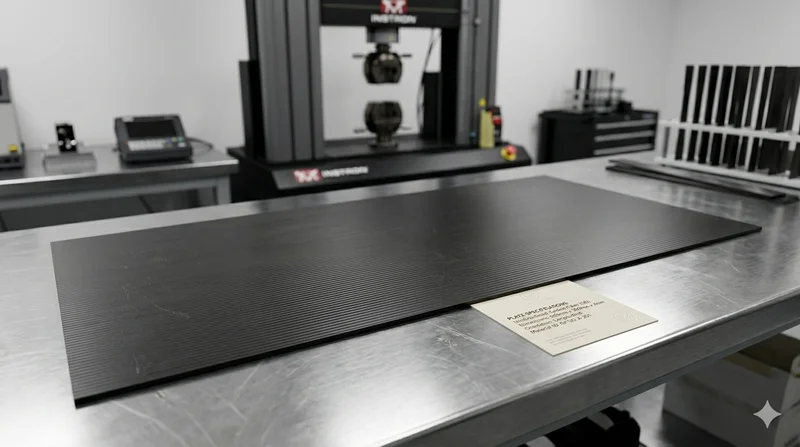
Carbon Fiber Plate — UD Unidirectional T700
Unidirectional carbon fiber plate with all fibers oriented in a single direction for maximum strength along the fiber axis. Essential for structural reinforcements, splints, and applications where load direction is predictable.
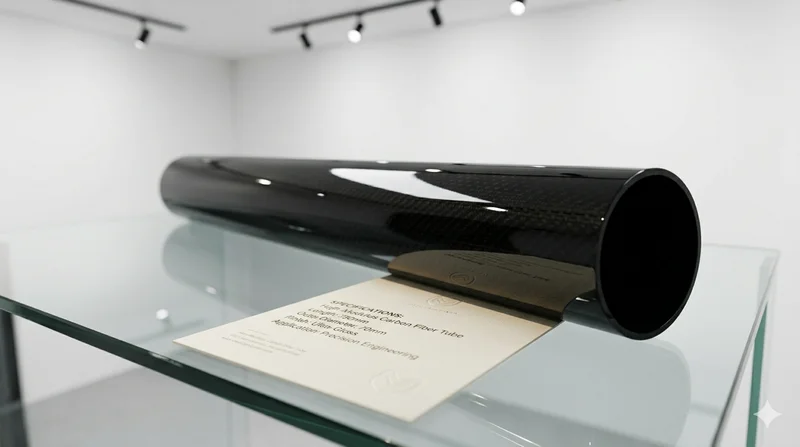
High Modulus Round Carbon Fiber Tube — M40
High modulus round tube manufactured with M40 grade fiber (tensile modulus 400 GPa). Designed for applications where maximum stiffness-to-weight ratio is critical, such as optical systems, precision machinery, and aerospace structures.