
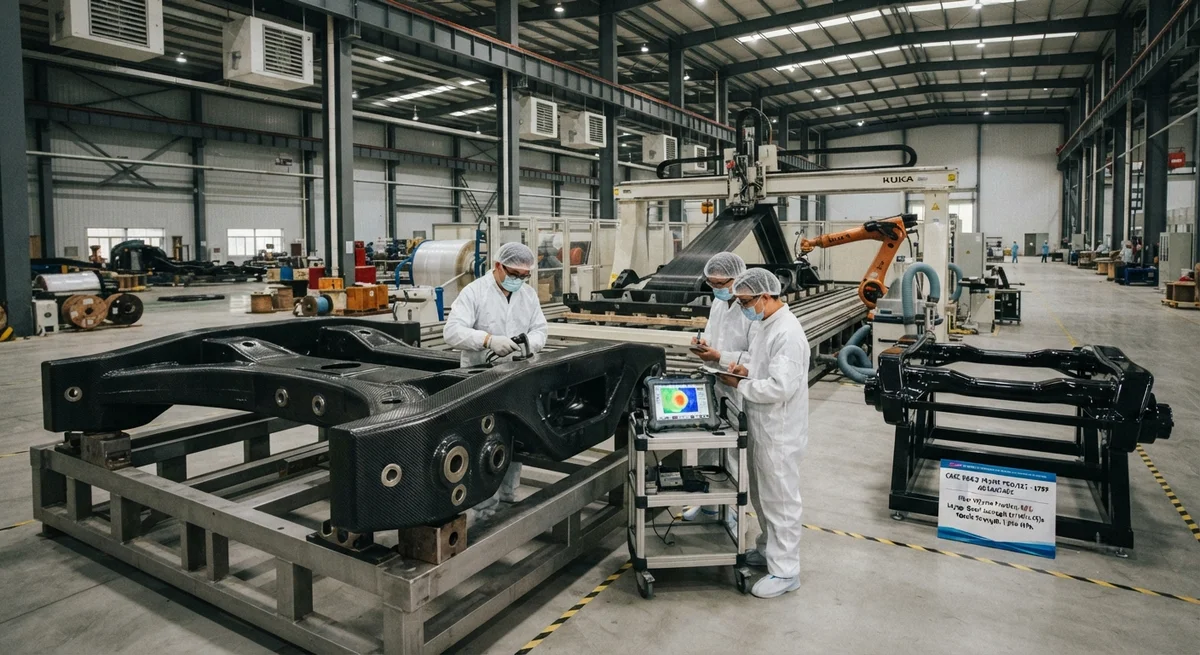
Carbon fiber composite bogie frames achieve 35-50% mass reduction compared to welded steel while maintaining structural integrity. This article examines manufacturing processes, fatigue performance, and lifecycle cost benefits for high-speed rail and metro applications.
The Evolution of Rail Vehicle Suspension Structures
Modern high-speed trains and metro systems demand increasingly sophisticated running gear to meet performance requirements at speeds exceeding 300 km/h. The bogie frame — the structural backbone supporting axles, suspension, and traction equipment — has traditionally been fabricated from welded steel or cast iron, with a typical mass of 1,800-2,500 kg per unit. Carbon fiber composite bogie frames represent a paradigm shift in rail vehicle engineering, offering mass reductions of 35-50% while maintaining or exceeding the structural performance of metallic equivalents.
The global rail composites market was valued at $2.1 billion in 2025 and is projected to reach $4.8 billion by 2032, according to a market analysis by MarketsandMarkets. Bogie frame applications represent one of the fastest-growing segments, driven by regulatory pressure to reduce axle loads — particularly for high-speed rail networks in Japan, France, Germany, and China, where maximum axle loads are strictly limited to 17 tonnes for Shinkansen, TGV, and ICE corridors respectively.
Material and Structural Design of Composite Bogie Frames
Carbon fiber bogie frames are typically manufactured using a combination of unidirectional and woven prepreg, with layup sequences designed to address the complex multi-axial loading conditions that bogie frames experience during service. Critical design considerations include:
- Primary load paths: The side frame members experience bending moments of 150-250 kN·m during emergency braking, requiring 20-30 mm thick laminates with 60-65% fiber volume fraction in the longitudinal direction. Quasi-isotropic layups with bias-oriented plies handle shear and torsion loads during curving and track irregularities.
- Bolted and bonded insert zones: Metallic inserts — typically forged aluminum 7075-T6 or titanium Ti-6Al-4V — are co-cured or bonded into the composite structure at attachment points. These inserts distribute concentrated loads from air springs, dampers, brake units, and traction motors without inducing delamination. Pull-out strength requirements exceed 80 kN for primary suspension attachment points.
- Fatigue performance: CFRP bogie frames have demonstrated fatigue endurance limits of 60-70% of ultimate tensile strength over 10 million cycles in laboratory testing, compared to 30-40% for S355JR steel and 25-35% for cast iron. This translates to a design life exceeding 30 years in typical high-speed service, compared to 15-20 years for welded steel frames before crack inspection becomes mandatory.
- Thermal management: Brake disc heat radiation during repeated emergency stops can raise local frame temperatures to 120-180°C. High-temperature epoxy systems with Tg above 200°C are specified for bogie frame components in proximity to braking systems.
Comparative Performance: CFRP vs. Steel vs. Aluminum Bogie Frames
| Parameter | CFRP Bogie Frame | Welded Steel (S355JR) | Aluminum (6082-T6) | Weight Saving |
|---|---|---|---|---|
| Mass per bogie (kg) | 1,100-1,400 | 1,800-2,500 | 1,500-2,000 | 30-56% vs steel |
| Tensile strength (MPa) | 850-1,050 (quasi-isotropic) | 470-510 | 310-340 | 1.7-2.2x stronger |
| Specific stiffness (GPa/(g/cm³)) | 70-85 | 25-27 | 26-28 | 2.6-3.3x stiffer/weight |
| Fatigue endurance (10⁷ cycles) | 60-70% UTS | 30-40% UTS | 25-35% UTS | 1.7-2.8x longer life |
| Corrosion resistance | Excellent (no galvanic if insulated) | Poor (requires coating) | Moderate (anodized) | No repainting needed |
| Inspection interval (years) | 8-12 | 3-5 | 4-6 | 2-4x longer intervals |
| Manufacturing cycle (per frame) | 5-8 days (cure + assembly) | 3-5 days | 3-5 days | Comparable series time |
The unsprung mass reduction achieved with CFRP bogie frames yields direct operational benefits: reduced track wear (12-18% reduction in rail head fatigue according to Network Rail field trials), lower energy consumption per tonne-km (4-7% improvement), and higher permissible operating speeds on existing infrastructure.
Manufacturing Processes for CFRP Bogie Frames
The production of carbon fiber bogie frames involves several specialized manufacturing steps that differ significantly from conventional metal fabrication:
- Prepreg layup and automated fiber placement (AFP): Large bogie frame geometries — typically 2.5-3.5 m in length — are laid up using multi-axis AFP heads capable of depositing 8-16 tow ends simultaneously at deposition rates of 20-40 kg/hour. The AFP process allows steered fiber paths that follow principal stress trajectories, optimizing material utilization.
- Out-of-autoclave (OOA) curing: To accommodate the large envelope of bogie frames, manufacturers increasingly employ OOA prepreg systems cured in heated press molds or industrial ovens under vacuum pressure only. OOA cycles of 6-8 hours at 120-180°C achieve void contents below 2%, comparable to autoclave-cured parts, while reducing capital expenditure on large autoclaves.
- Non-destructive inspection: Every bogie frame undergoes ultrasonic C-scan inspection per ASTM E2580, with full-volume phased-array UT covering all bond lines and co-cured insert zones. CT scanning is employed for first-article qualification and for any repaired regions.
- Machining: Diamond-tipped tools with spindle speeds of 8,000-15,000 RPM are used for drilling bolt holes to H7 tolerance and trimming net-shape edges. Coolant through the spindle prevents resin smearing and dimensional distortion from localized heating.
Field Performance and Certification
Carbon fiber bogie frames have been deployed in revenue service on several major rail networks. Japan's N700S Shinkansen series incorporates CFRP components in bolster beam and damper bracket applications, saving approximately 400 kg per trainset. China Railway's CR400 Fuxing high-speed trains have tested full CFRP bogie frames in prototype service since 2023, with cumulative test mileage exceeding 500,000 km. The European Union's Shift2Rail program has funded composite bogie frame development through its INNOWAG project, targeting 40% mass reduction for freight wagon bogies.
Certification of composite bogie frames follows EN 13749 (railway applications — wheelsets and bogies) and the European standard EN 13103 for axle design, supplemented by the German VDV 152 guideline for light rail vehicle running gear. Key certification requirements include: static load testing to 1.5x design load, fatigue testing to 10 million cycles with no crack initiation, fire-smoke-toxicity (FST) testing per EN 45545-2 for hazard level HL3, and impact testing simulating a 50 kN obstacle strike at track level.
Cost-Benefit Analysis for Rail Operators
| Lifecycle Cost Factor | CFRP Bogie Frame | Steel Bogie Frame |
|---|---|---|
| Initial unit cost (10-unit pilot batch) | $85,000-120,000 | $35,000-55,000 |
| Projected unit cost (500+ units/year) | $55,000-75,000 | $32,000-48,000 |
| Weight per bogie (kg) | 1,200 | 2,100 |
| Annual energy savings per bogie | $4,200-6,800 | — |
| Track maintenance cost reduction/year | $2,000-4,500 | — |
| Replacement interval (years) | 30+ | 15-20 |
| Lifecycle cost over 30 years (per bogie) | $180,000-260,000 | $220,000-340,000 |
Despite the 60-90% higher initial purchase cost, CFRP bogie frames deliver a lower total cost of ownership over 30 years of service, driven by energy savings, reduced track maintenance, and elimination of corrosion-related replacement cycles.
Frequently Asked Questions
How do carbon fiber bogie frames perform in extreme cold weather conditions typical of Siberian or Canadian rail routes?
Carbon fiber composites exhibit excellent low-temperature performance, with matrix-dominated properties such as interlaminar shear strength actually improving by 10-15% as temperatures drop from 20°C to -40°C due to increased resin stiffness. However, the mismatch in coefficient of thermal expansion between carbon fiber (-0.5 to 0.5 ppm/°C) and metallic inserts (16-24 ppm/°C for aluminum and steel) creates differential thermal strains that must be addressed in the design. Bonded insert designs incorporating a 0.5-1.0 mm compliant adhesive layer of elastomer-modified epoxy accommodate these strains without inducing delamination. Operators on routes such as the Trans-Siberian Railway or Canada's Hudson Bay Railway have validated CFRP bogie components through winter trials with temperatures reaching -50°C, with no structural anomalies reported after 50,000 km of service.
Can existing steel bogie frames be retrofitted with composite components, or does the entire bogie design need to change?
A hybrid retrofit approach is feasible and increasingly common. Existing steel bogie frames can incorporate CFRP replacement components for non-primary-structural elements such as bolster beams, damper brackets, and brake hanger supports, achieving 15-25% mass reduction without fundamental bogie redesign. For full mass reduction benefits of 35-50%, a complete bogie redesign is recommended to optimize load paths for composite construction. Several European rail operators have adopted a phased approach: first replacing bolted-on subcomponents with CFRP equivalents, then — after gaining operational experience — designing purpose-built composite bogie frames for new rolling stock procurements. This strategy reduces technical risk while building maintenance team competence with composite inspection and repair procedures.
What are the fire safety requirements for carbon fiber bogie frames in passenger rail applications?
Composite bogie frames fall under the strictest fire safety requirements in passenger rail. European standard EN 45545-2 mandates that rail vehicle structural components meet hazard level HL3 for passenger-carrying vehicles. CFRP bogie frames using standard epoxy resin systems must incorporate flame-retardant additives or intumescent coatings to meet the required limiting oxygen index of 32% or higher. Phenolic and benzoxazine resin systems offer inherently superior fire performance — achieving LOI of 38-45% with heat release rates below 60 kW/m² in cone calorimeter testing — but have higher processing costs and lower mechanical properties than epoxy. Many CFRP bogie frame designs use hybrid resin systems: epoxy for the primary structural laminate for strength, with a 1-2 mm surface layer of fire-resistant phenolic resin on all exposed surfaces. This approach balances structural performance with fire safety compliance.
Part of topic
Related Articles
- Recycled Carbon Fiber Market Forecast 2030: Technology Maturity and Commercialization Path
- South Korea Carbon Fiber Market 2026: Hydrogen Economy and Shipbuilding Innovation
- Wind Turbine Blade Leading Edge Protection 2026: Polyurethane, Tape, and Metallic Shield Solutions
- China Carbon Fiber Overcapacity 2026: Price War Impact and Industry Consolidation
- India Carbon Fiber Market 2026: Wind Energy, Aerospace, and Defense Expansion
- PAN Precursor Market 2026: Acrylonitrile Supply and Carbon Fiber Cost Structure
Interested in Our Products?
Contact our team for competitive pricing and technical specifications.
Get a QuoteRelated Products

Carbon Fiber Plate — 3K Twill T700 1.5mm
Thin 1.5mm carbon fiber plate with 3K twill weave surface. Lightweight and stiff, commonly used for covers, panels, drone bodies, and applications requiring a premium aesthetic appearance.
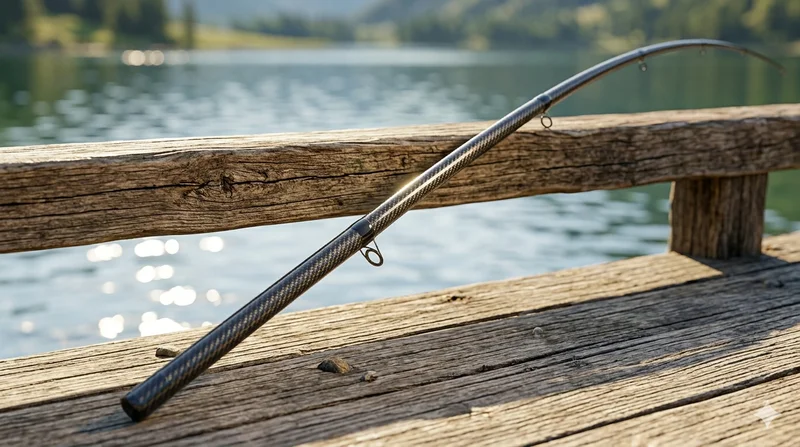
Carbon Fiber Fishing Rod Blank
High-quality carbon fiber fishing rod blank manufactured from multiple grades of Toray carbon fiber cloth. Available in a wide range of lengths, powers, and actions for freshwater and saltwater applications. Suitable for OEM rod building.

Carbon Fiber Plate — 3K Twill T700 3.0mm
Medium-thickness 3.0mm carbon fiber plate offering significantly higher load capacity while maintaining attractive 3K twill finish. Suitable for structural brackets, reinforcement plates, and load-bearing panels.

Square Carbon Fiber Tube — 3K Twill T700
Square cross-section carbon fiber tube manufactured with 3K twill weave for torsional strength. Preferred for structural frames, trusses, and support columns where rectangular geometry offers design flexibility.
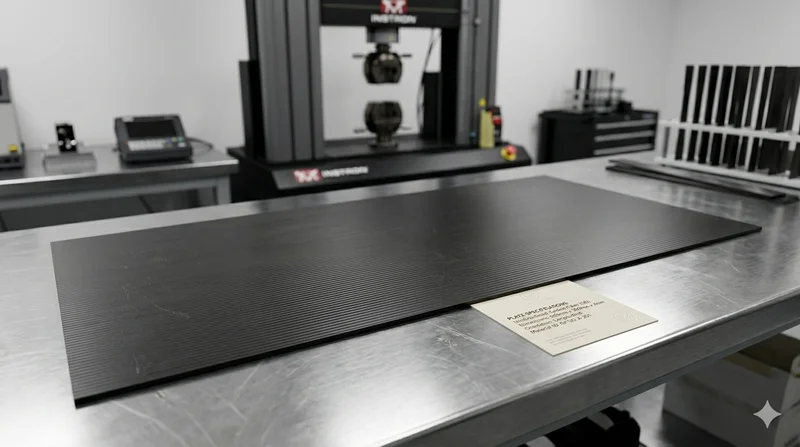
Carbon Fiber Plate — UD Unidirectional T700
Unidirectional carbon fiber plate with all fibers oriented in a single direction for maximum strength along the fiber axis. Essential for structural reinforcements, splints, and applications where load direction is predictable.