
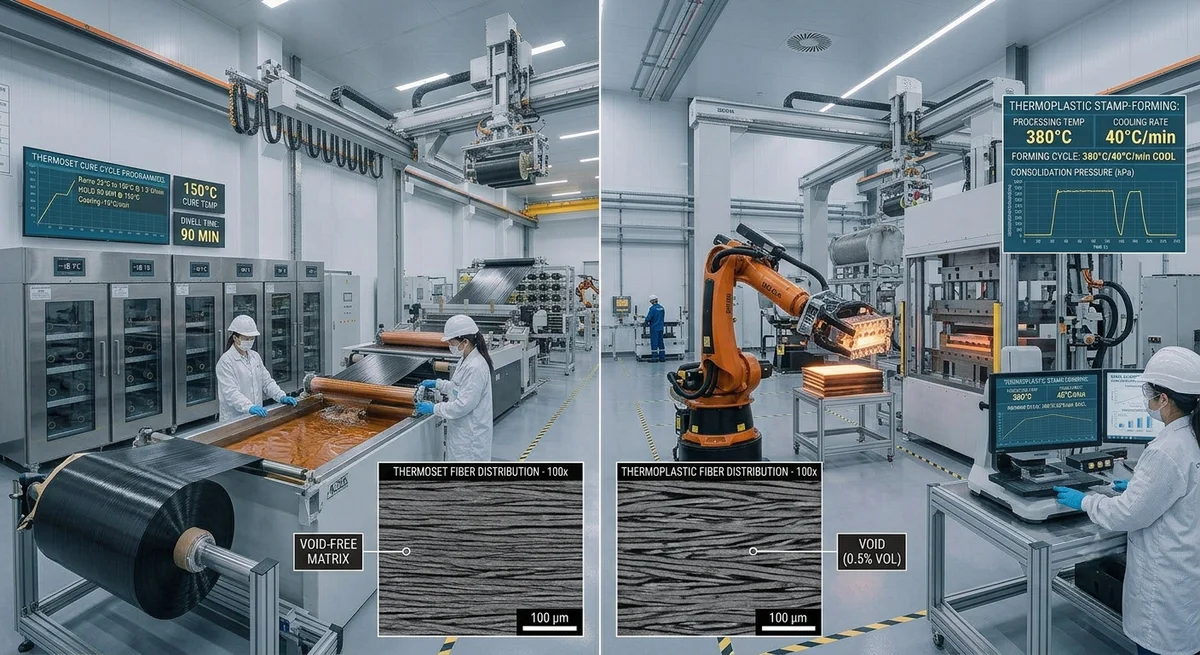
A comprehensive comparison of thermoplastic and thermoset prepreg systems for carbon fiber composites — covering material properties, processing parameters, cost analysis, and application-specific selection criteria.
Introduction
The choice between thermoplastic and thermoset prepreg systems is one of the most consequential decisions in carbon fiber composite manufacturing. Each material system offers fundamentally different processing characteristics, mechanical properties, and cost structures that directly impact production feasibility and part performance. Thermoplastics — primarily PEEK, PEKK, and low-melt PAEK variants — are gaining significant traction for aerospace and automotive applications, with the global carbon fiber thermoplastic composite market projected to reach USD 1.8 billion by 2030 (CAGR 11.2%). Meanwhile, thermoset epoxies remain the dominant matrix system, accounting for approximately 72% of all carbon fiber prepreg production in 2026.
| Property | Thermoset (Epoxy) | Thermoplastic (PEEK/PEKK) |
|---|---|---|
| Processing Temperature | 120–180°C | 340–400°C |
| Cycle Time (compression molding) | 5–15 min | 1–5 min |
| Shelf Life (at 23°C) | 30–60 days | Unlimited |
| Tensile Modulus (60% FV) | 70–90 GPa | 60–80 GPa |
| Interlaminar Fracture Toughness | 0.2–0.4 kJ/m² | 0.8–2.0 kJ/m² |
| Service Temperature (continuous) | 80–180°C | 120–260°C |
| Recyclability | Limited (downcycling) | Good (remelting) |
| Material Cost (prepreg, per kg) | $35–$65 | $80–$200 |
Processing Differences
- Temperature Requirements: Thermoset at 120–180°C (aluminum tooling). Thermoplastic at 340–400°C (heated steel tooling).
- Consolidation Mechanism: Thermoset — irreversible chemical crosslinking. Thermoplastic — physical phase change, remeltable.
- Dwell and Cool-Down: Thermoset: 60–120 min cure, 1–3°C/min. Thermoplastic: 2–5 min melt, 20–50°C/min.
Aerospace vs Automotive Selection
- Aerospace — Thermoset Dominance (60–70%): Superior compressive strength (1,200–1,600 MPa vs 900–1,200 MPa for thermoplastics), lower moisture absorption (0.5–1.0 wt% vs 1.5–2.5 wt%), established certification pedigree.
- Automotive — Thermoplastic Growth (8–12%/year): 30-second stamp-forming cycle vs 5–15-minute molding. Cost crossover at 50,000 parts/year. Applications: front-end modules, seat backs, battery enclosure covers.
Frequently Asked Questions
Can thermoplastic composites be processed in existing autoclaves?
Standard autoclaves (max 250°C) are unsuitable for PEEK/PEKK (340–400°C). Dominant methods: compression molding with heated platens, double-belt pressing, ATP with in-situ consolidation.
Minimum production volume for cost-competitive thermoplastics?
Automotive: >10,000–20,000 parts/year. Aerospace crossover lower at 3,000–8,000 parts/year due to higher weight reduction value.
Part of topic
Related Articles
- Bio-Based Carbon Fiber Precursors: Lignin and Polyethylene for Low-Cost Production
- Large-Tow Carbon Fiber Cost Analysis: 48K vs 60K Price-Performance Comparison
- Carbon Fiber-Resin Interface Bonding: Surface Treatment and Coupling Agent Optimization
- Digital Twin for Carbon Fiber Manufacturing: Real-Time Process Monitoring and Defect Prevention
- Thermoplastic Carbon Fiber Welding for Automotive: Ultrasonic and Induction Welding Process Windows
- Large-Tow Carbon Fiber Wet Spinning: Process Optimization for 48K/60K Production Efficiency
Interested in Our Products?
Contact our team for competitive pricing and technical specifications.
Get a QuoteRelated Products

Carbon Fiber Plate — 3K Twill T700 1.5mm
Thin 1.5mm carbon fiber plate with 3K twill weave surface. Lightweight and stiff, commonly used for covers, panels, drone bodies, and applications requiring a premium aesthetic appearance.

Square Carbon Fiber Tube — 3K Twill T700
Square cross-section carbon fiber tube manufactured with 3K twill weave for torsional strength. Preferred for structural frames, trusses, and support columns where rectangular geometry offers design flexibility.
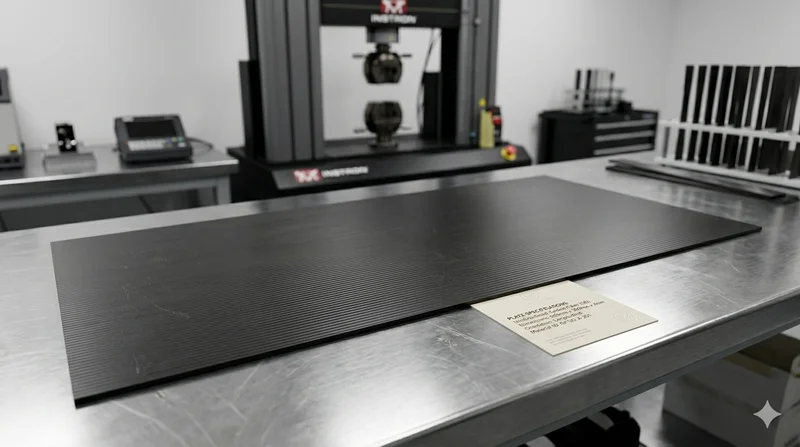
Carbon Fiber Plate — UD Unidirectional T700
Unidirectional carbon fiber plate with all fibers oriented in a single direction for maximum strength along the fiber axis. Essential for structural reinforcements, splints, and applications where load direction is predictable.
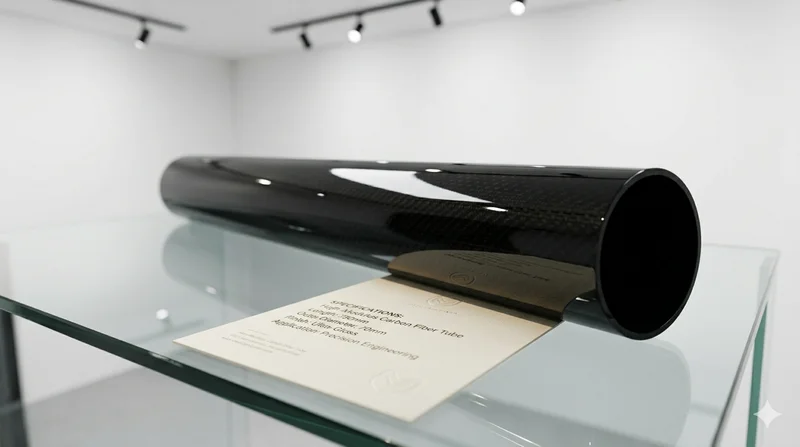
High Modulus Round Carbon Fiber Tube — M40
High modulus round tube manufactured with M40 grade fiber (tensile modulus 400 GPa). Designed for applications where maximum stiffness-to-weight ratio is critical, such as optical systems, precision machinery, and aerospace structures.
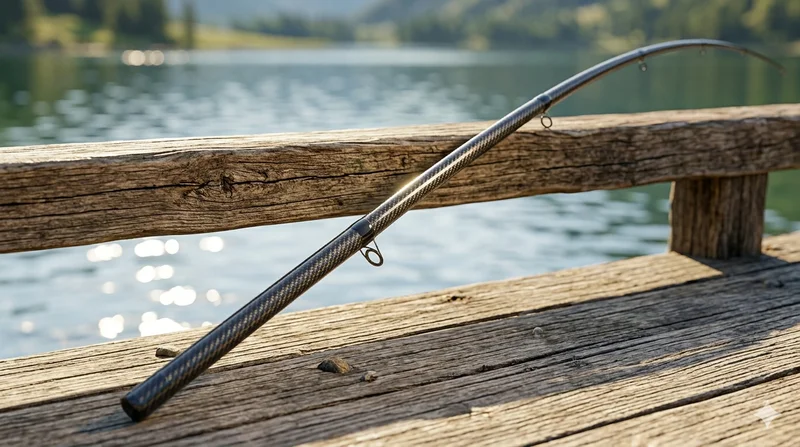
Carbon Fiber Fishing Rod Blank
High-quality carbon fiber fishing rod blank manufactured from multiple grades of Toray carbon fiber cloth. Available in a wide range of lengths, powers, and actions for freshwater and saltwater applications. Suitable for OEM rod building.