
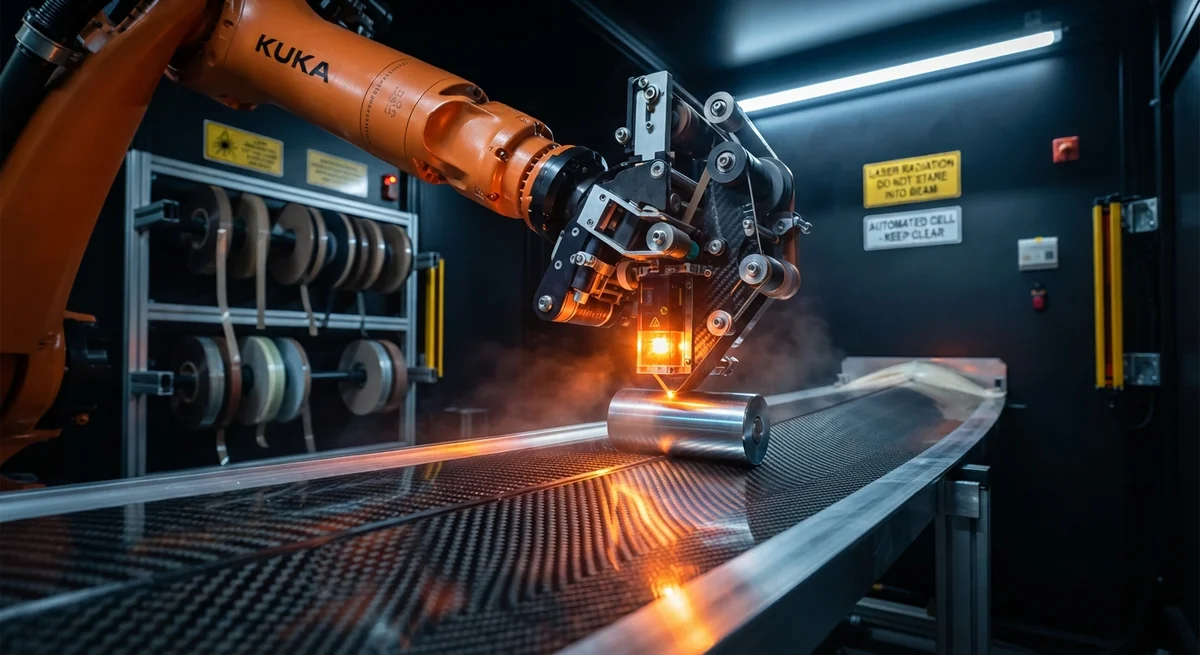
Automated thermoplastic composite (TPC) layup technology is transforming aerospace manufacturing by enabling cycle times under 60 seconds per ply, eliminating autoclave curing, and reducing per-part costs by 25–40% versus traditional thermoset prepreg systems.
The New Frontier in Aerospace Composites: Thermoplastic Automated Layup
Thermoplastic composites (TPCs) have long been recognized for their superior mechanical properties — higher impact resistance, infinite shelf life at room temperature, recyclability, and weldability — but their adoption in primary aerospace structures was historically limited by processing economics. That landscape has shifted dramatically with the maturation of automated fiber placement (AFP) and automated tape laying (ATL) systems optimized for thermoplastic prepregs operating at in-situ consolidation (ISC) conditions.
The fundamental process innovation is in-situ consolidation: a robotic AFP head applies heat (via laser, hot gas torch, or infrared), pressure (via compaction roller), and rapid cooling simultaneously, consolidating each ply to the substrate without requiring a separate autoclave or oven cycle. This eliminates the single most capital-intensive step in traditional composite manufacturing. A typical thermoset AFP part requires 4–8 hours of autoclave time per cure cycle plus bagging and debulking steps. A thermoplastic ISC part, by contrast, is fully consolidated as it is laid, emerging from the AFP cell ready for final inspection or assembly.
The production rate implications are profound. For a typical 2-meter-long aerospace stringer, a thermoset AFP process with autoclave curing achieves an end-to-end cycle time of approximately 8–12 hours. With thermoplastic ISC, the same stringer is produced in under 45 minutes — a 10x to 15x improvement in throughput.
Production Rate Comparison: Thermoset vs. Thermoplastic AFP
| Process Parameter | Thermoset AFP (Autoclave) | Thermoplastic AFP (ISC) | Improvement Factor |
|---|---|---|---|
| Layup rate (kg/hour) | 5–15 | 10–30 | 2x |
| Cure cycle time | 4–8 hours (autoclave) | 0 minutes (in-situ) | ∞ |
| Bagging/debulking steps | 4–6 steps required | 0 steps required | ∞ |
| End-to-end cycle (stringer) | 8–12 hours | 30–45 minutes | 10–15x |
| End-to-end cycle (skin panel 2m²) | 16–24 hours | 1.5–3 hours | 8–10x |
| Energy consumption (kWh/kg) | 35–55 | 8–15 | 3–4x |
| Tooling cost (relative) | 1.0x (baseline) | 0.4–0.6x | 1.8–2.5x |
| Shelf life of prepreg | –18°C freezer, 30 days | Room temp, indefinite | ∞ |
Cost Economics and Breakeven Analysis
Detailed cost models published by IACMI indicate that thermoplastic composite parts achieve cost parity with thermoset equivalents at annual production volumes of approximately 500–800 parts. Above 1,000 parts per year, TPC ISC yields a 15–25% total cost advantage. At volumes above 5,000 parts per year, the cost advantage widens to 30–40%.
| Annual Volume | Thermoset Cost/Part | TPC ISC Cost/Part | Δ% |
|---|---|---|---|
| 100 parts/yr | $1,200 | $1,680 | +40% |
| 500 parts/yr | $980 | $1,020 | +4% |
| 1,000 parts/yr | $870 | $740 | –15% |
| 5,000 parts/yr | $690 | $460 | –33% |
| 10,000 parts/yr | $550 | $340 | –38% |
Key Drivers for Thermoplastic AFP Adoption
- Autoclave elimination: Eliminates the largest capital equipment cost — a production-scale autoclave (4m × 12m) costs USD 3–6 million installed.
- Cold storage elimination: Thermoset prepregs require –18°C freezer storage; TPC prepregs store indefinitely at room temperature.
- Weldability and assembly integration: Reduces assembly labor by 30–50% and part count by up to 60%.
- Recyclability and sustainability: Scrap rates in TPC AFP are under 3% with reclaimed material directly remanufactured.
- Improved damage tolerance: PEEK and PEKK matrix composites offer 5–10x higher interlaminar fracture toughness versus epoxy systems.
- Higher service temperature: PEKK-based TPCs maintain structural properties up to 150–170°C.
Frequently Asked Questions
How does in-situ consolidation (ISC) work in thermoplastic AFP?
In-situ consolidation combines heat, pressure, and cooling at the point of deposition. A robotic AFP head delivers thermoplastic prepreg tape to the tool surface. A heat source raises the tape and substrate above the melt temperature (340–390°C for PEEK). A compaction roller applies 200–500 N of force. Cooling brings the material below the glass transition temperature. The entire process happens in under one second per point.
What are the main material systems used in thermoplastic aerospace AFP?
The three dominant matrix systems are PEEK (polyether ether ketone), PEKK (polyether ketone ketone), and LM-PAEK (low-melt polyaryl ether ketone). All are reinforced with high-strength carbon fibers (Toray T700, T800, or Hexcel IM7) at typical fiber volume fractions of 58–62%.
What are the main technical challenges limiting wider TPC AFP adoption?
The four primary challenges are: (1) Material cost — 1.5–2.5x higher than thermoset prepregs. (2) Defect management — inter-tape gaps, void content above 2%. (3) Tooling — steel or Invar required at 350–400°C, 2–3x higher cost. (4) Inspection — ultrasonic attenuation is 20–30% higher in semi-crystalline PEEK/PEKK.
Part of topic
Related Articles
- Bio-Based Carbon Fiber Precursors: Lignin and Polyethylene for Low-Cost Production
- Large-Tow Carbon Fiber Cost Analysis: 48K vs 60K Price-Performance Comparison
- Carbon Fiber-Resin Interface Bonding: Surface Treatment and Coupling Agent Optimization
- Digital Twin for Carbon Fiber Manufacturing: Real-Time Process Monitoring and Defect Prevention
- Thermoplastic Carbon Fiber Welding for Automotive: Ultrasonic and Induction Welding Process Windows
- Large-Tow Carbon Fiber Wet Spinning: Process Optimization for 48K/60K Production Efficiency
Interested in Our Products?
Contact our team for competitive pricing and technical specifications.
Get a QuoteRelated Products

Carbon Fiber Plate — 3K Twill T700 1.5mm
Thin 1.5mm carbon fiber plate with 3K twill weave surface. Lightweight and stiff, commonly used for covers, panels, drone bodies, and applications requiring a premium aesthetic appearance.

Square Carbon Fiber Tube — 3K Twill T700
Square cross-section carbon fiber tube manufactured with 3K twill weave for torsional strength. Preferred for structural frames, trusses, and support columns where rectangular geometry offers design flexibility.
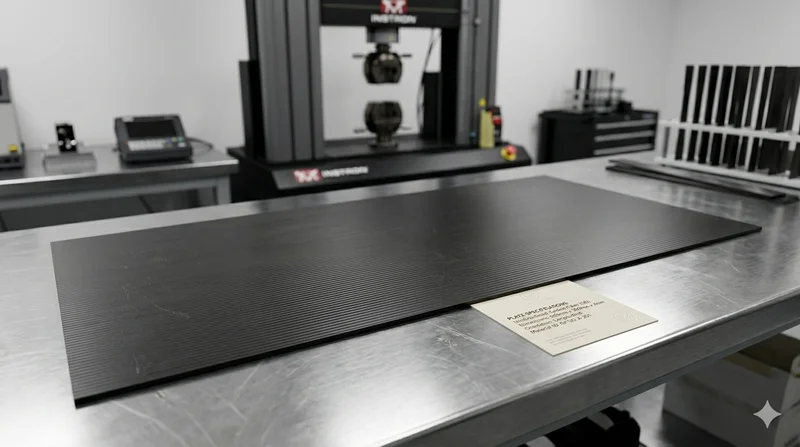
Carbon Fiber Plate — UD Unidirectional T700
Unidirectional carbon fiber plate with all fibers oriented in a single direction for maximum strength along the fiber axis. Essential for structural reinforcements, splints, and applications where load direction is predictable.
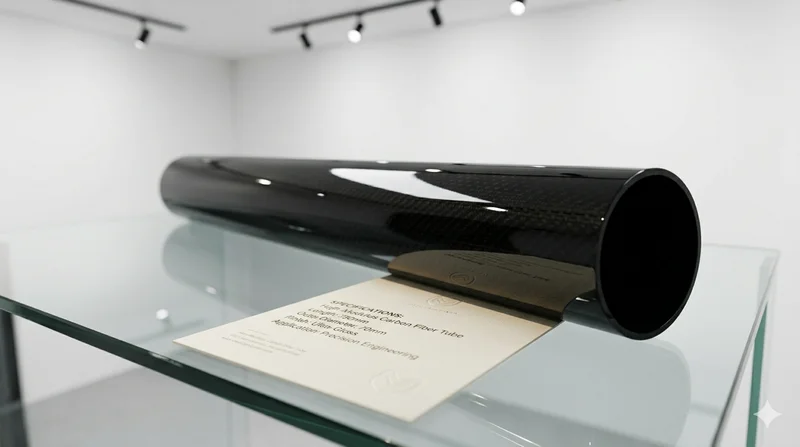
High Modulus Round Carbon Fiber Tube — M40
High modulus round tube manufactured with M40 grade fiber (tensile modulus 400 GPa). Designed for applications where maximum stiffness-to-weight ratio is critical, such as optical systems, precision machinery, and aerospace structures.
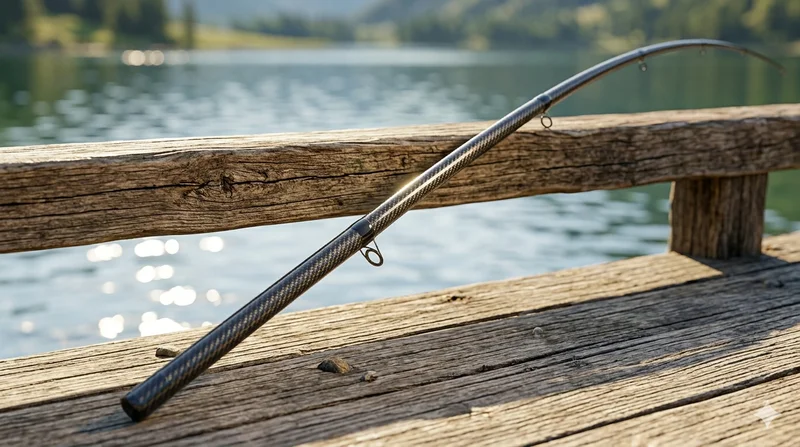
Carbon Fiber Fishing Rod Blank
High-quality carbon fiber fishing rod blank manufactured from multiple grades of Toray carbon fiber cloth. Available in a wide range of lengths, powers, and actions for freshwater and saltwater applications. Suitable for OEM rod building.