
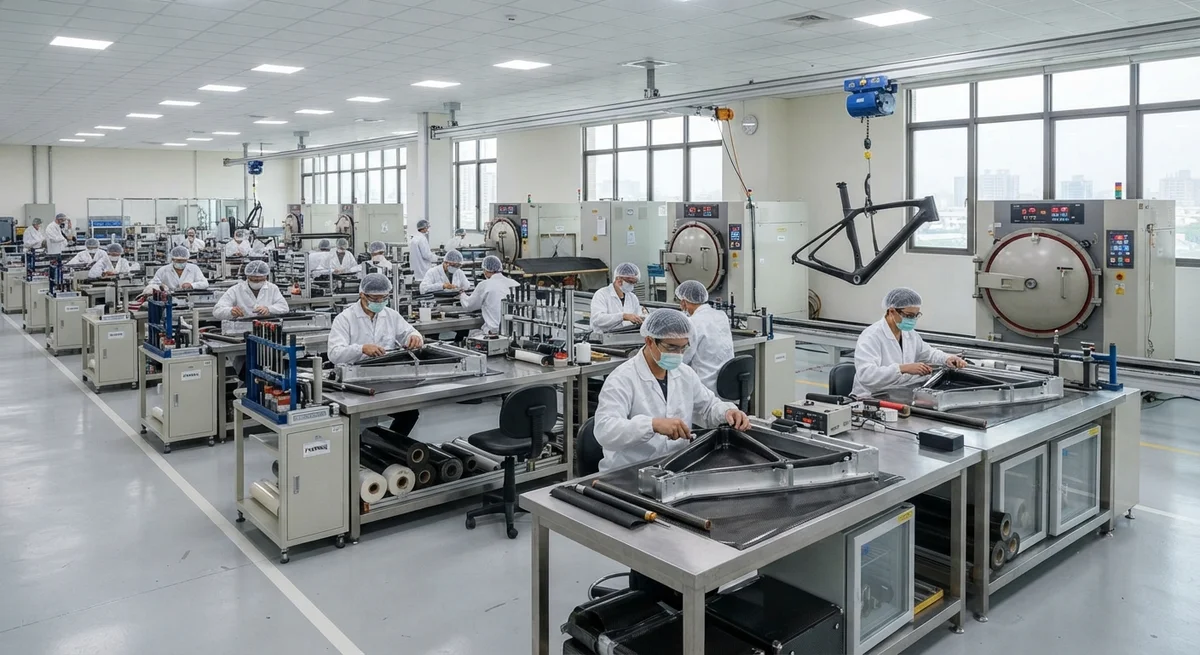
An in-depth analysis of Taiwan's vertically integrated carbon fiber sporting goods supply chain — from raw material sourcing and prepreg production to final assembly of bicycle frames, tennis rackets, golf shafts, and badminton equipment. Taiwan produces over 65% of the world's carbon fiber bicycle frames and 45% of premium tennis rackets, supported by a dense ecosystem of specialized manufacturers, R&D centers, and quality testing laboratories. This article examines the competitive advantages, manufacturing capabilities, and sourcing strategies for international brands working with Taiwanese partners.
Introduction: Taiwan's Dominance in Carbon Fiber Sporting Goods
Taiwan has established itself as the undisputed global manufacturing hub for carbon fiber sporting goods, a position built over four decades of sustained investment in composite materials technology, precision manufacturing, and supply chain integration. The island nation — with a population of just 23.5 million — produces approximately 65-70% of the world's carbon fiber bicycle frames, 45-50% of premium tennis rackets, 55-60% of carbon fiber golf shaft components, and 70-75% of high-end badminton rackets. The sporting goods composites sector contributes an estimated $4.2 billion annually to Taiwan's manufacturing economy, supporting over 60,000 direct jobs and an extensive network of specialized subcontractors, tooling shops, and materials suppliers.
Taiwan's competitive advantage is not simply one of labor cost — which has been gradually rising — but of an ecosystem density that has no parallel elsewhere in the world. Within a 50-kilometer radius of Taichung City, a buyer can visit carbon fiber prepreg manufacturers (including the world's largest independent prepreg producer, Swancor), frame and component mold makers, autoclave and oven fabricators, automated filament winding machine builders, paint and finishing specialists, and quality testing laboratories accredited to ISO 17025. This geographic concentration reduces development lead times, enables rapid prototyping iteration, and allows close technical collaboration between brand engineering teams and manufacturing partners. For international sporting goods brands — from Trek and Specialized in cycling to Wilson and Babolat in tennis, and Callaway and TaylorMade in golf — Taiwan represents not merely a sourcing destination but a strategic partnership ecosystem essential to their product development and manufacturing strategy.
The Vertically Integrated Supply Chain
Taiwan's carbon fiber sporting goods supply chain is structured across five distinct tiers, each with specialized capabilities and a deep knowledge base accumulated across decades of production experience. Understanding this structure is essential for B2B buyers sourcing carbon fiber sporting goods components or complete products from Taiwanese manufacturers.
| Supply Chain Tier | Typical Companies | Capabilities | Lead Time (weeks) | Typical Margin |
|---|---|---|---|---|
| Tier 1 — Raw Fiber / Prepreg | Swancor, Giant Global Group, Toho Tenax distributors | Carbon fiber prepreg production (woven, UD, multi-axial), resin formulation, slit tape manufacturing | 4–8 | 15–25% |
| Tier 2 — Mold & Tooling | Topkey, A-Tech, Chimei | Precision CNC mold machining (P20 steel, aluminum 7075), release coating, mold validation | 6–12 | 25–40% |
| Tier 3 — Forming & Curing | Giant (own frames), Topkey (OEM frames), Kunnan Lo (rackets), Fusitech (golf) | Prepreg layup (hand + automated), bladder molding, compression molding, autoclave curing, RTM | 2–6 | 20–30% |
| Tier 4 — Finishing & Assembly | Specialized finishing shops, paint lines | Surface preparation, primer + base + clear coat application, decal/logo application, final assembly | 1–3 | 10–20% |
| Tier 5 — Testing & QC | Sporting Goods Testing Lab (SGTL), BSCI, SGS Taiwan | ISO 4210 (bicycle), EN 13898 (racket), ASTM F1832 (golf shaft) fatigue/stress/impact testing | 1–3 | 5–10% (testing fee) |
The key advantage of Taiwan's ecosystem is that a brand can manage the entire product development cycle — from concept sketch and prepreg selection through mold fabrication, prototype layup, structural testing, and production ramp — within a single geographic region. This contrasts sharply with sourcing from multiple suppliers across different countries, where logistics, communication, and quality consistency become significant challenges. A typical carbon fiber bicycle frame development program in Taiwan follows a 16-28 week timeline: weeks 1-4 for design and FEA analysis, weeks 4-10 for mold and tooling fabrication, weeks 10-14 for prototype layup and initial testing, weeks 14-18 for structural certification testing (ISO 4210 fatigue and impact), and weeks 18-28 for production ramp-up and quality system validation.
Bicycle Frame Manufacturing: Precision at Scale
Taiwan's bicycle frame manufacturing capability is the crown jewel of its carbon fiber sporting goods industry. The country produces over 8 million carbon fiber bicycle frames annually, with the Taichung region alone accounting for 5.5-6 million frames per year. Major OEM manufacturers — including Topkey, A-Pro Tech, and Carbotec — operate state-of-the-art production facilities with annual capacities of 300,000-800,000 frames each. Giant Manufacturing, the world's largest bicycle manufacturer by revenue, operates its own carbon fiber frame production lines in Taichung (for its own brand) and also provides OEM services through its subsidiary, Giant Global Group.
The manufacturing process for a carbon fiber bicycle frame involves approximately 150-250 individual prepreg ply placements per frame, using unidirectional and woven carbon fiber prepregs with fiber areal weights ranging from 100 g/m² to 300 g/m². The layup schedule is frame-size specific — a size 56 cm road frame uses a different ply schedule from a size 52 cm frame, with additional reinforcement plies at the head tube, bottom bracket, and dropouts. After layup, the frame components (front triangle, rear stays, fork) are cured in silicone-bladder molding processes at 130-160°C and 8-12 bar internal pressure for 45-90 minutes, then bonded together using structural epoxy adhesives at 120-150°C for 20-40 minutes. The final frame weight for a mid-range road frame (1,200-1,400 g for the frame set) or a high-end model (750-950 g) depends on the fiber modulus (T700 standard, T800 high-modulus, or M30S/M40 ultra-high-modulus), the resin system, and the ply schedule optimization.
- Prepreg Material Selection: Mid-range frames use T700S (tensile modulus 230 GPa) with standard epoxy. Premium frames use T800 (294 GPa) or M40J (377 GPa) with toughened epoxy, increasing material cost by 35-60%.
- Bladder Molding Technology: Taiwan manufacturers have pioneered silicone-bladder molding with internal pressure control to ±0.5 bar, achieving void content below 0.8% and wall thickness tolerances of ±0.15 mm.
- Frame Certification: All production frames undergo ISO 4210-6 fatigue testing (100,000 cycles at ±300 N pedaling load, 50,000 cycles at ±400 N vertical load), CEN 14766 impact testing, and EFBe standard dropout fatigue testing.
- Paint and Finish: Taiwan's paint shops apply 4-6 coat systems (primer + 2-3 color coats + decals + 2K clear coat) with total film build of 80-150 μm, achieving gloss readings of 85-95 GU at 60°.
- Annual Model Cycles: The bicycle industry operates on 18-24 month product cycles, requiring Taiwanese OEMs to manage 30-60 active frame models simultaneously with new development programs starting every 3-4 months.
Tennis Racket and Golf Shaft Production
Beyond bicycle frames, Taiwan's expertise extends to tennis racket and golf shaft manufacturing. The tennis racket market — approximately 6-7 million units annually in the premium carbon fiber segment — is dominated by Taiwanese OEMs Kunnan Lo (formerly ProKennex, now the largest independent racket OEM globally) and Formosan Rubber Group. A premium tennis racket uses 60-80 prepreg plies of unidirectional and woven carbon fiber, laid up in a precisely engineered sequence around a polyurethane foam core or with a hollow frame construction using a silicone bladder. The racket is compression-molded at 150-170°C and 50-100 bar for 20-30 minutes, then undergoes drilling (16×19 or 18×20 string pattern), grommet insertion, paint, and quality testing per EN 13898 (impact resistance at 15 m/s and static bending to 1,500 N minimum). Typical OEM costs for a premium carbon fiber tennis racket frame range from $28-$55, with the brand adding 3-6× markup at retail.
Golf shaft manufacturing — Taiwan produces over 12 million carbon fiber golf shafts annually (55-60% of global supply) — uses a filament winding or roll-wrapping process. Parallel-wound prepreg sheets (6-12 plies per shaft) are rolled around a tapered steel mandrel, wrapped with shrink tape, and cured at 150-170°C. After curing, the mandrel is extracted, the shaft is tip-trimmed and butt-trimmed to length, and the flex profile is verified on a frequency analyzer. Golf shaft specs are defined by flex (L, A, R, S, X), weight (50-130 g), torque (1.5-6.0°), and kick point position (low, mid, high). Taiwan's shaft OEMs — including Fusitech, Graphite Leader, and J Glass Technology — supply major brands with price points ranging from $8-$18 per shaft (OEM cost) for standard models to $22-$45 for premium multi-material shafts incorporating boron fiber or titanium wire reinforcements.
Quality Control and Certification Ecosystem
| Sport Category | Governing Standard | Key Tests | Taiwan Testing Labs | Pass Criteria |
|---|---|---|---|---|
| Bicycle Frames | ISO 4210-6 / CEN 14766 | Pedaling fatigue (100k cycles), vertical fatigue (50k cycles), impact, drop weight | SGTL, BSCI, SGS Taiwan | No visible crack or failure after test cycle |
| Tennis Rackets | EN 13898 / ITF Approved | Impact resistance @ 15 m/s, static bending to 1,500 N, head deflection | SGTL, SGS Taiwan | No fracture, permanent bend <3 mm |
| Golf Shafts | ASTM F1832 / R&A / USGA | Torsional test, flexural stiffness, frequency analysis (0.25 cpm tolerance) | SGTL, Intertek Taiwan | Frequency within ±2 cpm of spec, torque within ±0.3° |
| Badminton Rackets | BWF Approved | Head deflection under 100 N, frame stiffness, string tension retention | SGTL, ITRI | Deflection <15 mm at 100 N load |
B2B Sourcing Strategy for International Brands
For international brands seeking to source carbon fiber sporting goods from Taiwan, a structured engagement approach maximizes the benefits of this ecosystem. First, MOQ (minimum order quantity) expectations vary by product category: bicycle frame MOQs range from 300-1,000 units per model per year for standard OEM, 1,000-3,000 for custom geometry, and 50-200 for premium boutique runs. Tennis racket MOQs are 500-2,000 units per model, while golf shaft MOQs range from 3,000-10,000 shafts per spec. Second, the development cost structure includes mold tooling ($15,000-$60,000 for a bicycle frame mold set, $8,000-$25,000 for a tennis racket mold), NRE (non-recurring engineering) fees for layup schedule development and testing ($5,000-$20,000 per model), and certification testing ($3,000-$8,000 per model). Third, intellectual property protection is managed through bilateral NDA agreements, exclusive mold ownership (tools remain the brand's property), and in some cases, dedicated production lines or exclusive capacity agreements with OEM partners. Taiwan's legal framework provides strong IP protection for registered patents and design rights, with the Intellectual Property Court (established 2008) providing specialized adjudication for composite manufacturing IP disputes.
Frequently Asked Questions
Why is Taiwan the dominant location for carbon fiber sporting goods manufacturing?
Taiwan's dominance stems from four interrelated factors: (1) a four-decade head start in composite manufacturing, originally seeded by technology transfer from US aerospace companies in the 1980s; (2) an unmatched density of the supply chain within a 50 km radius of Taichung, including prepreg makers, mold shops, layup houses, paint lines, and testing labs; (3) a skilled workforce trained through vocational programs and on-the-job experience — the average carbon fiber layup technician in Taiwan has 8-15 years of experience; and (4) a business culture of long-term partnership and continuous improvement (similar to Japanese keiretsu but more flexible). No other region — including China, Vietnam, or Eastern Europe — has yet replicated this ecosystem density.
What are the minimum order quantities (MOQs) for Taiwanese OEM production?
MOQs vary by product: bicycle frames — 300-1,000 units/model/year (standard OEM), 50-200 for boutique/premium; tennis rackets — 500-2,000 units/model; golf shafts — 3,000-10,000 shafts/spec; badminton rackets — 1,000-3,000 units/model. Lower MOQs are possible with higher per-unit pricing and NRE fees. Many Taiwanese OEMs also operate a "development partnership" model where smaller brands can start with 100-300 units at prototype pricing before committing to full production volume.
How does the cost of Taiwanese manufacturing compare to Chinese or Vietnamese alternatives?
Taiwanese OEM pricing is typically 15-35% higher than equivalent Chinese manufacturing and 25-45% higher than Vietnamese. However, the higher cost is offset by: (1) lower defect rates (Taiwan 1.5-3.0% vs China 4-8% vs Vietnam 5-10% for first-pass yield); (2) faster development cycles (16-28 weeks Taiwan vs 22-40 weeks China); (3) better IP protection; (4) superior surface finish and paint quality; and (5) the ability to handle complex multi-material constructions (carbon + titanium, carbon + boron hybrid layups) that are difficult to source elsewhere.
What certifications should a Taiwanese carbon fiber sporting goods supplier hold?
Key certifications include: ISO 9001:2015 (quality management) — virtually all OEMs hold this; ISO 14001 (environmental management) for larger manufacturers; BSCI or SA8000 (social compliance) for European brand sourcing; specific product certifications per the table above (ISO 4210, EN 13898, ASTM F1832); and factory-specific certifications such as Global Recycled Standard (GRS) for brands requiring sustainable materials sourcing. Taiwan's Sporting Goods Testing Laboratory (SGTL) in Taichung is ISO 17025 accredited and recognized by CEN, ISO, and ASTM for certification testing.
Part of topic
Related Articles
- Recycled Carbon Fiber Market Forecast 2030: Technology Maturity and Commercialization Path
- South Korea Carbon Fiber Market 2026: Hydrogen Economy and Shipbuilding Innovation
- Wind Turbine Blade Leading Edge Protection 2026: Polyurethane, Tape, and Metallic Shield Solutions
- China Carbon Fiber Overcapacity 2026: Price War Impact and Industry Consolidation
- India Carbon Fiber Market 2026: Wind Energy, Aerospace, and Defense Expansion
- PAN Precursor Market 2026: Acrylonitrile Supply and Carbon Fiber Cost Structure
Interested in Our Products?
Contact our team for competitive pricing and technical specifications.
Get a QuoteRelated Products
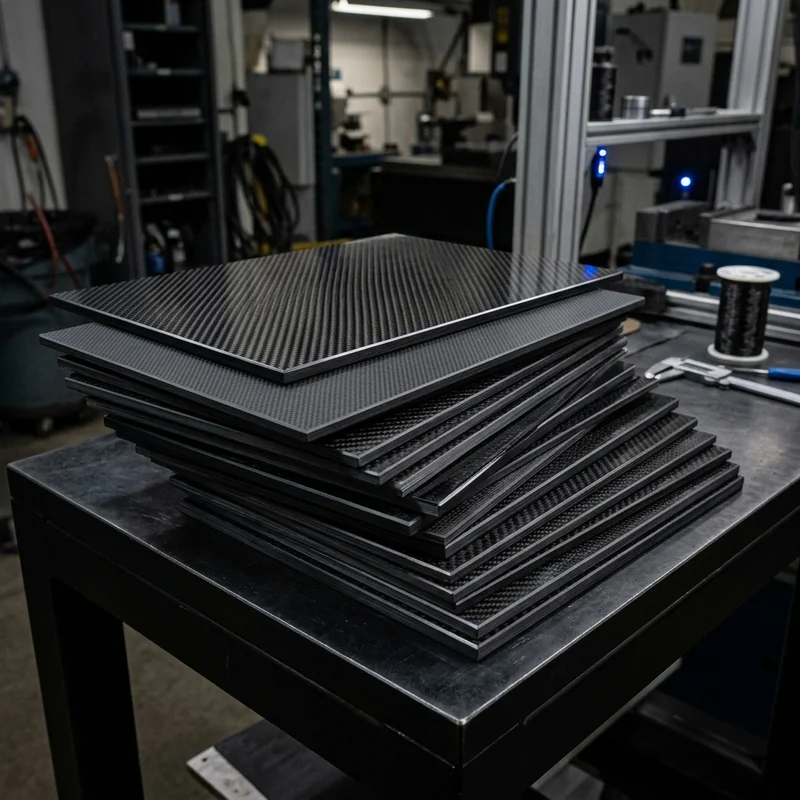
Carbon fiber standard plate-3k stripe
Lightweight, ultra-rigid standard sheets for drone fuselages, robot housings, facades and structural applications.

Carbon Fiber Plate — 3K Twill T700 1.5mm
Thin 1.5mm carbon fiber plate with 3K twill weave surface. Lightweight and stiff, commonly used for covers, panels, drone bodies, and applications requiring a premium aesthetic appearance.

Square Carbon Fiber Tube — 3K Twill T700
Square cross-section carbon fiber tube manufactured with 3K twill weave for torsional strength. Preferred for structural frames, trusses, and support columns where rectangular geometry offers design flexibility.

Carbon Fiber Plate — 3K Twill T700 3.0mm
Medium-thickness 3.0mm carbon fiber plate offering significantly higher load capacity while maintaining attractive 3K twill finish. Suitable for structural brackets, reinforcement plates, and load-bearing panels.
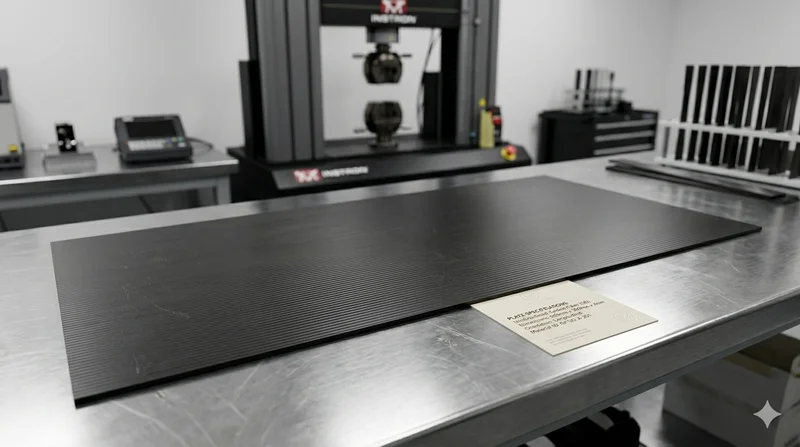
Carbon Fiber Plate — UD Unidirectional T700
Unidirectional carbon fiber plate with all fibers oriented in a single direction for maximum strength along the fiber axis. Essential for structural reinforcements, splints, and applications where load direction is predictable.