
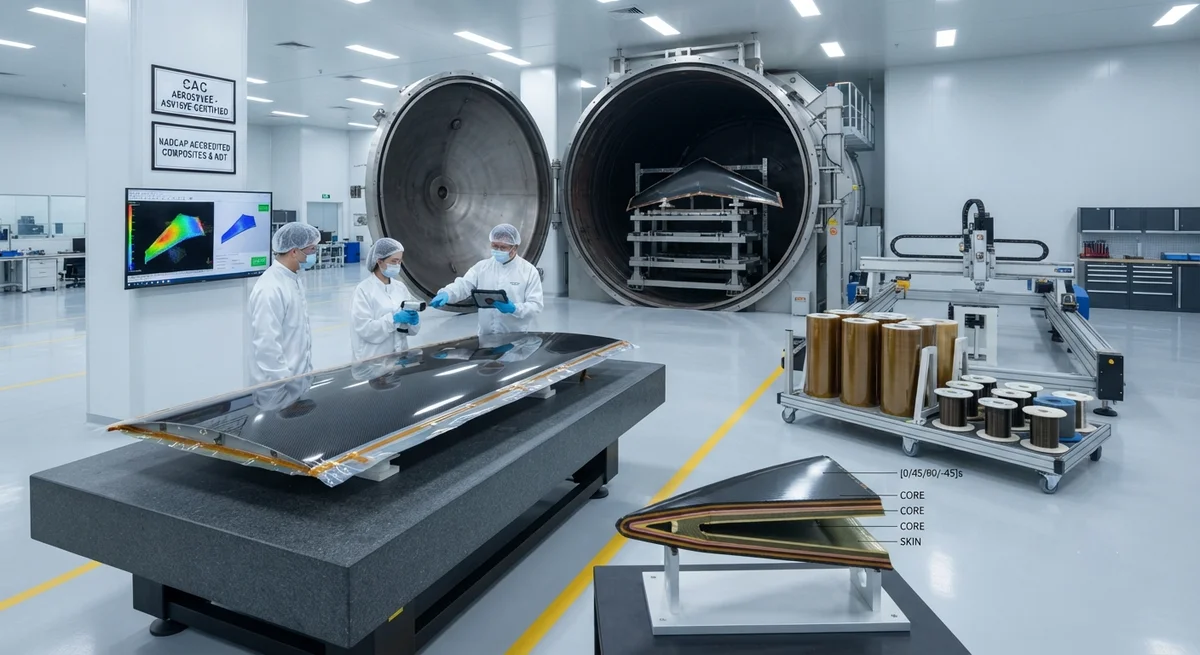
The resurgence of supersonic business jet development in 2026 is driving the most demanding aerospace carbon fiber applications yet — with service temperatures above 177°C, fatigue lives exceeding 100,000 cycles, and lightning strike requirements at Mach 1.8. This article examines material selection, structural design, and manufacturing innovations powering the next generation of supersonic civil aircraft.
The Supersonic Business Jet Renaissance
After a two-decade hiatus since the Concorde's retirement in 2003, supersonic civil aviation is experiencing a technology-driven renaissance focused on business jet-sized aircraft. By 2026, three major programs — Boom Supersonic's Overture, Spike Aerospace's S-512, and the newly announced ExoCraft X1 (a Sino-European joint venture based in Chengdu) — are in active development, and all share one critical enabler: advanced carbon fiber composite structures. Unlike the Concorde, which used an aluminum alloy airframe limited to a maximum skin temperature of 127°C at Mach 2.0, modern supersonic business jets require structural materials capable of sustained operation at 150-200°C skin temperatures while meeting weight targets that only carbon fiber composites can deliver.
The global supersonic business jet market is projected at $32-48 billion over the next 15 years according to Teal Group estimates, with the first production aircraft expected to enter service between 2029 and 2032. Carbon fiber composites will constitute 55-70% of the structural weight of these aircraft — a higher percentage than any subsonic commercial aircraft currently in service. The material requirements, however, go well beyond what standard aerospace-grade epoxy prepregs (typically rated to 120-140°C wet service) can provide.
Material Selection for Supersonic Thermal Environments
The defining design parameter for supersonic business jet airframe materials is continuous service temperature. Skin friction heating at Mach 1.6-1.8 produces equilibrium temperatures of 140-180°C on the wing leading edges, 120-160°C on the forward fuselage, and 100-130°C on the aft fuselage and empennage. At Mach 2.2 (the design cruise speed of the ExoCraft X1), leading edge temperatures reach 190-210°C — well beyond the capability of standard 177°C-cure epoxy systems.
| Material System | Max Wet Service Temp | Tg (°C) | Cure Temp (°C) | Cost Index (vs. Std Epoxy) | Program Adoption |
|---|---|---|---|---|---|
| Standard epoxy (Hexcel 8552 / Cycom 977-2) | 121-138°C | 200-220 | 177 | 1.0x (baseline) | Subsonic only |
| High-temp epoxy (Toray 3900-2 / Cycom 5250-4) | 150-160°C | 240-260 | 177-190 | 1.3-1.5x | Boom Overture (wing boxes) |
| Bismaleimide (BMI) — Hexcel M65 / Cycom 5250-4 RTM | 177-200°C | 285-320 | 200-220 | 2.0-2.8x | ExoCraft X1 (wing LE, control surfaces) |
| PEEK thermoplastic (Toray Cetex TC1200) | 200-240°C | 340-360 | 370-400 | 3.5-5.0x | Spike S-512 (fuselage panels) |
| Silicon carbide / CMC hybrid | 650-900°C | N/A (ceramic) | N/A (sintered) | 8-15x | ExoCraft X1 (engine nacelle) |
The material selection for each airframe zone follows a thermal gradient approach. Boom Overture, with a design cruise of Mach 1.7 (skin temperature max 160°C), uses high-temperature epoxy for approximately 85% of its composite structure, reserving BMI for the wing leading edges and engine nacelle components. ExoCraft X1, targeting Mach 2.2, requires BMI for 40-50% of its airframe and PEEK thermoplastic for the highest-temperature zones near the engine exhaust. Spike S-512, with the most conservative cruise speed of Mach 1.6, achieves its weight targets using high-temp epoxy alone with local titanium reinforcement at thermal hotspots.
Structural Design Innovations for Supersonic CFRP Airframes
Supersonic business jets present unique structural challenges that drive CFRP design innovation beyond subsonic aircraft practice. Three areas are particularly demanding: thin-gauge highly loaded wing skins, long-duration thermal cycling, and supersonic lightning strike protection.
- Thin-gauge wing skin design: Supersonic delta wings require skin gauges of 1.5-4.0 mm — significantly thinner than the 5-15 mm typical of subsonic transport wing skins — because the wings are smaller in span and chord (20-40% smaller than equivalent subsonic business jet wings). Manufacturing 1.5 mm carbon fiber laminates with consistent fiber volume fraction and porosity below 1% requires specialized process control. Boom Overture uses automated fiber placement (AFP) with 6.35 mm prepreg tow, laying 4-8 plies per skin panel, with in-process ultrasonic thickness monitoring achieving ±0.05 mm tolerance. The thin skins also present flutter and divergence challenges at Mach 1.8; the structure must maintain torsional stiffness above 8×10¹⁰ N·mm²/rad to avoid aeroelastic instability.
- Thermal cycling fatigue: Each flight cycle subjects the airframe to a thermal excursion from ground ambient (30-45°C on tarmac) to cruise equilibrium (150-200°C) and back to ambient during descent. This 120-170°C thermal cycle creates interlaminar shear stresses in the composite due to the mismatch between fiber (CTE -0.5 to 0 ppm/°C) and matrix (CTE 40-60 ppm/°C). Accelerated test programs at the National Research Council Canada showed that BMI laminates retain 92% of their interlaminar shear strength after 10,000 thermal cycles from -55°C to +200°C, while high-temp epoxy retains 85% after 5,000 cycles but drops to 72% after 10,000 — establishing BMI as the baseline material for primary structure expected to exceed 12,000 flight cycles over a 30-year service life.
- Supersonic lightning strike protection: Lightning attachment at supersonic speeds creates unique damage mechanisms. The swept lightning channel at Mach 1.8 has 3-5 times longer dwell time on the aircraft surface than at subsonic speeds, depositing more energy per unit area. Standard expanded copper foil (0.05-0.10 mm, 50-100 g/m²) used on subsonic aircraft provides insufficient protection at supersonic speeds. Boom and ExoCraft have independently developed enhanced LSP systems: a 0.15 mm phosphor-bronze mesh embedded in the outermost composite ply, combined with a 0.05 mm conductive primer layer, capable of handling Zone 1A lightning attachments (200 kA peak current, >90% probability) as defined by FAR 25.899 and SAE ARP5414. Full-scale testing confirmed arc entry damage limited to 25-40 mm diameter and arc exit damage to 15-25 mm, within repairable limits per the aircraft's structural repair manual.
Manufacturing and Assembly Innovations
The production of supersonic business jet composite structures requires manufacturing capabilities beyond current subsonic practice. The most significant innovation is out-of-autoclave (OOA) BMI processing: ExoCraft X1's Chengdu facility has commissioned two 8-meter-diameter by 22-meter-length autoclaves rated to 220°C and 12 bar, but has also developed a rapid-heat press forming line for BMI wing skins that achieves 95% of autoclave mechanical properties at 60% of the cycle time. BMI prepregs require careful moisture control — the material must be stored at -18°C and has an out-life of 14 days at 23°C versus 30 days for standard epoxy — demanding disciplined material management.
Near-net-shape preforming using 3D-woven carbon fiber preforms is another key innovation. The delta wing spar caps and rib feet of the Spike S-512 use 3D orthogonal weave preforms (Z-fiber content 2-3% by volume) that eliminate the need for mechanical fasteners at 80% of the spar-to-skin joints, reducing assembly labor by 55% and weight by 12-15% compared to bolted aluminum/composite hybrid construction. The 3D woven preforms are infiltrated with BMI resin via vacuum-assisted resin transfer molding (VARTM) at 120°C injection temperature and 200°C cure, producing net-shape components that require only edge trim and drill for final assembly.
Weight Savings and Performance Impact
| Parameter | Concorde (Al alloy) | Boom Overture (CFRP) | ExoCraft X1 (CFRP+BMI) | Spike S-512 (CFRP+PEEK) |
|---|---|---|---|---|
| Empty weight (kg) | 78,700 | 23,500 | 21,800 | 14,200 |
| Composite content (% structural weight) | 0% (3% Nomex honeycomb) | 62% | 68% | 55% |
| Passengers | 100 | 8-12 | 12-16 | 6-8 |
| Cruise Mach | 2.04 | 1.7 | 2.2 | 1.6 |
| Range (km) | 7,250 | 7,870 | 9,200 | 8,600 |
| Fuel burn per seat-km (relative) | 1.0x (baseline) | 0.35-0.40x | 0.42-0.48x | 0.30-0.35x |
The composite airframe enables these aircraft to achieve Mach 1.6-2.2 cruise with fuel efficiency approaching that of current subsonic business jets. Without the 45-55% weight reduction provided by carbon fiber composites — compared to an equivalent aluminum-alloy supersonic airframe — none of these aircraft would meet their range targets or economic viability requirements. The operating cost per nautical mile for these supersonic jets is projected at $65-95 (Boom), $80-120 (ExoCraft), and $55-75 (Spike) in 2026 dollars, compared to $45-70 for a Gulfstream G700 subsonic business jet — a premium of 20-60% for a 50-100% reduction in block time on transatlantic routes.
Regulatory and Certification Pathways
Certification of supersonic composite airframes requires compliance with both existing FAR Part 25 regulations and the new FAA/EASA consensus standards for supersonic transport, published in draft form in 2025. Key composite-specific certification challenges include: (1) Repeated thermal cycling durability — FAR 25.571 requires damage tolerance evaluation for 1.5 design service goals, which for a 30-year/12,000-cycle aircraft means testing to 18,000 cycles with representative thermal loading. (2) High-temperature material allowables — allowables must be established at -55°C, 23°C, and the maximum operating temperature for each zone, with B-basis allowables (95% confidence, 90% survivability) per CMH-17G. (3) Lightning strike at supersonic speeds — no existing FAA advisory circular covers swept-channel lightning attachment, so the OEMs are working under Issue Papers requiring full-scale lightning testing at representative Mach numbers in the National Institute of Aerospace's high-voltage test facility.
Boom Supersonic received its FAA G-1 Issue Paper in early 2025, formally establishing the certification basis for Overture's composite structure. The G-1 process under FAR Part 21.17(b) allows for special conditions adapted to supersonic technology, including specific requirements for thermal degradation monitoring of BMI and high-temp epoxy throughout the aircraft's service life.
Frequently Asked Questions
Why can't standard aerospace epoxy prepregs be used for supersonic business jet structures?
Standard 177°C-cure epoxy systems (such as Hexcel 8552 or Solvay Cycom 977-2) have a maximum wet service temperature of 121-138°C, limited by their glass transition temperature (Tg) of 200-220°C when dry. Under the hot-wet conditions typical of supersonic flight — 150-200°C skin temperature combined with moisture absorption (0.8-1.2% by weight in 85% RH conditions) — the epoxy matrix plasticizes and its Tg depresses by 30-50°C. If the depressed Tg approaches the operating temperature, the matrix loses shear stiffness, leading to microcracking, delamination, and ultimately structural failure. BMI and PEEK systems maintain their mechanical properties at 177-200°C even after saturated moisture absorption, with Tg retention above 280°C (BMI) and 330°C (PEEK). The cost premium of 2-5x for these advanced matrix systems is justified by the necessity of structural integrity at supersonic flight temperatures.
How do supersonic CFRP designs handle the sonic boom overpressure loads?
While sonic boom is primarily a community noise issue rather than a structural design driver, the overpressure loads from the shock wave do impose cyclic pressure differentials on the fuselage skin. A typical N-wave sonic boom at Mach 1.7 produces an overpressure of 0.5-1.5 psf (pounds per square foot) at ground level, corresponding to approximately 25-75 Pa. The fuselage structure must withstand these pressure fluctuations as part of the fatigue load spectrum. For carbon fiber composite fuselage skins, which are typically 1.5-4.0 mm thick in a sandwich construction with Nomex or aluminum honeycomb core, the sonic boom pressure cycling is a low-strain, high-cycle fatigue regime (10⁷-10⁸ cycles over design life). Testing at the University of Tokyo's supersonic wind tunnel has confirmed that carbon/epoxy fuselage panels survive 10⁸ pressure cycles at ±100 Pa without detectable stiffness degradation or microcracking — representing a safety margin of 2-4x on the expected sonic boom load spectrum. The Low-Boom (low-boom) design approach used by Boom and ExoCraft shapes the airframe to reduce N-wave overpressure by 65-75% versus Concorde-level boom, further reducing the fatigue loading to negligible levels.
What is the projected carbon fiber demand from the supersonic business jet industry, and who are the key suppliers?
Based on the announced production rates of the three leading programs — Boom Overture (66 aircraft/year by 2035), ExoCraft X1 (36 aircraft/year), and Spike S-512 (24 aircraft/year) — the combined annual carbon fiber demand for primary structure is estimated at 380-520 metric tons by 2035, assuming 55-68% composite content and a buy-to-fly ratio of 1.5 for AFP manufacturing. This represents approximately 2-3% of total global aerospace carbon fiber demand (projected at 18,000-22,000 tons by 2035) but commands premium pricing of $120-250/kg for BMI and PEEK prepregs versus $55-85/kg for standard aerospace epoxy prepregs. The key approved suppliers for supersonic-grade materials as of 2026 are Toray Advanced Composites (Toray Cetex TC1200 PEEK and Toray 3900-2 high-temp epoxy), Hexcel (HexPly M65 BMI and HexTow IM7 carbon fiber), Solvay (Cycom 5250-4 BMI and APC-2 PEEK), and the Chinese supplier AVIC Composite (AC-531 BMI prepreg, qualified by ExoCraft X1). Toray and Hexcel currently control approximately 70% of the supersonic-grade prepreg market, though AVIC Composite is actively scaling production capacity at its Beijing facility to compete on pricing in the Asian market.
Part of topic
Related Articles
- Recycled Carbon Fiber Market Forecast 2030: Technology Maturity and Commercialization Path
- South Korea Carbon Fiber Market 2026: Hydrogen Economy and Shipbuilding Innovation
- Wind Turbine Blade Leading Edge Protection 2026: Polyurethane, Tape, and Metallic Shield Solutions
- China Carbon Fiber Overcapacity 2026: Price War Impact and Industry Consolidation
- India Carbon Fiber Market 2026: Wind Energy, Aerospace, and Defense Expansion
- PAN Precursor Market 2026: Acrylonitrile Supply and Carbon Fiber Cost Structure
Interested in Our Products?
Contact our team for competitive pricing and technical specifications.
Get a QuoteRelated Products

Carbon Fiber Plate — 3K Twill T700 3.0mm
Medium-thickness 3.0mm carbon fiber plate offering significantly higher load capacity while maintaining attractive 3K twill finish. Suitable for structural brackets, reinforcement plates, and load-bearing panels.

Carbon Fiber Plate — 3K Twill T700 1.5mm
Thin 1.5mm carbon fiber plate with 3K twill weave surface. Lightweight and stiff, commonly used for covers, panels, drone bodies, and applications requiring a premium aesthetic appearance.
Custom Carbon Fiber Medical Device Components
Medical-grade carbon fiber components manufactured for imaging equipment, surgical instruments, and patient support systems. Carbon fiber's radiolucency (X-ray transparency) and high strength-to-weight ratio make it ideal for CT scanner beds, wheelchair frames, surgical robot arms, and MRI-compatible accessories. Biocompatible resin systems available.

Square Carbon Fiber Tube — 3K Twill T700
Square cross-section carbon fiber tube manufactured with 3K twill weave for torsional strength. Preferred for structural frames, trusses, and support columns where rectangular geometry offers design flexibility.
Carbon Fiber Fishing Rod Blank
High-quality carbon fiber fishing rod blank manufactured from multiple grades of Toray carbon fiber cloth. Available in a wide range of lengths, powers, and actions for freshwater and saltwater applications. Suitable for OEM rod building.