
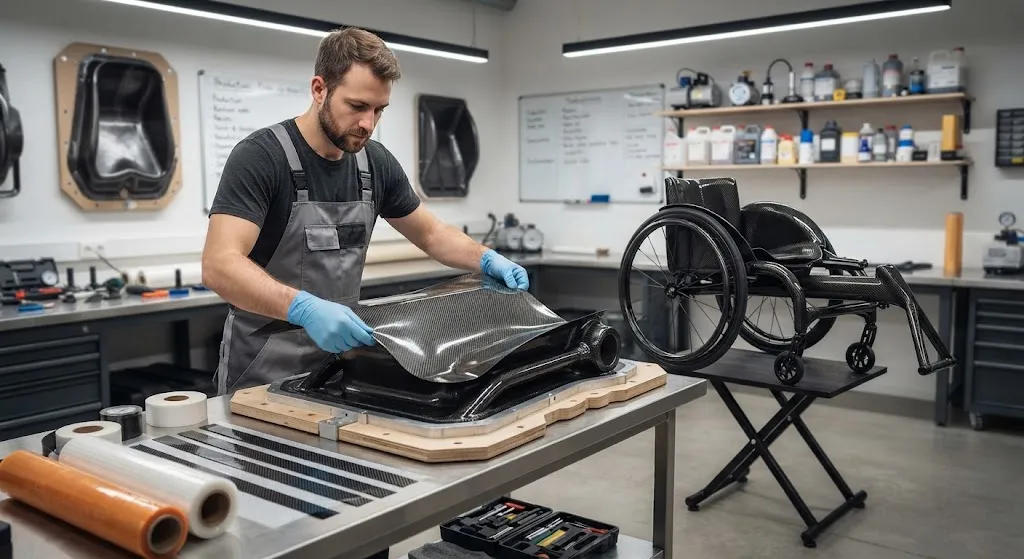
Carbon fiber racing wheelchairs sit at the sharp end of adaptive sports engineering. A Paralympic racing chair must be light enough to accelerate hard, stiff enough to transfer every push of the arm through the wheels, and tailored to the exact body geometry of a single athlete. No stan
Introduction
Carbon fiber racing wheelchairs sit at the sharp end of adaptive sports engineering. A Paralympic racing chair must be light enough to accelerate hard, stiff enough to transfer every push of the arm through the wheels, and tailored to the exact body geometry of a single athlete. No standard production frame can deliver all three, which is why the world's fastest racing chairs are custom laminated carbon fiber frames built around individual measurements — shoulder height, arm span, hip position and preferred camber.
For athletes, coaches and sports equipment buyers, understanding how these frames are engineered matters at every stage: specifying materials, reviewing a quote, or deciding whether a frame change justifies the cost. This article covers the material selection logic, the geometry that defines racing performance, the custom lamination process, realistic weight and stiffness targets, and the rules constraints that racing wheelchair design must respect.
Why High-Modulus Carbon Fiber Wins
Racing wheelchair frames are load-bearing structures with a punishing power-to-weight ratio. A racing push delivers forces through the hand rim into a frame that weighs only a few kilograms, and every excess gram of frame mass must be accelerated and decelerated thousands of times per race. Four material properties decide the frame material:
- Specific stiffness: High-modulus (HM) carbon fiber offers a modulus-to-density ratio roughly three to five times that of aluminum, meaning a frame can be dramatically lighter for the same stiffness, or dramatically stiffer for the same weight.
- Fatigue resistance: Racing frames absorb millions of push cycles; carbon fiber's fatigue endurance under repeated bending loads outperforms welded aluminum joints, where weld toes are classic crack initiation sites.
- Damping: The viscoelastic carbon fiber matrix system absorbs vibration, keeping the ride controllable at racing speeds where stiff metal frames transmit chatter through the athlete's upper body.
- Layup tunability: The frame builder can orient fibers along the main beam, around the rear axle mounts and through the cambered side frames, placing stiffness exactly where the load path demands it.
Intermediate modulus fibers such as T800-class fibers are the workhorse choice for racing frames: they combine a tensile modulus around 294 GPa with enough strain to failure to survive impact loads from collisions and curbs. Ultra-high-modulus fibers offer even higher stiffness but become brittle, and a frame that cannot absorb a crash without fracture is a safety risk, not a performance gain.
Racing Geometry: Camber, Wheelbase and Seat Position
Every racing wheelchair is a compromise between aerodynamics, stability and propulsion efficiency, and the carbon fiber frame makes those compromises possible by being rigid enough to hold aggressive angles without flexing:
- Camber: The rear wheels are tilted inward, typically 18-24 degrees from vertical. Camber widens the wheelbase at the ground for lateral stability, protects the athlete's hands from knuckle contact, and steers the chair naturally straight.
- Wheelbase and seat height: A long wheelbase improves tracking at speed but slows turns; seat height sets the athlete's center of gravity and their reach to the wheel rim. Both are set from anthropometric measurements rather than from a size chart.
- Seat bucket geometry: The seat pan and backrest angle are laminated as part of the frame, transferring power from the hips and trunk into the push stroke without the energy loss of a flexible seat.
- Front wheel offset: The small front fork and steering wheel position affects weight distribution and steering feel, typically tuned so that 25-35% of the combined athlete-chair weight rests on the front wheel.
Because these angles are baked into the mold and lamination tooling, changing them requires a new frame — another reason top teams commission ultra-light carbon fiber frames rather than adjustable metal ones: every adjustability mechanism adds grams and compliance.
The Custom Lamination Process
Building a custom racing frame is a two-stage process that combines measurement, modeling and hand layup. The table below summarizes the typical workflow:
| Stage | Activity | Typical Duration |
|---|---|---|
| 1. Athlete measurement | Anthropometric scan, push biomechanics review, seat position trials | Half day |
| 2. Frame design | Geometry definition, finite element check of beam and axle loads | 3-5 days |
| 3. Tooling and layup | Mold fabrication, prepreg cutting, hand or automated layup of the laminated tub | 3-7 days |
| 4. Cure and assembly | Vacuum bag cure, axle housing bonding, wheel and hand rim fit-up | 2-4 days |
| 5. Tuning | Ride testing, camber and seat adjustment, ballast for class weight rules | 1-2 days |
Modern frames are often built as a one-piece laminated tub — the main beam, seat bucket and side frames cured in a single cycle — rather than joined tubes. Prepregs of T800-class fiber in epoxy are laid into the mold with local reinforcement patches around the rear axle housings and the front steering tube, where loads are highest. Cure at 120-130 °C in a vacuum bag produces a void-free laminate, after which metal axle housings and brake mounts are bonded in place with structural adhesive.
Weight, Stiffness and Price Targets
Athletes and buyers comparing frame options should evaluate carbon fiber racing frames against realistic numbers. Typical values across the market:
| Frame Type | Frame Mass | Relative Stiffness | Typical Price Range |
|---|---|---|---|
| Standard aluminum racing frame | 3.5-5.0 kg | Baseline | $1,500-2,500 |
| Titanium custom frame | 3.0-4.0 kg | 1.0-1.2x | $2,500-4,500 |
| Carbon fiber production frame | 2.5-3.5 kg | 1.2-1.5x | $3,000-5,000 |
| Carbon fiber custom race frame | 1.6-2.6 kg | 1.5-2.0x | $4,500-8,000 |
Reducing frame mass from 3.5 kg to 2.0 kg — roughly a 1.5 kg saving — has a meaningful but bounded effect on race performance: the frame is only a fraction of the athlete-plus-chair system mass, so acceleration gains are measured in fractions of a percent. The bigger gains from carbon lamination come from stiffness and geometry: a stiffer frame wastes less of each push in frame flex, and custom geometry improves the biomechanics of every stroke. Buyers should treat the carbon premium as a purchase of stiffness, geometry and crash survivability, with the weight saving as a valuable bonus.
Rules and Classification Constraints
Racing wheelchair design operates inside a rulebook that shapes every engineering choice. Competition rules for wheelchair racing specify maximum dimensions, minimum wheel size and minimum frame mass in many classes, preventing an engineering arms race that would price athletes out of the sport. Two implications follow for carbon fiber design:
- Ballast is normal: Frames that come in under the class minimum mass are raced with fixed ballast positioned low and central, so a lighter carbon frame does not automatically mean a faster legal chair — but it gives the team freedom to place ballast where it improves handling.
- Crashworthiness is a design input: Because frames occasionally strike barriers and each other, builders over-design the axle housings and front fork beyond pure stiffness requirements, accepting a small weight penalty for fracture resistance.
Teams commissioning frames should confirm the current class rules before locking geometry, because rule changes — particularly minimum mass and wheel diameter limits — directly affect the optimal frame design.
Frequently Asked Questions
How much lighter is a carbon fiber racing wheelchair than an aluminum one?
Complete racing wheelchairs span roughly 4-9 kg depending on class and component specification. A custom laminated carbon fiber frame typically weighs 1.6-2.6 kg, compared with 3.5-5.0 kg for a standard aluminum frame — a saving of 1.5-2.5 kg before wheels and components are fitted. Because wheels, tires and hand rims dominate the remaining mass, the frame saving is proportionally larger than it first appears, and it is achieved together with higher stiffness.
Why don't all racing wheelchairs use carbon fiber?
Cost is the main barrier: a custom carbon frame costs two to three times a standard aluminum one, and the frame must be re-commissioned whenever the athlete's measurements or seat position change significantly. Aluminum and titanium frames remain popular for training chairs, development athletes and multi-user club fleets, where durability, adjustability and budget matter more than ultimate stiffness. Carbon fiber dominates at competition level, where custom geometry and stiffness transfer directly into race results.
How long does a custom racing frame take to build?
From athlete measurement to a ride-ready chair, a custom laminated frame typically takes three to five weeks. Measurement and design occupy the first week, tooling preparation and hand layup the second and third, and cure, assembly and tuning the final one to two weeks. Teams racing an international season typically order frames three to six months before their first major event to allow for tuning and spare-frame backup.
Can a carbon fiber racing frame be repaired?
Yes, and this is a major advantage over metal frames. A cracked aluminum weld usually ends the frame's life, while a carbon fiber laminate with a delamination or local damage can often be ground, patched with matched prepreg and re-cured to restore most of the original strength. Top teams carry repair kits, and manufacturers of custom frames typically offer re-lamination services for their own products. Severe impact damage to the axle housings or steering tube may still require frame replacement.
Conclusion
Carbon fiber racing wheelchairs convert material science and fabrication craft into measured race performance. High-modulus fiber selection, rigid custom geometry and one-piece laminated construction deliver frames that weigh as little as 1.6 kg while resisting millions of push cycles and surviving race-day impacts. The premium over metal frames buys stiffness, tunable geometry and repairability that aluminum and titanium simply cannot match — and for athletes competing at the highest level, those are exactly the properties that decide between silver and gold.
YongXian supplies high-modulus carbon fiber fabrics, prepregs and unidirectional tapes for custom sports equipment manufacturing. Explore our carbon fiber product range or contact our engineering team to discuss materials and technical support for your racing wheelchair program.
Part of topic
Related Articles
- Carbon Fiber Plate Amazon: Complete Guide
- Carbon Fiber And PU Case: Complete Guide
- Carbon Fiber Parts For Cars: Complete Guide
- Carbon Fiber Manufacturing Companies: Complete Guide
- Carbon Fiber Parts Manufacturing: Complete Guide
- Carbon Fiber Sheets for Sale: A Buyer Checklist for Thickness, Weave and Finish
Interested in Our Products?
Contact our team for competitive pricing and technical specifications.
Get a QuoteRelated Products

Carbon Fiber Plate — 3K Twill T700 3.0mm
Medium-thickness 3.0mm carbon fiber plate offering significantly higher load capacity while maintaining attractive 3K twill finish. Suitable for structural brackets, reinforcement plates, and load-bearing panels.

Carbon Fiber Plate — 3K Twill T700 1.5mm
Thin 1.5mm carbon fiber plate with 3K twill weave surface. Lightweight and stiff, commonly used for covers, panels, drone bodies, and applications requiring a premium aesthetic appearance.

Square Carbon Fiber Tube — 3K Twill T700
Square cross-section carbon fiber tube manufactured with 3K twill weave for torsional strength. Preferred for structural frames, trusses, and support columns where rectangular geometry offers design flexibility.
Carbon Fiber Plate — UD Unidirectional T700
Unidirectional carbon fiber plate with all fibers oriented in a single direction for maximum strength along the fiber axis. Essential for structural reinforcements, splints, and applications where load direction is predictable.
Round Carbon Fiber Tube — UD Unidirectional T700
Unidirectional (UD) round tube with all fibers aligned axially for maximum longitudinal stiffness. Ideal for applications requiring high bending rigidity with minimal weight, such as shafts, struts, and structural reinforcements.