Carbon fiber sheet for automotive parts programs live or die on the balance between mass saved and cost per part accepted by the business case. Supercars and race teams set the visible standard, but the volume opportunity sits in structural brackets, interior structures, and aftermarket panels where
Introduction
Carbon fiber sheet for automotive parts programs live or die on the balance between mass saved and cost per part accepted by the business case. Supercars and race teams set the visible standard, but the volume opportunity sits in structural brackets, interior structures, and aftermarket panels where carbon fiber sheets for cars replace aluminum or glass fibre without demanding aerospace paperwork on every lot. Choosing the wrong process for the wrong run rate is the fastest way to blow the program budget.
This guide maps carbon fiber sheet for car applications to the right stock form, process and grade, then walks the commercial questions that decide whether a carbon fiber sheet for automotive parts program is repeatable.
Where Carbon Fiber Sheet for Automotive Parts Works Best
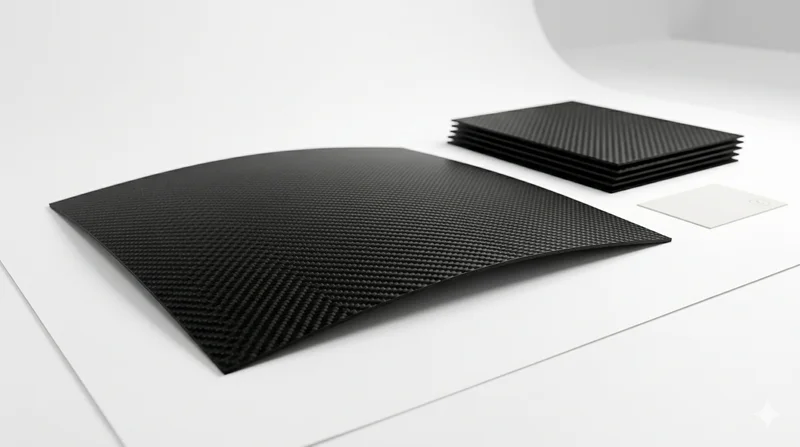
Sheet stock enters vehicles in two very different roles. As a flat laminate it becomes floor panels, seat backs, enclosure lids and brackets that are cut, formed slightly, or bonded into assemblies. As a moulded impression of sheet preform it becomes body panels and aerodynamic pieces with compound curvature. The first role tolerates standard plate sizes and CNC cutting; the second demands matched moulds, surface class targets and a press or autoclave capable of holding cosmetics. Confusing the two is how a cheap bracket study turns into an expensive class-A panel quote.
| Part family | Typical form | Thickness band | Key acceptance |
|---|---|---|---|
| Interior structure and brackets | Flat sheet, CNC cut | 1.5 to 4 mm | Hole true position, mass, screw pull-out |
| Seat shells and backs | Sheet or moulded laminate | 1.2 to 2.5 mm | Flex under load, surface class, fire rating path |
| Body panels and aero | Moulded from sheet preform | 1.0 to 2.0 mm skins | Class-A surface, gap and flush, UV topcoat |
| Structural reinforcement | Thick plate or pultruded inserts | 4 to 10 mm | Stiffness, joint design, crash energy path |
Carbon fiber sheets for cars in the aftermarket follow the same map: hoods and roofs are moulded cosmetics; trunk floors and brace plates are flat stock. Specify which map you are on before requesting carbon fiber sheet price - the price per kilogram is almost meaningless next to price per accepted part.
Process Choices: Prepreg, RTM and Compression Moulding
Prepreg sheet with autoclave cure gives the best fibre volume and surface, at the highest equipment and materials cost. Resin transfer moulding with sheet or patch preforms suits medium series where dimensional control and two-sided surface matter more than ultimate fibre volume. Compression moulding of sheet stacks moves fastest at higher volumes once tooling is paid for. For flat brackets and floor pieces, CNC-cut cured plate often wins outright: no tooling, fast revisions, and a carbon fiber sheet for automotive parts supply chain that behaves like a machine-shop commodity rather than a moulding campaign.
- Prototype and low series: cured plate plus CNC keeps tooling spend near zero and revisions cheap.
- Medium series with curvature: RTM or vacuum infusion with sheet preforms balances tooling cost and surface.
- High series cosmetics: compression or autoclave prepreg with a funded surface-repair process.
- Structural inserts: pultruded or thick plate bonded into metal assemblies where crash load paths are defined.
Grade, Thickness and Carbon Fiber Sheet Price Drivers
Fibre grade sets the strength ceiling; weave style sets drape and cosmetics; thickness sets stiffness and mass. General automotive brackets sit comfortably on T300-class plain or twill weave. Higher-strength T700-class fibre earns its premium where gauge reduction is the goal - thinner panel, same stiffness, lower mass, higher material cost per square metre but often lower total part cost after mass-related savings. Carbon fiber sheet price also moves with tolerance class, certified traceability, and how much of the statement of work is machining versus layup.
Programs that treat material price as the only lever usually lose money twice: once on scrap from unclear drawings, once on expedite freight when the wrong thickness was ordered. Write thickness, tolerance, fibre grade, weave, and surface side on the drawing; ask suppliers to quote those five axes separately so cost-down conversations have somewhere to go.
Sourcing Path for Carbon Fiber Sheet for Car Programs
Start with a gated plan: prototype on CNC-cut plate to validate fit and mass; freeze the design; then choose the series process against annual volume and surface class. Dual-source the material spec even if only one moulder is qualified, so carbon fiber sheet for automotive parts supply does not rest on a single press schedule. Require first-article dimensional reports, mass per part, and a surface standard reference before series release. Keep one golden sample sealed with the date code of the first accepted lot.
Frequently Asked Questions
Is carbon fiber sheet for automotive parts cheaper than aluminum?
Material per square metre is usually more expensive than sheet aluminum of similar stiffness. The business case often still works when mass reduction cascades into smaller motors, brakes or batteries, or when a bracket replaces several stamped pieces with one bonded laminate. Quote cost per accepted part, not cost per kilogram of raw sheet.
What thickness should I choose for interior carbon fiber sheet for car structures?
Most interior structures land between 1.5 mm and 3 mm when screw bosses and bond lines carry the loads. Below 1.2 mm, panels drum and screw pull-out drops sharply unless inserts are used. Above 4 mm you are usually over-specifying for interior duty and paying mass you did not need.
How do carbon fiber sheets for cars handle UV and clearcoat?
Untouched carbon laminate yellows and degrades under long UV exposure, so exterior parts need a UV-stable topcoat system qualified for the bake cycle you use. Interior parts can often skip the full cosmetic stack if they are covered or behind glass. Specify the coating system with the part, not as an afterthought at the paint shop.
Conclusion
Winning with carbon fiber sheet for automotive parts means matching part family to form, process to run rate, and grade to the real acceptance criteria - mass, surface, hole pattern or crash path. Flat brackets favor CNC-cut plate; curved cosmetics favour moulded preforms; structural inserts favour thick stock bonded into metal. To review plate and sheet grades for automotive programs, browse the carbon fiber products catalogue or contact the technical sales team with your part family, annual volume and surface class for a written sourcing proposal.
Part of topic
Related Articles
- Carbon Fiber Sheet for Furniture: Design, Specs and Sourcing | YongXian
- Carbon Fiber Plate for Medical Device: Design, Specs and Sourcing | YongXian
- Carbon Fiber Sheet for Sporting Goods: Design, Specs and Sourcing | YongXian
- Carbon Fiber Rod for Fishing Rod Blank: Design, Specs and Sourcing | YongXian
- Carbon Fiber Plate for Robotics: Design, Specs and Sourcing | YongXian
- Carbon Fiber Tube for Bicycle Frame: Tube Sets, Joints and Sourcing | YongXian
Interested in Our Products?
Contact our team for competitive pricing and technical specifications.
Get a QuoteRelated Products

Round Carbon Fiber Tube — 3K Plain Weave T700
Standard round carbon fiber tube manufactured from Toray T700 grade fiber with 3K plain weave. Offers balanced strength and stiffness for general industrial applications including robotics, automation, sports equipment, and aerospace structures.

Round Carbon Fiber Tube — UD Unidirectional T700
Unidirectional (UD) round tube with all fibers aligned axially for maximum longitudinal stiffness. Ideal for applications requiring high bending rigidity with minimal weight, such as shafts, struts, and structural reinforcements.

Carbon Fiber Plate — 3K Twill T700 3.0mm
Medium-thickness 3.0mm carbon fiber plate offering significantly higher load capacity while maintaining attractive 3K twill finish. Suitable for structural brackets, reinforcement plates, and load-bearing panels.

Round Carbon Fiber Tube — 3K Twill
Lightweight and ultra-stiff round tubes ideal for drone frames, robotics, and structural applications.
Carbon Fiber Plate — 3K Twill T700 1.5mm
Thin 1.5mm carbon fiber plate with 3K twill weave surface. Lightweight and stiff, commonly used for covers, panels, drone bodies, and applications requiring a premium aesthetic appearance.