
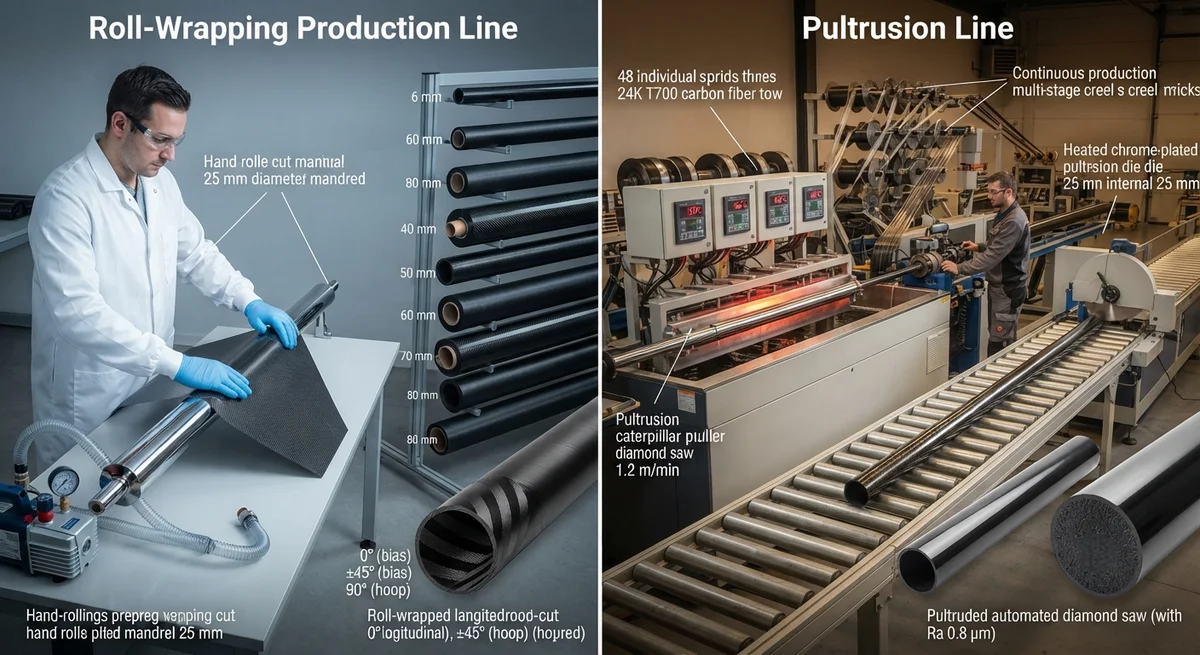
A technical comparison of roll-wrapped and pultruded carbon fiber tube manufacturing — covering mechanical properties, dimensional tolerances, production economics, and application-specific selection criteria for B2B buyers.
Introduction: Two Manufacturing Philosophies for Carbon Fiber Tubes
Carbon fiber tubes are among the most widely used semi-finished composite products, serving structural roles in aerospace actuators, robotic arms, drone frames, sporting goods, medical devices, and industrial machinery. Global production of carbon fiber tubes exceeded 18,000 tonnes in 2026, with two manufacturing processes accounting for over 85% of total output: roll-wrapping (also called prepreg roll-forming) and pultrusion (continuous pull-through processing). Despite producing visually similar round tubes, these two processes create fundamentally different products with distinct fiber architectures, mechanical properties, and cost structures.
For B2B buyers, selecting the wrong tube manufacturing process can result in premature failure, excessive cost, or unnecessary weight. This article provides a direct technical comparison of roll-wrapped versus pultruded carbon fiber tubes, with quantitative data on mechanical performance, dimensional tolerance, production economics, and application-specific selection criteria.
Process Fundamentals
Roll-Wrapped Tube Manufacturing
Roll-wrapping begins with prepreg — carbon fiber fabric or unidirectional tape pre-impregnated with partially cured epoxy resin. The prepreg is cut to precise dimensions, rolled onto a polished steel mandrel of the required inner diameter, vacuum bagged, and cured in an autoclave or oven at 120–180°C under 3–6 bar pressure. After curing, the mandrel is extracted, and the tube is trimmed to length. The key advantage of roll-wrapping is its ability to produce tubes with tailored fiber orientations — 0° unidirectional layers for axial stiffness, ±45° bias layers for torsional strength, and 90° hoop layers for crush resistance — each oriented exactly where needed.
Pultruded Tube Manufacturing
Pultrusion is a continuous process: carbon fiber tows (typically 12K or 24K) are pulled from a creel through a heated resin bath, then through a precisely ground steel die that defines the tube profile. The die is maintained at 140–200°C, curing the thermoset resin (typically polyester, vinyl ester, or epoxy) as the fiber-reinforced material passes through. Tube exits the die at speeds of 0.5–3.0 m/min, is cooled, and is cut to length by an automated saw. Pultrusion produces tubes with continuous, unbroken longitudinal fibers along the entire length, but offers limited fiber orientation flexibility — essentially, 0° longitudinal fibers with minimal off-axis reinforcement.
| Parameter | Roll-Wrapped Tube | Pultruded Tube | Advantage |
|---|---|---|---|
| Fiber orientation flexibility | 0° to ±90° (multi-angle) | Primarily 0° (can add ±15° veil) | Roll-wrap |
| Max outer diameter | 300 mm (practical); 600 mm (special) | 200 mm (standard); 400 mm (special) | Roll-wrap |
| Standard lengths | 500–3,000 mm | 2,000–12,000 mm (continuous) | Pultrusion |
| Tensile modulus (axial, standard grade) | 70–120 GPa | 90–150 GPa | Pultrusion |
| Flexural modulus | 65–110 GPa | 55–85 GPa | Roll-wrap |
| Torsional strength (MPa) | 120–250 | 40–80 | Roll-wrap |
| Crush strength (radial) | 80–180 MPa | 25–50 MPa | Roll-wrap |
| ID/OD concentricity (typical) | ±0.05–0.15 mm | ±0.02–0.08 mm | Pultrusion |
| Straightness tolerance | 0.5–1.5 mm/m | 0.2–0.8 mm/m | Pultrusion |
| Surface finish (Ra) | 0.8–3.2 μm | 0.4–1.6 μm | Pultrusion |
| Fiber volume fraction | 58–65% | 55–62% | Roll-wrap |
| Void content | 0.5–2.0% | 1.0–3.5% | Roll-wrap |
| Production rate | 1–8 tubes/hour (per mandrel) | 30–180 m/hour (continuous) | Pultrusion |
Mechanical Property Trade-Offs
Axial Performance: Pultrusion Excels
Because pultruded tubes have continuous, unidirectional fibers along the entire length (typically 60–70% of fibers are axially oriented), they deliver superior tensile strength and modulus in the tube axis direction. A standard pultruded tube using T700-grade fiber achieves tensile strength of 800–1,200 MPa and tensile modulus of 100–140 GPa. Roll-wrapped tubes of similar fiber grade typically achieve 600–1,000 MPa tensile strength and 70–120 GPa modulus, because some fibers are necessarily diverted to bias (±45°) and hoop (90°) orientations for structural integrity during handling and use. For applications where the primary load path is purely axial — such as push rods, structural struts, and telescopic boom extensions — pultrusion is the clear winner.
Multi-Axial Loading: Roll-Wrapping Excels
For tubes subjected to bending, torsion, or combined loading — which describes the majority of structural applications — roll-wrapped tubes significantly outperform pultruded tubes. The ±45° bias layers in a roll-wrapped tube provide torsional shear strength 2–4× higher than pultruded tubes. A typical roll-wrapped tube with a [±45/0₂/±45] layup achieves torsional strength of 150–250 MPa, compared to 40–80 MPa for a pultruded tube. Similarly, the 90° hoop layers provide radial crush resistance 3–5× higher — critical for applications where tubes are clamped, bolted, or subjected to lateral point loads.
Production Economics
The cost per tube depends heavily on geometry, quantity, and quality requirements. The following table presents representative costs for a common size — 25 mm OD × 2 mm wall × 1,000 mm length — at varying production volumes using T700-grade carbon fiber.
| Volume (tubes/year) | Roll-Wrapped (per tube) | Pultruded (per tube) | Pultrusion Savings |
|---|---|---|---|
| 100 | $28–$45 | $18–$30 | 30–36% |
| 1,000 | $14–$22 | $7–$12 | 45–50% |
| 10,000 | $8–$14 | $3.50–$6 | 55–60% |
| 100,000 | $5–$9 | $2–$3.50 | 55–62% |
When Roll-Wrapping Is More Cost-Effective
- Small diameters (<10 mm OD): Below 10 mm, filament tension control during pultrusion becomes difficult, and scrap rates increase. Roll-wrapping small tubes from thin prepreg (0.06–0.10 mm ply thickness) provides better yield and lower per-unit cost below 5 mm OD.
- Short tubes (<300 mm): Pultrusion setup cost (die fabrication, machine setup) is amortized over the entire production run. For runs under 500 pieces of short tubes, roll-wrapping often achieves lower per-part cost due to minimal tooling investment ($500–$2,000 for a mandrel vs $5,000–$15,000 for a pultrusion die).
- High-quality critical components: When the application requires full C-scan NDT, low void content (<1%), or aerospace-grade qualification, the autoclave-cured roll-wrapping process inherently delivers superior quality that justifies its higher base cost.
- Non-round or tapered tubes: Roll-wrapping can produce elliptical, square, rectangular, and tapered profiles by simply changing the mandrel shape. Pultrusion requires an entirely new die for each profile change — a $10,000–$40,000 investment per profile.
When Pultrusion Is More Cost-Effective
- Long tubes (>2,000 mm): Pultrusion produces continuous lengths without length limit. Roll-wrapping is typically limited to 3,000 mm due to mandrel handling constraints. For 6-meter tubes, pultrusion is the only practical process.
- High-volume commodity tubes (10,000+ units/year): Pultrusion's continuous nature and automation yield per-tube costs 55–62% below roll-wrapping at scale. For standard diameters used in consumer products, drones, and industrial equipment, pultrusion is the default choice.
- Tight concentricity requirements (<±0.05 mm): Pultruded tubes consistently achieve ID/OD concentricity within ±0.03–0.08 mm, while roll-wrapped tubes typically achieve ±0.08–0.15 mm. Applications such as precision bearing housings and pneumatic cylinder bodies favor pultrusion.
- Applications with purely axial loading: Push rods, tie rods, cable support tubes, and column structures where the load is exclusively along the tube axis benefit from pultrusion's superior axial properties and lower cost.
Application-Specific Recommendations
| Application | Recommended Process | Key Rationale |
|---|---|---|
| Drone motor arms (300–600 mm) | Roll-wrapped | Torsion/bending loads require ±45° bias layers; short length; cost-effective |
| Robotic arm structural links | Roll-wrapped | Multi-axis loading; fatigue-critical; high reliability required |
| Linear actuator push rods | Pultruded | Pure axial load; long length (1–3 m); tight straightness tolerance |
| Fishing rod blanks | Roll-wrapped | Tapered profile; multi-angle fiber for bending/torsion balance |
| Flag poles / antenna masts | Pultruded | Long length (4–12 m); moderate bending loads; cost-sensitive |
| Medical X-ray spacer tubes | Pultruded | Tight concentricity; long straight runs; radiolucent requirement |
| Drone landing gear struts | Roll-wrapped | Impact loads; short length; complex end fittings co-cured |
| Conveyor roller tubes | Pultruded | High volume; long length; purely radial loads |
Frequently Asked Questions
Can pultruded tubes be made with ±45° fibers for torsional strength?
Conventional pultrusion is limited to fiber orientations near the pull direction (0°). Off-axis fibers (≥30° from pull direction) experience high friction against the die walls, causing fiber buckling, resin pooling, and surface defects. Some specialized pultrusion lines incorporate a "veil" or "mat" layer at ±45° on the tube surface — typically 5–15% of total fiber content — providing modest torsional improvement (20–40% increase over all-0° fiber). However, this falls far short of a roll-wrapped tube where 40–60% of fibers can be in the ±45° orientation. For any application with significant torsion or combined loading, roll-wrapping is the recommended process. If the pultrusion cost advantage is critical, the designer should evaluate a hybrid approach: a pultruded tube with roll-wrapped ±45° end-caps at the load introduction points where torsional stresses peak.
How do raw material costs compare between the two processes?
At the raw material level, roll-wrapping uses prepreg — carbon fiber fabric pre-impregnated with epoxy resin. Prepreg costs $35–$65/kg for standard-modulus T700-grade material, depending on fabric architecture, resin system, and volume. Pultrusion uses dry fiber tows ($15–$25/kg for T700 12K/24K) plus a separate liquid resin ($4–$12/kg for polyester/vinyl ester, $15–$25/kg for epoxy). At equivalent fiber volume (60%), the raw material cost per kg of finished tube is: $45–$70/kg for roll-wrapped prepreg tubes, versus $20–$38/kg for pultruded tubes using polyester or vinyl ester resin. When pultrusion uses epoxy resin (for higher mechanical performance), the raw material cost rises to $30–$48/kg. The total manufactured cost gap is narrower than raw material alone suggests because pultrusion has higher capital equipment depreciation and tooling amortization. At production volumes below 5,000 tubes/year, roll-wrapping can achieve total cost parity with pultrusion when all factors — tooling, scrap rate, NDT requirements, and setup labor — are included.
What are the maximum practical lengths for roll-wrapped tubes?
The practical length limit for roll-wrapped tubes is determined by mandrel handling constraints, autoclave/oven dimensions, and prepreg width availability. Standard mandrel lengths range from 500 mm to 3,000 mm. Tubes up to 6,000 mm are possible with specialized equipment (horizontal winding, large autoclaves), but cost increases significantly — approximately 40–60% per tube per 1,000 mm of additional length beyond 3,000 mm — due to reduced production rate, higher tooling cost, and increased scrap risk from prepreg roll width limitations (standard prepreg rolls are 300–1,270 mm wide). For the common tube diameter range of 6–80 mm OD, the practical maximum length for cost-effective roll-wrapping is 3,000 mm. Beyond this, pultrusion is almost always the more economical choice. For tube diameters above 200 mm, roll-wrapping becomes the preferred process regardless of length, as pultrusion die costs and pull force requirements become prohibitive — a 300 mm OD pultrusion die costs $40,000–$80,000 and requires a 150–300 kN puller.
Part of topic
Related Articles
- Bio-Based Carbon Fiber Precursors: Lignin and Polyethylene for Low-Cost Production
- Large-Tow Carbon Fiber Cost Analysis: 48K vs 60K Price-Performance Comparison
- Carbon Fiber-Resin Interface Bonding: Surface Treatment and Coupling Agent Optimization
- Digital Twin for Carbon Fiber Manufacturing: Real-Time Process Monitoring and Defect Prevention
- Thermoplastic Carbon Fiber Welding for Automotive: Ultrasonic and Induction Welding Process Windows
- Large-Tow Carbon Fiber Wet Spinning: Process Optimization for 48K/60K Production Efficiency
Interested in Our Products?
Contact our team for competitive pricing and technical specifications.
Get a QuoteRelated Products

Carbon Fiber Plate — 3K Twill T700 1.5mm
Thin 1.5mm carbon fiber plate with 3K twill weave surface. Lightweight and stiff, commonly used for covers, panels, drone bodies, and applications requiring a premium aesthetic appearance.

Square Carbon Fiber Tube — 3K Twill T700
Square cross-section carbon fiber tube manufactured with 3K twill weave for torsional strength. Preferred for structural frames, trusses, and support columns where rectangular geometry offers design flexibility.

Carbon Fiber Plate — 3K Twill T700 3.0mm
Medium-thickness 3.0mm carbon fiber plate offering significantly higher load capacity while maintaining attractive 3K twill finish. Suitable for structural brackets, reinforcement plates, and load-bearing panels.
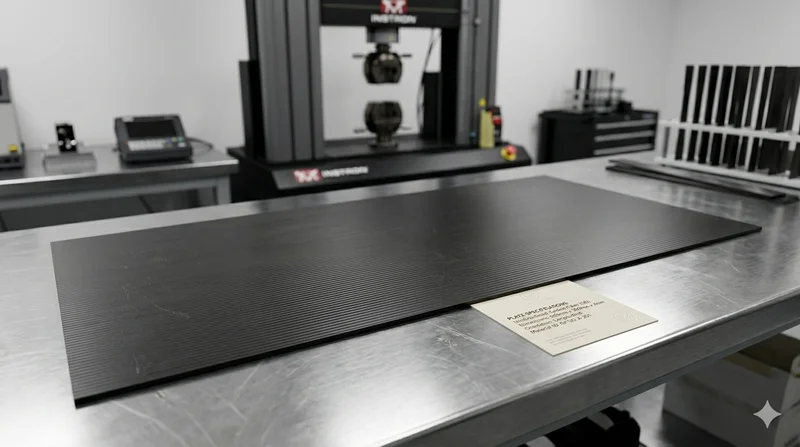
Carbon Fiber Plate — UD Unidirectional T700
Unidirectional carbon fiber plate with all fibers oriented in a single direction for maximum strength along the fiber axis. Essential for structural reinforcements, splints, and applications where load direction is predictable.
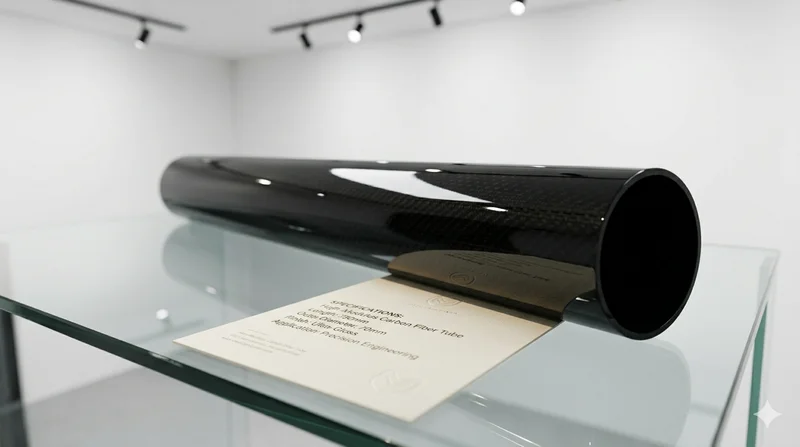
High Modulus Round Carbon Fiber Tube — M40
High modulus round tube manufactured with M40 grade fiber (tensile modulus 400 GPa). Designed for applications where maximum stiffness-to-weight ratio is critical, such as optical systems, precision machinery, and aerospace structures.