
Large carbon fiber parts — wind turbine blades, boat hulls, rail car bodies, and aerospace skins — present a manufacturing paradox. They need the strength and weight savings of composites, but their size makes the classic processes awkward. Autoclave prepreg is expensive and limited by
Introduction
Large carbon fiber parts — wind turbine blades, boat hulls, rail car bodies, and aerospace skins — present a manufacturing paradox. They need the strength and weight savings of composites, but their size makes the classic processes awkward. Autoclave prepreg is expensive and limited by autoclave dimensions. Resin transfer molding (RTM) requires a matched, rigid mold that is costly to build at large scale. Vacuum infusion is cheap but struggles to control resin flow across a large area, so weight and fiber volume fraction drift from part to part.
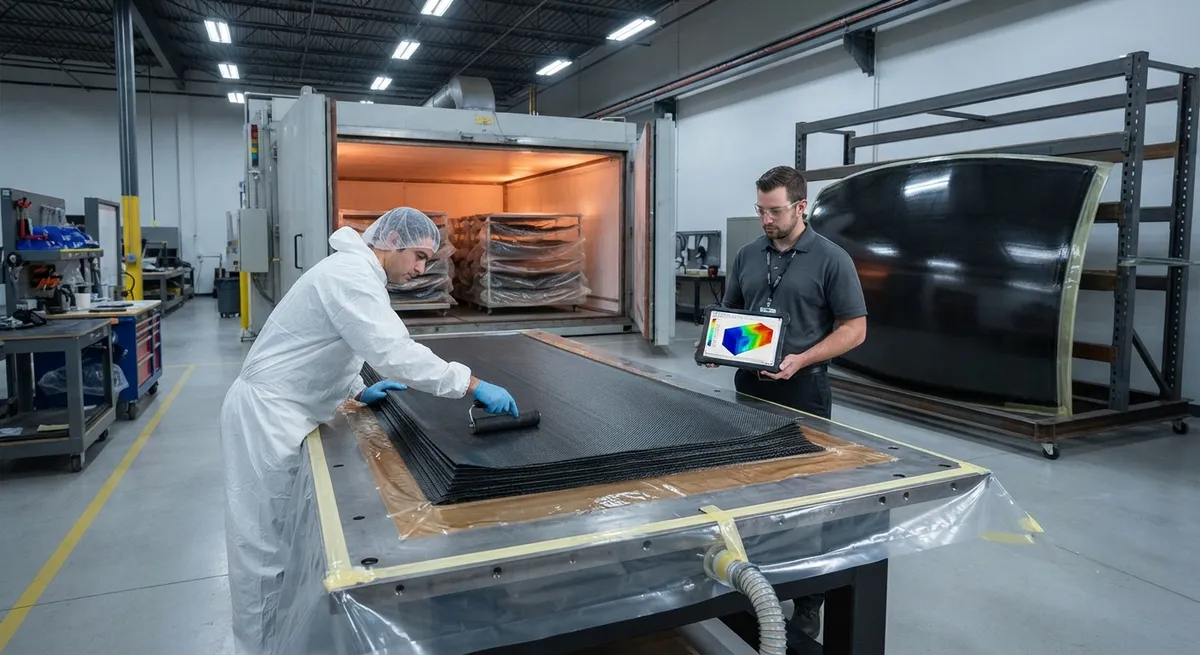
Resin film infusion (RFI) sits between these options. A solid resin film is laid into the tool, the dry carbon fiber stack is placed on top, and under vacuum and heat the resin melts and flows upward through the thickness of the laminate. Because the resin is already inside the tool in a controlled quantity, RFI delivers the weight uniformity of a closed-mold process with the low tooling cost of an open-mold one. This article explains how RFI controls resin flow, why it produces uniform part weight on large parts, and how its cost compares with RTM.
How Resin Film Infusion Works
RFI is a one-sided tooling process. A solid resin film — a thin sheet of uncured epoxy or other thermoset — is laid on the tool surface. The dry carbon fiber preform or fabric stack is placed over the film. The whole assembly is bagged and evacuated. Under vacuum and applied heat, the resin film melts, and the pressure differential drives the liquid resin upward through the thickness of the fiber stack, wetting the fibers as it rises.
Two features distinguish RFI from liquid infusion. First, the resin quantity is fixed by the film thickness and area, so the fiber volume fraction is set by design rather than by the vagaries of flow. Second, the flow path is short and vertical — through the thickness of the laminate — rather than long and horizontal across the part. Short flow paths mean fewer dry spots, less race-tracking, and far less dependence on resin viscosity and permeability than in a long horizontal infusion.
Resin Flow Control in RFI
Controlling resin flow in RFI is about managing the vertical flow front and the temperature profile. The resin must melt and flow evenly across the entire part, and it must fully wet the fibers before the resin gels. Three factors dominate. The resin film must be uniform in thickness, because a thick spot delivers excess resin and a thin spot risks dry fibers. The temperature ramp must be controlled so the resin reaches its minimum viscosity window and flows before it begins to cure. And the vacuum must be maintained so the pressure differential drives complete wet-out without trapping air.
Because the flow path is short, RFI is far more forgiving of resin viscosity than horizontal infusion. A resin that is too viscous for a long flow path can still wet a short vertical path. This widens the usable resin window and lets manufacturers use tougher, higher-performance resin systems that would be impractical to infuse horizontally across a large part.
Weight Uniformity and Fiber Volume Fraction
Weight uniformity is where RFI earns its reputation on large parts. In a long horizontal infusion, the resin front travels across the part, and by the time it reaches the far edge it has lost pressure and picked up contamination, so the far end is often resin-starved or resin-rich. In RFI, every point of the laminate receives resin from the film directly beneath it, so the resin distribution is uniform by construction. The result is a consistent fiber volume fraction and a consistent part weight from part to part.
This matters for two reasons. First, structural performance: fiber volume fraction directly sets the stiffness and strength of the laminate, so a uniform fraction means a part that meets its design allowables everywhere, not just in the well-wetted zones. Second, weight control: for aerospace and marine parts where weight is a specification, a process that holds part weight within a tight band avoids both overweight parts and the scrap of underweight ones. The table below compares RFI with RTM and vacuum infusion on the metrics that matter for large parts.
| Metric | Resin Film Infusion | Resin Transfer Molding | Vacuum Infusion |
|---|---|---|---|
| Tooling cost | Low (single-sided) | High (matched mold) | Low (single-sided) |
| Weight uniformity | Excellent | Excellent | Moderate |
| Fiber volume fraction | 50-60% | 55-65% | 45-55% |
| Flow path length | Short (through-thickness) | Short to medium | Long (across part) |
| Resin viscosity tolerance | Wide | Narrow | Narrow |
| Part size limit | Limited by tool and oven | Limited by mold size | Very large possible |
RFI typically reaches fiber volume fractions of 50-60%, slightly below RTM's 55-65% but well above vacuum infusion's 45-55%, and it does so with a single-sided tool.
Cost Comparison with RTM
The cost difference between RFI and RTM is dominated by tooling. RTM requires a matched two-sided mold that must withstand injection pressure, which at large scale means heavy, expensive steel or composite tooling. RFI uses a single-sided tool like vacuum infusion, so the tooling cost is a fraction of RTM's. For a large part — a hull, a blade, a body panel — the tooling saving can be the deciding factor between the two processes.
RTM's advantages are higher fiber volume fraction and faster cycle times, because the resin is injected under pressure and the part can be demolded quickly. RFI's advantages are lower tooling cost, simpler process, and better tolerance of high-performance resins. For low-to-medium volumes of large parts, RFI is usually the lower total-cost option; for high volumes of smaller parts where cycle time dominates, RTM wins. The table below summarizes the cost drivers.
- Tooling: RFI uses single-sided tooling; RTM needs matched molds. Tooling cost is the largest differentiator at large scale.
- Cycle time: RTM cures faster under pressure; RFI relies on oven cure, so cycle time is longer.
- Resin cost: RFI uses resin film, which is more expensive per kilogram than bulk resin, but wastes less.
- Labor: RFI layup is simpler than RTM injection setup, reducing labor per part.
- Scalability: RTM scales to high volume; RFI is best at low to medium volume.
For a large part produced in the hundreds per year, the tooling savings of RFI typically outweigh its longer cycle time, making it the lower-cost process overall.
Applications and Practical Considerations
RFI is used where large, flat or gently curved parts need uniform quality without the cost of a matched mold. Typical applications include wind turbine blade spars and shells, marine hulls and decks, rail and truck body panels, and aerospace skins and stiffened panels. It is also a natural fit for co-curing, where the resin film can bond a skin to a core or stiffener in the same cycle.
Practical considerations include the need for an oven or heated tool large enough for the part, careful film handling to avoid wrinkles and air entrapment, and a resin system whose viscosity window matches the part's size and cure schedule. Because the film is placed before the stack, RFI also requires a clean, controlled layup environment to keep the film and fibers free of contamination.
Frequently Asked Questions
What is the difference between resin film infusion and vacuum infusion?
In vacuum infusion, liquid resin is drawn from a reservoir across the surface of the part by vacuum, flowing horizontally through the fiber stack. In RFI, the resin is already placed inside the mold as a solid film, and it flows vertically through the thickness when heated. RFI gives better weight uniformity and fiber volume control because the resin quantity is fixed by the film, and the short vertical flow path is more forgiving of resin viscosity.
Can RFI be used with prepreg or only with dry fiber?
RFI is designed for dry fiber. The dry carbon fiber stack is placed over the resin film, and the resin flows up through it during cure. If you already use prepreg, you do not need RFI — the resin is already in the prepreg. RFI is the alternative when you want the cost and handling advantages of dry fiber with the controlled resin content of a film.
What fiber volume fraction can RFI achieve?
RFI typically achieves fiber volume fractions of 50-60%, depending on the fiber architecture and the film thickness. This is slightly below RTM's 55-60% but above vacuum infusion's 45-55%. The exact value is set by the ratio of film thickness to fiber stack thickness, so it is controlled by design rather than by flow behavior.
Is RFI suitable for very large parts like wind turbine blades?
Yes, RFI is well suited to large parts, and it is used for blade spars and other large structures. The main limit is the size of the oven or heated tool, not the process itself. Because the flow path is short and vertical, RFI does not suffer the flow-length limits that constrain long horizontal infusions, so it scales to very large parts more easily than liquid infusion.
Conclusion
Resin film infusion gives large carbon fiber parts the weight uniformity of a closed-mold process with the tooling economy of an open one. By placing the resin inside the mold as a film and driving it vertically through the fibers, RFI controls resin flow precisely, holds fiber volume fraction within a tight band, and avoids the flow-path problems that plague long horizontal infusions. Against RTM, RFI trades a slightly lower fiber volume fraction and longer cycle time for a much lower tooling cost — a trade that favors RFI for large, low-to-medium-volume parts.
Whether you are quoting a hull, a blade spar, or a body panel, the dry fiber you start with determines the quality of the RFI laminate. Explore our carbon fiber fabrics and prepreg materials with consistent areal weight and sizing chemistry, or contact our engineering team to select the right reinforcement for your resin film infusion program.
Part of topic
Related Articles
- Carbon Fiber Drone Blades and Propellers: Stiffness, Balance and Noise Reduction
- Fiberglass Filament Wound Tubes: Cost-Effective Alternative to Carbon Fiber
- Filament Wound Epoxy Tube Design: Wall Thickness, Fiber Angle and Load Optimization
- Filament Wound Epoxy Tubes: Testing Standards and Quality Assurance
- Filament Wound Epoxy Tubes Manufacturing: Process and Quality Control
- Filament Wound Fiberglass Tube: Process Parameters and Performance vs Carbon Fiber
Interested in Our Products?
Contact our team for competitive pricing and technical specifications.
Get a QuoteRelated Products
Carbon fiber standard plate-3k stripe
Lightweight, ultra-rigid standard sheets for drone fuselages, robot housings, facades and structural applications.

Carbon Fiber Plate — 3K Twill T700 3.0mm
Medium-thickness 3.0mm carbon fiber plate offering significantly higher load capacity while maintaining attractive 3K twill finish. Suitable for structural brackets, reinforcement plates, and load-bearing panels.

Carbon Fiber Plate — 3K Twill T700 1.5mm
Thin 1.5mm carbon fiber plate with 3K twill weave surface. Lightweight and stiff, commonly used for covers, panels, drone bodies, and applications requiring a premium aesthetic appearance.

Custom Carbon Fiber Medical Device Components
Medical-grade carbon fiber components manufactured for imaging equipment, surgical instruments, and patient support systems. Carbon fiber's radiolucency (X-ray transparency) and high strength-to-weight ratio make it ideal for CT scanner beds, wheelchair frames, surgical robot arms, and MRI-compatible accessories. Biocompatible resin systems available.

Square Carbon Fiber Tube — 3K Twill T700
Square cross-section carbon fiber tube manufactured with 3K twill weave for torsional strength. Preferred for structural frames, trusses, and support columns where rectangular geometry offers design flexibility.