
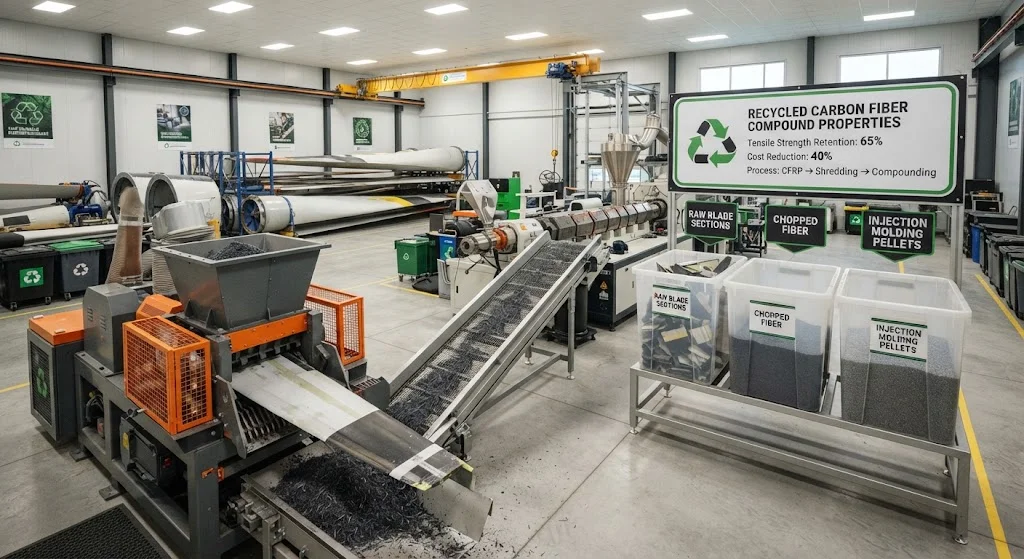
Recycled carbon fiber compounding technology is maturing to enable closed-loop recycling of wind turbine blade materials. This article examines recycling processes, compound properties, and applications in non-structural wind energy components.
Introduction
As the first generation of utility-scale wind turbine blades reaches end of life, the wind energy industry faces a growing waste management challenge. An estimated 2.4 million tons of blade material will require disposal or recycling by 2050. Recycled carbon fiber compounding offers a pathway to recover and reuse the carbon fiber content from end-of-life blades, creating value from waste while reducing environmental impact.
Carbon fiber reinforced polymer (CFRP) blades contain 20-40% carbon fiber by weight, representing a significant material resource. Recycling this fiber and incorporating it into new composite compounds can displace virgin carbon fiber in less demanding applications, reducing both waste and the demand for new fiber production.
Recycling Processes
Several recycling technologies are being developed and commercialized for carbon fiber composites:
Pyrolysis: Thermal decomposition at 400-700°C in an inert atmosphere burns off the resin matrix, recovering dry carbon fiber with 80-90% of original tensile properties. The fiber surface may require treatment to restore bonding capability with new resin systems.
Chemical solvolysis: Chemical decomposition using solvents (water, acids, or organic solvents) at elevated temperatures and pressures dissolves the resin matrix while preserving fiber properties. This process can recover fibers with 90-95% of original properties and may enable recovery of resin chemicals.
Mechanical grinding: Physical size reduction produces chopped fiber particles suitable for injection molding or compression molding applications. This process is simpler and less expensive but produces shorter fibers with reduced mechanical properties.
Compounding Technology
Recycled carbon fiber is processed into compound materials through several routes:
Injection molding compounds: Chopped recycled carbon fiber (3-12 mm length) compounded with thermoplastic resins (PA6, PA66, PP, PEEK) produces pellets suitable for injection molding. Fiber content typically ranges from 20-40% by weight.
Compression molding compounds: Chopped or matted recycled carbon fiber with thermoset or thermoplastic matrices produces sheet molding compound (SMC) or bulk molding compound (BMC) for compression molding into structural parts.
Non-woven mats: Recycled carbon fiber formed into random or oriented mats can be used in hand layup, vacuum infusion, or resin transfer molding processes, providing a lower-cost alternative to virgin carbon fiber fabrics.
Property Characteristics
Recycled carbon fiber compounds have distinct property profiles:
Tensile properties: Tensile strength and modulus of recycled fiber compounds are typically 60-80% of virgin fiber compounds, depending on fiber length, orientation, and processing method. Short fiber compounds used in injection molding have lower properties than long fiber or continuous fiber alternatives.
Impact resistance: Recycled fiber compounds often show improved impact resistance compared to virgin fiber compounds due to the random fiber orientation and energy absorption mechanisms of shorter fibers.
Cost advantage: Recycled carbon fiber costs 30-50% less than virgin fiber, providing a significant cost advantage for applications where the reduced mechanical properties are acceptable.
Wind Energy Applications
Recycled carbon fiber compounds are finding applications in wind energy:
Internal components: Injection molded internal brackets, ribs, and stiffeners that do not carry primary structural loads can effectively use recycled fiber compounds at significant cost savings.
Tooling: Recycled carbon fiber compounds are well-suited for manufacturing molds, fixtures, and tooling used in blade production, where the cost advantage is significant and property requirements are moderate.
Non-structural covers: Nacelle covers, hub covers, and other non-structural enclosures can use recycled fiber compounds, reducing material costs while maintaining appearance and environmental resistance.
Conclusion
Recycled carbon fiber compounding technology offers a viable pathway for managing end-of-life wind turbine blade materials while creating economic value. As recycling technologies mature and compound properties improve, recycled carbon fiber will increasingly displace virgin fiber in non-structural wind energy applications, supporting the industry's sustainability goals and circular economy objectives.
Part of topic
Related Articles
- Bio-Based Carbon Fiber Precursors: Lignin and Polyethylene for Low-Cost Production
- Large-Tow Carbon Fiber Cost Analysis: 48K vs 60K Price-Performance Comparison
- Carbon Fiber-Resin Interface Bonding: Surface Treatment and Coupling Agent Optimization
- Digital Twin for Carbon Fiber Manufacturing: Real-Time Process Monitoring and Defect Prevention
- Thermoplastic Carbon Fiber Welding for Automotive: Ultrasonic and Induction Welding Process Windows
- Large-Tow Carbon Fiber Wet Spinning: Process Optimization for 48K/60K Production Efficiency
Interested in Our Products?
Contact our team for competitive pricing and technical specifications.
Get a QuoteRelated Products
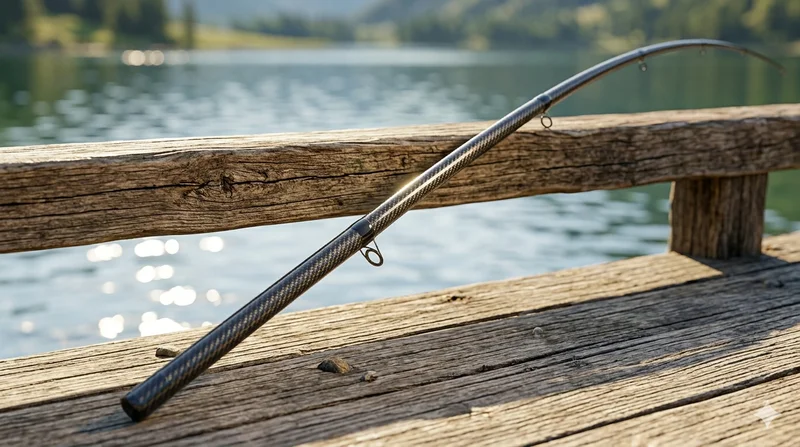
Carbon Fiber Fishing Rod Blank
High-quality carbon fiber fishing rod blank manufactured from multiple grades of Toray carbon fiber cloth. Available in a wide range of lengths, powers, and actions for freshwater and saltwater applications. Suitable for OEM rod building.

Carbon Fiber Plate — 3K Twill T700 3.0mm
Medium-thickness 3.0mm carbon fiber plate offering significantly higher load capacity while maintaining attractive 3K twill finish. Suitable for structural brackets, reinforcement plates, and load-bearing panels.

Carbon Fiber Plate — 3K Twill T700 1.5mm
Thin 1.5mm carbon fiber plate with 3K twill weave surface. Lightweight and stiff, commonly used for covers, panels, drone bodies, and applications requiring a premium aesthetic appearance.

Square Carbon Fiber Tube — 3K Twill T700
Square cross-section carbon fiber tube manufactured with 3K twill weave for torsional strength. Preferred for structural frames, trusses, and support columns where rectangular geometry offers design flexibility.
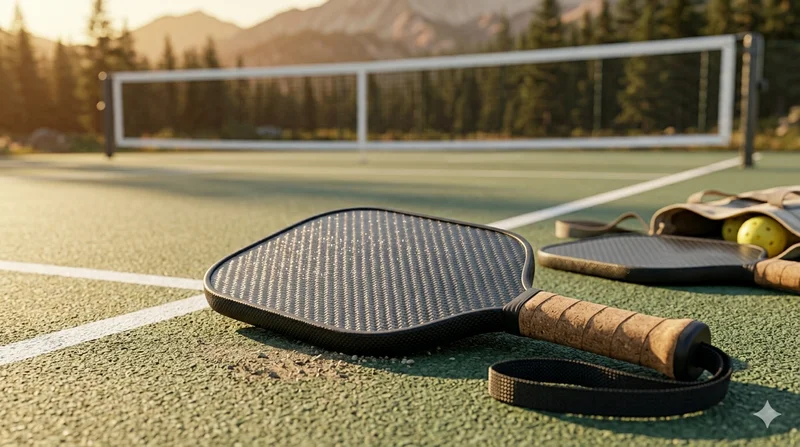
Carbon Fiber Pickleball Paddle
High-performance pickleball paddle with Toray T700 carbon fiber face and polypropylene honeycomb core. Delivers excellent power-to-weight ratio, spin generation, and vibration dampening for competitive play.