
Prosthetics and exoskeletons are the most human-centered applications in composites, because every gram of device weight is carried by the wearer and every structural cycle is counted against a body that either weighs the mass or supplies the energy to move it. Carbon fiber entered pros
Introduction
Prosthetics and exoskeletons are the most human-centered applications in composites, because every gram of device weight is carried by the wearer and every structural cycle is counted against a body that either weighs the mass or supplies the energy to move it. Carbon fiber entered prosthetics through running blades in the 1980s and became the default socket material through the 1990s, and it now dominates both laminated sockets and energy-storing feet. Exoskeletons followed the same path: industrial back-support frames and medical walking exoskeletons are built around carbon struts and shells precisely because a kilogram saved on the frame is a kilogram the wearer does not have to carry all day.
This article explains where carbon earns its place in these devices: the laminated socket that transfers load from the residual limb, the elastic foot that returns energy during gait, and the articulated frames of active exoskeletons. It also covers the design constraints that are rarely discussed in aerospace composites, chief among them fatigue under millions of low-load cycles, impact from falls, and the need to keep the interface with the human body comfortable and clean.
Why Weight Is the Controlling Variable
Energy cost scales with distal mass. A mass carried on the foot or shank costs several times more metabolic energy per step than the same mass carried at the waist, because the lower limb accelerates and decelerates it through swing phase. Researchers have measured that adding one kilogram to the foot increases metabolic cost by roughly 7-8% during walking, whereas the same kilogram at the center of mass costs about 1-2%. This asymmetry is what made carbon mandatory: a transtibial prosthesis with a laminated carbon socket and carbon foot is commonly 400-800 grams lighter than an equivalent device built from metal and leather, and that difference is felt as hours of additional endurance.
Fatigue is the second driver. A prosthetic socket is loaded and unloaded with every stride, roughly 5,000-7,000 cycles per day or well over a million cycles per year. Aluminum yields and cracks under such spectra unless heavily dimensioned; carbon laminates tolerate billions of cycles at their design strain because the endurance limit is a large fraction of static strength. The practical consequence is that carbon devices can be built thinner and lighter while meeting the same 3-5 year design life as heavier metal ones.
The Laminated Socket: Custom Geometry, Composite Structure
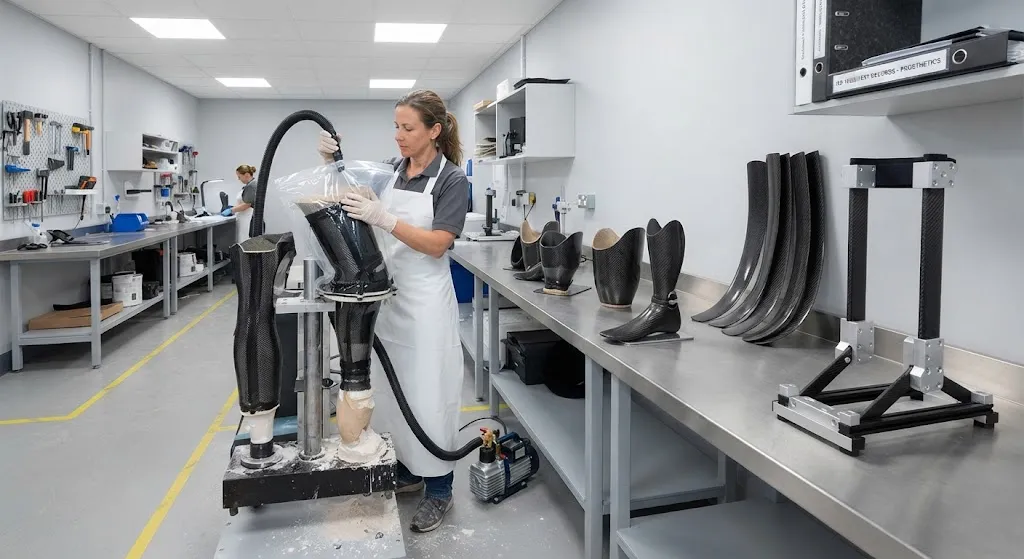
The socket is the custom part of any prosthesis: it must match the individual geometry of the residual limb while carrying the full body weight at every step. The standard process is vacuum lamination over a positive plaster or foam model of the limb. A flexible thermoplastic inner liner is first thermoformed for comfort and suspension, then carbon fabric and unidirectional reinforcement are draped over the model and consolidated under vacuum with an epoxy resin system formulated for low skin-contact sensitivity.
The laminate is built up strategically rather than uniformly:
- Unidirectional carbon along the long axis carries the axial load from the limb down to the pylon, typically oriented along the weight-bearing axis.
- Biaxial and plus/minus 45 degree carbon layers carry the twisting moments generated when the socket rotates against the residuum during gait.
- Local reinforcement pads at the patellar tendon, tibial crest, and other bony landmarks spread pressure and prevent localized stress concentrations.
- A hybrid glass-carbon outer layer on the rim provides damage tolerance where the socket edge meets soft tissue and clothing.
A finished transtibial socket weighs 200-400 grams depending on limb size, versus 600-900 grams for a conventional leather-laminated metal frame socket. Even more important for comfort, the socket is thin, typically 3-5 millimeters, which preserves joint range of motion and lets the fabricator tailor flexibility in specific zones.
Energy-Storing Feet and Running Blades
Carbon's elastic energy return is what created the modern running blade. A carbon leaf-spring foot bends under body weight during stance and rebounds during push-off, returning 80-90% of the stored energy, whereas a solid ankle-foot orthosis returns 40-60%. The classic design, the Flex-Foot introduced in the 1980s, is a single curved carbon laminate that stores energy in cantilever bending and releases it through the toe; the Cheetah running blade extends the same principle with a J-shaped spring tuned to the athlete's weight and sprint speed.
| Foot type | Typical mass | Energy return | Best suited for |
|---|---|---|---|
| Solid ankle-foot orthosis | 400-700 g | 40-60% | Daily low-activity walking, stability |
| Carbon dynamic response foot | 300-500 g | 70-85% | Active daily walking, some running |
| Carbon running blade | 350-550 g | 85-92% | Track and sprint events |
Getting the return requires precise laminate tuning. The stiffness of the spring is set by the number of carbon plies, the ply orientation, and the curvature of the mold; manufacturers offer the same foot in three to five stiffness categories matched to body weight. Because the blade flexes through hundreds of thousands of cycles at strains of 0.5-1.5%, the carbon spec is selected for fatigue life as much as stiffness, and the spring is designed to fail progressively rather than suddenly if overloaded.
Exoskeleton Frames: Carbon as the Skeleton
Active and passive exoskeletons impose a different requirement: the frame must transfer load from the wearer's body to the ground through hip, knee, and ankle joints while remaining light enough to wear for a full shift. Industrial back-support exoskeletons for lifting and repetitive tasks are built around carbon uprights and thigh shells, cutting 30-50% of the frame mass compared with aluminum while keeping the stiffness needed to offload the spine. Medical walking exoskeletons, which power the limbs through electric actuators, place carbon struts along the thigh and shank to reduce the inertia the motors must accelerate with every step.
The carbon advantage here is twofold. First, specific stiffness: a carbon tube of equal bending stiffness to an aluminum one weighs about 40% less, which directly extends battery life and shift endurance in active devices. Second, vibration damping: carbon dissipates vibration several times faster than aluminum, which matters because exoskeleton joints transmit motor and gear noise into the body. Carbon frames are typically designed as bonded assemblies, with machined aluminum joint blocks bonded to pultruded carbon tubes, a construction that keeps the composite parts simple and confines the precision machining to the metal fittings.
Design and Compliance Considerations
Medical devices face regulatory scrutiny that shapes material choice. ISO 10328 specifies static and fatigue testing of lower-limb prostheses, requiring structural proof at defined load levels and cyclic fatigue tests over millions of cycles. Laminated carbon sockets and feet routinely pass these tests, but the qualification burden means every geometry change or material change must be revalidated, which is why manufacturers standardize their laminates and rely on fabricators to follow demonstrated layup recipes faithfully. Exoskeletons are classified as medical devices or safety-related industrial equipment depending on use, with corresponding requirements for load ratings, torque limits, and fail-safe shutdown of powered joints.
Hygiene is a separate constraint unique to this market. Carbon sockets and frames must tolerate daily cleaning with alcohol and mild detergents, resist the salt and moisture of long-term skin contact, and present a smooth, sealed surface. Manufacturers handle this with sealed edge coatings and low-void laminates, because open porosity is not just a cosmetic defect but a route for moisture ingress and odor retention in a device worn against the body daily.
Frequently Asked Questions
Why is carbon fiber used instead of titanium in prosthetics?
Titanium is still used for pylons, alignment components, and joint hardware, but the large structural parts are carbon because of specific stiffness and fatigue life. A carbon laminate has roughly the same stiffness-to-weight ratio as titanium at about a third of the density, and its fatigue limit is a much higher fraction of static strength than titanium's. The human body also prefers carbon sockets because the laminate can be tailored wall thickness by wall thickness for comfort, while titanium's very high stiffness would transfer load too harshly against the residual limb.
How long does a carbon fiber prosthetic socket last?
A well-made laminated carbon socket is typically expected to last 3-5 years in daily use, though the limiting factor is usually fit rather than fatigue. The residual limb changes volume over time with activity and weight, and the socket's function depends on intimate contact, so a socket is usually replaced for fit reasons before it reaches material end of life. The carbon structure itself, tested to millions of cycles under ISO 10328 fatigue requirements, typically outlives the fitting window.
Can carbon fiber exoskeletons really reduce fatigue in workers?
Yes, when the exoskeleton is properly fitted and used for repetitive loading tasks. Passive back-support exoskeletons offload lumbar extensor muscles by a reported 20-40% during lifting and sustained bending, and reducing the frame mass with carbon extends how long workers tolerate wearing the device. The measured outcomes are reduced muscle activation and lower perceived exertion; the caveat is that comfort and sizing dominate adoption, which is why carbon's dual contribution of low mass and high stiffness is so valuable in the design.
Conclusion
Carbon fiber is not a premium option in prosthetics and exoskeletons; it is the enabling material. The laminated socket needs tailored stiffness and thin walls to fit the body, the energy-storing foot needs elastic return through millions of gait cycles, and the exoskeleton frame needs the lightest possible structure to make wearable robotics practical. In each case the decisive properties are the same: specific stiffness, fatigue endurance, and the ability to shape the laminate to the load path instead of shaping the metal to the material.
For device manufacturers and rehabilitation programs assessing carbon supply, the priorities are consistent laminate quality, documented mechanical properties, and fatigue data rather than raw strength numbers. Explore our carbon fiber sheet, tube, and braided sleeve range for medical device manufacturing, or contact our engineering team to discuss material selection and testing for your prosthetic or exoskeleton program.
Part of topic
Related Articles
- Carbon Fiber Sheets for Sale: A Buyer Checklist for Thickness, Weave and Finish
- Carbon Fiber Plate Running Shoes: Manufacturing Process and Material Specifications
- Carbon Fiber Tubes for Sale: Spec Sheet Fields That Actually Matter
- Carbon Fiber Sheets Near Me: Local Dealers and Quick Turnaround Procurement
- Carbon Fiber Tubes Near Me: Local Stock Availability and Same-Day Delivery Options
- Carbon Fiber Plate Orthotic: Lightweight Prosthetic and Medical Device Applications
Interested in Our Products?
Contact our team for competitive pricing and technical specifications.
Get a QuoteRelated Products

Carbon Fiber Plate — 3K Twill T700 1.5mm
Thin 1.5mm carbon fiber plate with 3K twill weave surface. Lightweight and stiff, commonly used for covers, panels, drone bodies, and applications requiring a premium aesthetic appearance.

Carbon Fiber Plate — 3K Twill T700 3.0mm
Medium-thickness 3.0mm carbon fiber plate offering significantly higher load capacity while maintaining attractive 3K twill finish. Suitable for structural brackets, reinforcement plates, and load-bearing panels.

Square Carbon Fiber Tube — 3K Twill T700
Square cross-section carbon fiber tube manufactured with 3K twill weave for torsional strength. Preferred for structural frames, trusses, and support columns where rectangular geometry offers design flexibility.
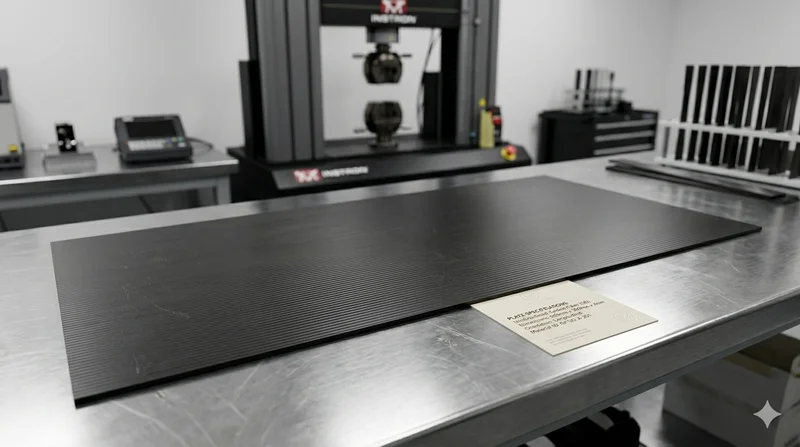
Carbon Fiber Plate — UD Unidirectional T700
Unidirectional carbon fiber plate with all fibers oriented in a single direction for maximum strength along the fiber axis. Essential for structural reinforcements, splints, and applications where load direction is predictable.
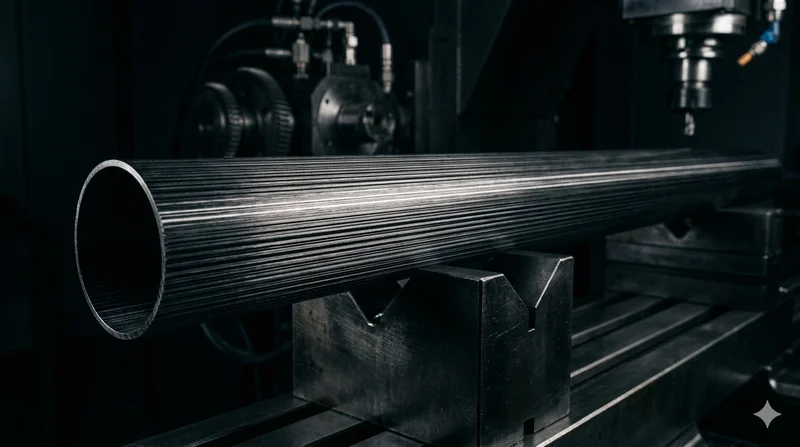
Round Carbon Fiber Tube — UD Unidirectional T700
Unidirectional (UD) round tube with all fibers aligned axially for maximum longitudinal stiffness. Ideal for applications requiring high bending rigidity with minimal weight, such as shafts, struts, and structural reinforcements.