
Carbon fiber prepreg is a time-sensitive material. From the moment a roll of unidirectional tape or woven fabric is impregnated with uncured resin, it begins a slow, irreversible chemical progression. The resin continues to advance its molecular weight, tack falls, and the material drif
Introduction
Carbon fiber prepreg is a time-sensitive material. From the moment a roll of unidirectional tape or woven fabric is impregnated with uncured resin, it begins a slow, irreversible chemical progression. The resin continues to advance its molecular weight, tack falls, and the material drifts away from its specified processing window. Every composites manufacturer has encountered the consequences: a batch that no longer lays up cleanly, parts that cure cloudy or porous, or — worst of all — an expensive aerospace part failing mechanical tests because the material sat too long on the shelf. Prepreg shelf life management is the discipline that keeps a time-constrained material reliable across procurement, warehousing, kitting, and the factory floor.
This article is written for OEM engineers, quality managers, and procurement teams who buy carbon fiber prepreg in production volumes. We will explain the difference between shelf life and outlife, walk through frozen storage logistics, describe how aging degrades tack and mechanical properties, and lay out the tracking and documentation practices that turn a perishable material into a dependable supply chain input.
Shelf Life vs Outlife: Two Different Clocks
Two distinct time limits govern prepreg, and confusing them is the most common source of quality failures. They are complementary, not interchangeable:
- Outlife (room-temperature life): The cumulative time the prepreg spends outside the freezer at a controlled temperature, usually 21°C (70°F) or below, before it is no longer recommended for processing. Outlife is the clock that matters on the factory floor — every thaw, layup, and debulk session consumes it.
- Shelf life (frozen storage life): The total calendar time the material is guaranteed to remain processable while stored continuously at the specified freezer temperature (typically -18°C or colder), counted from the manufacturing date. Shelf life is the warehouse clock.
Most aerospace-grade prepregs offer a shelf life of 6-12 months frozen and an outlife of 10-30 days at room temperature, though the exact values depend heavily on the resin chemistry. Fast-curing systems that are attractive for high-throughput production typically have shorter outlife, while high-temperature aerospace resins can tolerate a few weeks of exposure. The table below shows how processing recommendations change with cumulative outlife for a typical 177°C-curing (350°F) aerospace prepreg:
| Cumulative Outlife | Recommended Handling | Typical Effect on Material |
|---|---|---|
| 0-7 days | Normal layup and cure; full design allowables | Minimum resin advancement, best tack, widest process window |
| 8-15 days | Monitor tack; consider adjusted debulk cycle | Noticeable tack reduction; slight viscosity rise during cure |
| 16-25 days | Flag for inspection; confirm mechanical allowables with test coupons | Reduced drape, higher void risk at porous core interfaces |
| Beyond 25 days (~100% outlife) | Reject for critical structures; scrap or downgrade to non-structural use | Resin advancement may exceed spec; mechanical knockdown likely |
The central rule: outlife is cumulative and self-compounding. A prepreg stored frozen for a year is not "reset" — each thaw cycle permanently consumes a share of total outlife, and time outside the freezer cannot be recovered.
Frozen Storage Logistics
Correct frozen storage is non-negotiable for protecting the shelf-life clock, and it demands discipline across the whole chain from supplier to layup room.
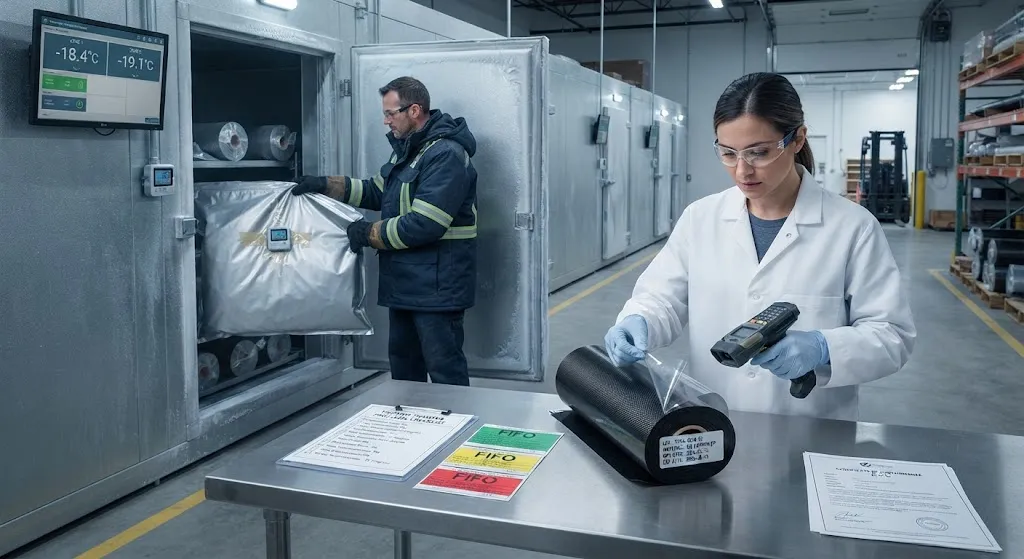
- Freezer specifications: Aerospace and industrial prepregs require storage at -18°C (0°F) or colder, with many high-performance resin systems specified to -24°C or below. Freezers must hold that temperature uniformly; a unit that cycles above -18°C shortens effective shelf life even if the thermostat reads correctly.
- Receiving and cold-chain integrity: On delivery, material must be inspected and moved to the freezer promptly, not left on a loading dock. Temperature data loggers shipped with the material verify that the cold chain was never broken in transit — a supplier may void warranty if excursions are detected.
- Sealed moisture protection: Prepreg arrives sealed in a moisture-barrier bag with desiccant. The bag must stay sealed in the freezer to prevent dessication, and condensation must be avoided when thawing: a sealed roll brought to room temperature will form moisture on the outside of the bag, not on the material.
- First-in, first-out (FIFO) rotation: Older lots should be consumed before new ones. Without FIFO discipline, a warehouse quietly accumulates batches that drift out of their process window.
How Aging Degrades the Material
Aging prepreg is not merely a cosmetic issue; it changes the physics of the material. As the uncured resin advances, several measurable things happen:
- Loss of tack (surface stickiness): The resin's surface becomes less sticky, so plies do not hold their position during layup, and trapped air is harder to expel during debulk. The part is more prone to wrinkles and porosity.
- Rising resin viscosity: The advancing molecular weight thickens the resin, which raises its flow viscosity during the cure. The resin may not wet out reinforcing fibers completely, producing dry spots and voids.
- Reduced drape and conformability: Stiffer resin makes the prepreg harder to form over complex tooling geometry, increasing the risk of bridging at tight radii.
- Mechanical knockdown: For aged material pushed beyond its outlife, tensile and especially interlaminar shear and compression-after-impact properties can fall below design allowables — a latent risk that may not surface until final testing.
The practical impact is that outlife is more than a paperwork rule: it is a direct proxy for the processability and final quality of the cured part.
Tracking and Documentation Systems
Modern prepreg management moves beyond spreadsheets into systems that guarantee traceability and prevent human error.
- Material-tracking software: ERP or MES modules track each roll or batch's manufacture date, remaining shelf life, cumulative outlife, and storage location. Bar-code or RFID scanning at every move updates a live inventory of how much room-temperature life each lot has left.
- Outlife budgets per job: A kitting or layup plan can draw an "outlife budget" for a given part: it spends a portion on thawing, a portion on layup, and a portion on debulk. If the plan would exceed the cumulative allowance, the system flags it before material is committed.
- Color-coded and lot-stamped labels: Physical labels showing manufacture date, outlife expiry, and freezer location are the on-the-floor failsafe that complements software, especially in smaller shops without full MES.
- Certificate of conformance (CoC): Procurement quality starts at the supplier — a CoC documents the resin system, manufacture date, and storage and handling requirements. Insisting on it at order time protects against ambiguous or missing data later.
Best Practices for OEM Procurement and Receiving
Procurement teams can reduce prepreg waste and risk with a few deliberate practices:
- Right-size order quantities and lead times: Ordering only what a program can consume within outlife, and scheduling deliveries close to use, avoids overstocking a perishable material that will eventually be scrapped.
- Verify cold chain at receipt: Check temperature loggers, packaging integrity, and conformance certificates before accepting a delivery. This is the last point at which a cold-chain break can be rejected at no cost.
- Standardize thawing protocols: Establish a documented thaw time (often 24-48 hours in a controlled, sealed-thaw area) so that outlife recording starts from a consistent point.
- Audit storage conditions: Calibrate freezer thermometers, log temperature trends, and confirm the freezer is never left open. Small temperature excursions compound over months of storage.
Because shelf life management is a cross-cutting quality function, a clear supplier-mandated handling specification plus disciplined internal tracking protects both product quality and the cost of scrap.
Frequently Asked Questions
What is the difference between prepreg shelf life and outlife?
Shelf life is the total guaranteed calendar time the prepreg remains processable while kept frozen at the specified temperature (typically -18°C or colder), counted from the manufacture date. Outlife is the cumulative time the material spends removed from the freezer at room temperature, consumed by thawing, layup, and debulk. Shelf life is the warehouse clock and outlife is the factory-floor clock; both are finite and cannot be reset by refreezing. A typical aerospace prepreg offers 6-12 months of frozen shelf life and 10-30 days of cumulative outlife, depending on resin chemistry.
Can I reuse prepreg that was left out at room temperature overnight?
Not automatically. Prepreg left out overnight does not instantly become unusable, because outlife is cumulative: a single overnight exposure consumes only a portion of the total allowance. What matters is the cumulative outlife across all thaw cycles, not any single event. Document the exposure, add it to the lot's recorded outlife budget, and check the material's tack and drape before layup. If the cumulative outlife is still within the manufacturer's specification, the material can typically be processed, though it is prudent to flag it for inspection. Once cumulative outlife approaches or exceeds 100%, reject the material for structural use regardless of any single short exposure.
How does frozen storage temperature affect the shelf life of prepreg?
Temperature is a first-order driver of resin advancement, following an Arrhenius-type relationship: every roughly 10°C below the specification adds substantial margin, and every degree above −18°C shortens effective shelf life faster than the stamped guarantee. Storage at −20°C to −24°C, as specified by many high-performance resin systems, preserves shelf life far better than a marginal freezer that cycles near −18°C. This is why the temperature of the freezer — not just the thermostat setpoint — and cold-chain integrity during transport matter so much: a warm or cycling storage environment silently consumes shelf life even though the material looks unchanged on the outside.
Conclusion
Prepreg shelf life management turns a perishable, time-constrained material into a dependable and predictable production input. The discipline rests on three foundations: understanding the two separate clocks of shelf life and cumulative outlife, protecting the frozen cold chain and moisture barrier across the entire logistics network, and tracking each lot's remaining life with systems that prevent both quality failures and scrap cost. When these practices are in place, a manufacturer can order, store, kit, and lay up carbon fiber prepreg with confidence that every cured part is backed by material that was still inside its process window.
For OEMs buying prepreg in volume, partnering with a supplier that provides clear storage and handling specifications, conformance certificates, and consistent lot quality is the first and most important safeguard. Explore our carbon fiber fabrics and prepregs with documented handling requirements, or contact our engineering and sales team to discuss prepreg supply, storage practices, and material qualification for your production program.
Part of topic
Related Articles
- Bio-Based Carbon Fiber Precursors: Lignin and Polyethylene for Low-Cost Production
- Large-Tow Carbon Fiber Cost Analysis: 48K vs 60K Price-Performance Comparison
- Carbon Fiber-Resin Interface Bonding: Surface Treatment and Coupling Agent Optimization
- Digital Twin for Carbon Fiber Manufacturing: Real-Time Process Monitoring and Defect Prevention
- Thermoplastic Carbon Fiber Welding for Automotive: Ultrasonic and Induction Welding Process Windows
- Large-Tow Carbon Fiber Wet Spinning: Process Optimization for 48K/60K Production Efficiency
Interested in Our Products?
Contact our team for competitive pricing and technical specifications.
Get a QuoteRelated Products
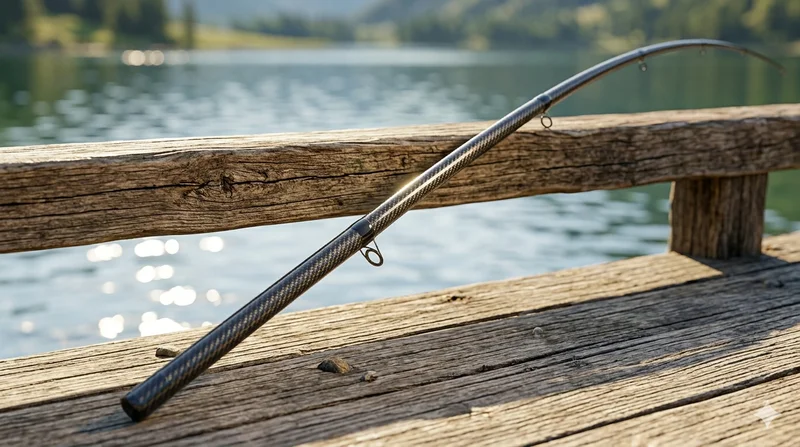
Carbon Fiber Fishing Rod Blank
High-quality carbon fiber fishing rod blank manufactured from multiple grades of Toray carbon fiber cloth. Available in a wide range of lengths, powers, and actions for freshwater and saltwater applications. Suitable for OEM rod building.

Carbon Fiber Plate — 3K Twill T700 1.5mm
Thin 1.5mm carbon fiber plate with 3K twill weave surface. Lightweight and stiff, commonly used for covers, panels, drone bodies, and applications requiring a premium aesthetic appearance.

Square Carbon Fiber Tube — 3K Twill T700
Square cross-section carbon fiber tube manufactured with 3K twill weave for torsional strength. Preferred for structural frames, trusses, and support columns where rectangular geometry offers design flexibility.
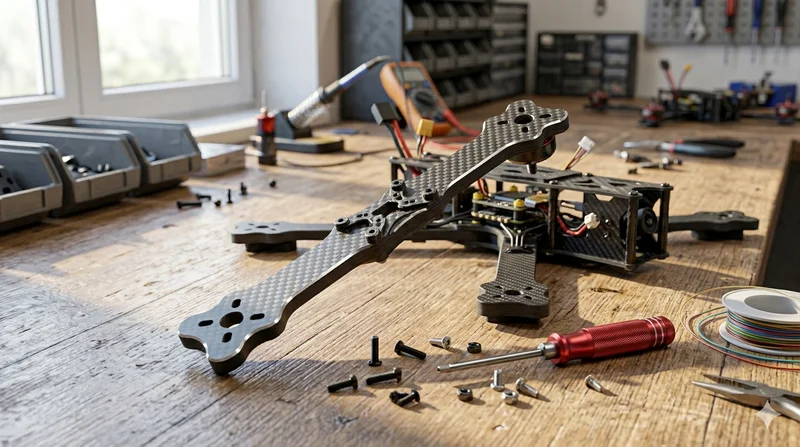
Carbon Fiber Drone Arm
Precision-molded carbon fiber drone arm combining unidirectional fiber for stiffness and woven layers for torsional strength. Designed for FPV, photography, and industrial drone platforms. Each arm is CNC-machined to exact specifications.
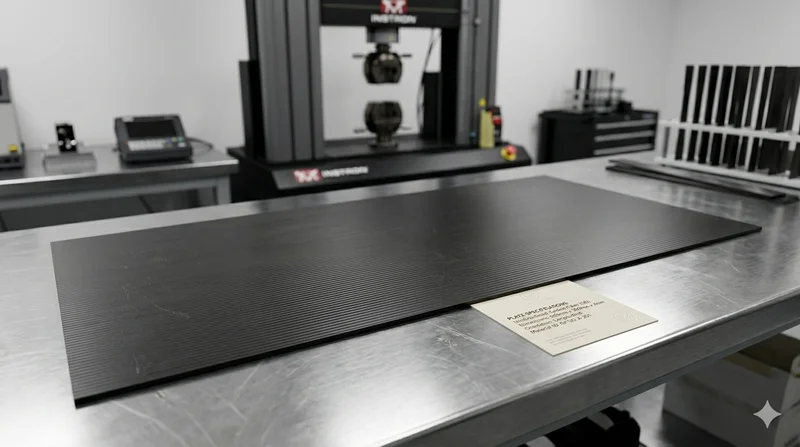
Carbon Fiber Plate — UD Unidirectional T700
Unidirectional carbon fiber plate with all fibers oriented in a single direction for maximum strength along the fiber axis. Essential for structural reinforcements, splints, and applications where load direction is predictable.